
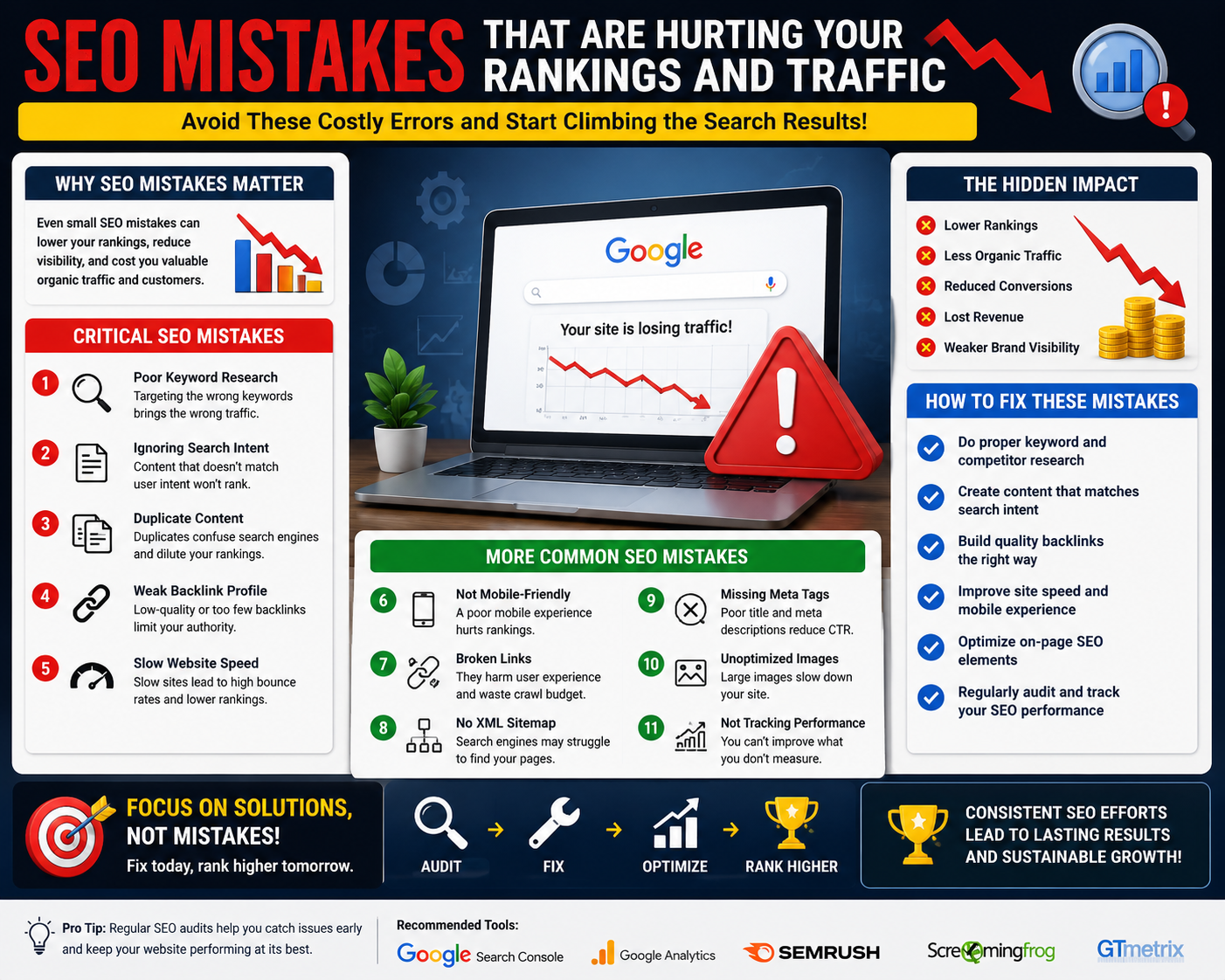

Every website owner wants higher rankings, more organic traffic, and increased conversions. Yet many businesses unknowingly make critical SEO mistakes that prevent them from achieving those goals.
The frustrating reality is that even a small SEO error can significantly impact search visibility. A slow website, poor keyword targeting, broken links, or weak content strategy can quietly damage performance while competitors continue climbing the search results.
The good news? Most SEO mistakes are fixable.
In this comprehensive guide, you’ll discover the most common SEO mistakes, why they matter, and how to correct them before they hurt your rankings and traffic even further.
Why SEO Mistakes Matter More Than Ever
Search engines have become smarter.
Google’s algorithms now evaluate:
- Content quality
- User experience
- Website performance
- Authority signals
- Search intent alignment
- Technical health
As search evolves, mistakes that were once minor can now have a significant impact on rankings.
Understanding the Real Cost of SEO Errors
Many website owners underestimate the consequences of poor optimization.
Lost Rankings
When Google identifies quality or technical issues, rankings can decline rapidly.
A drop from position #3 to position #10 can dramatically reduce traffic.
Reduced Organic Traffic
Lower rankings mean fewer clicks.
Since organic search often drives the majority of website traffic, SEO mistakes can directly affect business growth.
Lower Conversion Rates
Poor SEO frequently creates poor user experiences.
Visitors who encounter slow pages, confusing navigation, or irrelevant content are less likely to convert.
Mistake #1: Ignoring Search Intent
One of the biggest SEO mistakes is creating content that doesn’t match what users actually want.
Informational vs Transactional Content
Consider these searches:
Informational Intent
- What is SEO?
- How does SEO work?
Transactional Intent
- Buy SEO software
- Hire SEO consultant
If your content doesn’t align with user intent, rankings will suffer regardless of keyword optimization.
How to Fix It
- Analyze search results before creating content
- Match content format to intent
- Answer user questions thoroughly
- Focus on solving problems
Mistake #2: Poor Keyword Research
Many websites target keywords simply because they have high search volume.
Targeting the Wrong Keywords
High-volume keywords often have:
- Intense competition
- Low conversion potential
- Mismatched audiences
Instead, prioritize:
- Relevant keywords
- Long-tail phrases
- Intent-driven searches
- Real customer language
How to Fix It
Use keyword research tools and evaluate:
| Factor | Importance |
|---|---|
| Search Intent | High |
| Relevance | High |
| Competition | Medium |
| Volume | Medium |
| Conversion Potential | High |
Mistake #3: Keyword Stuffing
Years ago, repeating keywords excessively could improve rankings.
Today, it harms them.
Natural Optimization Strategies
Avoid writing like this:
“SEO mistakes are important SEO mistakes because SEO mistakes affect rankings.”
Instead:
- Write naturally
- Use related terms
- Focus on readability
- Prioritize users over search engines
Google understands context far better than it once did.
Mistake #4: Publishing Thin Content
Thin content lacks depth, value, and usefulness.
Examples include:
- Extremely short articles
- Generic content
- AI-generated pages without editing
- Pages with little original information
Creating Valuable Content
High-performing content typically includes:
- Detailed explanations
- Examples
- Research
- Expert insights
- Actionable advice
Depth often wins in competitive search results.
Mistake #5: Duplicate Content Issues
Duplicate content can confuse search engines.
Common causes include:
- Multiple URL versions
- Product variations
- Copied content
- Pagination issues
Canonicalization Best Practices
Use canonical tags to indicate preferred versions of pages and consolidate ranking signals.
Regular audits help identify duplicate content problems early.
Mistake #6: Neglecting Technical SEO
Even excellent content can fail if technical SEO is weak.
Crawlability Problems
Search engines must access pages efficiently.
Common issues include:
- Blocked resources
- Broken internal links
- Poor site architecture
- Incorrect robots.txt settings
Indexing Errors
Some pages never rank because they aren’t indexed properly.
Check regularly for:
- Noindex tags
- Canonical issues
- Sitemap problems
- Coverage errors
Mistake #7: Slow Website Speed
Speed is both an SEO factor and a user experience factor.
Core Web Vitals Impact
Slow websites often experience:
- Higher bounce rates
- Lower engagement
- Reduced conversions
- Poor rankings
How to Fix It
Improve speed by:
- Compressing images
- Reducing JavaScript
- Using caching
- Optimizing hosting
Every second matters.
Mistake #8: Poor Mobile Experience
Google uses mobile-first indexing.
If your mobile experience is poor, rankings may suffer.
Mobile-First Indexing
Ensure:
- Responsive design
- Readable text
- Fast mobile performance
- Easy navigation
Most users now browse primarily from mobile devices.
Mistake #9: Weak Internal Linking
Many websites overlook internal linking opportunities.
Building Content Connections
Strong internal links help:
- Distribute authority
- Improve navigation
- Increase page discovery
- Strengthen topical relevance
Every important page should receive meaningful internal links.
Mistake #10: Ignoring Meta Tags
Meta titles and descriptions remain important.
Optimizing Titles and Descriptions
Effective titles:
- Include target keywords
- Encourage clicks
- Match search intent
Effective descriptions:
- Summarize content
- Highlight benefits
- Increase click-through rates
Poor metadata often leads to missed traffic opportunities.
Mistake #11: Broken Links and Redirect Errors
Broken links damage both user experience and SEO.
Maintaining Site Health
Regularly check for:
- 404 pages
- Redirect chains
- Redirect loops
- Outdated URLs
Healthy websites provide smooth navigation experiences.
Mistake #12: Low-Quality Backlinks
Not all backlinks help rankings.
Quality Over Quantity
Avoid:
- Spam directories
- Link farms
- Paid link schemes
Focus on:
- Relevant websites
- Industry publications
- Editorial mentions
- Digital PR opportunities
One authoritative backlink can outperform dozens of low-quality links.
Mistake #13: Ignoring Structured Data
Structured data helps search engines understand content.
Rich Results Opportunities
Schema markup can improve visibility through:
- FAQs
- Reviews
- Products
- Articles
- Events
Rich results often increase click-through rates.
Mistake #14: Not Tracking SEO Performance
Many businesses implement SEO without measuring results.
Analytics and Search Console
Monitor:
- Organic traffic
- Rankings
- Click-through rates
- Conversions
- Technical errors
Data-driven decisions outperform guesswork.
Mistake #15: Forgetting User Experience
SEO is increasingly connected to user satisfaction.
Engagement Signals
Positive experiences encourage:
- Longer visits
- More page views
- Higher engagement
- Better conversions
Focus on users first, and rankings often follow.
Advanced SEO Mistakes Businesses Make
Experienced marketers also make strategic mistakes.
Examples include:
- Chasing algorithm updates
- Over-optimizing content
- Ignoring brand authority
- Publishing without promotion
- Failing to update older content
SEO success requires long-term thinking.
How to Conduct an SEO Mistake Audit
Use this checklist:
✅ Review keyword targeting
✅ Analyze search intent alignment
✅ Check page speed
✅ Test mobile usability
✅ Audit backlinks
✅ Fix broken links
✅ Review metadata
✅ Validate structured data
✅ Analyze internal linking
✅ Monitor search performance
Conduct audits quarterly to identify issues before they affect rankings.
For official SEO guidance, visit .
Frequently Asked Questions
1. What are the most common SEO mistakes?
Common mistakes include poor keyword research, ignoring search intent, slow page speed, duplicate content, weak internal linking, and technical SEO issues.
2. Can SEO mistakes lower rankings?
Yes. Many SEO mistakes directly affect crawlability, indexing, relevance, user experience, and authority, leading to ranking declines.
3. How often should I audit my website for SEO issues?
Most websites should conduct SEO audits every three to six months, while larger sites may require monthly reviews.
4. Is keyword stuffing still harmful?
Absolutely. Modern search engines prioritize natural language and user experience over excessive keyword repetition.
5. How important is page speed for SEO?
Page speed is very important because it affects both rankings and user satisfaction.
6. Do broken links affect SEO?
Yes. Broken links create poor user experiences and can waste crawl resources.
7. Can duplicate content hurt rankings?
Duplicate content can dilute ranking signals and make it harder for search engines to determine which page should rank.
8. What is the fastest SEO mistake to fix?
Updating title tags, fixing broken links, improving metadata, and correcting indexing issues can often provide quick improvements.
Conclusion
The most damaging SEO mistakes are often the ones that go unnoticed. Poor keyword targeting, technical issues, slow page speeds, weak content, and neglected user experiences can quietly erode rankings and traffic over time.
The good news is that every mistake covered in this guide can be identified and corrected. By conducting regular audits, focusing on user needs, maintaining technical health, and continuously improving content quality, businesses can protect their search visibility and create a stronger foundation for long-term growth.
SEO success isn’t about avoiding every mistake forever—it’s about finding problems early and fixing them before they become costly.