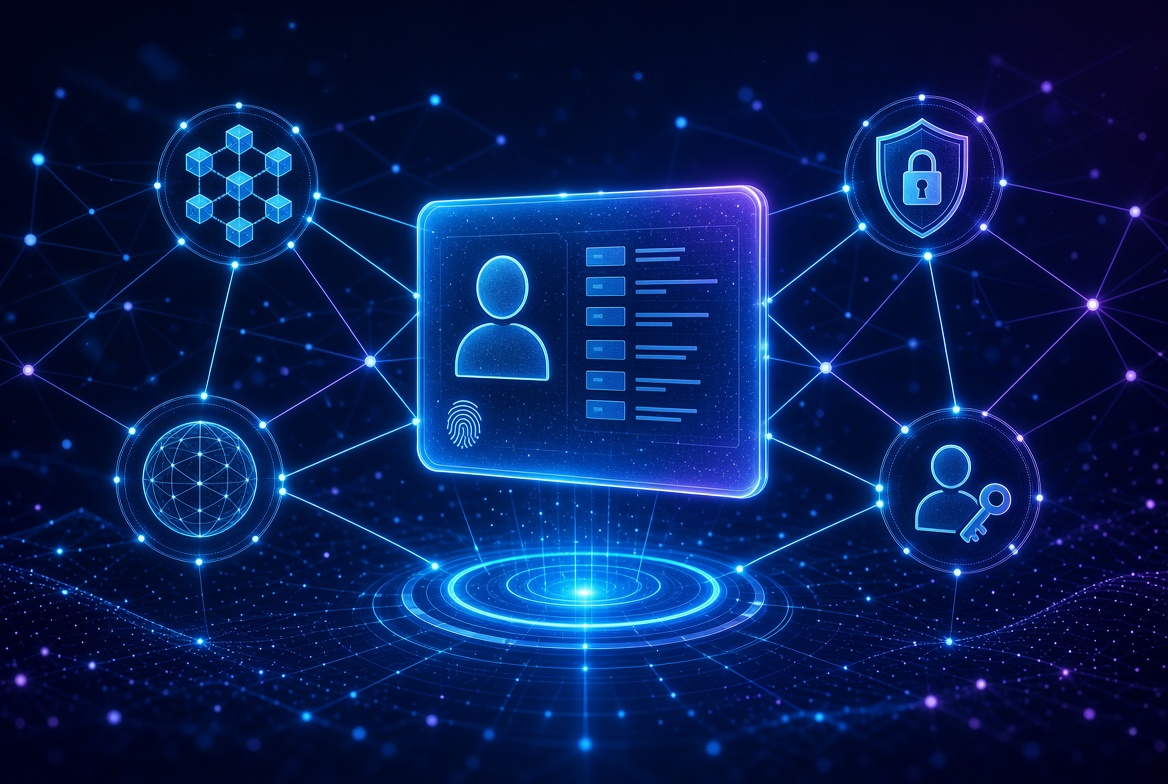

Decentralized identity (DID) is an emerging approach to digital identity management that aims to give individuals and organizations greater control over how they identify themselves and share personal information online. Instead of relying entirely on a single organization to manage identity information, decentralized identity systems can enable users to manage digital identifiers and credentials while allowing other parties to verify specific claims.
As digital services expand across banking, education, healthcare, e-commerce, and government administration, identity verification has become increasingly important. Traditional systems can require users to create numerous accounts, repeatedly submit personal documents, and trust centralized platforms to store sensitive information. These processes can create unnecessary friction and increase the consequences of data breaches.
Decentralized identity offers an alternative model. Through technologies such as cryptographic identifiers, verifiable credentials, digital signatures, and identity wallets, users may be able to prove selected information without repeatedly relying on a central identity provider.
However, decentralized identity is not a universal solution to identity fraud or privacy risks. Its effectiveness depends on the underlying technology, the organizations issuing credentials, the security of users’ devices, and the governance rules surrounding the system.
In this guide, we explain what decentralized identity means, how it works, its main components, real-world applications, benefits, challenges, and potential future developments.
Table of Contents
- What Is Decentralized Identity?
- How Does Decentralized Identity Work?
- Key Components of Decentralized Identity Systems
- Decentralized Identity vs. Traditional Digital Identity
- The Role of Decentralized Identifiers (DIDs)
- What Are Verifiable Credentials?
- Real-World Applications of Decentralized Identity
- Benefits of Decentralized Identity
- Security, Privacy, and Other Challenges
- Is Decentralized Identity the Same as Blockchain Identity?
- Decentralized Identity in Nigeria
- How Businesses Can Implement Decentralized Identity
- The Future of Decentralized Identity
- Expert Tips for Evaluating DID Solutions
- Common Decentralized Identity Mistakes to Avoid
- Frequently Asked Questions
- Conclusion
1. What Is Decentralized Identity?
Decentralized identity is an approach to identity management that distributes control and responsibility across users, credential issuers, verifiers, and supporting infrastructure instead of placing everything under one central identity provider.
In a decentralized identity system, a user may hold digital credentials issued by trusted organizations and present those credentials to services that need to verify them.
For example, a university could issue a digitally signed qualification to a graduate. The graduate could store the credential in a compatible digital wallet and later present it to an employer. The employer could verify the credential’s authenticity without necessarily requesting a new confirmation directly from the university every time.
The exact process depends on the credential format, wallet, issuer, and verification system.
Decentralized identity is closely associated with decentralized identifiers (DIDs) and verifiable credentials, although these concepts are related rather than interchangeable.
A decentralized identifier is a type of digital identifier designed to support verifiable control without necessarily depending on a centralized registration authority. Verifiable credentials are digitally represented claims that can be checked for authenticity and integrity.
Together, these technologies can support portable identity information and new ways to establish trust across different services.
Why is decentralized identity attracting attention?
Traditional identity systems often require users to depend on individual platforms to create and manage accounts. Each platform may maintain its own database, authentication process, and identity records.
This can create several problems:
- Users may have to submit the same information to multiple organizations.
- Sensitive information may be stored in numerous databases.
- A compromised central provider may affect many connected services.
- Users may have limited visibility into how their identity information is shared.
- Moving credentials between platforms can be difficult.
Decentralized identity aims to address some of these issues by supporting portable credentials, verifiable claims, and greater user involvement in identity management.
However, decentralized identity does not necessarily eliminate centralized organizations. Governments, banks, universities, and employers may still issue credentials and determine which claims they recognize.
The central idea is to separate the roles of identity holders, credential issuers, and verifiers so that identity information can be exchanged and checked without every interaction depending on a single identity database.
2. How Does Decentralized Identity Work?
Although decentralized identity implementations vary, many follow a process involving identity creation, credential issuance, secure storage, presentation, and verification.
Step 1: An identity holder establishes control of an identifier
A person or organization creates or obtains a digital identifier using a supported identity system.
Depending on the implementation, this may involve generating cryptographic keys and establishing a decentralized identifier.
The private key is particularly important because it can be used to prove control of the identifier or authorize certain actions.
The identifier itself does not automatically prove a person’s legal identity. It primarily provides a way to refer to an entity and, where supported, verify control over the associated identifier.
Step 2: A trusted organization verifies information
A credential issuer determines whether a claim is sufficiently supported by evidence.
For example, a university may check its academic records before issuing a degree credential. A professional association may verify that an applicant meets the requirements for a certification.
The verification process depends on the issuer’s procedures and the type of credential being issued.
Decentralized technology does not make an inaccurate claim accurate. Trust still depends on the quality and reliability of the issuer.
Step 3: The issuer creates a digital credential
The issuer creates a credential containing relevant information and protects its integrity using a supported cryptographic mechanism.
The credential may identify the issuer, describe the claims being made, specify the subject, and include information needed for validation.
The credential is then delivered to the identity holder or an appropriate credential-management application.
Step 4: The holder stores the credential
The user may store the credential in a digital identity wallet or another compatible environment.
A wallet can help manage credentials and prepare them for presentation to services that request them.
The wallet may also help the user review the information being shared. The level of control available depends on the implementation.
Wallet security is essential because someone who gains unauthorized access to a user’s credentials or private keys may be able to misuse them.
Step 5: A service requests proof
Suppose a job applicant needs to demonstrate that they hold a professional qualification.
The employer requests an appropriate credential or proof of a specific claim. The applicant presents the relevant information using a supported mechanism.
A well-designed system should request only the information necessary for the intended purpose.
For example, the employer may need to confirm that the applicant holds a qualification without requiring unrelated personal information.
Step 6: The verifier checks the credential
The receiving service validates the credential according to the relevant trust framework and technical standards.
Depending on the implementation, this may include checking:
- The credential’s digital signature or other integrity mechanism.
- Whether the issuer is trusted for the claim being made.
- Whether the credential is expired.
- Whether the credential has been revoked.
- Whether the credential is valid for the intended purpose.
- Whether the presentation satisfies the service’s requirements.
A technically valid credential does not automatically mean the claim should be accepted. The verifier must also decide whether the issuer is trustworthy and whether the claim meets its requirements.
Step 7: The service makes an access decision
After verification, the service determines whether the user meets the relevant criteria.
For instance, an employer may accept a valid professional qualification, while a financial institution may require additional checks before approving a customer account.
This distinction matters because decentralized identity can help verify claims, but it does not replace every legal, regulatory, or operational decision associated with identity verification.
3. Key Components of Decentralized Identity Systems
Several technical and organizational components work together to support decentralized identity.
Decentralized identifiers
Decentralized identifiers, commonly abbreviated as DIDs, are identifiers designed to support verifiable digital identity without necessarily requiring a centralized identity provider.
A DID can be associated with cryptographic verification material and other information needed to interact with its corresponding DID method.
Different DID methods have different creation, resolution, update, and deactivation mechanisms.
A DID does not inherently contain a person’s complete identity record. Nor does the use of a DID automatically make the associated activity private or anonymous.
Verifiable credentials
Verifiable credentials are digital credentials containing claims that can be verified using appropriate technical and trust mechanisms.
Examples include:
- University qualifications.
- Professional certifications.
- Membership credentials.
- Employment credentials.
- Training certificates.
- Selected eligibility attributes.
Credentials can reduce reliance on paper documents, but their value depends on who issued them, how they were issued, and whether the receiving party trusts the issuer.
Digital identity wallets
A digital identity wallet helps users manage and present digital credentials.
Depending on the product, it may support credential storage, consent screens, cryptographic operations, and the presentation of selected information.
Wallets need strong protection against unauthorized access, malware, device theft, and loss of private keys.
Users should also understand whether their wallet provider can access their information and what happens if they lose access to the device.
Cryptographic keys and digital signatures
Cryptographic keys are used to establish control, authenticate actions, and support verification.
A private key must be protected from unauthorized use. A corresponding public key can be used in supported verification processes.
Digital signatures can help a verifier establish that information was signed by the holder of a particular key and has not been altered since signing.
However, a valid signature alone does not prove that the underlying claim is true. The verifier must also evaluate the issuer and the process used to create the credential.
Issuers, holders, and verifiers
Most verifiable credential systems involve three main roles.
Issuer: The organization or entity that creates and issues a credential.
Holder: The person or organization that receives and manages the credential.
Verifier: The party that evaluates a presented credential to decide whether to accept the claims it contains.
For example, a university may act as the issuer, a graduate as the holder, and an employer as the verifier.
These roles help separate the creation, possession, and verification of identity claims.
Trust frameworks
A trust framework establishes the rules under which participants issue, hold, and accept credentials.
It may specify which organizations are authorized to issue particular credentials, what evidence they must verify, how credentials are revoked, and what security or privacy requirements participants must follow.
Without an effective trust framework, a technically valid credential may have little practical value because the receiving service may not know whether to trust the issuer.
Supporting registries and infrastructure
Some implementations use public or distributed infrastructure to publish information about identifiers, verification methods, issuer status, or credential schemas.
Others rely on different mechanisms.
Not every decentralized identity system uses blockchain, and not every implementation stores identity-related information on a public ledger.
The architecture should be selected according to the system’s requirements, privacy needs, governance model, and operating environment.
4. Decentralized Identity vs. Traditional Digital Identity
Traditional digital identity systems frequently rely on a central organization or identity provider to manage user accounts and authentication.
Decentralized identity can distribute certain functions and support portable credentials that users present to multiple services.
Neither approach is universally superior. The right model depends on the application and its risks.
| Feature | Traditional Centralized Identity | Federated Identity | Decentralized Identity |
|---|---|---|---|
| Identity management | Managed primarily by a central organization | Shared across an identity provider and connected services | Identity identifiers and credentials may be managed across multiple parties |
| User account | Usually created and maintained by each service or its provider | May use one account to access multiple connected services | May involve credentials held in a user-controlled wallet |
| Credential portability | Often limited across unrelated systems | Depends on federation arrangements | Can support portable credentials across compatible systems |
| Trust model | Trust in the central service | Trust in participating identity providers | Trust in issuers, credential formats, verification methods, and governance |
| Privacy | Depends on data collection and account architecture | Depends on provider policies and information shared | Can support selective disclosure, but privacy is not automatic |
| Recovery | Usually managed by the central service | Depends on the identity provider | May require recovery mechanisms for wallets, keys, or credentials |
| Main advantage | Simpler administration and familiar workflows | Convenient access to connected services | Potentially greater portability and user control |
| Main challenge | Centralized data and account risks | Dependence on identity providers | Interoperability, key management, governance, and recovery |
A centralized system may be appropriate for a small organization that needs straightforward account management.
Federated identity may work well for a company whose employees need access to multiple business applications.
Decentralized identity may be valuable where credentials must be presented and verified across organizations that do not share a single identity database.
Some systems may combine all three approaches.
5. The Role of Decentralized Identifiers (DIDs)
Decentralized identifiers are an important concept in decentralized identity, but they are frequently misunderstood.
A DID is a specific type of identifier designed to support verifiable digital identity. It is not the same thing as a digital identity document, a credential, or a complete identity profile.
A DID can be used with a DID method that defines how the identifier is created, resolved, updated, or deactivated.
Depending on the method, a DID may be associated with a DID document containing information such as public keys and service endpoints.
The exact structure and available features vary.
How DIDs can be used
DIDs may support several applications:
- Identifying an entity in a decentralized identity system.
- Establishing control through cryptographic keys.
- Supporting the verification of digital credentials.
- Enabling interactions between compatible identity applications.
- Helping separate identifiers from conventional account names.
For example, a software developer might use a compatible decentralized identity system to manage credentials issued by training providers or professional organizations.
A prospective employer could then verify selected credentials using a compatible verification process.
The employer would still need to determine whether the issuers are trustworthy and whether the credentials satisfy its hiring requirements.
Do DIDs require blockchain?
No. Blockchain is one possible technology used by certain DID methods, but it is not a universal requirement.
Different DID methods use different approaches to identifier creation and resolution. Some may use distributed ledgers, while others rely on different infrastructure.
Selecting a DID method requires evaluating its security properties, governance, availability, privacy implications, maintenance requirements, and compatibility with the systems that need to use it.
For authoritative technical information, consult the W3C Decentralized Identifiers specification.
6. What Are Verifiable Credentials?
Verifiable credentials are digitally represented claims that can be checked using appropriate verification mechanisms.
They are central to many decentralized identity architectures because they allow trusted organizations to issue information that recipients can later present to other parties.
Example: A digital university certificate
Imagine that a student completes a degree at an accredited university.
The university verifies its academic records and issues a digital credential containing the student’s qualification.
The student receives the credential in a compatible wallet.
Later, when applying for a job, the student presents the credential to a prospective employer.
The employer checks the credential’s integrity, issuer, status, and other relevant details.
If the credential satisfies the employer’s requirements, it can help establish that the applicant holds the stated qualification.
This process may be more convenient than repeatedly requesting paper certificates and contacting the issuing institution manually.
However, the employer must still verify that the university is recognized for the relevant qualification and that the credential meets the employer’s requirements.
Selective disclosure
Some credential systems support mechanisms that allow a user to disclose only selected information.
For example, a user may be able to demonstrate that they meet an eligibility requirement without revealing every attribute contained in an underlying credential.
The exact capability depends on the credential format and cryptographic scheme.
Selective disclosure can reduce unnecessary data sharing, but it does not automatically prevent tracking. Persistent identifiers, network metadata, and repeated presentations may still reveal information about a user.
Credential revocation and expiration
Credentials may become invalid because they expire, are revoked, or no longer meet the requirements of the receiving service.
For example, an organization may revoke a credential that was issued incorrectly or that is no longer valid under its rules.
A verifier needs a reliable way to evaluate credential status where applicable.
Status checks themselves should be designed carefully because they can potentially reveal when and where credentials are being used.
Why verifiable credentials matter
Verifiable credentials can make it easier to exchange trusted claims between organizations.
They may reduce administrative work, improve the portability of qualifications, and support privacy-conscious verification.
Their success depends on interoperability, issuer reliability, user-friendly tools, and agreement about which credentials should be accepted.
For more information about technical standards, visit the W3C Verifiable Credentials Data Model.
7. Real-World Applications of Decentralized Identity
Decentralized identity can support a range of applications where credentials need to be issued by one organization and verified by another.
Education and professional qualifications
Universities, training providers, and professional bodies can issue digital credentials that graduates and members present to employers or other institutions.
This can make qualification checks more efficient and reduce dependence on paper certificates.
A practical deployment must still account for accreditation, credential revocation, and the trustworthiness of the issuing institution.
Recruitment and employment
Job applicants often need to demonstrate qualifications, training, licenses, or previous employment.
Digital credentials can make these claims easier to present and verify across organizational boundaries.
Employers should avoid treating any digital credential as conclusive proof without checking the issuer and the relevance of the credential.
Banking and financial services
Financial institutions may explore verifiable credentials to support customer onboarding or the exchange of selected identity attributes.
A customer could potentially present an appropriate credential issued by a trusted provider instead of repeatedly submitting the same information.
Financial institutions would still need to meet applicable customer due diligence, anti-money-laundering, sanctions screening, and recordkeeping requirements.
Decentralized identity does not remove those obligations.
Healthcare
Healthcare organizations may use digital credentials to verify professional qualifications, staff roles, or specific patient-related attributes.
For example, a hospital may need to confirm that a healthcare professional holds an appropriate license.
Patient identity and medical records require especially careful privacy protection. A decentralized identity system should not expose sensitive medical information unnecessarily.
Government services
Governments may explore verifiable credentials for licenses, permits, qualifications, and other official records.
These systems could allow citizens to present approved credentials to participating organizations.
Public-sector deployments need clear legal authority, accessibility provisions, strong governance, and alternatives for individuals who cannot use the digital system.
E-commerce and age or eligibility verification
Some online services need to establish whether a customer meets a particular requirement.
In suitable cases, a privacy-preserving credential could help demonstrate eligibility without disclosing an entire identity record.
The system must use a trusted issuer and a verification process that satisfies the applicable legal requirements.
Supply chain and business credentials
Organizations can use verifiable credentials to exchange information about business registration, certifications, training, or compliance.
A company may present a credential issued by a recognized certification body to demonstrate that it meets a defined requirement.
Verifiers must still assess the issuer’s authority, the credential’s status, and the scope of the certification.
Internet of Things and machine identity
Connected devices and software systems need ways to establish trust with other devices and services.
Decentralized identity concepts may support some machine identity applications, depending on the architecture.
For example, a connected device could use cryptographic credentials to establish its identity to a compatible system.
However, machine identity also requires secure provisioning, key protection, revocation, software maintenance, and access-control policies.
8. Benefits of Decentralized Identity
Decentralized identity can offer meaningful benefits when the technology is matched to an appropriate use case.
Greater control over credential presentation
Users may be able to manage credentials and decide when to present them to compatible services.
This can reduce dependence on a single account provider for every identity-related interaction.
However, user control depends on the wallet, credential format, service design, and applicable rules.
Reduced repetitive verification
Portable credentials can help users demonstrate previously verified claims to multiple organizations.
For example, a professional qualification may be presented to several employers without requiring a new manual confirmation from the issuing institution every time.
The receiving organization must still validate the credential and decide whether to trust the issuer.
Potential reduction in unnecessary data sharing
Some implementations support selective disclosure or the presentation of limited attributes.
This can reduce the amount of personal information shared during certain transactions.
Privacy benefits depend on the credential format, identifier design, wallet behavior, and the information collected by verifiers.
Improved credential portability
Credentials can potentially be used across multiple compatible services rather than remaining locked inside one organization’s platform.
This can benefit education, recruitment, professional licensing, and cross-organizational business processes.
Portability requires compatible standards and recognition arrangements. A credential is not automatically accepted everywhere.
Stronger cryptographic verification
Digital signatures and related cryptographic mechanisms can help verifiers detect unauthorized changes to credential information.
They can also help establish that a credential was issued using a particular key.
Cryptographic verification does not independently establish the truth of a claim or guarantee that the issuer’s private key was never compromised.
Potentially fewer centralized data repositories
Some decentralized identity designs allow users to hold credentials rather than requiring every verifier to maintain a complete copy of identity information.
Reducing unnecessary copies of personal data can reduce certain breach risks.
Nevertheless, issuers, wallets, and verifiers may still retain records, and some applications require central databases for operational or legal reasons.
Better support for cross-organizational trust
Decentralized identity can provide a framework for exchanging and validating credentials across organizations.
This is especially useful when participants need to verify claims but do not want to create a shared identity database.
Effective governance and mutual recognition remain necessary.
9. Security, Privacy, and Other Challenges
Decentralized identity can reduce some risks associated with centralized systems, but it also creates challenges that need to be addressed.
Private-key loss
In some decentralized identity systems, private keys are essential for controlling identifiers or authorizing actions.
If a user loses access to the keys and has no effective recovery method, they may lose access to important credentials or identity functions.
Systems should provide secure and understandable recovery options appropriate to their risk level.
Wallet compromise
A compromised phone, computer, or wallet application may expose credentials or enable unauthorized presentations.
Users and organizations should protect devices, maintain software updates, use secure authentication, and avoid storing sensitive credentials in poorly protected environments.
Wallet providers also need transparent security practices and clear policies for handling incidents.
Fraudulent credential issuers
A credential may be cryptographically valid but still contain false information if the issuer is dishonest or unreliable.
For example, an unrecognized organization could issue a credential claiming that someone holds a professional qualification.
Verifiers must assess whether the issuer is authorized and trusted for the specific claim.
Credential revocation and status checking
Verifiers need a way to determine whether a credential remains valid where revocation or status checks apply.
Poorly designed status systems can expose information about credential holders or create availability problems.
Implementations should balance reliable validation with privacy and resilience.
Privacy leakage
Decentralized identity does not guarantee anonymity.
A persistent identifier may allow activities to be linked across services. A verifier may also collect information about when a credential was presented or what service was accessed.
Privacy-conscious systems should avoid unnecessary correlation, limit logging, and use different identifiers for different contexts where appropriate.
Interoperability problems
Different systems may use different credential formats, DID methods, wallet interfaces, and trust frameworks.
Without interoperability, users may discover that a credential issued in one ecosystem cannot be accepted in another.
Standards compliance, conformance testing, and agreements between participating organizations are essential.
Governance and accountability
Decentralized systems still require decisions about who can issue credentials, how disputes are handled, how compromised keys are managed, and which rules govern participation.
If these questions are not addressed, the system may become difficult to trust or maintain.
Regulatory uncertainty
Legal requirements differ by country and industry. Identity verification, privacy, electronic signatures, financial compliance, and record retention may be governed by different laws.
Organizations should obtain appropriate legal and compliance advice before using decentralized identity for regulated services.
Accessibility and digital exclusion
Some people may lack compatible smartphones, stable internet access, digital literacy, or the documents required to obtain credentials.
A digital-only identity process can exclude legitimate users if alternatives are not available.
Inclusive systems should account for accessibility needs and provide appropriate support.
10. Is Decentralized Identity the Same as Blockchain Identity?
No. Decentralized identity and blockchain identity are related concepts, but they are not interchangeable.
Decentralized identity describes an approach to identity management in which control and verification functions may be distributed across multiple participants.
Blockchain identity generally refers to identity-related systems that use blockchain infrastructure for some part of the process.
Some decentralized identity systems use blockchain technology, but others do not.
When blockchain may be useful
A distributed ledger may provide a shared way to publish or verify certain information across organizations that do not want to rely on one central operator.
Depending on the design, a ledger might contain public keys, identifier-related information, registry entries, or other data needed for verification.
Why identity information should not automatically be placed on a blockchain
Public blockchains may make recorded information difficult or impossible to remove. This can conflict with privacy requirements and the need to correct inaccurate information.
Publishing personal identity details directly to a public ledger can create long-term privacy risks.
A more privacy-conscious architecture may keep personal credentials off-chain and use distributed infrastructure only for limited verification information where justified.
Even then, identifiers and metadata can sometimes be linked to individuals, so privacy analysis remains necessary.
What should organizations consider?
Before adopting a blockchain-based identity solution, organizations should evaluate:
- Whether a distributed ledger is actually necessary.
- What information would be recorded.
- Whether the information could identify or be linked to a person.
- How updates and revocation would work.
- Who controls the relevant infrastructure.
- How the system meets privacy and regulatory requirements.
- What happens if the underlying technology or governance model changes.
The goal should be to select the simplest architecture that satisfies the business, security, and privacy requirements.
11. Decentralized Identity in Nigeria
Nigeria’s expanding digital economy creates opportunities to explore decentralized identity for education, financial services, professional qualifications, business verification, and digital public services.
However, practical adoption requires careful integration with existing identity infrastructure, legal obligations, and local operating conditions.
Opportunities for financial technology companies
Fintech companies often need to verify customers and exchange identity-related information while meeting regulatory requirements.
Verifiable credentials may eventually support selected verification workflows, provided they are issued by trusted sources and accepted under the applicable regulatory framework.
A credential-based process must not be treated as a replacement for legally required customer due diligence unless the relevant requirements permit it.
Digital certificates for education
Nigerian universities, vocational institutions, and professional organizations could explore digitally signed credentials for certificates and qualifications.
Employers and other institutions could validate credentials through compatible systems, potentially reducing manual verification work.
Successful adoption would require participating institutions to agree on credential formats, issuer recognition, verification procedures, and correction or revocation processes.
Business registration and supplier verification
Businesses frequently exchange documents during procurement, partnerships, and compliance checks.
Verifiable credentials could help participating organizations confirm selected business attributes or certifications.
The value would depend on whether relevant authorities and commercial partners recognize the credentials.
Privacy and regulatory considerations
Organizations implementing decentralized identity in Nigeria must consider applicable data-protection requirements, including obligations under the Nigeria Data Protection Act where relevant.
They should determine what personal information is processed, why it is necessary, how it is protected, who can access it, and how long it is retained.
For official information about Nigeria’s data-protection framework, visit the Nigeria Data Protection Commission.
Businesses dealing with regulated identity verification should also review relevant requirements from the appropriate sector regulators.
Challenges to adoption
Potential barriers include limited interoperability, integration costs, varying digital literacy, device and connectivity constraints, uncertainty about credential recognition, and the difficulty of coordinating many independent organizations.
A practical starting point is to identify a narrow use case where several participants share a clear verification problem.
For example, a group of educational institutions and employers could explore a pilot for digitally verifiable professional or academic certificates.
A limited pilot can help participants test security, usability, governance, and cost before attempting a broader rollout.
12. How Businesses Can Implement Decentralized Identity
Organizations should not adopt decentralized identity simply because it is an emerging technology. They should identify a specific problem and determine whether a decentralized approach offers measurable advantages over conventional alternatives.
Step 1: Define the use case
Determine what the organization needs to verify.
Possible use cases include professional qualifications, employee credentials, customer attributes, supplier certifications, or access permissions.
Specify who issues the credential, who holds it, who verifies it, and what decision the verification supports.
Step 2: Establish the trust model
Identify which issuers will be recognized and what evidence they must check before issuing credentials.
Define how verifiers will decide whether to trust an issuer.
Without a clear trust model, a system may verify the technical integrity of credentials without establishing whether their claims are credible.
Step 3: Choose suitable standards
Evaluate relevant standards for decentralized identifiers and verifiable credentials.
Consider compatibility with existing applications, wallets, credential formats, and verification tools.
Avoid selecting a proprietary approach without understanding its interoperability and migration limitations.
Step 4: Select a credential and wallet architecture
Determine how credentials will be issued, stored, presented, and revoked.
Assess whether users will need a dedicated wallet, whether credentials can be recovered after device loss, and how private keys will be protected.
Consider whether the chosen architecture is usable for people with different devices and levels of technical experience.
Step 5: Conduct a privacy assessment
Map the personal information processed throughout the credential lifecycle.
Identify whether the system uses persistent identifiers, retains presentation logs, or exposes information through status checks.
Minimize data collection and avoid publishing personal information to public infrastructure without a strong, justified reason.
Step 6: Implement security controls
Use appropriate cryptographic protections, secure key management, authentication, software updates, and access controls.
Establish processes for responding to compromised keys, fraudulent credentials, and security incidents.
Security responsibilities should be assigned clearly across issuers, holders, wallet providers, and verifiers.
Step 7: Test interoperability
Test whether credentials can be issued, stored, presented, and verified across the actual systems that participants will use.
Testing should include expired credentials, revoked credentials, invalid signatures, untrusted issuers, unavailable services, and attempted misuse.
Step 8: Run a controlled pilot
Start with a limited number of users and participating organizations.
Measure verification time, error rates, support requests, user satisfaction, operating costs, and security incidents.
Use the results to identify problems before expanding the system.
Step 9: Establish governance and support
Define how credentials are issued and revoked, how disputes are resolved, how trust lists are maintained, and how users obtain assistance.
Document each participant’s responsibilities and establish a process for handling changes to standards or infrastructure.
Step 10: Measure long-term value
Compare the solution with the previous process.
Evaluate whether it improves portability, reduces unnecessary data sharing, lowers verification costs, or improves user experience enough to justify the investment.
If it does not deliver meaningful benefits, a conventional identity solution may be more appropriate.
13. The Future of Decentralized Identity
Decentralized identity is still developing, and its future will depend on technical maturity, institutional adoption, regulation, and public trust.
Several trends could influence its evolution.
Wider use of verifiable credentials
Digital credentials may become more common in education, employment, professional licensing, and business verification.
Their usefulness will depend on broad issuer recognition and the ability of different systems to verify credentials consistently.
Greater focus on privacy-preserving verification
Organizations are increasingly interested in verifying specific claims without collecting complete identity records.
Selective disclosure and other privacy-enhancing techniques may help reduce unnecessary exposure of personal information.
Their effectiveness will depend on implementation details and the surrounding data-handling practices.
Integration with established identity systems
Decentralized identity is unlikely to replace all centralized or federated systems.
Instead, organizations may combine established authentication platforms with verifiable credentials for selected cross-organizational workflows.
Hybrid architectures may offer a practical way to adopt new capabilities without replacing entire identity infrastructures.
Better wallet usability and recovery
For decentralized identity to reach a wider audience, credential wallets need to become easier to use.
Users need clear interfaces, reliable backup and recovery options, transparent privacy controls, and understandable explanations of what they are sharing.
Improved usability can reduce the likelihood of mistakes and make credential systems more accessible.
Stronger standards and interoperability
Common standards and conformance testing can help reduce fragmentation.
If credentials can be issued and verified consistently across compatible systems, users and organizations may benefit from greater portability.
However, technical compatibility alone will not establish mutual trust. Organizations must also agree on issuer recognition and governance.
Machine identity and AI agents
As software agents and connected systems perform more automated tasks, they will need reliable ways to establish identity and authority.
Decentralized identity concepts may contribute to certain machine identity applications, but automated systems will still require strict permission controls, monitoring, and revocation mechanisms.
An authenticated AI agent should not automatically receive broad authority to access personal information or perform transactions.
Regulation and public trust
Governments and regulators will influence how digital credentials are accepted and how identity data is processed.
Adoption will depend on whether systems provide meaningful privacy protections, accessible alternatives, reliable dispute processes, and clear accountability.
The strongest long-term implementations are likely to be those that solve real problems while respecting users’ rights and practical needs.
14. Expert Tips for Evaluating DID Solutions
Before investing in decentralized identity technology, consider the following recommendations.
Start with a real verification problem. Identify where conventional identity processes are slow, repetitive, expensive, or unnecessarily intrusive.
Check issuer credibility. A valid cryptographic signature does not guarantee that the issuer is qualified or authorized to make the claim.
Protect private keys. Understand how keys are generated, stored, backed up, rotated, and revoked.
Evaluate recovery carefully. Make sure users can recover access without creating an easy path for account takeover.
Minimize data exposure. Request only the claims needed for the transaction and assess whether identifiers could link activities across services.
Test interoperability early. Confirm that the intended issuers, wallets, and verifiers support compatible standards and workflows.
Avoid unnecessary blockchain use. Choose distributed-ledger infrastructure only when it provides a clear advantage over simpler alternatives.
Plan for credential revocation. Establish how incorrect, compromised, expired, or otherwise invalid credentials will be handled.
Assess accessibility. Ensure the system can serve users with different devices, connectivity conditions, and accessibility requirements.
Measure results. Compare costs, processing times, errors, privacy risks, and user experience against the existing process.
15. Common Decentralized Identity Mistakes to Avoid
Assuming decentralized identity eliminates fraud
Fraudsters may still submit false information, obtain credentials from unreliable issuers, steal private keys, or compromise wallets.
Decentralized identity changes how credentials can be managed and verified, but it does not eliminate the need for fraud prevention.
Treating every DID as a verified real-world identity
A DID can identify an entity within a system without establishing that the entity is a particular legal person.
Additional evidence and trusted credentials may be necessary to establish real-world identity.
Assuming every credential is accepted everywhere
Credentials are only useful when receiving organizations can interpret them and trust their issuers.
Interoperability and recognition arrangements must be established.
Ignoring privacy risks
Persistent identifiers and transaction records may allow user activity to be linked.
Privacy must be evaluated across the complete system, including wallets, verifiers, issuers, and supporting infrastructure.
Using blockchain without a clear requirement
A blockchain can introduce complexity, cost, and long-term data-management challenges.
Organizations should establish why a distributed ledger is necessary before adopting one.
Neglecting lost-device scenarios
Users may lose devices, forget recovery information, or have keys compromised.
A system without a viable recovery strategy may create serious usability and operational problems.
Overlooking issuer governance
A decentralized architecture still needs reliable rules for who can issue credentials and which issuers are trusted.
Without effective governance, verifiers may be unable to distinguish reliable credentials from misleading claims.
Launching without user education
Users need to understand how to protect credentials, recognize suspicious requests, approve presentations, and recover access.
Clear instructions and support can reduce preventable security and usability problems.
16. Frequently Asked Questions
1. What is decentralized identity (DID)?
Decentralized identity is an approach to digital identity management that distributes certain identity functions across users, issuers, verifiers, and supporting infrastructure. It can enable users to manage digital credentials and present them to services that need to verify specific claims.
2. How does decentralized identity work?
A trusted organization issues a digital credential after checking relevant information. The holder stores the credential in a compatible wallet and presents it when needed. A verifier checks the credential’s integrity, issuer, status, and other relevant requirements before deciding whether to accept it.
3. What is the difference between DID and decentralized identity?
DID commonly refers to a decentralized identifier, a specific type of identifier used in decentralized identity systems. Decentralized identity is the broader approach to managing identifiers, credentials, verification, and trust. A DID is not the same as a complete digital identity.
4. Does decentralized identity require blockchain?
No. Some decentralized identity implementations use blockchain or distributed-ledger technology, while others rely on different infrastructure. The appropriate architecture depends on security, privacy, governance, interoperability, and operational requirements.
5. Is decentralized identity more secure than traditional identity systems?
Not automatically. Decentralized identity can reduce some centralized data risks and support cryptographic verification, but it introduces challenges involving private-key protection, wallet security, recovery, and issuer trust. Security depends on the entire implementation.
6. What are verifiable credentials?
Verifiable credentials are digital credentials containing claims that can be checked using appropriate technical and trust mechanisms. Examples include academic certificates, professional qualifications, and certain eligibility credentials.
7. How can decentralized identity benefit Nigerian businesses?
It may help Nigerian businesses verify qualifications, exchange trusted credentials, improve selected onboarding processes, and reduce repetitive manual checks. Adoption requires trusted issuers, compatible technology, appropriate governance, and compliance with applicable Nigerian laws and regulations.
8. What is the future of decentralized identity?
Potential developments include wider use of verifiable credentials, privacy-preserving verification, more interoperable wallets, integration with existing identity platforms, and improved machine identity management. Adoption will depend on practical value, public trust, security, and regulatory acceptance.
Conclusion
Decentralized identity offers a different way to manage digital identifiers and exchange trusted identity claims. By combining cryptographic verification, digital credentials, identity wallets, and agreed trust frameworks, it can make some identity processes more portable, efficient, and privacy-conscious.
Its potential applications span education, employment, financial services, government administration, healthcare, and business verification. In Nigeria, it could help participating organizations improve selected verification processes while reducing repetitive document handling.
However, decentralized identity is not automatically private, anonymous, interoperable, or more secure than conventional systems. Its success depends on reliable credential issuers, secure key management, usable recovery mechanisms, clear governance, and careful protection of personal information.
Businesses should begin with a specific use case, assess the risks, and test whether decentralized identity provides measurable benefits over existing alternatives. They should also establish how credentials will be issued, verified, revoked, and recognized across participating organizations.
As digital services continue to expand, decentralized identity may become an important part of the wider identity technology landscape. Its lasting value will depend on whether it makes digital interactions more trustworthy and convenient without creating unnecessary complexity or compromising user privacy.
Stay connected with SignalMediaMKG for more insights into emerging technologies, cybersecurity, digital transformation, and the future of the digital economy.




