
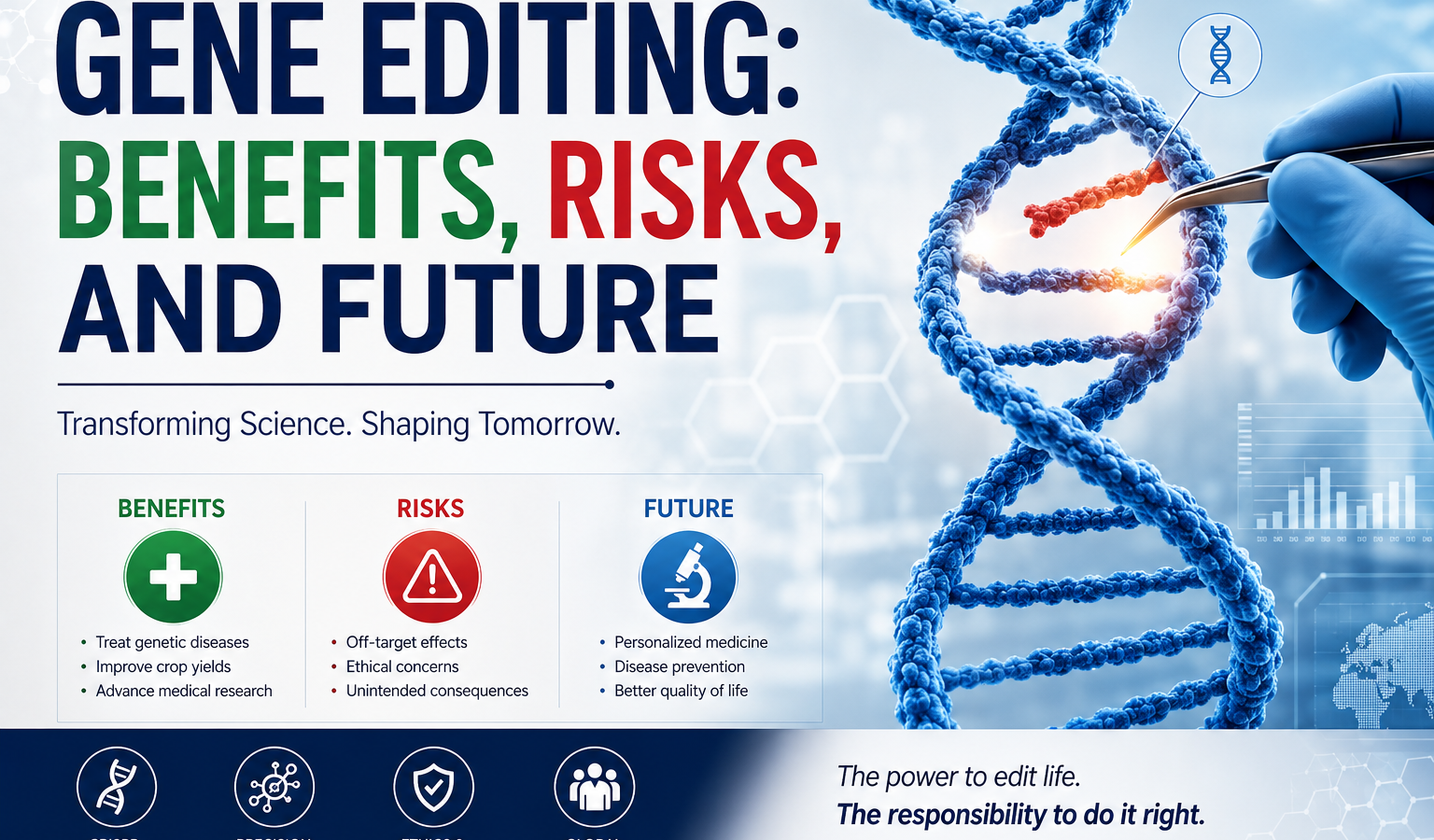

Table of Contents
- What gene editing means
- How gene editing works
- Major gene editing tools
- Uses in medicine and agriculture
- Benefits and risks
- Ethical concerns
- Future outlook
- FAQs
- Conclusion
- Call to action
What Gene Editing Means
Gene editing is a set of techniques that lets scientists change DNA at specific points. Instead of broadly altering an entire genome, gene editing targets a chosen sequence and modifies it with precision. That makes it different from older forms of genetic modification that were less exact.
The field has moved quickly because it can support research, improve crops, and help treat inherited disorders. The World Health Organization has also emphasized that the science raises important ethical and governance questions, especially when edits could affect future generations.
How Gene Editing Works
Most gene editing systems follow the same basic idea. A molecular tool finds a matching DNA sequence, cuts or rewrites the DNA, and then the cell repairs the change. Scientists use that repair process to remove, replace, or fix genetic material.
This is why gene editing is so powerful. It does not just observe a gene. It can change the gene itself. That gives researchers a direct way to study disease and design targeted treatments.
Main Gene Editing Tools
CRISPR-Cas9
CRISPR-Cas9 is the most widely known gene editing system. It uses a guide RNA to direct the Cas9 enzyme to a specific DNA sequence. Once there, Cas9 cuts the DNA so the cell can repair it.
Base Editing
Base editing changes one DNA letter into another without making a full double-strand break. That can reduce some of the risks linked with traditional cutting methods. Scientists use it when a tiny correction can solve the problem.
Prime Editing
Prime editing is often described as a search-and-replace approach for DNA. It can make smaller insertions, deletions, or substitutions with more flexibility than standard CRISPR methods.
Where Gene Editing Is Used
Medicine
Gene editing is already being tested and used in medicine for blood disorders, eye diseases, and other inherited conditions. In 2023, the first CRISPR-based therapy received regulatory approval in the UK, US, and other markets for sickle cell disease and transfusion-dependent beta thalassemia.
That approval was a major milestone. It showed that gene editing is no longer only a lab technique. It is now part of real-world treatment development.
Agriculture
In agriculture, gene editing can help create crops that resist disease, tolerate heat, or need fewer chemical inputs. That matters as climate pressure grows and food systems face more instability. The FAO and other public institutions have discussed biotechnology as one part of improving food resilience.
Research
Researchers use gene editing to understand how genes affect traits and disease. By switching a gene on, off, or altering its sequence, scientists can test how cells behave under different conditions.
Benefits of Gene Editing
- Can target specific DNA changes with high precision
- Helps researchers identify how diseases develop
- May lead to one-time or long-lasting treatments
- Can improve crop resilience and productivity
- May reduce dependence on some chemical treatments
The biggest benefit is precision. A well-designed edit can affect only the target gene instead of altering the whole genome. That reduces unnecessary changes and creates more focused research and treatment options.
Risks and Limitations
Gene editing is promising, but it is not risk-free. Edits can land in the wrong spot, create unintended changes, or affect how cells behave in ways scientists do not yet fully understand. Off-target effects remain one of the main technical concerns.
There are also delivery challenges. Scientists must get the editing tool into the right cells at the right time. That is often harder than the edit itself.
Ethical Concerns
Ethics is one of the most important parts of the gene editing conversation. Somatic editing affects only the treated person, while germline editing can pass changes to future generations. The WHO has called for strong oversight, public engagement, and careful governance.
Key ethical questions include consent, safety, fairness, access, and whether society should allow heritable editing at all. These are not just scientific questions. They are social choices.
Comparison Table
| Tool | Main Strength | Main Limitation | Best Use |
|---|---|---|---|
| CRISPR-Cas9 | Flexible and widely used | Can cause double-strand breaks | General editing and research |
| Base Editing | Very precise single-letter changes | Limited edit types | Point mutation correction |
| Prime Editing | More versatile “search and replace” edits | Still developing | Complex small edits |
Expert Tips
- Use gene editing only with clear clinical or research goals.
- Validate edits with multiple safety checks.
- Separate somatic applications from heritable applications.
- Pair technical work with ethics review early.
- Keep the public informed with simple, transparent language.
Common Mistakes
- Assuming all gene editing methods work the same way
- Ignoring off-target risks
- Overpromising cures before trials are complete
- Skipping ethical review
- Confusing gene editing with traditional genetic modification
FAQs
What is gene editing in simple terms?
Gene editing is a way to change DNA at specific locations so scientists can remove, correct, or replace genetic information.
How is gene editing different from gene therapy?
Gene therapy usually adds or delivers genetic material, while gene editing directly changes the DNA sequence itself.
Is CRISPR the same as gene editing?
CRISPR is one gene editing technology, but not the only one. Base editing and prime editing are other important tools.
Can gene editing cure disease?
It may cure or greatly improve some diseases, especially genetic blood disorders, but results depend on the condition, the delivery method, and long-term safety.
What is off-target editing?
Off-target editing happens when the tool changes DNA in the wrong place. Scientists work hard to reduce this risk.
Is gene editing used in food?
Yes. Researchers and companies are using it to improve crops and food traits, including resistance to disease and environmental stress.
Is germline editing allowed?
Rules vary by country, but germline editing remains highly restricted or prohibited in many places because changes could affect future generations.
What is the future of gene editing?
The future likely includes more precise tools, safer delivery systems, better clinical applications, and stronger global governance.
Conclusion
Gene editing is reshaping biology, medicine, and agriculture. Its precision makes it one of the most important scientific advances of the modern era, but its power also requires careful oversight, strong safety checks, and ethical responsibility.
As the science matures, gene editing will likely become more accurate, more useful, and more common in real-world applications. The challenge is making sure progress stays safe, fair, and transparent.
Keep learning about gene editing, follow trusted scientific sources, and stay informed about how this technology is changing healthcare and food systems.