
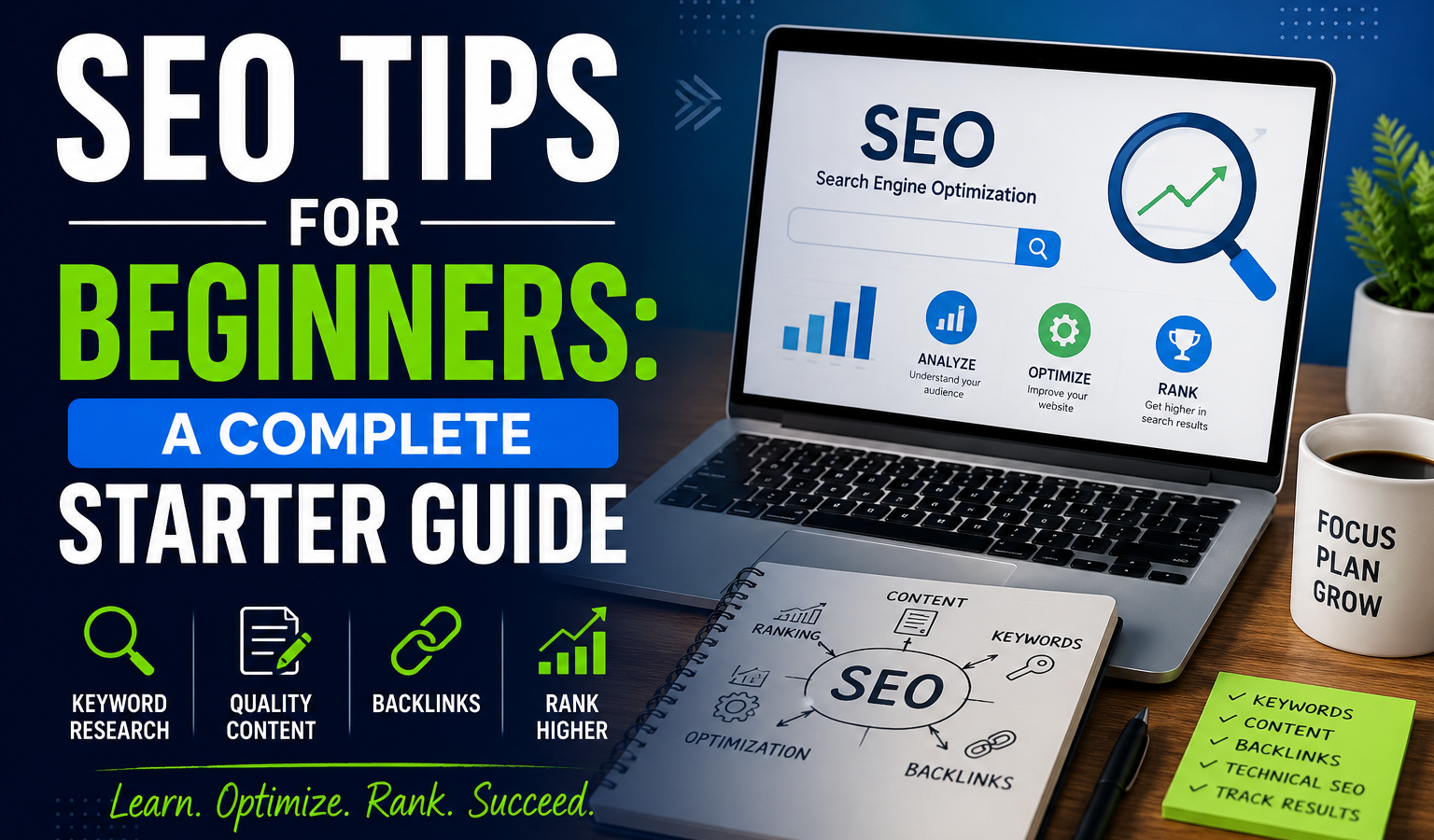

If you are new to search engine optimization, the good news is simple: SEO is learnable. You do not need to be a developer, a large brand, or a paid ads expert to improve your visibility in Google. You need a clear process, consistent execution, and content that genuinely helps people.
This guide breaks down SEO tips for beginners in a practical way. You will learn how search engines work, how to choose the right keywords, how to improve on-page SEO, how to build trust, and how to avoid common mistakes that slow down growth. The focus is on actions you can apply today.
Search engine optimization matters because organic search remains one of the most valuable traffic sources for websites. Google continues to dominate search globally, so improving your rankings can bring steady visitors without paying for every click. The real goal is not just traffic, but relevant traffic that turns into readers, leads, and customers.
Table of Contents
- What SEO is and why it matters
- How search engines work
- SEO tips for beginners
- Keyword research for beginners
- On-page SEO basics
- Technical SEO essentials
- Content SEO and E-E-A-T
- Link building for beginners
- Useful SEO tools
- Common mistakes
- Expert tips
- FAQs
- Conclusion and call to action
What SEO Is and Why It Matters
SEO stands for search engine optimization. It is the process of improving your website so search engines can understand it, trust it, and show it to users who are searching for related topics. Good SEO helps your pages appear in search results when people need answers, products, or services.
For beginners, SEO can feel technical at first. In reality, the core idea is straightforward: create useful content, organize it well, and make your site easy to crawl and understand. When those three things work together, your pages have a better chance of ranking.
SEO is valuable because organic visitors often have strong intent. A person searching for a specific question, product, or solution is already interested. That means search traffic can convert well when your content matches the search intent correctly.
Statistically, search is still enormous. Google processes billions of searches each day, and studies from major SEO platforms consistently show that top-ranking results receive the majority of clicks. That is why even small ranking improvements can matter a lot.
How Search Engines Work
Search engines use three main steps: crawling, indexing, and ranking. Crawling means discovering pages. Indexing means storing and understanding them. Ranking means deciding which pages should appear first for a query.
When you publish a page, search engines look for signals such as the page title, headings, content quality, links, page speed, mobile friendliness, and user satisfaction. These signals help search engines determine whether your page deserves visibility.
For beginners, this means every part of your site matters. Your content should answer the searcher’s question. Your structure should be clean. Your technical setup should not block crawling. Your pages should load quickly and work well on phones.
SEO Tips for Beginners
1. Start with search intent
Search intent is the reason behind a search. Before writing, ask what the user wants. Are they looking for information, a comparison, a tutorial, or a product? If your content does not match the intent, it will struggle to rank.
For example, someone searching “SEO tips for beginners” likely wants a beginner-friendly guide, not advanced technical jargon. Your article should be clear, useful, and easy to follow from the first paragraph to the last.
2. Choose one primary keyword per page
Every page should have one main keyword and a few closely related phrases. This helps the page stay focused. Do not try to rank one article for too many different topics. That usually weakens relevance.
For this article, the primary keyword is “SEO tips for beginners.” Supporting phrases can include beginner SEO guide, how to do SEO, on-page SEO basics, keyword research for beginners, and SEO best practices.
3. Use keywords naturally
Keyword stuffing hurts readability and can weaken trust. Place your primary keyword in the title, introduction, one or two subheadings, and naturally throughout the body. Focus more on helpful explanation than repetition.
4. Write for humans first
SEO content should be useful to readers first. If people stay on the page, scroll, click internal links, and return for more, that is a positive sign. Search engines are designed to reward content that satisfies users.
5. Optimize your title tag
Your title tag is one of the strongest on-page SEO signals. Keep it specific, clear, and under 60 characters where possible. Place the main keyword near the beginning. Make it attractive without sounding clickbait-heavy.
6. Write a strong meta description
Meta descriptions do not directly guarantee higher rankings, but they can improve click-through rates. A good description should summarize the page, include the keyword naturally, and give users a reason to click.
7. Use clean headings
Headings help readers scan your content and help search engines understand the page structure. Use one H2 for each major topic and H3s for supporting points. Keep headings descriptive and specific.
8. Improve internal linking
Internal links connect related pages on your site. They help visitors discover more content and help search engines understand which pages are important. Link from your new article to older relevant posts whenever possible.
9. Make your content useful and complete
Thin content rarely performs well. Answer the topic fully. Include examples, steps, explanations, and FAQs. A strong beginner guide should leave the reader with practical next actions, not just general advice.
10. Keep paragraphs short
Short paragraphs improve readability, especially on mobile. They also make long guides feel less intimidating. Aim for one idea per paragraph and break complex topics into smaller sections.
Keyword Research for Beginners
Keyword research helps you discover what people are searching for. It also shows how competitive a topic is and what format of content users expect. For beginners, this is one of the most important SEO skills to learn.
Start with seed ideas. Think about your niche, your audience’s problems, and the questions they ask. Then expand those ideas using search suggestions, related searches, competitor pages, and keyword tools.
- Begin with a broad topic.
- Find question-based phrases.
- Look for long-tail keywords.
- Check search intent.
- Review the top-ranking pages.
- Choose terms that fit your content goal.
Long-tail keywords are especially useful for new websites. They are usually more specific and often easier to rank for. Instead of targeting only “SEO,” you might target “SEO tips for beginners” or “how to do on-page SEO for a blog.”
That approach is smart because it gives you a realistic chance to compete while still attracting people who are actively looking for your topic.
On-Page SEO Basics
On-page SEO refers to everything you can improve directly on a page. This includes the content, headings, title tag, meta description, image alt text, URL slug, and internal links.
For beginners, on-page SEO is the easiest place to start because you control it completely. A well-optimized page can outperform a poorly structured page even if the two cover similar topics.
| On-Page SEO Element | What to Do | Why It Helps |
|---|---|---|
| Title tag | Use the main keyword and keep it clear | Improves relevance and clicks |
| Headings | Structure content with H2s and H3s | Supports readability and crawlability |
| Meta description | Write a compelling summary | Can improve click-through rate |
| URL slug | Keep it short and descriptive | Makes the page easier to understand |
| Images | Add alt text where needed | Improves accessibility and relevance |
Technical SEO Essentials
Technical SEO helps search engines access and understand your website. You do not need to be a programmer to handle the basics, but you do need to check a few important things.
First, your site should be mobile-friendly. Most users browse on phones, and Google uses mobile-first indexing. Second, your site should load quickly. Slow pages frustrate users and can reduce engagement.
Third, make sure your pages are indexable. Check that important pages are not blocked by robots.txt, noindex tags, or broken canonical settings. Fourth, use HTTPS so visitors feel safe and search engines can trust your site more easily.
Other technical basics include XML sitemaps, proper redirects, clean URLs, and fixing broken links. These may sound small, but they help search engines move through your site efficiently.
Content SEO and E-E-A-T
Content SEO means creating pages that solve real problems and communicate expertise clearly. E-E-A-T stands for Experience, Expertise, Authoritativeness, and Trust. It is a useful framework for producing stronger content.
You can strengthen E-E-A-T by writing from practical experience, citing credible sources when relevant, using clear author details, and keeping your content accurate and updated. Readers trust content that feels honest and useful.
To improve content SEO, answer the main question quickly, then expand with useful detail. Add examples. Explain terms. Anticipate follow-up questions. Avoid filler. Every section should move the reader forward.
- Show practical knowledge.
- Use plain language.
- Be accurate and current.
- Support claims with reliable references when needed.
- Update content regularly.
Link Building for Beginners
Backlinks are links from other websites to yours. They are still an important ranking signal because they help search engines see your site as trusted and useful. However, quality matters far more than quantity.
Beginners should focus on simple, ethical link-building methods. That includes creating link-worthy content, sharing helpful resources, writing guest posts where appropriate, getting listed in relevant directories, and building relationships in your niche.
A natural backlink profile grows over time. Avoid spammy tactics, paid link schemes, or irrelevant links. Those methods can create more harm than benefit.
Useful SEO Tools for Beginners
You do not need every SEO tool on the market. A few reliable tools can help you research, optimize, and measure performance more effectively.
- Google Search Console for indexing and performance data
- Google Analytics for traffic behavior
- Keyword research tools for topic discovery
- SEO plugins for on-page optimization
- Page speed tools for technical checks
For WordPress users, SEO plugins like SEOPress can simplify title tags, meta descriptions, sitemaps, schema, and content analysis. That makes it easier to stay consistent while learning SEO fundamentals.
Expert Tips
- Target long-tail keywords first to build momentum.
- Refresh old content instead of publishing only new posts.
- Use internal links to push authority to important pages.
- Study the top 3 results before writing any article.
- Improve CTR with clearer titles and stronger meta descriptions.
- Add helpful images, examples, or checklists where possible.
- Focus on one search intent per page.
- Measure results monthly, not daily.
Common Mistakes
- Choosing keywords without checking intent
- Writing thin or repetitive content
- Stuffing keywords unnaturally
- Ignoring title tags and meta descriptions
- Using poor internal linking structure
- Publishing without mobile optimization
- Forgetting image alt text
- Neglecting updates after publishing
One of the biggest beginner mistakes is expecting fast results. SEO usually takes time. Search engines need to crawl, index, and evaluate your pages, and competition can be strong. Consistent improvement is what pays off.
FAQs
1. What are the best SEO tips for beginners?
The best SEO tips for beginners are to focus on search intent, use one primary keyword, write helpful content, improve on-page SEO, and build clean internal links.
2. How long does SEO take to work?
SEO can take several weeks or months to show results, depending on competition, content quality, and your site’s authority. New websites often need more time.
3. Do I need backlinks to rank?
Backlinks help, but they are not the only factor. Strong content, good structure, and technical SEO also matter. Many beginner pages can rank through quality and relevance first.
4. Is keyword stuffing still a problem?
Yes. Keyword stuffing can hurt readability and trust. Search engines prefer natural language that clearly helps users.
5. What is the easiest SEO win for beginners?
Improving title tags, meta descriptions, and internal links is one of the easiest wins. These changes are simple but often make a meaningful difference.
6. Should beginners use SEO plugins?
Yes. SEO plugins can help you manage metadata, sitemaps, and basic optimization without needing advanced technical knowledge.
7. Can I do SEO without paid tools?
Yes. Free tools like Google Search Console and Google Analytics can cover many beginner needs. Paid tools are helpful later, but not required at the start.
8. What should I do after publishing an SEO article?
After publishing, submit the page for indexing, add internal links, share it where relevant, and monitor performance. Then update it based on search data and user engagement.
Conclusion
SEO does not have to be complicated. The best SEO tips for beginners are simple: understand search intent, publish useful content, use keywords naturally, organize your pages well, and keep improving over time. Small, consistent actions can create real growth.
When you focus on helping users first, SEO becomes much easier. Search engines want to reward pages that satisfy searchers. That means quality, clarity, and consistency matter more than tricks.
Call to Action
Start with one page. Choose one keyword, write one helpful article, optimize the title and description, and add internal links. Then repeat the process. That is how beginners build a strong SEO foundation.