
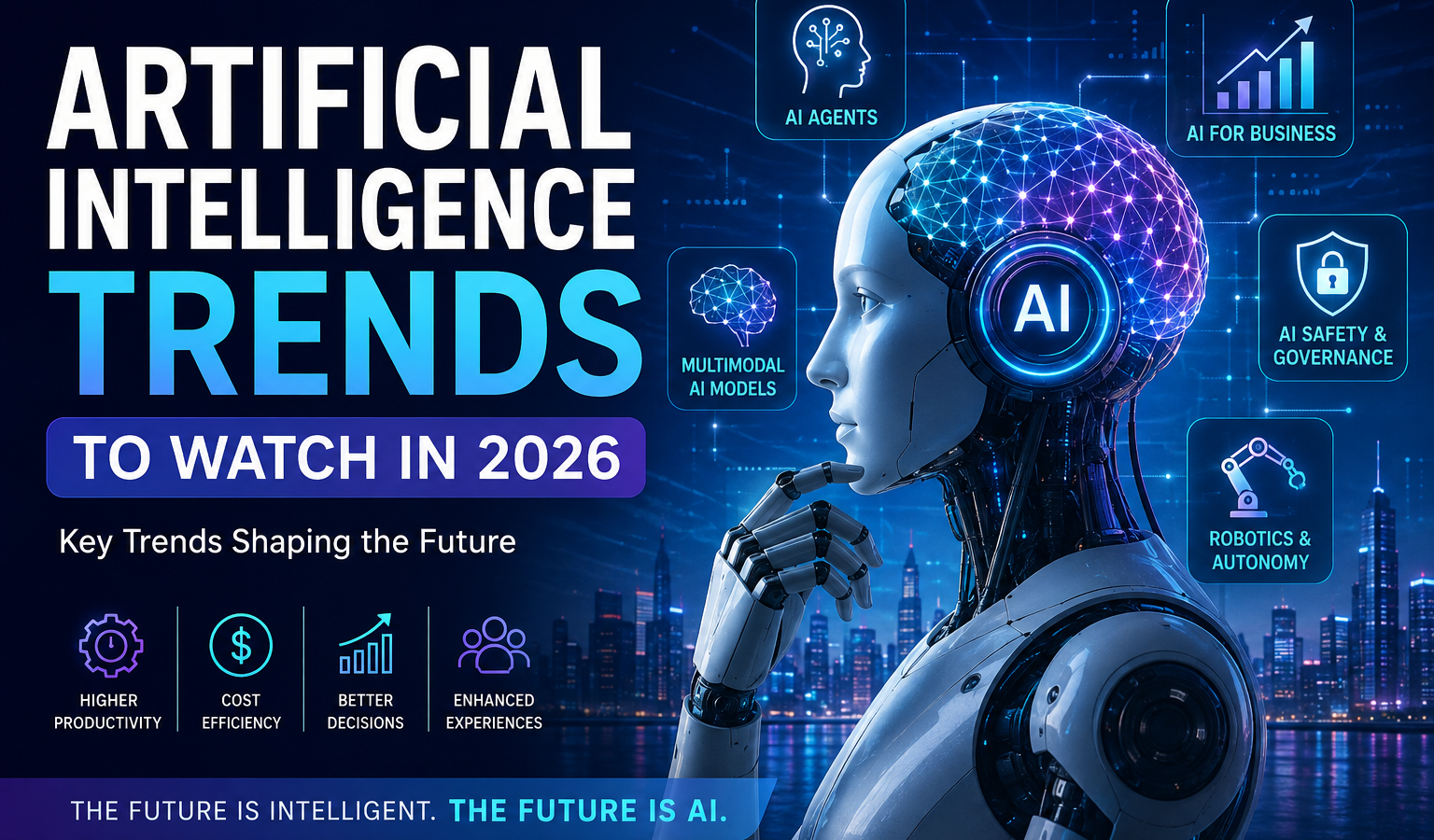

Artificial intelligence is moving beyond the chatbot era. In 2026, the most important artificial intelligence trends are increasingly about systems that can reason across different types of information, use tools, complete multi-step tasks, run closer to the device, and operate inside real business workflows.
The shift matters because AI adoption is no longer limited to technology companies. Organizations are using AI in marketing, software engineering, customer service, knowledge management, product development, operations, and other functions. Stanford’s 2026 AI Index reports that 88% of surveyed organizations used AI in at least one business function in 2025, while generative AI was used in at least one business function at 70% of organizations. The same report says generative AI reached 53% adoption in just three years, faster than the personal computer or the internet. Stanford HAI AI Index
At the same time, adoption should not be confused with maturity. McKinsey’s 2025 global survey found that 88% of respondents reported regular AI use in at least one business function, but nearly two-thirds said their organizations had not yet begun scaling AI across the enterprise. That gap between experimentation and measurable value is one of the defining themes of the current AI market. McKinsey State of AI
Table of Contents
- 1. Agentic AI and autonomous workflows
- 2. Multimodal artificial intelligence
- 3. Reasoning models and AI inference
- 4. Small language models and on-device AI
- 5. AI-powered search and answer engines
- 6. AI coding and software development
- 7. Physical AI and intelligent robotics
- 8. AI in healthcare and scientific discovery
- 9. AI governance, safety, and regulation
- 10. AI cybersecurity and adversarial AI
- 11. AI and the changing workplace
- 12. Comparing the major AI trends
- Expert tips for preparing for AI trends
- Common mistakes to avoid
- Frequently asked questions
1. Agentic AI and Autonomous Workflows
One of the strongest artificial intelligence trends is the transition from AI that answers questions to AI that can take actions. Agentic AI systems are designed to pursue a goal, plan a sequence of steps, use tools, interact with software, and return a result with varying degrees of human supervision.
A traditional chatbot might explain how to prepare a report. An AI agent could gather information, analyze a spreadsheet, draft the report, check it against a set of rules, and prepare the final document. The distinction is important because the value comes from completing a workflow rather than simply generating text.
McKinsey’s 2025 survey found that 62% of respondents said their organizations were at least experimenting with AI agents. Twenty-three percent reported that their organizations were scaling an agentic AI system somewhere in the enterprise, while another 39% had begun experimenting with agents. However, deployment remained limited across individual business functions. McKinsey
Why agentic AI matters
- It can automate multi-step workflows rather than isolated tasks.
- It can connect foundation models to business software and databases.
- It can reduce repetitive research, administration, and coordination work.
- It creates new opportunities for human-AI collaboration.
The practical challenge is reliability. Companies need permissions, audit trails, evaluation systems, clear escalation rules, and human review for high-impact decisions. In other words, successful agentic AI requires workflow engineering as much as model selection.
2. Multimodal Artificial Intelligence
AI is becoming increasingly multimodal. Instead of treating text, images, audio, video, and other data types as separate inputs, modern systems can combine them within a single interaction.
This trend changes how people interact with computers. A user can show an AI a product photograph, ask a spoken question, provide a document, and request a structured response. For businesses, multimodal AI can support visual inspection, customer service, document processing, media production, accessibility, education, and research.
Examples of multimodal applications
- Analyzing documents that contain text, charts, tables, and images.
- Creating and editing images or video from natural-language instructions.
- Voice-based assistants that understand context and visual information.
- AI systems that inspect products, equipment, or physical environments.
- Educational tools that combine diagrams, speech, text, and demonstrations.
The Stanford AI Index reports that several frontier models now meet or exceed human baselines on multimodal reasoning and other advanced evaluations. That does not mean AI is universally reliable, but it shows how quickly the capability frontier is moving.
3. Reasoning Models and AI Inference
Another major artificial intelligence trend is greater emphasis on reasoning. Rather than optimizing only for fast text generation, model developers are increasingly focused on systems that can spend more computation on difficult problems, evaluate intermediate steps, and produce stronger results on mathematics, coding, science, and complex analysis.
This creates an important distinction between training and inference. Training builds a model’s capabilities, while inference is what happens when the model processes a user’s request. Improvements in inference techniques can make AI more capable without requiring every task to use the largest possible model.
For businesses, reasoning models are particularly relevant when the cost of an incorrect answer is higher than the cost of additional computation. Examples include software debugging, research analysis, financial modeling, scientific workflows, and complex planning.
The trade-off
More reasoning can improve performance, but it can also increase latency and compute costs. The best AI architecture will therefore often combine fast models for routine tasks with more capable reasoning systems for difficult cases.
4. Small Language Models and On-Device AI
AI progress is not only about larger models. Small language models and specialized models are becoming strategically important because they can be cheaper, faster, easier to deploy, and more suitable for privacy-sensitive environments.
On-device AI can process certain tasks directly on phones, computers, vehicles, cameras, and other hardware. This can reduce dependence on cloud infrastructure and improve responsiveness. It can also limit the amount of sensitive information that needs to leave a device.
Where smaller models can win
- Offline or low-connectivity environments.
- Private applications that handle sensitive information.
- Embedded devices and edge computing.
- High-volume business tasks where inference cost matters.
- Specialized tasks where a focused model can outperform a general-purpose model on cost and latency.
This trend suggests a more diverse AI ecosystem. Large frontier models will remain important, but organizations will increasingly choose models based on the job rather than assuming that the largest model is always the best option.
5. AI-Powered Search and Answer Engines
Search is changing from a list of links toward systems that can summarize information, compare sources, answer follow-up questions, and sometimes perform deeper research. This is one of the artificial intelligence trends with direct consequences for publishers, marketers, businesses, and consumers.
Traditional search optimization remains important, but content strategies increasingly need to satisfy both human readers and AI-mediated discovery. Clear structure, original information, authoritative sourcing, concise explanations, topical depth, and strong entity relationships can help content remain useful as search interfaces evolve.
What publishers should focus on
- Create genuinely useful original content instead of rewriting existing pages.
- Demonstrate first-hand experience where appropriate.
- Use descriptive headings and concise answers.
- Support important claims with trustworthy sources.
- Build topical authority instead of targeting isolated keywords.
- Keep factual content updated as technologies change.
6. AI Coding and Software Development
AI coding assistants are evolving from autocomplete tools into development partners. They can explain code, generate functions, review changes, write tests, search documentation, troubleshoot errors, and help developers work across larger codebases.
The bigger trend is not simply automatic code generation. It is the redesign of the software development workflow. Developers can spend less time writing repetitive code and more time defining requirements, reviewing architecture, testing behavior, and validating security.
AI-assisted development is expanding
Modern coding workflows increasingly combine an AI assistant with repositories, terminals, issue trackers, documentation, testing tools, and deployment systems. This creates a path toward agentic software engineering in which AI can handle longer development tasks while a human remains responsible for review and approval.
However, generated code still needs testing. AI can introduce incorrect assumptions, insecure patterns, dependency problems, or subtle bugs. The strongest development teams treat AI output as a starting point that must pass normal engineering controls.
7. Physical AI and Intelligent Robotics
AI is moving beyond screens and into physical environments. Robotics companies are combining perception, language, planning, simulation, and machine learning to create systems that can operate in warehouses, factories, hospitals, logistics environments, and eventually more general-purpose settings.
This trend is often described as physical AI. It connects software intelligence with sensors, actuators, machines, and real-world feedback.
Potential applications
- Warehouse picking and inventory management.
- Industrial inspection and predictive maintenance.
- Agricultural monitoring and precision operations.
- Healthcare assistance and rehabilitation.
- Delivery, logistics, and autonomous transportation.
- Household and service robotics.
Robotics has a harder deployment environment than software. A model operating on a website can be restarted after an error; a robot operating around people must deal with physical safety, uncertainty, and changing environments. That is why simulation, testing, and safety engineering are central to this trend.
8. AI in Healthcare and Scientific Discovery
Healthcare and science are among the areas where AI could produce significant long-term benefits. AI systems can assist with medical imaging, documentation, clinical decision support, drug discovery, protein research, literature analysis, and experimental design.
The important trend is the movement from AI as a productivity tool toward AI as a research collaborator. Systems that can analyze large scientific datasets and propose hypotheses may shorten parts of the discovery process.
Yet healthcare requires a higher standard of evidence than ordinary consumer software. Privacy, clinical validation, bias, explainability, accountability, and regulatory compliance all matter. AI should support qualified professionals rather than encourage people to treat generated answers as medical diagnoses.
9. AI Governance, Safety, and Regulation
As AI becomes more capable, governance is becoming a core business function. Organizations must determine what data AI can access, which tasks it may perform, how outputs are evaluated, and who is responsible when something goes wrong.
Stanford’s 2026 AI Index highlights a widening gap between AI capabilities and society’s ability to govern and evaluate those systems. That gap is likely to make AI governance one of the defining artificial intelligence trends of the next several years.
Key elements of responsible AI governance
- Data governance and privacy controls.
- Model evaluation and monitoring.
- Human oversight for high-impact decisions.
- Access controls and least-privilege permissions.
- Documentation of AI use cases and risks.
- Incident response and audit trails.
- Compliance with applicable laws and industry requirements.
Governance should not be treated as paperwork added after deployment. It works best when risk controls are designed into the AI workflow from the beginning.
10. AI Cybersecurity and Adversarial AI
AI is becoming both a cybersecurity defense tool and a new attack surface. Security teams can use AI to analyze logs, detect suspicious behavior, summarize alerts, investigate incidents, and accelerate response. Attackers can also use AI to automate reconnaissance, phishing content, social engineering, and other malicious activity.
This creates an arms race. Organizations need to secure AI systems themselves while also using AI to defend traditional infrastructure.
AI security priorities
- Protect API keys and model credentials.
- Restrict agent permissions and tool access.
- Monitor unusual agent behavior.
- Test for prompt injection and data exfiltration risks.
- Validate third-party models and integrations.
- Keep humans involved in sensitive security decisions.
11. AI and the Changing Workplace
The workplace is likely to change through task redesign rather than a simple replacement of entire occupations. AI can automate portions of many jobs while increasing the importance of judgment, communication, domain expertise, verification, and problem framing.
McKinsey reports that AI could theoretically automate more than half of current U.S. work hours with today’s technologies, but the organization emphasizes that this is not a forecast of job losses. Adoption takes time, and roles can shrink, expand, or change as human and machine capabilities are combined. McKinsey: Agents, Robots, and Us
Stanford’s 2026 AI Index also reports uneven labor-market effects, including changes concentrated in hiring pipelines and younger workers in exposed occupations. This makes continuous learning increasingly important for both employees and employers.
Skills that become more valuable
- Critical thinking and verification.
- Domain-specific expertise.
- AI literacy and workflow design.
- Data interpretation.
- Communication and collaboration.
- Cybersecurity and privacy awareness.
- Creative problem-solving.
12. Comparing the Major AI Trends
| Trend | Main benefit | Key challenge | Best fit |
|---|---|---|---|
| Agentic AI | Workflow automation | Reliability and permissions | Business operations |
| Multimodal AI | Richer interaction | Evaluation and consistency | Media, support, research |
| Reasoning models | Complex problem solving | Cost and latency | Science, coding, analysis |
| Small/on-device AI | Speed and privacy | Capability limits | Devices and edge computing |
| AI search | Faster information discovery | Accuracy and source quality | Research and publishing |
| AI coding | Developer productivity | Code quality and security | Software teams |
| Physical AI | Automation in the real world | Safety and hardware | Industry and logistics |
| AI governance | Responsible scaling | Complexity and compliance | Every organization |
| AI cybersecurity | Faster detection and response | Adversarial use | Security operations |
Expert Tips for Preparing for AI Trends
The most useful response to rapid AI change is not to chase every new model. Instead, build an adaptable strategy.
- Start with business problems. Identify repetitive, expensive, slow, or error-prone workflows before selecting an AI product.
- Measure outcomes. Track time saved, quality, revenue impact, cost reduction, customer satisfaction, or other meaningful metrics.
- Use the smallest effective model. A cheaper model can be preferable when it meets the required accuracy and latency.
- Keep humans in the loop. Use stronger review controls when decisions affect money, safety, employment, health, or legal rights.
- Secure AI access. Treat agents as software identities with explicit permissions rather than giving them unrestricted access.
- Train employees. AI literacy should cover prompting, verification, privacy, security, and responsible use.
- Build for change. Avoid locking critical workflows to a single model when practical. Use modular architectures that allow models to evolve.
Common Mistakes to Avoid
- Chasing hype instead of value: A fashionable AI feature is not automatically a useful business solution.
- Automating before standardizing: AI can make a poorly designed process faster without making it better.
- Ignoring verification: Generated content can contain factual, logical, or security errors.
- Giving agents excessive permissions: Autonomous systems should receive only the access required for their tasks.
- Ignoring data privacy: Sensitive information should not be sent to AI services without understanding how it is handled.
- Measuring activity instead of outcomes: The number of prompts or AI-generated documents is less useful than measurable business results.
- Assuming one model fits everything: Different workloads have different requirements for speed, cost, reasoning, privacy, and accuracy.
Frequently Asked Questions
1. What are the biggest artificial intelligence trends in 2026?
The biggest trends include agentic AI, multimodal models, reasoning systems, small and on-device AI, AI-powered search, AI coding, physical AI and robotics, healthcare AI, AI governance, and AI cybersecurity.
2. What is agentic AI?
Agentic AI refers to AI systems designed to pursue goals and complete multi-step tasks using reasoning, tools, software integrations, and sometimes other AI systems. Human supervision can range from frequent approval to monitoring and exception handling.
3. Is generative AI still an important trend?
Yes. Generative AI remains a major foundation of the current AI ecosystem, but the focus is expanding from generating content to reasoning, taking actions, using tools, and operating inside workflows.
4. Why is multimodal AI important?
Multimodal AI allows systems to work across formats such as text, images, audio, and video. This makes AI more useful for real-world tasks where information is naturally distributed across multiple data types.
5. Will AI replace jobs?
AI is more likely to change tasks and workflows at different speeds across occupations. Some tasks may become automated, while demand grows for skills involving judgment, domain expertise, communication, AI oversight, and problem-solving. The outcome will vary by industry and role.
6. Why are small AI models becoming important?
Small models can offer lower cost, lower latency, and better suitability for local or privacy-sensitive applications. They are particularly useful when a task does not require the full capability of a large frontier model.
7. How should businesses prepare for AI trends?
Businesses should identify high-value use cases, establish AI governance, train employees, protect data, measure outcomes, and introduce AI into workflows gradually. They should also design systems that can adapt as models and regulations change.
8. What is the most important AI trend to watch?
Agentic AI deserves close attention because it represents a shift from AI that produces answers to AI that can execute workflows. However, its real impact will depend on reliability, security, governance, and measurable business value.
Conclusion
The artificial intelligence trends shaping 2026 point toward a broader transformation of computing. AI is becoming multimodal, more capable at reasoning, more autonomous, more embedded in software, and increasingly connected to physical machines.
But the most important story is not simply that models are becoming more powerful. It is that organizations are learning how to integrate AI into real workflows. The winners are unlikely to be the people who experiment with the largest number of tools. They will be the teams that identify valuable problems, deploy the right level of automation, measure outcomes, protect users, and keep humans responsible for important decisions.
For individuals, the opportunity is equally practical. Learn how modern AI works, develop strong verification habits, understand how AI agents and multimodal tools can support your work, and build skills that complement machine intelligence.
Call to Action
AI is evolving quickly, but you do not need to master every new model. Start with one meaningful workflow, test an AI solution, measure the result, and expand from there. Bookmark this guide and revisit it as new artificial intelligence trends emerge throughout 2026.