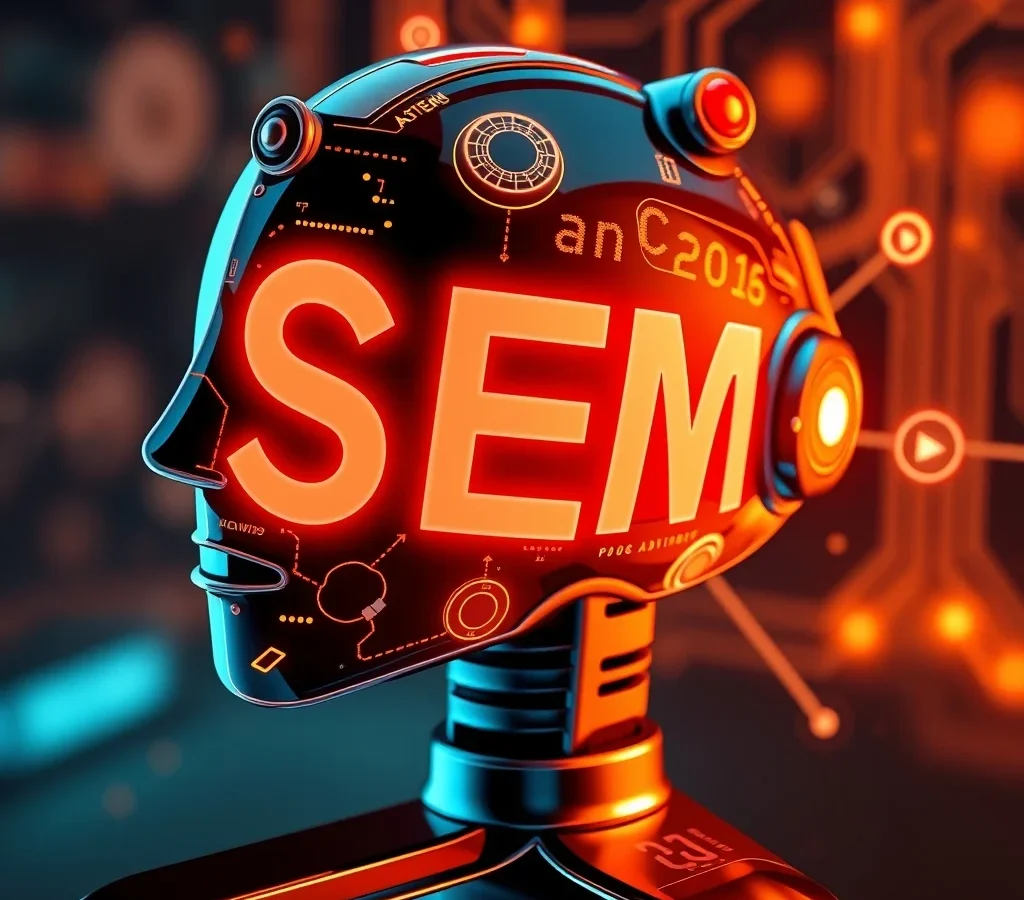

Search engine marketing (SEM) is entering a new phase. For years, paid search depended heavily on keyword lists, manual bids, ad variations, audience settings, and frequent human adjustments. Those fundamentals still matter, but artificial intelligence is changing how campaigns are planned, delivered, and measured.
The future of SEM is increasingly about giving advertising systems better goals, data, creative assets, and business signals so they can make decisions at scale. Google, for example, now offers AI Max for Search campaigns, while Performance Max uses AI-driven bidding and automated targeting across Google inventory. These developments point toward a broader shift from manually controlling every campaign setting to managing an intelligent system around measurable business outcomes.
This guide explains what AI-powered advertising means for SEM, where the technology is creating value, what marketers should watch carefully, and how businesses can prepare for the next generation of search advertising.
Table of Contents
- What Is AI-Powered SEM?
- Why SEM Is Changing
- How AI Is Transforming Search Advertising
- Key Benefits of AI-Powered Advertising
- Traditional SEM vs AI-Powered SEM
- The Role of Human Marketers
- How to Build an AI-Ready SEM Strategy
- Expert Tips
- Common Mistakes
- The Future of SEM
- FAQs
What Is AI-Powered SEM?
AI-powered SEM is the use of machine learning, predictive models, automation, and generative AI to improve paid search advertising. Instead of relying entirely on fixed rules, AI systems analyze large volumes of signals and use those signals to predict which users, queries, creatives, bids, and landing-page experiences are most likely to produce a desired outcome.
Modern AI-powered advertising can influence several parts of a campaign:
- Search-term matching and query expansion.
- Real-time or auction-time bidding.
- Ad headline and description customization.
- Audience and intent discovery.
- Landing-page selection and URL expansion.
- Budget allocation and conversion optimization.
- Creative testing and asset combinations.
- Performance forecasting and reporting.
Google describes AI Max for Search campaigns as an optimization layer for existing Search campaigns. Its features include broader search-term matching, text customization, final URL expansion, reporting improvements, and additional controls. citeturn0search1
Why SEM Is Changing
Search behavior is becoming more complex. Consumers can discover products through traditional search results, shopping experiences, voice interfaces, visual search, social platforms, and AI-generated answers. That means advertisers increasingly need systems that can interpret intent rather than depend on a small list of exact phrases.
Microsoft Advertising reported in March 2026 that about 80% of consumers in its research rely on zero-click results in at least 40% of their searches. The same source notes that voice queries are five times more frequent on mobile. These figures illustrate why advertisers must think beyond the old model of simply matching a keyword to an ad. citeturn0search12
AI is well suited to this environment because it can process many signals simultaneously. Instead of asking only, “What keyword did the person type?”, an AI-driven system can consider intent, context, device, location, historical behavior, creative relevance, conversion probability, and other available signals.
How AI Is Transforming Search Advertising
1. Smarter bidding
Automated bidding is one of the clearest examples of AI in SEM. Rather than setting one bid and leaving it unchanged, machine-learning systems can adjust bids according to the likelihood and value of a conversion.
Google’s Performance Max documentation states that Smart Bidding can optimize for conversions or conversion value at auction time. Available strategies include Maximize Conversions and Maximize Conversion Value, with optional target CPA or target ROAS controls depending on the strategy. citeturn0search0turn0search4
The practical advantage is scale. A human cannot manually evaluate every auction in real time, but an automated system can make bid decisions across a very large number of opportunities.
2. Broader search-term matching
AI is reducing the dependence on rigid keyword lists. Modern systems can use the meaning of a query, campaign context, existing keywords, ad creative, landing pages, and historical performance to identify searches that may be relevant even when they do not exactly match a manually selected keyword.
Google’s AI Max for Search campaigns uses AI to expand search-term matching and can use broad-match and keywordless technology to find relevant queries beyond an advertiser’s existing keyword set. citeturn0search1
3. Dynamic ad creation
Generative AI is also changing how advertisers produce creative assets. Instead of writing every variation manually, advertisers can provide core messaging, landing-page content, brand information, and other inputs while AI generates or adapts headlines and descriptions.
Google Ads API release notes for 2026 describe an AssetGenerationService for generating text and image assets with generative AI. Google also documents automated text customization in AI Max and automated asset creation within Performance Max. citeturn0search8turn0search10
4. Better landing-page alignment
A strong ad is only useful when the landing-page experience matches the user’s intent. AI-powered campaigns can increasingly select or expand to relevant URLs based on the query and available website content.
Final URL expansion in Google’s AI-driven campaign systems is designed to identify a more relevant landing page and can dynamically support the ad experience. citeturn0search1turn0search10
5. More sophisticated audience discovery
AI can identify patterns among users who are likely to convert. Advertisers can provide audience signals, customer information, search themes, conversion data, and other business context to help guide the system.
Importantly, audience signals are not necessarily hard boundaries. Google’s Performance Max documentation explains that AI can find relevant audiences beyond the signals supplied by the advertiser when doing so is expected to support campaign goals. citeturn0search0
6. Automated optimization across assets and channels
Modern advertising platforms can combine text, images, video, audiences, placements, and landing pages. This changes campaign management from optimizing one advertisement at a time to managing groups of assets around a business objective.
Performance Max, for example, can access multiple Google advertising channels from a unified campaign and uses asset groups to organize creative components around themes or audiences. citeturn0search7
Key Benefits of AI-Powered Advertising
Faster optimization
AI can process campaign signals continuously. This can reduce the delay between detecting a performance change and responding to it.
Greater scale
Large advertisers may have thousands of keywords, products, creative combinations, and audience signals. Automation makes it possible to manage this complexity without manually adjusting every variable.
Improved relevance
When AI connects query intent with suitable creative and landing-page content, advertisements can become more contextually relevant.
More efficient use of data
Conversion tracking, customer value, search behavior, and campaign history can provide valuable signals for predictive optimization. The quality of these inputs directly affects the quality of automated decisions.
More creative experimentation
Generative AI can help advertisers create multiple variations quickly. Human review remains essential, but AI can reduce the production bottleneck that often limits testing.
Potentially better business outcomes
AI does not automatically guarantee lower costs or higher returns. Its value depends on accurate conversion tracking, appropriate goals, sufficient data, strong creative, good landing pages, and sensible controls. The objective should therefore be measurable business performance rather than automation for its own sake.
Traditional SEM vs AI-Powered SEM
| Area | Traditional SEM | AI-Powered SEM |
|---|---|---|
| Keyword strategy | Heavy manual keyword selection | Intent-based expansion and automated matching |
| Bidding | Manual or rule-based adjustments | Machine-learning and auction-time optimization |
| Ad creation | Mostly manual copywriting | Human strategy combined with AI-generated variations |
| Targeting | Predefined audiences and settings | Signals plus predictive audience discovery |
| Landing pages | Usually selected manually | Can be dynamically matched to intent |
| Optimization | Periodic manual analysis | Continuous automated optimization |
| Reporting | Mostly campaign-level analysis | Increasingly granular combinations of queries, assets, and outcomes |
| Human role | Execution-heavy | Strategy, governance, creative direction, and measurement |
The Role of Human Marketers
The rise of AI does not eliminate the need for SEM professionals. It changes where their expertise matters most.
Humans remain responsible for defining business objectives, protecting brand positioning, understanding customers, setting acceptable acquisition costs, evaluating creative quality, interpreting results, and making decisions when automated recommendations conflict with business reality.
This is particularly important because AI optimizes toward the signals it receives. If a business tracks low-value leads as conversions, an automated system may become very good at generating low-value leads. Better technology cannot compensate for a poorly defined objective.
The future SEM specialist is therefore less of a bid operator and more of a strategist, analyst, experiment designer, data steward, and AI governance manager.
How to Build an AI-Ready SEM Strategy
1. Define the business outcome first
Start with revenue, qualified leads, profit, subscriptions, bookings, or another meaningful business outcome. Avoid optimizing solely for clicks unless clicks genuinely represent the business objective.
2. Fix conversion tracking
Audit conversion actions, attribution settings, values, duplicate events, offline conversions, and lead quality. AI systems need reliable feedback to learn what success looks like.
3. Improve first-party data
Where permitted and appropriate, use high-quality customer and conversion data to strengthen audience understanding. Keep privacy, consent, and applicable data-protection requirements at the center of the process.
4. Build strong creative assets
Give AI high-quality raw material. Provide clear value propositions, differentiators, product benefits, proof points, offers, brand terminology, and calls to action. Automation works better when the source material is strong.
5. Strengthen landing pages
Every important advertising theme should lead to a page that answers the user’s intent. Make pages fast, mobile-friendly, persuasive, trustworthy, and easy to navigate.
6. Use AI with controlled experimentation
Do not change every campaign setting simultaneously. Test new AI features against a defined baseline where practical. Track cost per qualified lead, revenue, conversion rate, ROAS, profit, and other relevant metrics.
7. Monitor search quality
Broader matching can discover valuable demand, but it can also introduce irrelevant queries. Review search-term insights, exclusions, brand controls, geography, and landing-page behavior regularly.
8. Protect the brand
AI-generated assets should follow brand standards. Establish rules for claims, tone, prohibited language, legal requirements, pricing statements, and sensitive topics before enabling broad automation.
Expert Tips
- Optimize for value, not volume: A campaign that produces more conversions is not necessarily better if the additional conversions have low business value.
- Feed the system better signals: Accurate conversion tracking and meaningful conversion values are among the most important foundations of automated optimization.
- Keep humans in the loop: Review automated creative, targeting behavior, search quality, and landing-page relevance.
- Give AI useful context: Search themes, audience signals, product feeds, brand information, and strong landing pages can help guide automated systems.
- Test incrementally: Compare changes against a clear baseline instead of judging performance from short-term fluctuations.
- Watch profitability: ROAS can hide margin differences. If possible, connect advertising decisions to actual customer or product value.
Common Mistakes
- Turning on automation without tracking: AI needs accurate feedback to optimize intelligently.
- Using weak conversion goals: Optimizing toward page views or unqualified leads can produce misleading performance improvements.
- Assuming AI is always correct: Automated recommendations are not a substitute for business judgment.
- Ignoring search quality: Expanded matching should be monitored rather than left completely unattended.
- Publishing unreviewed AI copy: Generated ads can contain inaccurate claims, awkward language, or messaging that does not fit the brand.
- Changing too many variables at once: This makes it difficult to determine which change caused a performance shift.
- Neglecting landing pages: Better targeting cannot rescue a slow, confusing, or poorly matched landing page.
The Future of SEM
The direction of SEM is clear: more decisions will be assisted or executed by AI, while humans will increasingly define the objectives and constraints.
Search advertising is also becoming less dependent on the idea that a campaign is simply a list of keywords and ads. AI can connect queries, audiences, creative assets, landing pages, and conversion signals into a more adaptive system.
Google’s 2026 documentation shows this transition in concrete terms. AI Max is expanding Search campaigns with AI-driven matching and asset optimization, while Performance Max continues to use automated bidding, targeting, asset groups, and cross-channel optimization. citeturn0search1turn0search7
Microsoft Advertising is likewise describing AI-powered search as a change in the customer journey rather than the disappearance of search advertising. Its 2026 guidance emphasizes the importance of conversion signals, feed quality, and the boundaries advertisers set around AI systems. citeturn0search13
The next competitive advantage will therefore come from the quality of the entire advertising system: business data, measurement, creative assets, website experience, customer understanding, and strategic direction.
FAQs
1. What is AI-powered advertising in SEM?
AI-powered advertising uses machine learning and generative AI to automate or improve tasks such as bidding, targeting, search-term matching, ad creation, asset selection, and campaign optimization.
2. Will AI replace SEM specialists?
AI is more likely to change SEM roles than eliminate them. Manual execution will become less important, while strategy, measurement, experimentation, brand governance, and business analysis will become more valuable.
3. Is AI-powered SEM better than traditional SEM?
It can be more scalable and responsive, but results depend on campaign setup and data quality. AI is not automatically better simply because it is automated.
4. Does AI-powered SEM reduce advertising costs?
It can improve efficiency in some situations, but there is no universal guarantee of lower CPC or CPA. Advertisers should evaluate profitability, conversion quality, and incremental business value.
5. What data does AI need for SEM?
Useful inputs can include conversion data, conversion values, search behavior, campaign history, customer signals, product information, landing-page content, and creative assets. The exact inputs depend on the advertising platform and campaign type.
6. Can AI write search ads?
Yes. Modern advertising platforms can generate or customize text assets. However, advertisers should review AI-generated messaging for accuracy, brand consistency, compliance, and persuasion before relying on it at scale.
7. What is AI Max for Search campaigns?
AI Max is a set of AI-powered features for Google Search campaigns. Google describes it as an optimization layer that can expand search-term matching, customize text assets, support final URL expansion, and provide additional reporting and controls. citeturn0search1
8. How should a small business prepare for AI-powered SEM?
Start with accurate conversion tracking, a clear business goal, strong landing pages, compelling creative, and a manageable test budget. Adopt automation gradually and evaluate results based on qualified leads, revenue, or another meaningful business metric.
Conclusion
The future of SEM is not simply about replacing manual advertising with machines. It is about building smarter systems that can interpret intent, adjust bids, generate relevant creative, discover audiences, and connect advertising activity to measurable business outcomes.
AI-powered advertising is already moving SEM in this direction. The advertisers most likely to benefit will not be those who automate everything blindly. They will be the businesses that combine high-quality data, strong creative, excellent landing pages, disciplined experimentation, and human strategic oversight.
In other words, AI may run more of the mechanics of SEM, but humans still determine what the advertising is supposed to accomplish.
Call to Action
Ready to prepare your search campaigns for the AI-powered future? Start by auditing your conversion tracking, campaign goals, landing pages, creative assets, and data quality. Then introduce AI-driven features gradually, measure the business impact, and keep refining your strategy around the outcomes that matter most.
Sources: Google Ads API documentation and Microsoft Advertising industry guidance, accessed August 2026.