
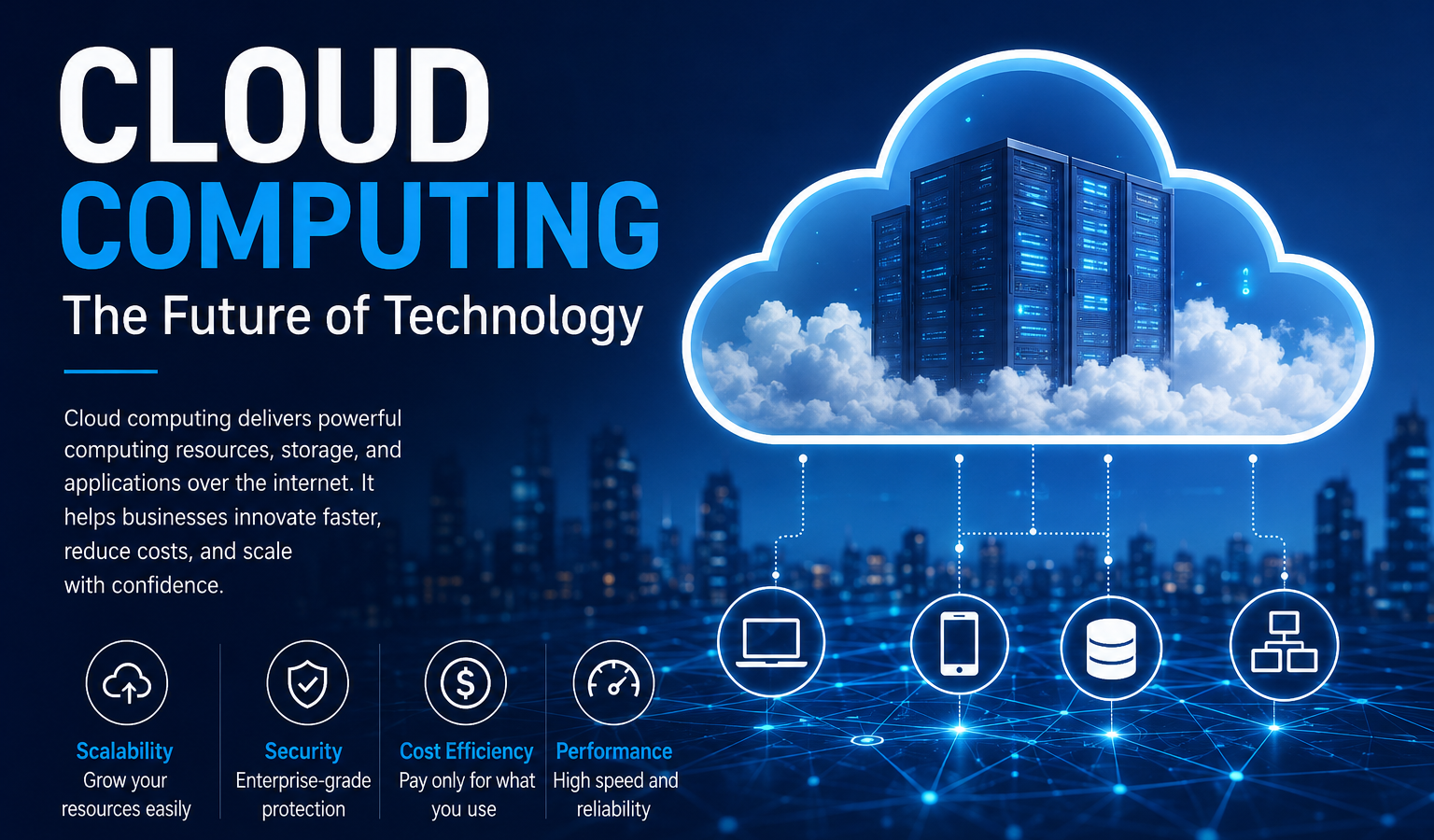

Cloud computing has changed how organizations buy, deploy, manage, and scale technology. Instead of owning every server and storage device, businesses can access computing resources over the internet and pay for capacity according to their needs. This model supports everything from small websites and mobile applications to enterprise analytics, artificial intelligence, backup, and disaster recovery.
For individuals and businesses, understanding cloud computing is no longer optional. The right cloud strategy can reduce infrastructure overhead, improve agility, strengthen resilience, and help teams launch digital services faster. The wrong strategy can create unexpected bills, security gaps, vendor lock-in, and unnecessary complexity.
This guide explains what cloud computing is, how it works, the major service and deployment models, its benefits and limitations, security considerations, costs, use cases, and practical tips for choosing a cloud approach.
Table of Contents
- What Is Cloud Computing?
- How Cloud Computing Works
- Types of Cloud Computing Services
- Cloud Deployment Models
- Benefits of Cloud Computing
- Common Cloud Computing Use Cases
- Cloud Computing vs Traditional IT
- Cloud Security and Privacy
- Cloud Costs and Cost Optimization
- Expert Tips for Adopting Cloud Computing
- Common Cloud Computing Mistakes
- Frequently Asked Questions
- Conclusion
What Is Cloud Computing?
Cloud computing is the delivery of computing resources over a network, usually the internet, on demand. These resources can include servers, virtual machines, storage, databases, networking, software, analytics platforms, and machine-learning infrastructure.
Instead of purchasing a physical server and maintaining it in an office or data center, an organization can provision a virtual server from a cloud provider in minutes. It can increase or reduce resources as demand changes and pay according to the selected pricing model.
The National Institute of Standards and Technology describes cloud computing around five essential characteristics: on-demand self-service, broad network access, resource pooling, rapid elasticity, and measured service. Those characteristics explain why cloud platforms are fundamentally different from traditional infrastructure.
Why Cloud Computing Matters
The most important shift is from infrastructure ownership to infrastructure consumption. A company can focus more on its application, customers, and business processes instead of spending most of its time maintaining hardware.
Cloud computing also makes experimentation easier. A development team can create a test environment, run an experiment, and remove the resources afterward without purchasing permanent equipment.
How Cloud Computing Works
Cloud computing depends on large-scale data centers containing physical servers, storage systems, networking equipment, power infrastructure, and cooling systems. Providers abstract much of that physical infrastructure through virtualization, automation, orchestration, and software-defined networking.
Virtualization
Virtualization allows a physical server to host multiple isolated virtual machines. Each virtual machine can run its own operating system and applications while sharing underlying hardware.
Resource Pooling
Cloud providers pool computing resources across large infrastructure environments. Automated systems allocate resources to customers based on demand, configuration, availability, and capacity.
Automation and APIs
Cloud platforms expose management consoles, command-line interfaces, and application programming interfaces. These tools allow teams to provision infrastructure through repeatable processes and infrastructure-as-code systems.
Elasticity
Elasticity allows applications to add or release resources as workload requirements change. Auto-scaling can add capacity during a traffic spike and reduce capacity when demand falls.
Types of Cloud Computing Services
Cloud services are commonly grouped into Infrastructure as a Service, Platform as a Service, and Software as a Service. Each model gives the customer a different level of control and responsibility.
Infrastructure as a Service (IaaS)
IaaS provides fundamental computing resources such as virtual machines, storage, and networking. The customer normally manages the operating system, applications, configurations, and much of the security above the infrastructure layer.
IaaS is useful when an organization needs significant control over its environment. Typical workloads include custom applications, development environments, enterprise systems, and workloads that require specific operating-system configurations.
Platform as a Service (PaaS)
PaaS provides a managed application platform. The provider handles more of the underlying infrastructure and runtime environment, allowing developers to concentrate on application code and data.
This model can accelerate development because teams spend less time configuring operating systems, servers, and runtime components.
Software as a Service (SaaS)
SaaS delivers complete applications through the internet. The provider manages the application, infrastructure, updates, and much of the operational stack.
Email, customer relationship management, collaboration platforms, accounting applications, and project-management tools are common SaaS examples.
Serverless Computing
Serverless computing lets developers run application functions without managing traditional servers directly. The provider handles infrastructure provisioning and scaling, while billing is often tied to execution or resource consumption.
Cloud Deployment Models
The deployment model describes where cloud infrastructure operates and how it is shared or controlled.
Public Cloud
A public cloud is operated by a third-party provider that offers computing resources to multiple customers. Customers receive logically isolated environments while the provider manages the underlying physical infrastructure.
Private Cloud
A private cloud is dedicated to one organization. It can offer greater control over infrastructure and configuration, although it may require more operational expertise and investment.
Hybrid Cloud
A hybrid cloud combines private infrastructure with public cloud services. Organizations may use this approach when they need to keep certain workloads in a controlled environment while using public cloud resources for scalability or specialized services.
Multicloud
Multicloud means using services from more than one cloud provider. It can improve flexibility and provide access to specialized capabilities, but it can also increase operational complexity.
Benefits of Cloud Computing
1. Lower Upfront Infrastructure Costs
Cloud computing can reduce the need for large capital purchases of servers, storage, and networking equipment. Organizations can provision resources when they need them rather than building infrastructure for maximum future capacity.
2. Scalability
Cloud platforms make it easier to increase capacity as workloads grow. This is especially valuable for websites, applications, and services with unpredictable traffic.
3. Faster Deployment
Traditional infrastructure procurement can take days or weeks. Cloud resources can often be provisioned in minutes, allowing development teams to move faster.
4. Global Reach
Major cloud providers operate infrastructure in multiple geographic regions. Businesses can deploy services closer to customers and design architectures that support geographic resilience.
5. Business Continuity
Cloud storage, replication, backup, and disaster-recovery services can help organizations recover from hardware failures and other disruptions.
6. Access to Advanced Technology
Cloud platforms provide managed databases, analytics, artificial intelligence, machine learning, container platforms, and specialized hardware without requiring every organization to build those capabilities from scratch.
7. Remote Collaboration
Cloud-based applications allow authorized users to access systems and data from different locations, supporting distributed teams and remote operations.
Common Cloud Computing Use Cases
- Website hosting: Run websites and web applications on scalable infrastructure.
- Data backup: Store copies of important information away from primary systems.
- Disaster recovery: Restore applications and data after outages or failures.
- Application development: Create temporary development and testing environments.
- Big data analytics: Process large datasets using scalable compute and storage.
- Artificial intelligence: Access GPUs, machine-learning platforms, and managed AI services.
- Content delivery: Distribute files and media closer to users.
- Business applications: Run or consume CRM, finance, productivity, and collaboration software.
Cloud Computing vs Traditional IT
| Factor | Cloud Computing | Traditional IT |
|---|---|---|
| Infrastructure | Provider-managed or shared | Usually owned or leased directly |
| Provisioning | Often minutes | Can take days or weeks |
| Scaling | Highly flexible | Often requires hardware planning |
| Cost model | Consumption or subscription based | Higher upfront capital investment is common |
| Maintenance | Shared with provider | Mostly handled internally |
| Global deployment | Generally easier | Requires additional infrastructure |
Cloud Security and Privacy
Moving workloads to the cloud does not eliminate security responsibilities. Cloud security follows a shared-responsibility model: the provider secures the underlying cloud infrastructure, while customers remain responsible for many aspects of their applications, identities, configurations, and data.
Identity and Access Management
Use strong authentication, least-privilege permissions, role-based access controls, and regular access reviews. Multi-factor authentication should be enabled for privileged accounts whenever supported.
Data Protection
Protect sensitive data both in transit and at rest. Encryption, secure key management, data classification, retention policies, and carefully designed access controls should form part of the architecture.
Monitoring and Logging
Centralized logs and security monitoring help teams detect suspicious activity, investigate incidents, and demonstrate compliance where required.
Backup and Recovery
Do not assume that cloud-hosted data is automatically backed up. Define recovery point objectives and recovery time objectives, then test restoration procedures regularly.
Cloud Costs and Cost Optimization
Cloud pricing can be efficient, but poorly managed consumption can produce surprising bills. Costs may come from compute, storage, databases, network traffic, managed services, licenses, and premium features.
Effective cost management starts with visibility. Tag resources, assign ownership, set budgets and alerts, and review usage regularly.
- Remove unused resources.
- Right-size virtual machines and databases.
- Use automatic scaling where appropriate.
- Choose storage tiers based on access patterns.
- Schedule non-production resources to shut down when idle.
- Review data-transfer costs before moving large datasets.
- Use provider pricing calculators before major deployments.
Expert Tips for Adopting Cloud Computing
- Start with business outcomes. Define the problem before selecting a cloud service.
- Build a migration inventory. Document applications, dependencies, data, owners, and performance requirements.
- Use a phased migration. Start with manageable workloads and learn before moving critical systems.
- Automate infrastructure. Infrastructure as code improves consistency, repeatability, and auditability.
- Design for failure. Use redundancy and tested recovery procedures instead of assuming outages will never occur.
- Measure continuously. Track cost, availability, performance, security findings, and user experience.
- Train your team. Cloud architecture changes operational responsibilities, so skills development is part of the migration.
Common Cloud Computing Mistakes
Ignoring Cost Governance
Moving quickly without budgets, tagging, and ownership can turn cloud flexibility into uncontrolled spending.
Overprovisioning Resources
Teams sometimes select larger instances than necessary. Measure actual workloads and right-size resources based on evidence.
Weak Identity Controls
Excessive permissions and unmanaged credentials can create serious security exposure. Apply least privilege and strong authentication.
Skipping Disaster-Recovery Testing
A backup that has never been restored is not a proven recovery strategy. Test restoration regularly and document the results.
Moving Everything Without Architecture Review
Cloud migration is not simply a copy-and-paste exercise. Some applications need redesign, refactoring, modernization, or retirement before migration.
Cloud Computing Statistics and Industry Context
Cloud adoption has become a major part of modern enterprise IT. Gartner has projected continued growth in worldwide public-cloud end-user spending, while Flexera’s State of the Cloud research has consistently shown that organizations identify managing cloud spend as a major challenge. These trends highlight two realities: cloud demand continues to expand, and governance remains essential.
Industry estimates vary because researchers measure different segments of cloud services and use different methodologies. For this reason, cloud statistics should be treated as directional evidence rather than universal measurements. Businesses should evaluate their own workload, financial, security, and operational data before making investment decisions.
Frequently Asked Questions
1. What is cloud computing in simple terms?
Cloud computing means using computing resources such as servers, storage, databases, and software over a network instead of relying entirely on equipment owned and operated locally.
2. What are the three main cloud service models?
The three traditional service models are Infrastructure as a Service (IaaS), Platform as a Service (PaaS), and Software as a Service (SaaS).
3. Is cloud computing secure?
Cloud computing can be highly secure when organizations configure services correctly, control identities, encrypt sensitive data, monitor activity, and follow appropriate security practices. Security remains a shared responsibility.
4. Is cloud computing cheaper than traditional IT?
It can be, but not automatically. Savings depend on workload characteristics, utilization, architecture, licensing, data transfer, staffing, and how well resources are governed.
5. What is the difference between public and private cloud?
Public cloud infrastructure is operated by a provider for multiple customers, while private cloud infrastructure is dedicated to one organization.
6. What is hybrid cloud?
Hybrid cloud combines private infrastructure with public cloud services and allows organizations to place workloads where operational, security, regulatory, or performance requirements are best satisfied.
7. Can small businesses use cloud computing?
Yes. Small businesses commonly use cloud email, storage, website hosting, accounting software, collaboration tools, backup services, and other SaaS products without maintaining large IT infrastructure.
8. How should a business start using cloud computing?
Start by identifying business goals and workloads, assess security and compliance requirements, estimate costs, choose an appropriate service model, and migrate a manageable workload before expanding.
Conclusion
Cloud computing has become a foundational technology for modern digital services. Its value comes from more than replacing physical servers. Cloud platforms provide elasticity, automation, managed services, global infrastructure, and access to advanced technologies that can help organizations respond faster to changing demands.
However, successful cloud adoption requires discipline. Security, identity management, cost governance, architecture, observability, backup, and skills development should be designed into the strategy from the beginning.
The best cloud environment is not necessarily the one with the most services. It is the environment that delivers the required business outcomes with an appropriate balance of cost, performance, security, resilience, and operational complexity.
Call to Action
Ready to make better use of cloud computing? Start by auditing your current infrastructure, identifying one workload that would benefit from cloud services, estimating its costs, and creating a small proof of concept. A measured first step can provide the data you need for a larger and more confident cloud strategy.