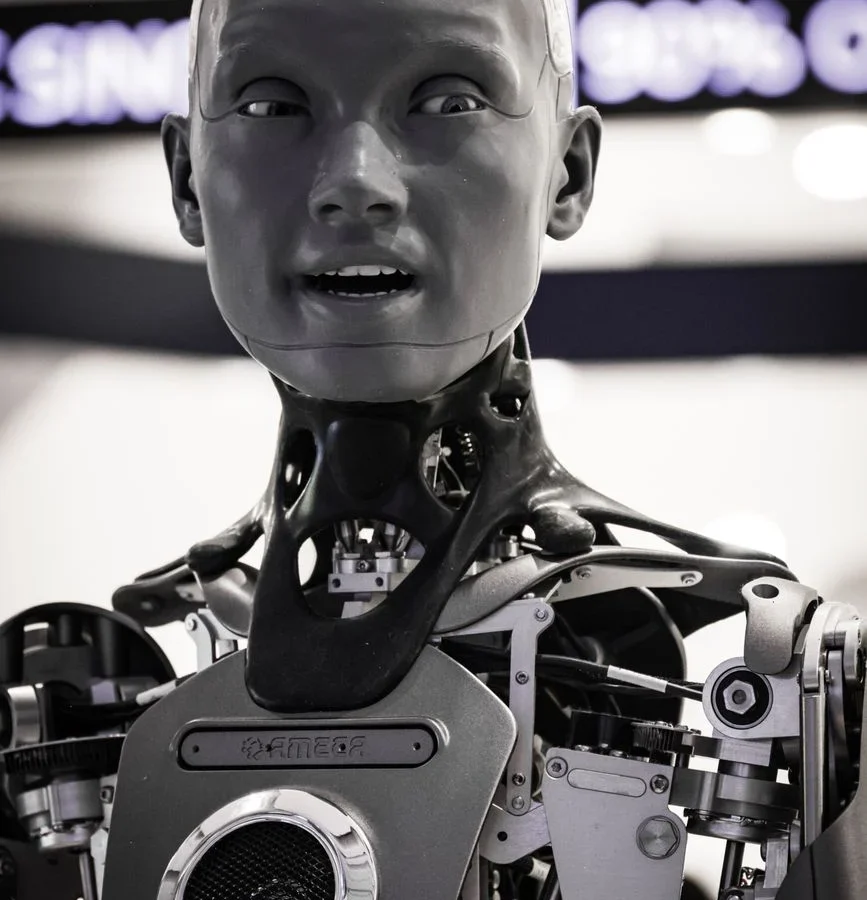

Humanoid robots are robots designed with a human-like body structure, typically including a torso, head, arms, hands, and two legs. The goal is not simply to make a robot look human. A human-shaped design can allow robots to operate in environments built around human bodies, tools, doors, shelves, vehicles, and workstations.
Recent advances in artificial intelligence, computer vision, sensors, actuators, batteries, simulation, and robotics software have accelerated interest in humanoid systems. Companies and research organizations are testing them for industrial work, logistics, research, education, healthcare support, and other environments.
However, humanoid robotics remains a difficult engineering problem. Reliable walking, balance, dexterous manipulation, safe interaction, power management, perception, and real-time decision-making all have to work together.
Table des matières
- What Are Humanoid Robots?
- How Humanoid Robots Work
- Key Components of a Humanoid Robot
- AI and Humanoid Robots
- Applications of Humanoid Robots
- Humanoid vs Other Robots
- Avantages Potentiels
- Défis et limitations
- Safety and Security
- The Future of Humanoid Robotics
- Conseils d'experts
- Common Misconceptions
- Foire aux questions
What Are Humanoid Robots?
A humanoid robot is a machine whose physical design resembles the human body sufficiently to support human-like movement or interaction. Many humanoids use two legs, two arms, a torso, a head-like sensor platform, and hands or grippers.
The design can provide a practical advantage in spaces already optimized for people. A robot that can reach shelves at human height, use stairs, manipulate familiar tools, and move through standard work areas may require fewer environmental changes than a specialized machine.
That does not mean a humanoid shape is always the best choice. Industrial robots, autonomous mobile robots, robotic arms, wheeled platforms, and specialized machines can outperform humanoids on particular tasks. The correct robot depends on the job and environment.
How Humanoid Robots Work
1. Perception
Cameras, depth sensors, inertial measurement units, force sensors, microphones, and other sensors provide information about the robot and its surroundings. Computer vision systems can identify objects, surfaces, people, obstacles, and locations.
2. Localization and mapping
The robot needs to estimate where it is and understand the surrounding environment. Depending on the system, this can involve simultaneous localization and mapping, visual-inertial estimation, prebuilt maps, or other navigation techniques.
3. Motion planning
Software determines how the robot should move its body, arms, hands, and legs to accomplish a task while avoiding obstacles and maintaining stability.
4. Actuation
Electric motors, gearboxes, transmissions, and other actuators convert control signals into physical movement. The actuators must provide sufficient torque, speed, precision, and controllability for the robot’s intended tasks.
5. Balance and control
Walking is substantially harder than moving a robot on wheels because the robot must continuously manage its center of mass and contact with the ground. Sensors and control algorithms continuously adjust movement to maintain stability.
6. Manipulation
Hands and arms introduce another difficult problem. Picking up a box is relatively straightforward compared with manipulating irregular objects, flexible materials, small components, or tools that require precise force.
7. Decision-making
Higher-level software determines what the robot should do, while lower-level control systems translate those decisions into safe physical movements. Increasingly, AI models are being used to connect perception, language, task planning, and action.
Key Components of a Humanoid Robot
| Component | Purpose | Typical challenge |
|---|---|---|
| Sensors | Measure surroundings and robot state | Noise, occlusion, latency, and sensor fusion |
| Actuators | Produce physical movement | Power, heat, efficiency, precision, and durability |
| Control system | Maintains movement and stability | Real-time computation and dynamic environments |
| Hands/grippers | Manipulate objects | Dexterity and reliable force control |
| Compute hardware | Runs perception, planning, and AI | Performance, power consumption, and thermal limits |
| Batterie | Provides mobile power | Energy density, weight, charging, and runtime |
AI and Humanoid Robots
Artificial intelligence is becoming an important part of humanoid robotics because many real-world tasks cannot be completely described using fixed rules. AI can help robots recognize objects, interpret language, estimate actions, learn from demonstrations, and generalize across variations in an environment.
Vision-language-action models are an especially important research direction. These systems attempt to connect visual observations and language instructions with physical actions. Instead of programming every movement individually, developers can train or configure systems to associate situations and goals with appropriate behaviors.
Machine learning is also used in simulation and control. Robots can practice tasks in virtual environments before selected behaviors are transferred to physical hardware. This can reduce some of the cost and risk associated with collecting physical training data, although simulation does not perfectly reproduce the real world.
AI does not remove the need for conventional robotics engineering. Safety controllers, motion planning, state estimation, sensor fusion, actuator control, and emergency systems remain essential.
Applications of Humanoid Robots
Manufacturing
Humanoids are being investigated for repetitive material handling, inspection support, component movement, and other tasks in industrial environments. A key attraction is the possibility of deploying robots in workspaces already designed for humans.
Warehousing and logistics
Warehouses contain shelves, bins, carts, packages, and workstations designed around human workflows. Humanoids may eventually assist with picking, carrying, sorting, and other physical tasks, particularly where flexibility is more valuable than maximum speed.
Research and development
Humanoid platforms provide researchers with a challenging physical environment for studying locomotion, manipulation, perception, learning, and human-robot interaction.
Healthcare and assisted living
Researchers are exploring robots that could support selected physical or administrative tasks in healthcare and assisted-living environments. These applications require particularly strong safety, reliability, privacy, and human-supervision requirements.
Éducation
Humanoid platforms can be used to teach programming, robotics, artificial intelligence, control systems, and human-robot interaction.
Household tasks
Household robotics is one of the most ambitious areas because homes are unstructured environments containing many different objects, surfaces, layouts, and unexpected situations. General-purpose household assistance remains considerably more difficult than demonstrations in controlled environments.
Humanoid Robots vs Other Robots
| Robot type | Strength | Meilleur ajustement | Typical trade-off |
|---|---|---|---|
| Humanoid robot | Human-compatible mobility and manipulation | Flexible environments designed for people | Complexity, energy use, and cost |
| Robotic arm | Precise repetitive manipulation | Manufacturing workcells | Limited mobility without additional systems |
| Wheeled mobile robot | Efficient movement on suitable floors | Warehouses and indoor logistics | Difficulty with stairs and uneven terrain |
| Specialized machine | Highly optimized task performance | Stable, repetitive processes | Less flexible outside its designed task |
Humanoids should therefore be evaluated by total task economics and operational requirements rather than appearance. A simpler robot can be a better engineering solution when the environment allows it.
Potential Benefits of Humanoid Robots
- Compatibility with human environments: Two legs and human-like reach can allow access to existing spaces and equipment.
- Task flexibility: A general-purpose platform may perform several types of physical work.
- Potential workforce support: Robots could handle selected repetitive, physically demanding, or hazardous tasks.
- Reusability: A versatile platform could potentially be adapted to multiple tasks through software and tool changes.
- Research platform: Humanoids provide a valuable testbed for advanced AI, control, perception, and manipulation.
Défis et limitations
Energy consumption
Bipedal movement and continuous balancing require energy. Battery weight also creates a difficult engineering trade-off: more battery can increase runtime while adding mass that the robot must carry.
Dexterous manipulation
Human hands are extremely capable. Replicating their flexibility, tactile sensitivity, strength, reliability, and low-cost biological operation remains difficult.
Real-world reliability
A robot may perform a task successfully during a demonstration but still struggle with variations in lighting, object placement, floor conditions, unexpected people, damaged packages, or unfamiliar objects.
Safety around people
Humanoid robots are designed to operate near humans in many proposed applications. Safe physical interaction therefore requires careful mechanical design, sensing, control limits, fault detection, and emergency behavior.
Cost and maintenance
Advanced robots contain complex mechanical, electrical, computational, and software systems. Maintenance, replacement components, calibration, charging infrastructure, and specialized support can materially affect the economics.
AI reliability
An AI system may make incorrect classifications or choose an inappropriate action. Physical robots need safety layers that prevent uncertain software decisions from becoming dangerous physical behavior.
Safety and Security
Humanoid robots combine software and physical machinery, so cybersecurity can become a physical-safety concern. A compromised robot could potentially be instructed to move, access systems, or perform actions outside its intended operating boundaries.
Security should include authenticated communications, protected software updates, strong identity and access controls, network segmentation where appropriate, logging, secure development practices, and carefully designed fail-safe behavior.
Physical safety also requires layered controls. Emergency stops, force limits, collision detection, safe operating zones, redundant sensing where justified, and controlled recovery behavior can reduce risk.
Robots intended for industrial environments should be evaluated against applicable workplace safety standards and the requirements of the deployment jurisdiction.
The Future of Humanoid Robotics
The next phase of humanoid robotics is likely to focus less on impressive demonstrations and more on reliability, useful work, operating cost, maintenance, and measurable productivity.
AI could make robots more adaptable by allowing them to learn task variations from demonstrations, instructions, simulation, and operational data. Better tactile sensing and dexterous hands could also expand the range of objects that robots can manipulate.
Another important development is the integration of robotics with simulation, digital environments, edge computing, and advanced AI hardware. Our Spatial Computing guide provides additional context on systems that connect digital information with physical environments.
Haptics may also become increasingly relevant because touch and force feedback can help robots understand contact with objects and allow people to interact with machines more naturally. See our Haptic Technology guide for more background.
Even if humanoids become substantially more capable, specialized robots will remain important. The future of robotics is more likely to be a combination of robot types than a world in which one form replaces every other machine.
Conseils d'experts
- Evaluate the task before the robot: Start with the operational problem and determine whether a humanoid actually provides an advantage.
- Measure total cost: Include charging, maintenance, downtime, supervision, integration, and safety infrastructure.
- Separate AI from safety controls: High-level AI should not be the only mechanism preventing dangerous physical actions.
- Test edge cases: Evaluate unusual objects, people entering the workspace, sensor failures, network outages, and unexpected physical conditions.
- Use simulation strategically: Simulation can accelerate development, but physical testing remains essential.
- Plan for maintenance: Mechanical wear, calibration, batteries, actuators, sensors, and software updates all affect availability.
Common Misconceptions
- “Humanoid means human-level intelligence.” Body shape says little about a robot’s reasoning or autonomy.
- “Humanoids are automatically better than specialized robots.” Specialized machines can be cheaper, faster, and more reliable for constrained tasks.
- “AI makes robots fully autonomous.” Physical autonomy still requires reliable sensing, control, safety systems, and environmental robustness.
- “A successful demonstration proves commercial readiness.” Production deployment requires repeatability, uptime, maintenance, safety, integration, and economic justification.
- “Humanoid robots only matter for factories.” Potential applications also include logistics, research, education, healthcare support, and other environments, although many remain experimental or limited.
Foire aux questions
1. What is a humanoid robot?
A humanoid robot is a robot designed with a human-like body structure, often including a torso, two arms, two legs, a head-like sensor platform, and hands or grippers.
2. Why are companies developing humanoid robots?
One reason is that many workplaces and tools are designed for humans. A robot with similar reach and mobility may be able to operate in existing environments without completely redesigning them.
3. Are humanoid robots controlled by AI?
Many modern humanoid research and commercial systems use AI for perception, planning, learning, language interaction, or task execution. They also rely on conventional robotics control systems for precise and safe physical movement.
4. What can humanoid robots do today?
Capabilities vary substantially. Current systems can demonstrate walking, object manipulation, navigation, inspection, and selected industrial or research tasks. Their reliability and autonomy depend heavily on the platform and environment.
5. Are humanoid robots safe around people?
Safety depends on the robot’s design, software, operating environment, and controls. Systems intended to work near people require layered physical and software safety mechanisms and appropriate testing.
6. How are humanoid robots different from industrial robotic arms?
Industrial robotic arms are usually optimized for precise tasks in controlled workcells. Humanoids emphasize mobility and the ability to interact with environments designed for people.
7. What is the biggest challenge for humanoid robots?
There is no single challenge. Reliable whole-body control, dexterous manipulation, perception, energy efficiency, safety, durability, cost, and generalization to unfamiliar situations are all significant challenges.
8. Will humanoid robots replace human workers?
Some tasks may become increasingly automated, particularly repetitive or physically demanding work. However, the impact on employment will vary by industry and task, and humanoid robots still face substantial technical and economic limitations.
Conclusion
Humanoid robots combine robotics, artificial intelligence, computer vision, sensing, motion control, mechanical engineering, and increasingly sophisticated learning systems. Their human-compatible form could make them useful in environments that were built around people, particularly where flexibility matters.
At the same time, humanoid robotics is far from a solved problem. Walking, manipulation, energy management, safety, reliability, maintenance, and economic viability remain difficult. The most important progress will come from robots that deliver dependable value in real environments rather than simply impressive demonstrations.
As AI and robotics continue to converge, humanoid systems will remain an important area to watch. Their eventual role will depend on how effectively developers solve the engineering, safety, economic, and human factors that stand between prototypes and dependable everyday machines.
Follow SignalMediaMKG for more practical technology guides covering robotics, AI, automation, computing, and emerging technologies.




