

Table of Contents
- What Google ranking factors are
- The most important ranking factors in 2026
- Content quality and E-E-A-T
- Core Web Vitals and page experience
- Search intent and topical authority
- Backlinks, internal links, and technical SEO
- Expert tips, mistakes, FAQs, and conclusion
What Are Google Ranking Factors?
Google ranking factors are the signals Google uses to decide which pages deserve the top positions in search results. Google says its automated ranking systems look at many factors and signals across hundreds of billions of pages to show the most relevant and useful results. citeturn941921search1turn168157search5
In simple terms, Google is trying to answer one question: which page best satisfies the searcher’s intent? That means rankings are not driven by one trick or one metric. They are shaped by content quality, relevance, usability, trust, authority, and technical health. citeturn941921search0turn243188search2
This matters because Google processes an enormous volume of search demand every day, and the competition for visibility is intense. Third-party estimates place daily Google searches in the billions, but the exact figure is not publicly confirmed by Google. What is clear is that even a small ranking improvement can create meaningful traffic gains. citeturn940190search14turn940190search8
The Most Important Ranking Factors
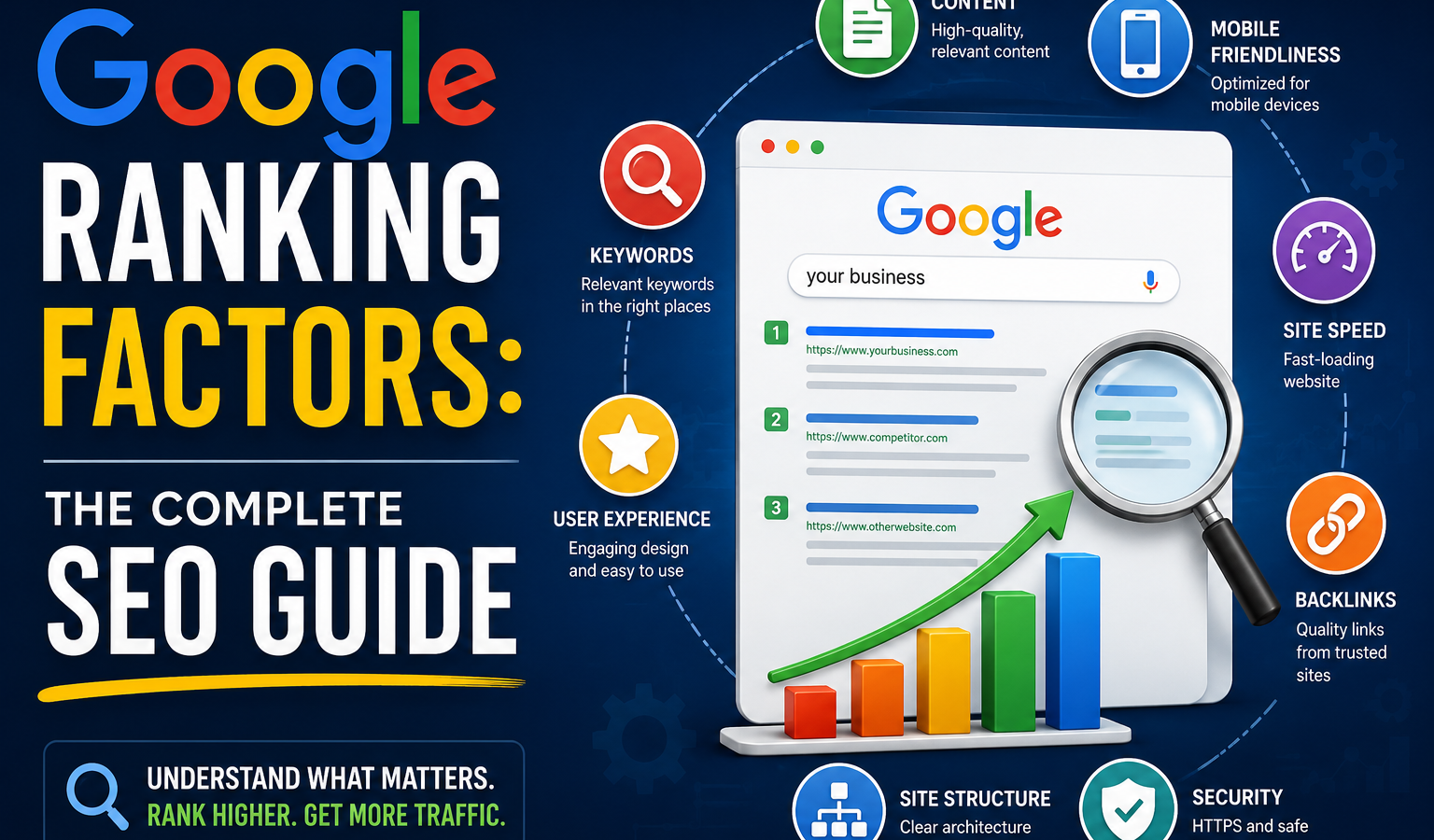
Google does not publish a ranked checklist of every signal, but its official documentation makes the priorities fairly clear. The strongest recurring themes are helpful content, E-E-A-T, page experience, mobile-first indexing, structured data, crawlability, and link signals. citeturn172838search0turn243188search0turn940190search1turn280219search5
Here is the practical order most site owners should care about.
| Factor | Why it matters | Priority |
|---|---|---|
| Helpful content and E-E-A-T | Shows Google your page is useful, original, and trustworthy | Very high |
| Search intent match | Ensures the page format and depth match what searchers want | Very high |
| Core Web Vitals | Improves loading, responsiveness, and visual stability | High |
| Mobile-first indexing | Google primarily indexes the mobile version of your site | High |
| Backlinks and authority | Help Google assess trust and prominence | High |
| Internal linking | Helps discovery and distributes relevance across your site | Medium to high |
| Structured data | Helps Google understand content and eligibility for rich results | Medium |
Content Quality and E-E-A-T
Helpful, reliable, people-first content
Google’s helpful content guidance says ranking systems are designed to prioritize helpful, reliable information created to benefit people, not content made mainly to manipulate rankings. That is why thin pages, copied summaries, and generic AI text often underperform. citeturn243188search2turn172838search3
The strongest content is specific, original, and complete. It answers the question fully, uses clear examples, and gives the reader a reason to trust the page. For YMYL topics, the trust requirement becomes even more important. Google’s guidance on E-E-A-T reinforces that experience, expertise, authoritativeness, and trustworthiness are central quality concepts. citeturn172838search2turn172838search7
What E-E-A-T looks like in practice
- Clear author identity and credentials
- First-hand experience or subject-matter depth
- Fresh data, examples, and screenshots where useful
- Transparent sourcing and fact checking
- Strong About, Contact, and editorial trust signals
Search Intent and Topical Authority
Ranking well is not only about having the keyword in the page. The page has to satisfy the intent behind the keyword. A search for “Google ranking factors” usually expects an explanatory guide, not a sales page or a 200-word definition. Matching format, depth, and perspective is a major part of winning the query. citeturn941921search0turn280219search2
Topical authority also matters. Sites that cover a subject deeply across connected articles tend to build stronger relevance than sites that publish isolated posts. This is one reason cluster-based content strategies often outperform one-off articles. Google’s link and ranking documentation supports the idea that interconnected, crawlable content helps discovery and interpretation. citeturn280219search1turn280219search5
Core Web Vitals and Page Experience
Core Web Vitals are a set of metrics for loading performance, interactivity, and visual stability. Google says they are used by its ranking systems, and site owners should aim for good scores. The key metrics are Largest Contentful Paint, Interaction to Next Paint, and Cumulative Layout Shift. citeturn243188search1turn243188search0
Google also makes an important distinction: good page experience helps, but it does not guarantee a top position. The page still has to be relevant and useful. In practice, performance becomes especially important when many pages are equally strong on content. citeturn243188search0turn243188search8
How to improve page experience
- Compress and properly size images
- Reduce layout shifts from ads and embeds
- Use caching and a lightweight theme
- Minimize unused scripts
- Improve mobile usability and tap targets
Mobile-First Indexing
Google uses the mobile version of a site’s content for indexing and ranking. That means your mobile layout, content, links, metadata, and structured data should be as complete as the desktop version. citeturn940190search1turn168157search0
This is why mobile design is no longer optional. If a page looks fine on desktop but hides important content on mobile, Google may not evaluate it the way you expect. The safest approach is responsive design with identical core content across devices. citeturn168157search0
Backlinks and Link Authority
Google uses links as a signal when determining relevance and discovering pages to crawl. In plain language, links still act like a trust and discovery layer. High-quality backlinks from relevant sites can strengthen a page’s authority, especially when they come from pages that themselves are credible. citeturn280219search5turn941921search0
Not all links are equal. A small number of relevant, editorially earned links usually beats a large number of weak or spammy links. Google’s spam policies and ranking systems are designed to devalue manipulative link building. citeturn243188search5turn172838search0
Internal Linking and Site Structure
Internal links help Google discover pages and understand how topics connect. Good link architecture also helps users move through the site naturally. Google Search Central says link architecture is a crucial part of site design for indexation and navigation. citeturn280219search1turn280219search5
A strong internal linking strategy usually follows a hub-and-spoke model. Your main pillar page covers the broad topic, and supporting pages cover subtopics in more detail. This builds clarity for both readers and search engines. citeturn280219search1turn280219search12
Structured Data and Schema Markup
Structured data helps Google understand page content and may make a page eligible for rich results. Google recommends JSON-LD as the preferred format, and says structured data must follow quality guidelines to qualify. It improves understanding, but it does not guarantee rankings or rich results. citeturn280219search0turn280219search8
For blog content, Article schema, Breadcrumb schema, and Organization schema are often the most useful starting points. For product, review, recipe, and local pages, the right schema type can improve search presentation and click-through performance. citeturn280219search0turn280219search8
Comparison: High-Impact vs Lower-Impact SEO Actions
| High-impact actions | Lower-impact actions |
|---|---|
| Write the best answer on the page | Keyword stuffing headings |
| Match search intent exactly | Chasing every possible keyword variant |
| Improve page speed and mobile UX | Obsessing over tiny technical fixes first |
| Build authority with useful links | Buying low-quality backlinks |
| Create internal content clusters | Publishing disconnected blog posts |
| Add trustworthy author and brand signals | Hiding who wrote the content |
Expert Tips
- Write for one primary search intent per page.
- Use original examples, data, or commentary.
- Make the first 200 words instantly useful.
- Link to supporting pages inside the same topic cluster.
- Review Google Search Console monthly for query and page patterns.
Common Mistakes
- Publishing thin content with no real depth
- Copying structure from top-ranking pages without adding value
- Ignoring mobile performance
- Using internal links only in footers or sidebars
- Forgetting about trust signals such as author bios and contact pages
- Using schema that does not match visible content
FAQs
1. What are the top Google ranking factors?
The biggest factors are helpful content, search intent match, E-E-A-T, page experience, mobile usability, backlinks, internal links, and structured data. citeturn243188search2turn243188search0turn280219search5
2. Does Google use over 200 ranking factors?
SEO experts often say Google uses more than 200 signals, but Google does not publish a full official count. What Google does confirm is that it uses many factors and signals to rank pages. citeturn941921search1turn168157search5
3. Is content quality the most important factor?
Yes, content quality is usually the foundation. Without a helpful page that matches the query, technical SEO and backlinks have less effect. Google’s helpful content guidance makes this clear. citeturn243188search2turn172838search0
4. Do backlinks still matter?
Yes. Google still uses links as a signal of relevance and trust, but quality matters more than quantity. citeturn280219search5turn941921search0
5. Are Core Web Vitals a direct ranking factor?
Google says Core Web Vitals are used by its ranking systems, and site owners should aim for good scores. They are not the only ranking input, but they matter. citeturn243188search1turn243188search0
6. Does mobile optimization affect rankings?
Yes. Google indexes the mobile version of your site first, so mobile content and usability are essential. citeturn940190search1turn168157search0
7. Does schema markup improve rankings?
Schema does not guarantee better rankings, but it helps Google understand your content and may improve eligibility for rich results. citeturn280219search0turn280219search8
8. Can AI content rank on Google?
Yes, if it is useful, accurate, and people-first. Google’s guidance says the production method matters less than the quality and helpfulness of the final content. citeturn243188search6turn172838search3turn674963search5
Conclusion
Google ranking factors are best understood as a system, not a secret list. The pages that win usually do three things well: they satisfy the searcher, they prove trust, and they remove friction. If your content is genuinely useful, technically sound, mobile-friendly, and easy to navigate, you give Google strong reasons to rank it higher. citeturn243188search2turn243188search0turn940190search1turn280219search5
Focus first on helpful content, then on technical polish, then on authority building. That sequence usually produces the fastest and most durable SEO gains.
Call to Action
Review one page on your site today, improve its intent match, add one internal link, and make one trust signal stronger. Small improvements compound fast in SEO.