
O conteúdo digital é mais fácil de criar, distribuir, copiar e modificar do que nunca. Fotos, vídeos, músicas, documentos e outros ativos digitais podem circular por websites e plataformas de mídia social em segundos. Embora isso crie oportunidades para criadores e empresas, também introduz desafios envolvendo violação de direitos autorais, propriedade de conteúdo, distribuição não autorizada e autenticidade digital.
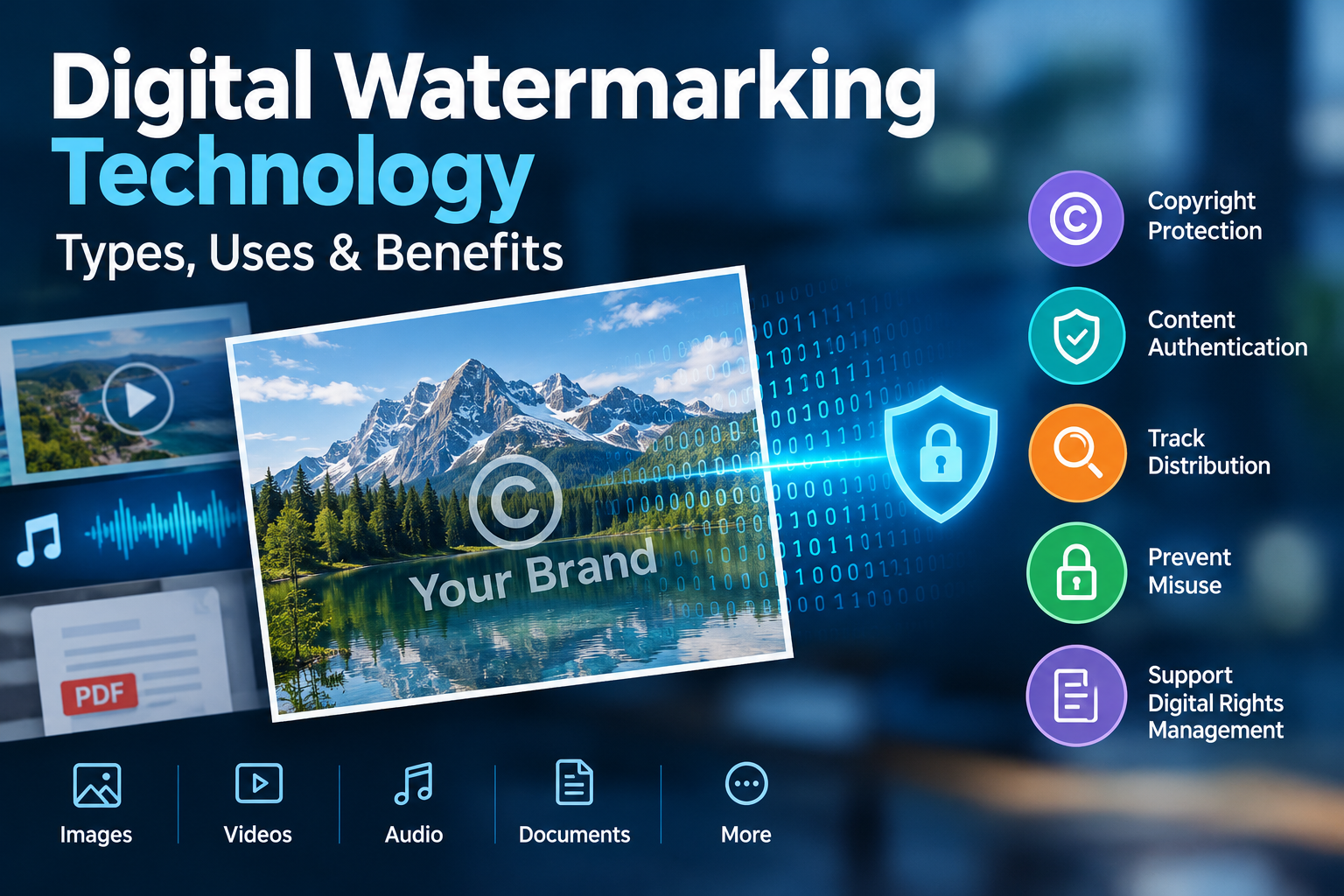
Tecnologia de marca d'água digital ajuda a enfrentar esses desafios incorporando informações identificáveis no conteúdo digital. Dependendo do método utilizado, uma marca d'água pode ser visível para os espectadores ou estar oculta dentro de uma imagem, vídeo, arquivo de áudio ou documento. Ela pode ajudar a identificar o proprietário do conteúdo, rastrear cópias não autorizadas, verificar autenticidade ou apoiar processos de gerenciamento de conteúdo.
A marca d'água digital está se tornando cada vez mais relevante para fotógrafos, editores, cineastas, músicos, empresas de software, instituições educacionais e organizações que gerenciam ativos digitais valiosos.
No entanto, a marcação não é uma solução completa para pirataria digital ou desinformação. Sua eficácia depende de como a marca d'água é implementada, do tipo de conteúdo a ser protegido e se a marca d'água pode sobreviver a cópias, compressão, edição ou remoção intencional.
Este guia explica como a marca d'água digital funciona, os principais tipos, aplicações práticas, benefícios, limitações e desenvolvimentos futuros.
Tabela de Conteúdos
- O que é a tecnologia de marca d'água digital?
- Como funciona a marca d'água digital?
- Tipos de marca d'água digital
- Marca d'água digital vs. Criptografia vs. Assinaturas digitais
- Aplicações comuns de marca d'água digital
- Principais benefícios da marca d'água digital
- Desafios e Limitações
- Marca d'água digital e inteligência artificial
- Como as empresas podem implementar marca d'água digital
- Tendências de marca d'água digital a observar
- Erros comuns de marca d'água digital
- Perguntas Frequentes
- Conclusão
1. O Que É Tecnologia de Marcação D'água Digital?
A marca d'água digital é uma técnica usada para incorporar informações em um arquivo digital de modo que a informação possa ajudar a identificar, autenticar, rastrear ou proteger o conteúdo.
A marca d'água pode conter informações como:
- O nome ou identificador de um proprietário de direitos autorais.
- Um identificador de marca ou empresa.
- Uma referência de transação ou licença.
- Um código único associado a um destinatário particular.
- Metadados usados para identificar um arquivo ou verificar sua origem.
- Informação que ajuda a estabelecer se o conteúdo foi alterado.
Marcas d'água podem ser adicionadas a imagens digitais, vídeos, gravações de áudio, documentos eletrônicos e outros tipos de mídia digital.
Por exemplo, um fotógrafo pode colocar um logotipo visível sobre uma imagem exibida em um portfólio online. Isso torna a fonte da imagem mais reconhecível, embora o logotipo possa ser cortado ou removido.
Uma empresa de mídia de estoque pode, em vez disso, embutir uma marca d'água oculta em imagens de pré-visualização. Se uma imagem de pré-visualização for distribuída sem autorização, a empresa pode ser capaz de detectar o identificador embutido e investigar sua origem.
Esses exemplos ilustram duas abordagens diferentes: branding visível e informações menos notáveis incorporadas ao conteúdo digital em si.
Por Que a Marcação D'água Digital É Importante?
Arquivos digitais podem ser duplicados sem degradar sua qualidade da mesma forma que cópias repetidas podem afetar alguns materiais físicos. Uma vez que um arquivo é compartilhado online, seu proprietário pode ter controle limitado sobre a sua distribuição.
A marcação digital fornece uma maneira de manter uma conexão entre um arquivo e informações sobre sua propriedade, origem ou distribuição.
Ela pode suportar fluxos de trabalho de gerenciamento de direitos autorais, autenticação de conteúdo, licenciamento de mídia e a investigação de compartilhamentos não autorizados.
É importante notar que uma marca d'água não estabelece automaticamente a propriedade legal. Disputas sobre propriedade também podem exigir contratos, arquivos originais, carimbos de data e hora, registros de licenciamento ou outras evidências.
2. Como A Marcação D'água Digital Funciona?
O processo técnico varia de acordo com o tipo de arquivo e o método de marcação d'água, mas a maioria dos sistemas segue um fluxo de trabalho semelhante.
Passo 1: Prepare o Conteúdo Digital
O processo começa com um arquivo original, como uma fotografia, vídeo, gravação de áudio ou documento PDF.
O sistema identifica o formato do conteúdo e determina qual técnica de marcação d'água é apropriada.
Por exemplo, um método projetado para fotografias pode não funcionar efetivamente para uma gravação de áudio, pois os arquivos têm estruturas e características perceptuais diferentes.
Passo 2: Crie a Marca D'água
A marca d'água pode consistir em um logotipo, texto, identificador único, sequência de bits ou outras informações.
Uma marca d'água visível pode conter o nome de uma empresa. Uma marca d'água oculta pode conter um código único vinculado a um registro de banco de dados.
A quantidade de informação embutida depende do método e do propósito pretendido.
Passo 3: Incorpore a Marca D'água
O sistema de marcação d'água modifica o conteúdo ou sua representação digital subjacente para incorporar as informações selecionadas.
Na marcação d'água de imagens, isso pode envolver a modificação de valores de pixels selecionados ou a transformação da imagem em uma representação baseada em frequência antes de fazer alterações cuidadosamente controladas.
Algumas técnicas usam a transformada discreta do cosseno ou a transformada discreta de wavelet. Outras operam diretamente nos pixels ou utilizam representações aprendidas.
Para áudio e vídeo, os métodos de incorporação são adaptados às características dos sinais sonoros e quadros de vídeo.
The goal is often to balance two competing requirements:
- Imperceptibility: The watermark should not noticeably reduce the content’s quality.
- Robustez: The watermark should remain detectable after expected forms of processing or modification.
A watermark optimized for one purpose may perform poorly at another. For example, a highly subtle watermark may be difficult to detect after aggressive compression.
Passo 4: Distribua o Conteúdo Com Marca D'água
The watermarked file can then be published, licensed, shared, or delivered to customers.
Some organizations embed the same watermark in every copy. Others create a unique watermark for each recipient, transaction, or distribution channel.
Unique recipient identifiers can help investigate leaks, but their use must be managed carefully to avoid exposing personal information or creating unfair accusations when files are redistributed.
Passo 5: Detecte ou Extraia a Marca D'água
When a file needs to be checked, compatible detection software analyzes it for the embedded information.
Depending on the technique, the system may need the original file, a reference watermark, a secret key, or other supporting information.
A detected identifier can then be compared with stored records to help identify the content’s source or associated license.
Passo 6: Investigue e Responda
The final step depends on the purpose of the watermark.
A media company might investigate unauthorized distribution. A publisher might verify whether a document came from an approved source. A business might use the result as one component of a broader authenticity check.
Watermark detection should not automatically be treated as conclusive proof of wrongdoing. Detection systems can produce false positives, and some transformations can damage or remove a watermark.
3. Tipos de Marcação D'água Digital
Digital watermarking can be classified in several ways, including visibility, robustness, detectability, and the type of content being protected.
3.1 Marcação D'água Visível
Visible watermarking places an identifiable mark directly on the displayed content.
Os exemplos incluem:
- A photographer’s logo on an image.
- A broadcaster’s logo in the corner of a video.
- A draft label across a confidential document.
- A company name over a preview image.
Vantagens:
- Easy for people to recognize.
- Can provide immediate branding.
- May discourage casual unauthorized reuse.
Limitations:
- Can interfere with the viewing experience.
- May be cropped, obscured, or removed.
- May not establish ownership on its own.
Visible watermarking is particularly useful when the primary objective is branding or communicating the status of a file.
3.2 Marcação D'água Invisível
Invisible watermarking embeds information that is not normally apparent to the viewer or listener.
The information may be detected using specialized software.
Invisible watermarking is used in some copyright-management systems, content-tracking workflows, and media-authentication applications.
Its effectiveness depends on the embedding technique, the quality of the original content, and the changes made to the file after embedding.
A watermark that is invisible in one format may become detectable after conversion, while another may become too damaged to recover.
3.3 Marcação D'água Robusta
Robust watermarking is designed to remain detectable after common forms of processing.
Depending on the implementation, this may include:
- Image resizing.
- Compression.
- Changes in brightness or contrast.
- Audio compression.
- Video transcoding.
- Certain forms of noise or signal modification.
Robustness is important when content is expected to move across platforms that modify files during uploading or distribution.
However, no robust watermark is guaranteed to survive every transformation or deliberate removal attempt.
3.4 Marcação D'água Frágil
Fragile watermarking is designed to be sensitive to changes in the protected content.
If the file is modified, the watermark may be damaged or fail verification.
This characteristic can be useful for detecting tampering with images, documents, or other digital records.
For example, a system could use a fragile watermark to help determine whether an image has been modified since it was prepared.
The method must be designed carefully because ordinary operations, such as file conversion or compression, can also cause changes that affect verification.
3.5 Marcação D'água Semi-Frágil
Semi-fragile watermarking aims to tolerate certain acceptable transformations while detecting other modifications.
A system might be designed to tolerate limited compression but flag changes that are more likely to indicate substantive editing.
The distinction depends on the watermarking algorithm and its verification rules. It should not be assumed that every semi-fragile watermark can reliably distinguish harmless changes from malicious ones.
3.6 Marcação D'água Cega e Não Cega
Watermarking systems can also be classified by the information needed to detect a watermark.
Blind watermarking attempts to detect or extract the watermark without requiring the original unwatermarked content.
Non-blind watermarking requires the original content or another reference file during verification.
Blind techniques can simplify large-scale monitoring because the original file does not always need to be stored for comparison. Non-blind techniques can be useful when the verification process benefits from a trusted reference.
3.7 Marcação D'água Digital por Tipo de Mídia
Watermarking techniques also differ according to the content being protected.
| Media type | Typical use | Exemplo |
|---|---|---|
| Imagens | Copyright identification and authenticity checks | Watermarking a photograph |
| Vídeos | Copyright management and distribution tracking | Embedding an identifier in a licensed video |
| Audio | Music ownership and media tracking | Embedding information in a recording |
| Documents | Identification and document-integrity workflows | Watermarking an approved PDF |
| Digital artwork | Ownership identification and licensing | Embedding a creator identifier |
| Scientific or medical images | Provenance and record-management workflows | Linking an image to associated records |
The most appropriate method depends on the content format, intended use, quality requirements, and threat model.
4. Marcação D'água Digital vs. Criptografia vs. Assinaturas Digitais
Digital watermarking, encryption, and digital signatures can all contribute to digital-content protection, but they solve different problems.
| Recurso | Digital watermarking | Encryption | Digital signatures |
|---|---|---|---|
| Main purpose | Embed identifying or verification information in content | Protect information from unauthorized access | Verify integrity and support authentication of a signed message or file |
| Changes the content or representation | Geralmente | Encrypts the protected data | Typically signs a hash or representation without embedding a visible mark |
| Hides content from unauthorized viewers | No, not by itself | Yes, when properly implemented | No, not by itself |
| Can help trace copies | Yes, with suitable techniques | Not inherently | Not inherently |
| Can detect changes | Some methods can | Not its primary purpose | Yes, if the verification process detects a mismatch |
| Typical use | Copyright management and media tracking | Confidential communications and protected storage | Software distribution, document signing, and file verification |
These technologies can be used together.
For example, a media distributor could encrypt a video during delivery, embed a watermark associated with the recipient, and use digital signatures to authenticate relevant software or metadata.
Combining controls can provide stronger protection than relying on any single technique.
5. Aplicações Comuns de Marcação D'água Digital
Digital watermarking supports a range of business, creative, technical, and institutional activities.
5.1 Proteção de Direitos Autorais para Fotógrafos e Artistas
Photographers and digital artists frequently share their work through websites, online portfolios, marketplaces, and social media platforms.
Visible watermarks can make the creator’s identity recognizable. Invisible watermarks may provide an additional way to identify the source of a copied image.
For example, a photography business could embed a unique identifier into licensed preview images and retain the corresponding records in its asset-management system.
If an image appears on an unrelated website, the business may investigate whether it was used within the license terms.
Watermarking can support copyright-management efforts, but it does not prevent every unauthorized use or replace appropriate licensing agreements.
5.2 Streaming de Vídeo e Distribuição de Mídia
Film studios, broadcasters, and streaming services distribute valuable video content across multiple platforms and devices.
Watermarking can help identify the source of unauthorized copies, particularly when each customer or distribution channel receives a differently watermarked version.
Forensic watermarking is one approach used to associate leaked content with a particular distribution path.
A watermark can provide an investigative lead, but organizations must consider whether identifiers can be transferred, removed, spoofed, or incorrectly associated with a recipient.
5.3 Música e Conteúdo de Áudio
Audio watermarking can embed information into sound recordings while attempting to preserve the listener’s experience.
Possible applications include identifying licensed recordings, tracking distribution, and supporting rights-management processes.
The technical challenge is to make the watermark sufficiently subtle while allowing it to survive expected changes such as compression, resampling, or format conversion.
Audio watermarking may be combined with content fingerprinting. These are different technologies: watermarking embeds information, while fingerprinting identifies content through characteristics extracted from the signal.
5.4 Publicação Digital e Jornalismo Online
Publishers create original photographs, illustrations, infographics, videos, and other digital assets.
Watermarking can help publishers identify their content and support investigations into unauthorized reuse.
For a digital publication, a content-management workflow might apply a visible brand mark to selected promotional images while retaining hidden identifiers in higher-value licensed assets.
Publishers should avoid making visible marks so large that they undermine the reader’s experience.
5.5 Proteção de Documentos e Fluxos de Trabalho Corporativos
Organizations exchange proposals, reports, presentations, research documents, and confidential business materials.
Visible watermarks such as “Draft,” “Confidential,” or “Internal Use Only” can communicate how a document should be handled.
Some systems also embed document identifiers to support tracking or audit workflows.
However, a watermark saying “Confidential” does not enforce access restrictions. Sensitive documents may also require permissions, encryption, secure sharing, access logging, and retention controls.
5.6 E-Learning e Educação Online
Online learning providers distribute recorded lectures, training videos, course materials, and downloadable resources.
Watermarking can support content ownership and discourage unauthorized redistribution.
For example, an educational platform could display a learner-specific identifier in a course video or embed a distribution identifier into licensed material.
Any learner-specific watermark should be designed with privacy in mind. Displaying unnecessary personal information can expose students if content is shared publicly.
5.7 Forense Digital e Investigações
Digital forensic teams may use watermark detection as one source of information when examining files.
A watermark could help connect a media file to a known distribution process or indicate that it was produced by a particular system.
The result should be interpreted alongside other evidence, including file metadata, access records, original files, and the chain of custody.
A watermark alone should not be treated as proof that a specific person created, altered, or distributed a file.
5.8 Imagens Médicas e Científicas
Medical institutions and research organizations manage digital images that may be shared among professionals, researchers, and authorized systems.
Watermarking may support provenance or help associate images with relevant identifiers.
However, medical use requires particular care. Any watermarking process must avoid compromising diagnostic information, changing clinically important image characteristics, or interfering with interoperability.
Sensitive patient data should not be embedded into images without appropriate privacy, security, and governance controls.
5.9 E-Commerce e Fotografia de Produtos
Online retailers and product manufacturers invest in product photography, promotional graphics, and branded media.
Watermarking can help identify the source of these assets and discourage unauthorized commercial reuse.
Retailers may use visible marks on preview images while distributing clean, unwatermarked versions to authorized partners under controlled licensing arrangements.
5.10 Publicação Governamental e do Setor Público
Government agencies and public institutions publish reports, maps, photographs, and other official materials.
Watermarking can help identify document versions or connect assets to internal records.
It is particularly important to distinguish watermarking from formal digital signatures. A watermark may support identification, while a properly implemented digital signature can help verify whether signed data has changed and whether the signature corresponds to a trusted signing key.
6. Principais Benefícios da Marca d'Água Digital
Melhor Identificação de Conteúdo
A watermark can preserve information that helps identify a file’s owner, source, license, or distribution channel.
This can be valuable when files are copied or separated from their original descriptions.
Suporte à Gestão de Direitos Autorais
Watermarks can make unauthorized use easier to investigate by helping rights holders connect copies to original assets or licensing records.
Their value depends on the quality of the implementation and the organization’s ability to respond to detected misuse.
Rastreamento de Distribuição Aprimorado
Organizations that issue different watermarks to different recipients can sometimes identify which distribution path is associated with a leaked copy.
This is particularly relevant to high-value video, licensed media, and confidential previews.
Sinais Adicionais de Autenticação
Some watermarking systems can provide evidence that a file is associated with a particular source or has undergone a defined processing workflow.
This information may support verification, but it should be combined with stronger controls when authenticity has significant legal, financial, or operational consequences.
Integração Flexível
Watermarking can be incorporated into media-processing systems, content-management platforms, publishing workflows, and digital asset-management tools.
The integration may be automated so that identifiers are applied when files are uploaded, exported, licensed, or delivered.
Reconhecimento de Marca
Visible watermarks can communicate a creator’s or organization’s identity when content is shared beyond its original platform.
This can support brand awareness, although excessive or poorly positioned watermarks can reduce the quality of the content.
7. Desafios e Limitações da Marca d'Água Digital
Despite its benefits, digital watermarking has important limitations.
Remoção e Manipulação de Marca d'Água
Attackers may attempt to remove, obscure, crop, or distort a watermark.
Some methods may survive ordinary processing but fail under more aggressive modifications. Others may be vulnerable to specialized removal techniques.
Watermarking should therefore be treated as one layer in a broader content-protection strategy.
Degradação da Qualidade
Embedding information requires some form of modification or alteration to the file representation.
If the watermark is too strong, it may reduce image quality, introduce audio artifacts, or interfere with video presentation.
Designers must balance visibility, robustness, and capacity according to the intended use.
Falsos Positivos e Erros de Detecção
A detection system may incorrectly identify a watermark or fail to detect one that is present.
This can happen because of noise, unsupported transformations, poor implementation, or limitations in the detection algorithm.
High-stakes decisions should not rely on a watermark detector alone.
Conversão de Formato e Compressão
Social platforms, messaging applications, video editors, and document tools may modify files during upload, download, or export.
These changes can damage a watermark, particularly when the system was not designed to tolerate that processing.
Testing should reflect the actual distribution environments in which the content will be used.
Preocupações com a Privacidade
Recipient-specific watermarks can contain or reference identifiers associated with individual users.
If these identifiers are exposed, they may create privacy risks or reveal information about a customer’s activity.
Organizations should minimize personal data, restrict access to mapping records, establish retention rules, and document how watermark data is used.
Limitações Legais e Evidenciais
A watermark may help identify content, but its presence does not automatically prove legal ownership, the identity of the person who distributed a file, or whether a particular use was unlawful.
Organizations should maintain supporting evidence such as contracts, original assets, license records, timestamps, and audit logs.
Custos de Implementação
A basic visible watermark may be inexpensive to implement. More advanced forensic watermarking systems can require specialized software, integration, testing, monitoring, and ongoing maintenance.
Businesses should evaluate the value of the protected content and the likelihood of misuse before investing in complex systems.
8. Marca d'Água Digital e Inteligência Artificial
Artificial intelligence is changing how digital content is generated, edited, distributed, and analyzed.
Generative AI systems can create realistic images, videos, voices, music, and written content. This increases the need for reliable methods to communicate content provenance and identify unauthorized redistribution.
Digital watermarking is one approach being developed and deployed in this environment.
Marcação de Conteúdo Gerado por IA
Some AI systems can embed information into generated images, audio, or other media.
A detector may then analyze the content to determine whether it contains a watermark associated with a particular system.
This can help content platforms, publishers, or researchers investigate where media may have originated.
However, not all AI-generated content contains a watermark. Some watermarks can be damaged or removed, and detection results may be inconclusive.
A missing watermark does not prove that content was created by a human.
Detecção de Mídia Sintética
Watermarking may complement other methods used to investigate AI-generated or manipulated media.
These can include:
- Digital signatures.
- Content provenance records.
- Metadata analysis.
- Reverse-image search.
- Media forensics.
- Platform-level disclosure labels.
- Human review and source verification.
Each method has different strengths and limitations. Combining independent signals can provide a more useful assessment than relying on a single detector.
Marca d'água versus Credenciais de Conteúdo
Digital watermarking and content credentials are related but distinct concepts.
Watermarking embeds information within content. Content-credential systems can attach cryptographically verifiable provenance information describing a file’s origin or editing history.
A provenance record can help establish whether recorded information has been altered, provided the relevant signatures and trust mechanisms verify correctly. It does not necessarily establish that the content’s claims are truthful or that the original creator was trustworthy.
The two approaches can complement one another: a watermark may remain associated with the media itself, while signed credentials can carry more detailed information about its provenance.
9. Como as empresas podem implementar marcas d'água digitais
Organizations considering digital watermarking should begin by defining the problem they want to solve.
Passo 1: Identifique os ativos a proteger
Determine which files are most valuable or most likely to be reused without permission.
These might include:
- Product photographs.
- Training videos.
- Licensed stock images.
- Music recordings.
- Confidential reports.
- Digital artwork.
- Research materials.
Not every file requires the same level of protection.
Passo 2: Defina o modelo de ameaça
Identify the risks the watermark must address.
For example, a photographer may primarily want to display ownership information. A video distributor may need to trace unauthorized copies. A document-management team may want to identify confidential files or detect tampering.
The intended outcome determines which watermarking method is appropriate.
Passo 3: Escolha o tipo certo de marca d'água
Select a visible, invisible, robust, fragile, or semi-fragile approach based on the requirements.
Consider whether the system must survive compression, whether the original file will be available during verification, and whether a watermark needs to be unique to each recipient.
Passo 4: Proteja os dados associados
If watermarks use identifiers linked to a database, protect that database with appropriate access controls, encryption, monitoring, and backups.
If a secret key is required for embedding or detection, manage it securely and define a process for rotation and recovery.
Do not store sensitive information directly in the watermark unless there is a clear need and an appropriate privacy and security assessment.
Passo 5: Integre a marca d'água nos fluxos de trabalho existentes
Watermarking may be added to an existing content-management or media-delivery process.
For example, a publisher could automatically watermark preview images when editors upload them. A training platform could apply a learner-specific watermark when a video is delivered.
Automation reduces manual effort, but the organization should ensure that watermarking does not unintentionally affect original master files or approved distribution formats.
Passo 6: Teste condições do mundo real
Test the system against realistic processing scenarios.
These may include:
- Resizing and cropping.
- Compression and transcoding.
- Screenshots and screen recordings.
- File-format conversion.
- Changes in brightness or contrast.
- Audio resampling.
- Partial editing.
- Repeated distribution through common platforms.
Testing should measure both successful detection and the frequency of false detections.
Passo 7: Estabeleça um processo de resposta
Decide what happens when a watermark is detected in an unexpected location.
A practical process might involve reviewing the file, comparing it with original records, checking license terms, preserving evidence, and contacting the relevant parties where appropriate.
Avoid automatic accusations or penalties based solely on a detector’s result.
Passo 8: Revise desempenho e privacidade
Monitor watermark detection rates, file quality, processing time, system costs, and operational outcomes.
Review privacy risks when unique recipient identifiers are used. Limit access to identifying records and retain them only as long as necessary.
10. Tendências em marcas d'água digitais a observar
Several developments are likely to influence how digital watermarking is used.
Marca d'água mais forte para mídia gerada por IA
AI developers and media organizations are exploring ways to identify generated content through embedded signals and related provenance mechanisms.
The challenge is to create systems that are useful across different platforms and robust enough for realistic content transformations.
Maior integração da proveniência do conteúdo
Watermarking may increasingly operate alongside signed metadata, content credentials, digital signatures, and media-management systems.
This combination can help organizations connect a file with its origin, licensing information, and editing history.
Melhor marca d'água forense
Media distributors may continue developing techniques that identify the source of unauthorized copies while minimizing visible or audible changes.
Such systems must be evaluated against privacy, accuracy, and resistance-to-removal requirements.
Detecção e monitoramento automatizados
AI-assisted tools may help organizations scan large collections of images, videos, and audio files for specific watermarks.
Automation can reduce the workload involved in checking large media libraries, although detection quality and false-positive rates remain important considerations.
Melhor suporte para distribuição entre plataformas
Digital content frequently moves between platforms that compress, crop, re-encode, or otherwise modify it.
Watermarking systems will need to account for these transformations if they are to remain useful in complex distribution environments.
Maior atenção à transparência e à privacidade
As watermarking becomes more closely connected with content tracking and AI-generated media, organizations will need clear policies explaining what information is embedded, how it is used, and how long related records are retained.
Technical capability alone is not enough; trustworthy implementation also requires responsible governance.
11. Erros comuns em marcas d'água digitais
Businesses and creators can reduce avoidable problems by understanding several common mistakes.
Relying only on a visible watermark: A logo can be cropped or removed. Combine watermarking with licensing records, access controls, and monitoring where appropriate.
Assuming every watermark is permanent: Different methods tolerate different transformations. Test the watermark against realistic distribution conditions.
Using watermarks that damage content quality: A watermark that is too prominent or intrusive can reduce the value of the content being protected.
Treating detection as conclusive proof: A detected watermark is a technical signal that requires interpretation. Verify it alongside supporting evidence.
Ignoring privacy requirements: Unique identifiers can create risks if they expose personal data or allow unauthorized tracking.
Failing to protect watermarking keys: Where secret keys are used, poor key management can undermine the entire system.
Confusing watermarking with encryption: A watermark does not prevent someone from opening or viewing a file. Confidential content may need encryption and access controls.
Failing to keep original files and records: Original assets, license agreements, and reliable audit logs can be essential when investigating unauthorized use.
12. Perguntas frequentes
1. O que é tecnologia de marca d'água digital?
Digital watermarking is a technique that embeds identifying or verification information into digital content such as images, videos, audio, and documents. It can support copyright management, content tracking, authentication workflows, and tamper detection.
2. Qual é o principal objetivo da marca d'água digital?
Its main purpose is to associate digital content with information about its source, ownership, license, distribution, or integrity. The exact purpose depends on the watermarking method and how the system is used.
3. Qual é a diferença entre marcas d'água visíveis e invisíveis?
Visible watermarking displays a mark, such as a logo or text, directly on the content. Invisible watermarking embeds information that normally cannot be seen or heard and requires compatible software or a verification process to detect.
4. As marcas d'água digitais podem ser removidas?
Yes. Some watermarks can be removed or damaged through cropping, editing, compression, or specialized techniques. Robust watermarking is designed to survive certain transformations, but no method is guaranteed to withstand every attack.
5. A marca d'água digital previne a violação de direitos autorais?
No. Watermarking can discourage casual reuse, support ownership identification, and help investigate unauthorized distribution. It does not prevent every infringement or replace copyright law, licensing agreements, or enforcement procedures.
6. Qual é a diferença entre marca d'água digital e impressão digital?
Digital watermarking embeds information into a file. Digital fingerprinting analyzes characteristics of a file to generate a representation that can help identify matching or similar content. Both can support content identification, but they work differently.
7. A marca d'água digital é útil para imagens geradas por IA?
Yes. Watermarking can help identify images associated with particular AI systems or generation workflows. However, not all AI-generated images contain watermarks, and some watermarks can be removed or damaged. Additional provenance and verification methods may be necessary.
8. Uma marca d'água digital pode provar quem criou um arquivo?
Not by itself. A watermark can provide information associated with a file, but it may be copied, manipulated, or incorrectly attributed. Reliable conclusions require supporting evidence, such as original files, licensing records, trusted signatures, or audit logs.
Conclusão
Digital watermarking technology provides a practical way to associate digital content with information about its ownership, source, licensing, or distribution. It can support photographers, publishers, filmmakers, musicians, educational platforms, and businesses that manage valuable digital assets.
Its usefulness depends on selecting the right technique for the intended purpose. Visible watermarks can support branding, invisible watermarks can provide less noticeable identifiers, and robust or fragile methods can serve different content-tracking and integrity-checking requirements.
However, watermarking should not be mistaken for complete protection against piracy, unauthorized access, or misinformation. It works best as part of a broader strategy that may include encryption, access controls, digital signatures, content credentials, licensing agreements, and reliable recordkeeping.
As AI-generated media and digital distribution continue to expand, watermarking will remain one of several technologies that organizations can use to improve content identification and provenance.
The key takeaway: Digital watermarking is most effective when it is matched to a clearly defined use case, tested against realistic threats, and supported by appropriate security, privacy, and verification procedures.
Chamada para Ação
Do you create, publish, or distribute digital content? Consider reviewing how your organization identifies and protects its images, videos, audio files, and documents. Choosing the right combination of watermarking and complementary security measures can help you manage digital assets more responsibly.