
Технологии трансформируют то, как люди живут, работают, общаются, учатся и ведут бизнес. От искусственного интеллекта и облачных вычислений до робототехники, кибербезопасности и квантовых вычислений, новые инновации создают новые возможности, меняя традиционные отрасли.
Понимание технологических трендов имеет важное значение для бизнеса, предпринимателей, разработчиков, инвесторов, студентов и профессионалов, которые хотят оставаться конкурентоспособными в быстро меняющейся цифровой экономике.
Однако не каждая новая технология приобретает широкое признание. Некоторые инновации созревают быстро и приносят немедленную коммерческую выгоду, в то время как другим требуются годы исследований, разработки инфраструктуры и прогресса в регулировании, прежде чем они доберутся до массовых пользователей.
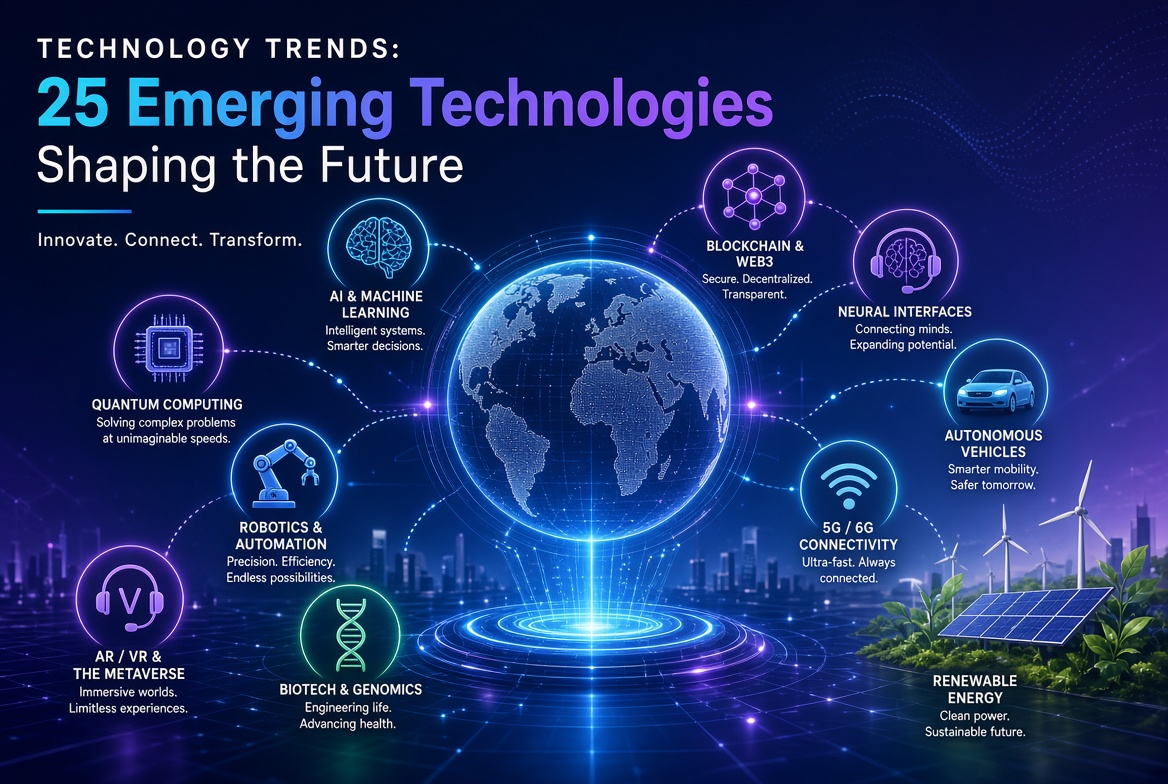
Этот гид исследует 25 важных технологических трендов, формирующих будущееобъясняет, как они работают, подчеркивает их практическое применение и исследует возможности и вызовы, которые они представляют.
Содержание
- Что такое технологии?
- Почему важны технологические тренды
- 25 технологий, на которые стоит обратить внимание
- Как технологические тренды влияют на бизнес
- Технологические тренды в Нигерии и Африке
- Преимущества следования за новыми технологиями
- Испытания адаптации технологий
- Как подготовиться к будущим технологическим изменениям
- Часто задаваемые вопросы
- Заключение
Что такое технологии?
Технологические тренды — это схемы развития, принятия и инвестиций, касающиеся цифровых инструментов, научных инноваций, программного обеспечения, аппаратного обеспечения и технологических систем.
Технологический тренд может возникнуть, когда новое изобретение становится коммерчески практичным, когда существующая технология значительно улучшается, или когда организации начинают принимать решение для решения широко распространенной проблемы.
Например, искусственный интеллект стал важным технологическим трендом, потому что улучшения в машинном обучении, вычислительной инфраструктуре и обработке данных сделали приложения ИИ более доступными.
Аналогично, облачные вычисления изменили способ, которым бизнес покупает и управляет вычислительными ресурсами, позволяя им получать доступ к инфраструктуре и программному обеспечению через интернет, а не полагаясь исключительно на физические системы.
Технологические тренды можно сгруппировать по нескольким категориям:
- Искусственный интеллект: Технологии, которые выполняют задачи, связанные с предсказанием, языком, рассуждением или распознаванием образов.
- Вычислительная инфраструктура: Системы, которые предоставляют вычислительную мощность, хранилище, сети и развертывание приложений.
- Кибербезопасность: Технологии, направленные на защиту систем, личностей, сетей и информации.
- Автоматизация и робототехника: Машины и программное обеспечение, выполняющие задачи с уменьшенным вручным вмешательством.
- Связь: Технологии, соединяющие устройства, приложения, транспортные средства и инфраструктуру.
- Цифровые взаимодействия: Инструменты, изменяющие способ взаимодействия людей с информацией и цифровыми средами.
- Устойчивые технологии: Инновации, которые улучшают энергетическую эффективность и уменьшают негативное воздействие на окружающую среду.
Понимание этих категорий помогает организациям выявлять инновации, соответствующие их целям, а не следовать за каждым новым технологическим развитием.
Почему важны технологические тренды
Технологические тренды влияют на бизнес-стратегию, занятость, образование, здравоохранение, финансовые услуги, производство, транспорт и коммуникацию.
Организации, которые понимают актуальные изменения, могут раньше выявлять возможности, улучшать операционную эффективность и готовиться к конкурентным изменениям.
1. Они создают бизнес-возможности
Новые технологии могут создавать совершенно новые рынки и улучшать существующие продукты.
Например, инструменты поддержки клиентов на базе ИИ позволяют компаниям автоматически отвечать на часто задаваемые вопросы, в то время как программное обеспечение на базе облака позволяет предпринимателям предлагать цифровые услуги без необходимости содержать дорогую физическую инфраструктуру.
2. Они повышают продуктивность
Автоматизация, передовая аналитика и инструменты ИИ могут сократить рутинную работу и помочь сотрудникам сосредоточиться на задачах, требующих суждения, творчества и человеческого взаимодействия.
3. Они влияют на ожидания потребителей
Клиенты все больше ожидают удобных цифровых платежей, отзывчивых веб-сайтов, персонализированных рекомендаций, безопасной аутентификации и доступных онлайн-услуг.
Бизнесы, которые не могут удовлетворить разумные цифровые ожидания, могут столкнуться с трудностями в удержании клиентов.
4. Они помогают организациям управлять рисками
Понимание изменений в кибербезопасности, цифровой идентичности и защите цепочки поставок программного обеспечения позволяет компаниям готовиться к изменяющимся угрозам.
5. Они влияют на развитие карьеры
Специалисты, которые развивают соответствующие технические и аналитические навыки, могут улучшить свои возможности трудоустройства по мере того, как отрасли принимают новые системы.
Тем не менее, ценность технологии зависит от ее практического применения. Изучение модного инструмента без понимания решаемых им проблем может обеспечить ограниченные долгосрочные преимущества.
25 технологий, на которые стоит обратить внимание
1. Искусственный интеллект и машинное обучение
Искусственный интеллект является одной из самых влиятельных технологических тенденций, поскольку он позволяет программному обеспечению выполнять задачи, такие как анализ информации, распознавание шаблонов, генерация контента и поддержка принятия решений.
Машинное обучение — это отрасль ИИ, которая позволяет системам учить шаблоны из данных и использовать их для предсказания или классификации.
Компании используют эти технологии для обнаружения мошенничества, поддержки клиентов, прогнозирования спроса, обработки документов, систем рекомендаций и контроля качества.
Генеративный ИИ расширил спектр приложений, позволяя системам создавать текст, изображения, аудио, видео и программный код.
Тем не менее, системы ИИ могут генерировать неправдивую информацию, воспроизводить предвзятости или раскрывать конфиденциальные данные, если они плохо спроектированы. Организациям следует внедрять соответствующее тестирование, человеческий контроль, меры конфиденциальности и безопасности.
Почему это важно: ИИ может повысить продуктивность и обеспечить новые услуги, когда применяется к четко определенным проблемам.
2. Агентный ИИ
Агентный ИИ относится к системам, разработанным для достижения целей путем планирования задач, использования доступных инструментов, оценки результатов и выполнения нескольких шагов с различной степенью автономии.
Например, агент ИИ может исследовать поставщиков, сравнивать спецификации продуктов, организовывать находки и подготавливать рекомендации по закупкам.
В разработке программного обеспечения агенты могут помогать в исследовании ошибок, предлагать изменения в коде и проводить тесты.
Тем не менее, автономные системы требуют четко определенных разрешений и границ. Агент, который может получать доступ к записям клиентов, отправлять электронные письма, изменять файлы или выполнять финансовые транзакции, может причинить значительный ущерб, если его инструкции или меры безопасности недостаточны.
Почему это важно: Agentic AI could automate more complex workflows than conventional question-and-answer assistants, but reliability and control remain essential.
3. Генерация с использованием данных для поиска (RAG)
Retrieval-Augmented Generation combines information retrieval with generative AI.
Instead of relying exclusively on information learned during training, a RAG application searches a selected collection of documents and supplies relevant passages to an AI model when answering a question.
For example, a company could build an internal assistant that retrieves information from product manuals, employee policies, technical documentation, and customer support records.
This approach can make answers more relevant to an organization’s information and provide a way to reference supporting documents.
However, the system still requires appropriate access controls, accurate document indexing, and safeguards against irrelevant or malicious retrieved content.
Почему это важно: RAG provides a practical approach to building AI assistants around specialized or frequently updated information.
4. Кибербезопасность на основе ИИ
Cybersecurity technologies increasingly use AI and machine learning to identify suspicious activity, analyze security events, prioritize alerts, and detect unusual behavior.
These capabilities can help security teams investigate large volumes of information more efficiently.
For example, an AI-assisted security platform might identify unusual login patterns, detect potentially malicious files, or highlight suspicious network traffic.
Attackers can also use AI to create convincing phishing messages, automate reconnaissance, and adapt malicious campaigns.
Consequently, organizations must consider both the defensive and offensive uses of AI.
Почему это важно: AI is changing how security teams identify and respond to threats, but it does not eliminate the need for sound security practices.
5. Облачные вычисления
Cloud computing provides access to computing resources, databases, storage, networking, and software through remotely managed infrastructure.
Instead of purchasing and maintaining every server, businesses can use cloud services and scale resources according to demand.
Common cloud service models include Infrastructure as a Service, Platform as a Service, and Software as a Service.
Applications range from website hosting and data analytics to enterprise software and AI development.
Cloud computing can reduce infrastructure management requirements, although expenses may increase when resources are poorly configured or monitored.
Organizations must also consider availability, data residency, vendor dependency, backup procedures, and access security.
Почему это важно: Cloud infrastructure supports many modern digital services and makes advanced computing capabilities accessible to organizations of different sizes.
6. Периферийные вычисления
Edge computing processes information closer to where it is generated instead of sending every operation to a distant cloud server.
This approach can reduce communication delays, lower network traffic, and support applications that require rapid responses.
Examples include industrial sensors, connected vehicles, smart cameras, and local processing in healthcare equipment.
An edge device may analyze sensor information locally and transmit only important results to a central platform.
Edge computing does not eliminate cloud infrastructure. Many systems combine local processing with centralized storage, analytics, and management.
Почему это важно: Edge computing supports responsive applications where network latency, connectivity limitations, or data-processing requirements make centralized processing less suitable.
7. Квантовые вычисления
Quantum computing uses quantum-mechanical principles to process information in ways that differ from conventional computing.
Quantum computers use quantum bits, or qubits, and may offer advantages for certain specialized computational problems.
Potential applications include aspects of molecular simulation, materials science, optimization, and scientific research.
However, practical quantum computing faces substantial challenges, including noise, error correction, hardware complexity, and the difficulty of demonstrating useful advantages over conventional systems.
It is important not to assume that quantum computers will outperform ordinary computers for every task.
Почему это важно: Quantum computing could eventually influence specialized scientific and industrial applications, although many anticipated benefits remain under development.
8. Постквантовая криптография
Post-quantum cryptography focuses on cryptographic methods designed to resist attacks from sufficiently capable quantum computers.
This area is important because some widely deployed public-key cryptographic systems could become vulnerable if large, fault-tolerant quantum computers become practical.
Organizations may need to identify where cryptography is used, evaluate vulnerable systems, and prepare for migration to suitable post-quantum algorithms.
The transition can affect software, network equipment, identity systems, certificates, and long-lived encrypted information.
Post-quantum cryptography is distinct from quantum computing: it uses mathematical cryptographic methods that can generally run on conventional computers.
Почему это важно: Preparing for future cryptographic risks requires planning before quantum computers reach the capabilities needed to threaten existing systems.
9. Безопасность нулевого доверия
Zero Trust is a security approach based on the principle that access should not be granted solely because a user or device is connected to an organization’s internal network.
Access decisions can consider identity, device condition, requested resources, location, and other relevant risk signals.
Organizations may implement Zero Trust through multifactor authentication, least-privilege access, network segmentation, continuous monitoring, and contextual access policies.
For example, an employee accessing sensitive company information from an unfamiliar device may face additional verification requirements.
Zero Trust is not a single product. It is an architectural approach that combines multiple security controls.
Почему это важно: Modern organizations need security models that account for remote work, cloud applications, third-party services, and compromised credentials.
10. Пароли и аутентификация без паролей
Passkeys provide an authentication method based on public-key cryptography, reducing reliance on traditional passwords.
Depending on the platform and configuration, users can authenticate using a device PIN, fingerprint, facial recognition, or another supported method.
Passkeys are designed to resist common password-based attacks, including phishing, because authentication is cryptographically associated with the legitimate service.
They can improve convenience while reducing risks related to password reuse and credential theft.
However, organizations must still plan for account recovery, device replacement, administrative access, and user education.
Почему это важно: Passkeys offer a practical path toward more secure and convenient digital authentication.
11. Технологии поискового извлечения и векторного поиска
Modern search systems increasingly combine traditional keyword matching with semantic search.
Vector databases store numerical representations of information, known as embeddings, which can help applications identify items with similar meanings or characteristics.
These systems can support document discovery, product recommendations, image search, customer support, and RAG applications.
For example, a product search engine could identify items related to a user’s request even when the wording differs from the product description.
Performance depends on embedding quality, indexing strategies, data preparation, and evaluation methods.
Почему это важно: Semantic search helps applications retrieve relevant information beyond exact keyword matches.
12. Робототехника и интеллектуальная автоматизация
Robotics combines mechanical systems, sensors, control software, and computing to perform physical tasks.
Intelligent robots may use computer vision, machine learning, and planning algorithms to operate in environments that are more complex than traditional automated production lines.
Applications include manufacturing, agriculture, logistics, inspection, healthcare, and warehouse operations.
Software automation also continues to expand. Robotic Process Automation can handle repetitive digital tasks, such as transferring information between business systems.
The most effective automation strategy identifies tasks where automation is reliable and economically justified.
Почему это важно: Robotics and software automation can improve consistency, productivity, and operational efficiency when supported by suitable workflows and maintenance.
13. Человекообразные роботы
Humanoid robots are machines designed with body structures or movement capabilities resembling those of humans.
Some are developed for research, demonstrations, industrial tasks, or environments designed around human workers.
Their potential applications include material handling, inspection, and selected repetitive tasks.
However, building robots that can safely perform diverse tasks in unpredictable environments remains technically challenging.
Cost, energy consumption, dexterity, maintenance, reliability, and safety requirements can limit practical deployment.
Почему это важно: Humanoid robotics may eventually expand automation into environments designed for people, but widespread adoption depends on demonstrated performance and economic value.
14. Цифровые двойники
A digital twin is a digital representation of a physical object, process, or system that can be updated using information from its real-world counterpart.
A digital twin may combine sensor data, simulation, engineering models, and historical records.
Manufacturers can use digital twins to monitor equipment, investigate performance problems, simulate changes, and support maintenance planning.
Cities and infrastructure operators may also use them to model buildings, transport systems, or energy networks.
A digital model is not automatically a complete digital twin. Its usefulness depends on the quality of its data, the accuracy of its models, and how well it reflects the physical system.
Почему это важно: Digital twins can help organizations understand complex systems and test decisions before implementing changes in the physical world.
15. Интернет вещей (IoT)
The Internet of Things connects physical devices equipped with sensors, software, and network communication capabilities.
Examples include smart meters, connected appliances, industrial sensors, environmental monitors, and agricultural monitoring equipment.
IoT systems can collect information about temperature, humidity, equipment condition, energy use, and other operational variables.
Businesses can use these insights to monitor assets, automate responses, and improve resource management.
However, connected devices may introduce security vulnerabilities if they use weak passwords, outdated firmware, or insecure communication protocols.
Почему это важно: IoT enables physical environments to generate information that supports monitoring, automation, and data-driven decisions.
16. 5G и продвинутая связь
Fifth-generation mobile networks provide capabilities intended to support higher data rates, improved responsiveness, and greater device connectivity under suitable conditions.
These capabilities can support mobile broadband, industrial applications, connected equipment, and certain real-time services.
Actual performance depends on spectrum availability, network deployment, signal conditions, device capabilities, and service configuration.
Advanced connectivity is also important for applications that combine cloud computing, edge processing, and connected sensors.
Почему это важно: Reliable connectivity is a foundation for many emerging digital services, although network coverage and affordability influence adoption.
17. Пространственные вычисления
Spatial computing combines digital information with an understanding of physical spaces, objects, and user movement.
It can incorporate technologies such as computer vision, spatial mapping, sensors, and three-dimensional interfaces.
Applications include industrial training, architectural visualization, remote assistance, design, and interactive learning.
For example, a technician might view digital instructions aligned with the physical components of a machine.
Spatial computing is a broad category that overlaps with augmented reality, virtual reality, and mixed reality.
Почему это важно: Spatial interfaces can make complex digital information easier to understand when it is connected to real-world environments.
18. Дополненная реальность и смешанная реальность
Augmented reality overlays digital information onto a view of the physical environment, while mixed reality can support more integrated interactions between digital objects and the surrounding world.
Depending on the device, these experiences may use smartphones, tablets, headsets, or specialized glasses.
Businesses can use AR for product demonstrations, maintenance instructions, navigation, and interactive training.
Retailers may allow customers to preview furniture or other products in a room before making a purchase.
Limitations include hardware costs, comfort, battery life, visual quality, and the availability of useful applications.
Почему это важно: AR and mixed reality offer new ways to present information and support tasks that benefit from visual, spatial guidance.
19. WebAssembly и WebGPU
WebAssembly enables applications to execute compiled code in supported environments, including modern web browsers.
It can help developers run computationally demanding software on the web while maintaining portability across supported platforms.
WebGPU provides a modern browser interface for accessing graphics-processing capabilities, subject to device and browser support.
Together with other web technologies, these tools can support advanced graphics, scientific visualization, creative applications, and certain forms of local machine learning.
They do not eliminate the need to consider browser compatibility, security, performance, and device limitations.
Почему это важно: Advanced web technologies can make sophisticated applications available through browsers without requiring every user to install a traditional desktop program.
20. Безопасность цепочки поставок программного обеспечения
Modern software depends on numerous external libraries, packages, build tools, development services, and infrastructure components.
A vulnerability or compromise in one dependency can affect many downstream applications.
Software supply chain security aims to reduce these risks through dependency management, access controls, secure build systems, vulnerability scanning, signed artifacts, and software provenance.
A Software Bill of Materials, or SBOM, records components included in a software product and can help organizations identify affected dependencies.
However, an SBOM is most useful when it is accurate, maintained, and integrated into vulnerability-management processes.
Почему это важно: Protecting software requires attention not only to application code but also to the components and processes used to create and distribute it.
21. Конфиденциальные вычисления
Confidential computing uses hardware-based security mechanisms to protect sensitive data while it is being processed in supported environments.
Traditional security controls often emphasize protecting information while it is stored or transmitted. Confidential computing can help extend protection to certain operations performed in memory.
Potential applications include financial analytics, healthcare research, sensitive cloud workloads, and collaboration involving confidential information.
Implementation depends on hardware capabilities, software architecture, threat models, and the correct configuration of trusted execution environments.
It is not a complete security solution and does not automatically protect against every form of compromise.
Почему это важно: Confidential computing can help organizations process sensitive information while reducing exposure under specific threat scenarios.
22. Цифровая идентичность и децентрализованная идентичность
Digital identity technologies help verify users, devices, organizations, and credentials in online environments.
Applications include online banking, government services, workforce authentication, healthcare systems, and electronic transactions.
Decentralized identity approaches seek to give individuals or organizations greater control over certain identity credentials and how they are presented.
Some systems use verifiable credentials and decentralized identifiers, although designs differ significantly across implementations.
Strong identity systems must address verification quality, privacy, credential recovery, fraud, interoperability, and legal requirements.
Почему это важно: Reliable digital identity is essential for secure online transactions and access to increasingly digital services.
23. Финансовые технологии и встроенные финансы
Financial technology uses software, data, and digital infrastructure to deliver or improve financial services.
Examples include mobile payments, digital banking, online lending, automated financial management, and payment APIs.
Embedded finance integrates financial capabilities into non-financial products or platforms. For example, an online marketplace might allow customers to pay directly through its purchasing workflow.
These services can make transactions more convenient, but they also introduce requirements involving fraud prevention, consumer protection, privacy, compliance, and financial risk.
Почему это важно: FinTech can broaden access to financial services and make digital transactions easier for businesses and consumers.
24. Зеленые вычисления и энергоэффективные технологии
Green computing focuses on reducing the environmental impact of computing systems throughout their lifecycle.
Approaches include improving energy efficiency, extending hardware lifespans, optimizing software, using renewable electricity, and reducing electronic waste.
Data centers, AI workloads, connected devices, and digital infrastructure can consume substantial energy and other resources.
Software optimization can sometimes reduce the computing resources required to deliver a service, although the environmental impact depends on workload characteristics and infrastructure.
Organizations can evaluate energy consumption, hardware utilization, equipment lifespan, and resource efficiency to identify improvement opportunities.
Почему это важно: As digital services expand, efficient computing can help manage operating costs and environmental impacts.
25. Интерактивные интерфейсы «мозг-компьютер» и нейроморфные вычисления
Brain-computer interfaces establish communication pathways between brain activity and external devices.
Research and clinical applications include assistive communication, movement support, and the investigation of neurological functions.
Different systems use different approaches, including non-invasive sensors and surgically implanted electrodes. Their capabilities, risks, and intended uses vary substantially.
Neuromorphic computing takes a different approach. It explores computing architectures inspired by aspects of biological neural systems, with the goal of supporting certain forms of efficient information processing.
Both fields remain technically demanding and involve significant questions about reliability, privacy, safety, and practical deployment.
Почему это важно: These technologies may open new possibilities in healthcare, assistive systems, and specialized computing, although their maturity varies widely.
Как технологические тренды влияют на бизнес
Technology trends can influence business performance through productivity, customer experience, cost structures, security, and product development.
However, successful adoption requires more than purchasing new software or investing in fashionable technology.
Улучшение операционной эффективности
Automation can reduce repetitive tasks, while analytics can help identify bottlenecks and improve resource allocation.
For example, a logistics company might combine route-planning software with vehicle tracking to improve delivery coordination.
Создание новых продуктов и услуг
Businesses can use APIs, cloud infrastructure, AI, and digital payments to develop products that would previously have required greater technical investment.
A small company might build a subscription service using cloud hosting, an established payment provider, and existing software components.
Укрепление клиентского опыта
Personalized recommendations, faster customer support, and more convenient digital transactions can improve the customer journey.
These capabilities should be designed around genuine customer needs rather than introduced simply because the technology is available.
Улучшение управления рисками
Cybersecurity tools, digital identity systems, and monitoring platforms can help businesses identify and manage operational threats.
Technology alone cannot eliminate risk. Effective governance, employee training, and clear response procedures remain necessary.
Поддержка более обоснованных решений
Business intelligence and AI-powered analytics can help organizations examine sales, inventory, customer behavior, and operational performance.
Decision-makers should verify data quality and understand the limitations of analytical models before relying on their outputs.
Технологические тренды в Нигерии и Африке
Technology adoption in Nigeria and across Africa presents opportunities to address practical challenges in finance, agriculture, education, healthcare, transportation, energy, and commerce.
The most valuable innovations are often those that respond to local conditions, including infrastructure availability, affordability, language requirements, regulatory frameworks, and customer behavior.
1. Цифровые платежи и финансовые технологии
Mobile payments, electronic transfers, payment gateways, and digital financial platforms support transactions between consumers and businesses.
Entrepreneurs can use established payment services to accept online payments, sell digital products, or manage e-commerce transactions.
Trust, fraud prevention, transaction reliability, and regulatory compliance remain important.
2. Бизнес-услуги на базе ИИ
Businesses can use AI tools to draft content, summarize documents, categorize customer inquiries, analyze information, and automate selected workflows.
Local-language support and the quality of available data can influence how effectively these applications serve different communities.
Companies should avoid entering confidential information into AI services without appropriate privacy and security safeguards.
3. Сельскохозяйственные технологии
Sensors, satellite imagery, weather information, and analytical tools can help farmers monitor environmental conditions and make better-informed operational decisions.
Potential applications include irrigation planning, crop monitoring, pest identification, and supply-chain coordination.
Solutions must be practical, affordable, and appropriate for local connectivity and farming conditions.
4. Цифровое образование
Online learning platforms, virtual classrooms, educational applications, and AI-assisted learning tools can expand access to educational resources.
Offline functionality, accessible pricing, device availability, and relevant educational content are important considerations.
5. Электронная коммерция и цифровое предпринимательство
Entrepreneurs can use websites, online marketplaces, digital marketing, and cloud-based tools to reach customers beyond their immediate communities.
For example, a Nigerian entrepreneur can build a niche information website, offer online services, sell digital products, or develop a subscription platform.
Long-term success still depends on product quality, customer trust, effective marketing, and sustainable business economics.
6. Кибербезопасность и цифровое доверие
As more transactions and services move online, businesses need stronger authentication, secure websites, reliable backups, fraud prevention, and effective data-protection practices.
Small businesses should begin with practical measures such as multifactor authentication, software updates, secure payment integrations, access controls, and incident-response planning.
Преимущества следования новым технологическим трендам
Following technology developments can provide several advantages.
Better strategic planning: Organizations can identify technologies that may affect their industries and prepare appropriate responses.
New business opportunities: Emerging technologies may create demand for software, consulting, training, digital products, and specialized services.
Improved productivity: Suitable tools can automate repetitive work and reduce operational delays.
Competitive differentiation: Businesses that solve customer problems effectively may distinguish themselves from competitors.
Improved security awareness: Monitoring cybersecurity developments helps organizations understand changing risks.
Professional development: Learning relevant technologies can improve technical knowledge and support career growth.
Innovation: Understanding new capabilities can inspire better products, services, and business processes.
These benefits are not automatic. They depend on the relevance of the technology, implementation quality, staff capability, and measurable results.
Испытания адаптации технологий
Although technology can create substantial value, organizations must also manage several challenges.
Высокие затраты на внедрение
Hardware, software licenses, cloud usage, integration, employee training, and maintenance can increase the total cost of ownership.
A technology that appears affordable initially may become expensive as usage grows.
Риски кибербезопасности
New systems can introduce vulnerabilities, additional access points, and dependencies on external providers.
Security should be incorporated into technology selection and implementation rather than added as an afterthought.
Недостаток навыков
Some technologies require specialized skills that may not be available within an organization.
Training existing employees, hiring specialists, and working with experienced implementation partners can help address this problem.
Конфиденциальность и соблюдение норм
AI systems, analytics platforms, connected devices, and identity technologies may process personal or confidential information.
Organizations should determine what data is collected, how it is used, who can access it, and which legal requirements apply.
Проблемы интеграции
New software may not work smoothly with existing databases, workflows, or applications.
Compatibility assessments and controlled testing can reduce the likelihood of disruption.
Шум и неопределенные результаты
Technology vendors may promote ambitious benefits that are difficult to achieve in practice.
Businesses should conduct pilots, measure results, compare alternatives, and define success criteria before making large investments.
Как подготовиться к будущим технологическим изменениям
You do not need to adopt every emerging technology to remain competitive. A structured approach can help you focus on developments with the greatest potential value.
Шаг 1: Определите актуальные проблемы
Start by identifying challenges that affect your business, career, or personal objectives.
Examples include reducing administrative work, improving website performance, protecting customer data, or reaching new customers.
Шаг 2: Изучите подходящие технологии
Investigate technologies that address the identified problems.
Compare their capabilities, limitations, costs, security requirements, and maturity.
Шаг 3: Оцените бизнес-ценность
Estimate the expected benefits and total implementation costs.
Consider measurable indicators such as time saved, error reduction, customer satisfaction, operating expenses, or additional revenue.
Шаг 4: Начните с небольшого пилотного проекта
Test the technology on a limited scale before introducing it across the organization.
A pilot can reveal integration problems, usability concerns, security weaknesses, and unexpected expenses.
Шаг 5: Обучите сотрудников
Ensure that the people using the technology understand how it works, what its limitations are, and when human intervention is required.
Шаг 6: Реализуйте меры безопасности
Review authentication, access permissions, data protection, backups, software updates, and incident-response procedures.
Шаг 7: Измерьте результаты
Compare actual performance against the original objectives.
If a technology does not deliver sufficient value, adjust the implementation, test an alternative, or discontinue the project.
Шаг 8: Отслеживайте развитие
Technology changes continuously. Review relevant developments periodically and update your strategy when new evidence justifies a change.
Часто задаваемые вопросы
1. Каковы самые важные технологические тренды?
Important trends include artificial intelligence, AI agents, cloud computing, cybersecurity, automation, edge computing, digital identity, advanced connectivity, and energy-efficient computing. The most relevant trends depend on the industry and the problems an organization needs to solve.
2. Какой технологический тренд окажет наибольшее влияние на бизнес?
Artificial intelligence is likely to remain an important influence because it can be integrated into many existing workflows. However, cybersecurity, cloud infrastructure, automation, and digital payments may be equally important in particular industries.
3. Какие технологические тренды должны изучить новички в первую очередь?
Beginners can start with digital literacy, AI tools, cybersecurity fundamentals, cloud computing concepts, data analysis, and basic programming. The best learning path depends on whether the goal is employment, entrepreneurship, or personal productivity.
4. Как мелкие предприятия могут извлечь выгоду из новых технологий?
Small businesses can use cloud-based software, AI-assisted workflows, digital payments, customer relationship management systems, and analytics tools to improve productivity and reach customers. They should begin with affordable solutions that address measurable business needs.
5. Всегда ли новые технологии надежны?
No. Some technologies are mature and widely deployed, while others remain experimental. Reliability depends on the application, implementation, testing, security controls, and operating environment.
6. Как мне быть в курсе технологических трендов?
Follow reputable technology publications, official technical documentation, research organizations, professional communities, and industry reports. Focus on developments relevant to your interests rather than attempting to follow every announcement.
7. Какие технологические тренды предлагают возможности для предпринимателей?
Potential opportunities include AI-powered services, cybersecurity consulting, website development, cloud services, educational platforms, digital payments, business automation, and specialized software. Entrepreneurs should validate customer demand before investing heavily.
8. Какова разница между технологическим трендом и технологической инновацией?
A technology innovation is a new or significantly improved product, method, or system. A technology trend describes a broader pattern of development, adoption, or investment that may involve multiple innovations over time.
Заключение
Technology trends are reshaping industries by changing how organizations process information, protect data, automate operations, connect devices, and deliver services.
Artificial intelligence, cloud computing, cybersecurity, robotics, digital identity, and energy-efficient computing offer opportunities to improve productivity and develop new products. Other fields, including quantum computing, brain-computer interfaces, and neuromorphic computing, continue to advance through research and specialized applications.
However, successful technology adoption requires more than following popular developments. Businesses and individuals must evaluate practical benefits, implementation costs, security risks, available skills, and long-term sustainability.
The most effective strategy is to identify a real problem, investigate relevant technologies, test promising solutions, and measure the results.
For entrepreneurs, professionals, and organizations, staying informed about technology trends can support better decisions and help identify opportunities in the evolving digital economy.
Stay informed, continue learning, and adopt technology where it creates measurable value.
Explore more technology guides on SignalMediaMKG to understand the innovations influencing digital business, cybersecurity, software development, and the future of computing.