
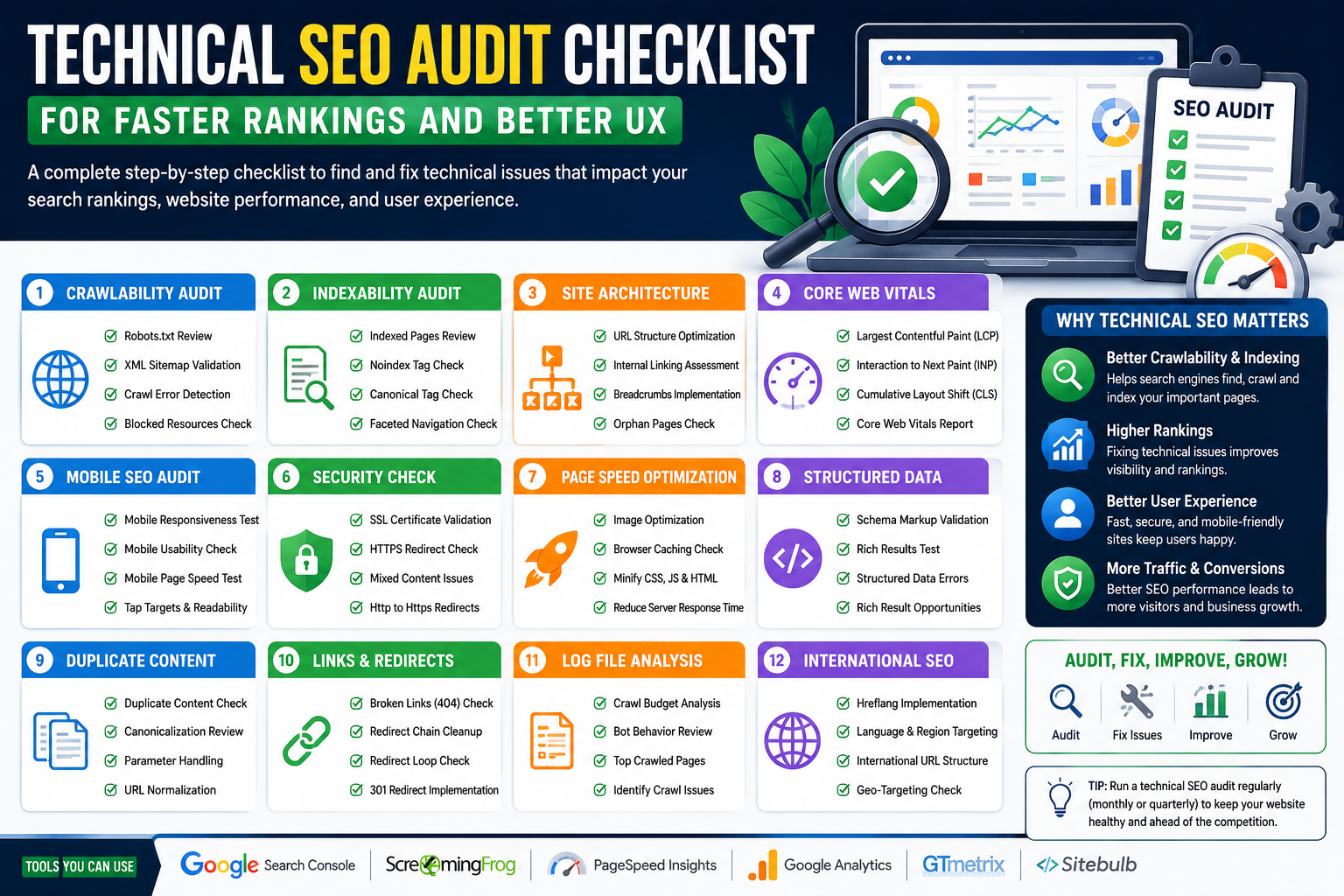

A thorough technical SEO audit is one of the most effective ways to improve search rankings, increase organic traffic, and deliver a better user experience. While great content attracts visitors, technical SEO ensures search engines can crawl, understand, and index your website efficiently.
Many websites struggle to rank because of hidden technical issues such as slow loading pages, crawl errors, broken links, duplicate content, or poor mobile performance. Even the best content can underperform if technical foundations are weak.
This comprehensive guide provides a complete technical SEO audit checklist that businesses, marketers, and SEO professionals can use to uncover and fix issues that may be limiting search visibility.
What Is a Technical SEO Audit?
A technical SEO audit is the process of evaluating a website’s infrastructure to identify issues that affect crawling, indexing, rankings, performance, and user experience.
The goal is to ensure:
- Search engines can access pages
- Content is indexed properly
- Users enjoy fast performance
- Website architecture supports navigation
- Technical errors are minimized
Unlike content SEO, technical SEO focuses on backend elements that influence search performance.
Why Technical SEO Matters in 2026
Google continues to place greater emphasis on user experience and website quality.
Search Engine Crawling and Indexing
Search engines must discover and understand your pages before ranking them.
Technical issues can prevent:
- Crawling
- Indexing
- Ranking
- Content discovery
Without proper optimization, valuable pages may never appear in search results.
User Experience and Rankings
Google increasingly uses user experience signals when evaluating websites.
Important factors include:
- Fast page loads
- Mobile usability
- Secure browsing
- Stable page layouts
- Accessible navigation
A technically sound website benefits both users and search engines.
Preparing for a Technical SEO Audit
Before beginning your audit, gather data from multiple sources.
Essential SEO Tools
Common tools include:
- Google Search Console
- Google Analytics
- Screaming Frog
- PageSpeed Insights
- Lighthouse
- Sitebulb
These platforms help uncover technical weaknesses.
Key Performance Benchmarks
Track baseline metrics such as:
| Metric | Target |
|---|---|
| LCP | Under 2.5 seconds |
| INP | Under 200 ms |
| CLS | Under 0.1 |
| Mobile Speed | Excellent |
| Crawl Errors | Zero critical issues |
Benchmarks provide a clear starting point for improvements.
Website Crawlability Audit
Search engines must be able to access your content.
Robots.txt Review
Check your robots.txt file to ensure critical pages are not accidentally blocked.
Common mistakes include:
- Blocking important directories
- Preventing image indexing
- Restricting CSS or JavaScript files
Review permissions carefully.
XML Sitemap Validation
A sitemap helps search engines discover important pages.
Verify:
- Sitemap accessibility
- Proper formatting
- Updated URLs
- Accurate page inclusion
Remove outdated or broken URLs.
Crawl Error Detection
Use Google Search Console to identify:
- Server errors
- Redirect issues
- Not found pages
- Blocked resources
Address crawl issues promptly.
Indexability Audit
Not every page discovered by search engines is automatically indexed.
Indexed Pages Review
Compare:
- Indexed pages
- Published pages
Unexpected discrepancies may indicate technical problems.
Noindex and Canonical Tags
Verify correct implementation of:
- Noindex tags
- Canonical URLs
- Pagination directives
Improper usage can prevent important pages from ranking.
Site Architecture Analysis
A well-structured website improves discoverability.
URL Structure Optimization
Ideal URLs should be:
- Short
- Descriptive
- Keyword relevant
- Easy to understand
Example:
example.com/technical-seo-audit
Avoid unnecessary parameters whenever possible.
Internal Linking Assessment
Strong internal links help distribute authority throughout the site.
Review:
- Orphan pages
- Navigation paths
- Anchor text relevance
- Link depth
Important pages should be accessible within a few clicks.
Core Web Vitals Evaluation
Core Web Vitals remain a significant ranking and usability factor.
Largest Contentful Paint (LCP)
Measures loading speed.
Improve by:
- Compressing images
- Upgrading hosting
- Using content delivery networks
- Optimizing server response times
Interaction to Next Paint (INP)
Measures responsiveness.
Reduce delays by:
- Minimizing JavaScript
- Improving code efficiency
- Reducing third-party scripts
Cumulative Layout Shift (CLS)
Measures visual stability.
Prevent shifts by:
- Defining image dimensions
- Reserving ad space
- Avoiding dynamic content jumps
Stable pages provide better user experiences.
Mobile SEO Audit
Google primarily evaluates websites through mobile-first indexing.
Mobile Responsiveness
Ensure:
- Responsive layouts
- Readable text
- Functional menus
- Accessible buttons
Mobile usability directly impacts rankings.
Mobile Page Speed
Improve performance through:
- Image optimization
- Lazy loading
- Reduced code bloat
- Efficient caching
Fast mobile experiences improve engagement.
HTTPS and Website Security
Security is a trust and ranking factor.
SSL Validation
Confirm:
- HTTPS implementation
- Certificate validity
- Secure redirects
Users expect secure browsing.
Mixed Content Issues
Mixed content occurs when secure pages load insecure resources.
Fix:
- Image URLs
- Script URLs
- External resources
Full HTTPS consistency is essential.
Page Speed Optimization
Speed improvements often produce immediate SEO benefits.
Image Optimization
Optimize by:
- Compressing files
- Using next-generation formats
- Implementing lazy loading
- Serving responsive images
Images frequently account for the largest page resources.
JavaScript and CSS Efficiency
Reduce:
- Unused code
- Render-blocking resources
- Excessive scripts
Cleaner code improves performance.
Structured Data Audit
Schema markup helps search engines understand content.
Schema Markup Validation
Validate:
- Article schema
- FAQ schema
- Product schema
- Organization schema
Use structured data testing tools to identify errors.
Rich Result Opportunities
Proper schema can improve visibility through:
- Rich snippets
- FAQs
- Review stars
- Event listings
Enhanced search results often improve click-through rates.
Duplicate Content Analysis
Duplicate content can dilute ranking signals.
Canonicalization Best Practices
Use canonical tags to indicate preferred versions of pages.
Examples include:
- Product variations
- URL parameters
- Pagination
Parameter Handling
Review URLs containing:
- Tracking parameters
- Session IDs
- Filtering options
These may generate unnecessary duplicates.
Broken Links and Redirect Audit
Broken experiences harm users and search engines.
404 Error Identification
Locate and fix:
- Internal broken links
- Deleted pages
- Outdated references
Every broken path weakens site quality.
Redirect Chain Cleanup
Avoid multiple redirect hops.
Best practice:
Old URL → New URL
Avoid:
Old URL → Intermediate URL → New URL
Direct redirects improve efficiency.
Log File Analysis
Advanced technical audits often include server log reviews.
Understanding Bot Behavior
Log files reveal:
- Crawl frequency
- Crawl waste
- Important page access
- Search engine priorities
This data helps improve crawl efficiency.
International SEO Considerations
Global websites require additional optimization.
Hreflang Implementation
Hreflang tags help search engines serve the correct language version.
Validate:
- Language codes
- Regional targeting
- Bidirectional references
Improper implementation can cause indexing confusion.
Monitoring and Reporting
SEO audits should not be one-time activities.
Track regularly:
- Crawl errors
- Core Web Vitals
- Index coverage
- Organic traffic
- Conversion rates
Continuous monitoring helps maintain technical health.
For official technical SEO guidance, review Google’s documentation at .
Frequently Asked Questions
1. What is a technical SEO audit?
A technical SEO audit evaluates website infrastructure, performance, crawlability, indexability, and usability to improve search visibility.
2. How often should a technical SEO audit be performed?
Most websites benefit from quarterly audits, while large or rapidly changing sites may require monthly reviews.
3. Does technical SEO improve rankings?
Yes. Fixing technical issues can improve crawl efficiency, indexing, page experience, and overall search performance.
4. What are Core Web Vitals?
Core Web Vitals measure loading speed, responsiveness, and visual stability to evaluate user experience quality.
5. Why is mobile SEO important?
Google primarily uses mobile-first indexing, making mobile performance critical for rankings.
6. How do broken links affect SEO?
Broken links create poor user experiences, waste crawl budget, and can negatively impact site quality signals.
7. Is HTTPS required for SEO?
HTTPS is considered a trust and ranking signal and is strongly recommended for all websites.
8. What tools help with technical SEO audits?
Popular tools include Google Search Console, Lighthouse, PageSpeed Insights, Screaming Frog, and various website crawlers.
Conclusion
A comprehensive technical SEO audit provides the foundation for stronger rankings, improved crawlability, faster page speeds, and a better user experience. While content and backlinks remain essential, technical optimization ensures that search engines can fully access, understand, and rank your website.
By following this checklist, addressing technical issues proactively, and monitoring performance regularly, businesses can build a website that satisfies both search engines and users. In an increasingly competitive search landscape, strong technical SEO remains one of the most reliable paths to long-term organic growth.