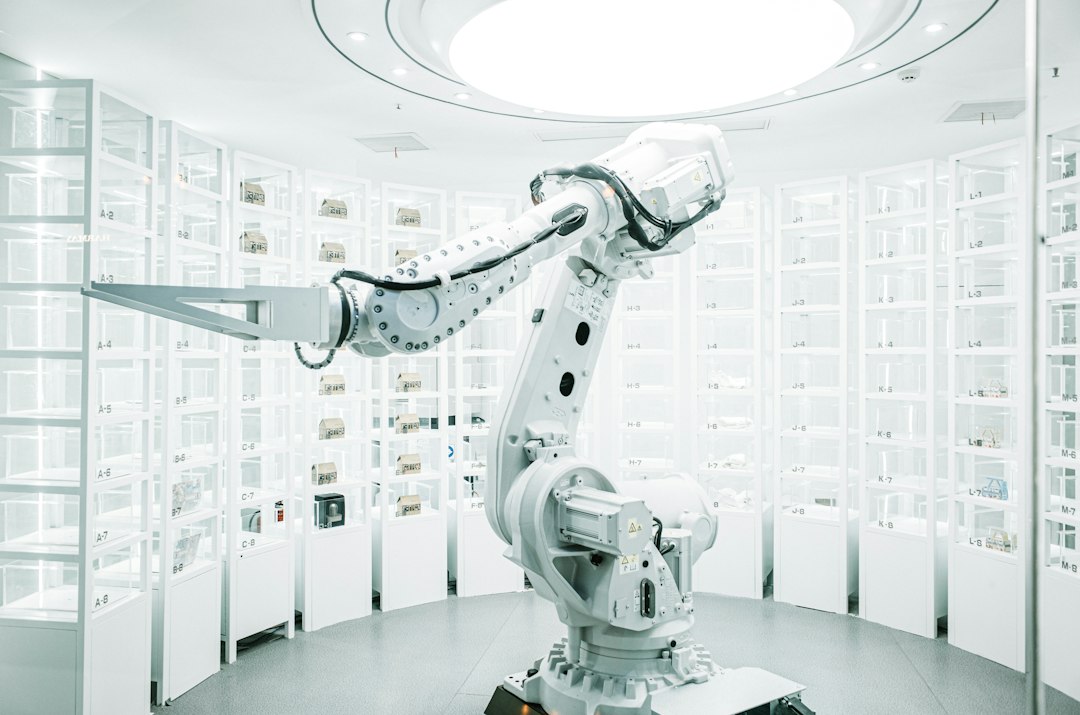

Robotics has advanced far beyond machines that perform repetitive tasks in factories. Today, robots can connect to the internet, exchange information with other devices, analyze data from their surroundings, and make intelligent decisions with limited human intervention. This development has contributed to the emergence of the Internet of Robotic Things (IoRT).
The Internet of Robotic Things combines robotics, the Internet of Things (IoT), artificial intelligence (AI), cloud computing, sensors, and network connectivity. Together, these technologies enable robots to collect environmental information, communicate with other connected systems, and coordinate activities across different locations.
For example, a warehouse robot can communicate with inventory software to locate products, coordinate with other robots to avoid collisions, and send operational data to a central platform. In agriculture, connected robots can monitor crops, identify areas that require watering, and share information with automated irrigation systems.
These capabilities create opportunities in manufacturing, healthcare, agriculture, logistics, transportation, and smart cities.
This article explains what the Internet of Robotic Things is, how it works, its major applications, benefits, challenges, and future potential.
İçindekiler
- What Is the Internet of Robotic Things?
- How Does IoRT Work?
- Key Technologies Behind IoRT
- IoRT vs. IoT vs. Traditional Robotics
- Major Applications of IoRT
- Benefits of the Internet of Robotic Things
- Challenges and Security Risks
- IoRT Applications in Nigeria and Africa
- How Businesses Can Implement IoRT
- Future Trends in IoRT
- Expert Tips for Adopting IoRT
- Common Misconceptions About IoRT
- Sıkça Sorulan Sorular
- Sonuç
1. What Is the Internet of Robotic Things?
The Internet of Robotic Things, commonly abbreviated as IoRT, is a technology concept that combines connected robotic systems with the communication and data-sharing capabilities of the Internet of Things.
Traditional robots are often designed to perform specific tasks according to programmed instructions. Although some traditional robots can operate autonomously, they may have limited communication with external devices or systems.
IoRT expands these capabilities by connecting robots to networks, sensors, software platforms, and other intelligent machines.
An IoRT system can collect information, interpret its environment, communicate with connected systems, and use the resulting information to perform tasks more effectively.
For example, consider a smart manufacturing facility with several connected robots. One robot assembles components, another performs quality inspections, and a third transports finished products. Through a shared communication system, these robots can exchange information and coordinate their activities.
If the inspection robot identifies a defective component, it can send a notification to the production system. The system may then instruct another robot to remove the defective item or alert a human operator.
This interconnected approach can improve coordination, visibility, and operational efficiency.
Important characteristics of IoRT
The main characteristics of IoRT include:
- Bağlantı: Robots communicate with software platforms, sensors, devices, or other robots.
- Sensing: Connected robots collect information about their surroundings.
- Data exchange: Information moves between robots and connected systems.
- Intelligence: AI and analytics can help robots interpret information and select actions.
- Autonomy: Robots can perform some tasks without continuous human control.
- Coordination: Multiple robots can cooperate to complete larger tasks.
- Remote monitoring: Operators can monitor performance and, where supported, control robots remotely.
Not every IoRT system needs all these capabilities. The specific features depend on the application, network infrastructure, and level of automation.
2. How Does IoRT Work?
The Internet of Robotic Things works by combining physical machines, sensors, communication networks, computing platforms, and intelligent software.
Although implementations differ, most IoRT systems follow a similar operational process.
Step 1: Robots collect information
Robots use sensors to observe their environment and monitor their own operating conditions.
These sensors may include cameras, proximity sensors, temperature sensors, pressure sensors, accelerometers, and location systems.
For example, a warehouse robot may use cameras and distance sensors to identify shelves, detect obstacles, and determine where products are located.
An agricultural robot may collect information about soil moisture, crop appearance, and environmental conditions.
Step 2: Data is processed
The information collected by sensors must be interpreted before the robot can respond.
Depending on the application, data processing may occur directly on the robot, through an edge-computing device, or on a remote computing platform.
Onboard processing is particularly important when a robot needs to react quickly to nearby obstacles or changing conditions.
Cloud platforms can support tasks that require large amounts of computing power, historical information, or coordination across multiple locations.
Step 3: Robots communicate with connected systems
The robot transmits relevant information through a communication network.
This may involve Wi-Fi, Ethernet, cellular networks, Bluetooth, or specialized industrial communication technologies.
The appropriate connection depends on the environment, required response time, coverage, reliability, and security requirements.
For example, a delivery robot may send its location and operating status to a fleet management platform. The platform can use this information to monitor deliveries and coordinate other robots.
Step 4: Software analyzes the information
Connected software can combine robot data with information from other sources.
An intelligent warehouse system might consider inventory records, delivery schedules, robot locations, and charging requirements when deciding which task should be assigned next.
AI may help with object recognition, navigation, predictive maintenance, route planning, and decision support.
However, not every IoRT system requires advanced AI. Some applications rely on predefined rules and conventional automation software.
Step 5: The system selects an action
Based on the available information, the robot or its controlling software determines what should happen next.
Possible actions include changing direction, picking up an item, adjusting a machine setting, notifying an operator, or requesting assistance from another robot.
Safety-critical actions should follow carefully designed constraints and validated control procedures.
Step 6: The robot performs the task and reports the result
The robot carries out the selected action and may send updated information to the connected platform.
The system can then monitor the outcome and adjust future instructions when necessary.
This creates a continuous cycle of sensing, communication, analysis, action, and feedback.
3. Key Technologies Behind IoRT
IoRT depends on several complementary technologies.
Internet of Things sensors
IoT sensors allow connected systems to collect information from the physical environment.
They can measure temperature, humidity, movement, pressure, location, and other relevant conditions.
When integrated with robots, sensors provide the information required for navigation, monitoring, and task execution.
Artificial intelligence and machine learning
Artificial intelligence helps robots interpret complex information and make decisions.
Machine learning can support object recognition, predictive maintenance, route optimization, anomaly detection, and classification.
For example, an inspection robot may use computer vision to identify surface defects in manufactured products.
AI systems must still be tested carefully because inaccurate predictions or recognition errors can lead to operational problems.
Cloud computing
Cloud computing provides remote infrastructure for storing data, running applications, analyzing information, and managing connected devices.
A company operating robots across several facilities may use a centralized platform to monitor equipment, review performance, and coordinate operations.
Cloud computing is not suitable for every real-time robotic task. Systems that require immediate responses should retain the necessary control functions locally.
Sınır Hesaplama
Edge computing processes information close to where it is generated.
This can reduce communication delays and decrease the amount of data sent to remote servers.
For instance, a mobile robot can process camera images locally to detect nearby obstacles without waiting for a remote service to respond.
A well-designed IoRT architecture often combines edge computing with cloud services.
Communication networks
Robots need reliable connections to exchange data with other devices and software systems.
Depending on the application, networks may include Wi-Fi, wired Ethernet, cellular connectivity, or industrial communication systems.
Network design must account for coverage, interference, latency, bandwidth, and security.
A robot operating inside a factory may use a different network architecture from a delivery robot moving through public streets.
Robotics and control systems
Robotics hardware provides the physical capabilities required to perform tasks.
These capabilities may include robotic arms, wheels, grippers, motors, cameras, and specialized tools.
Control software translates decisions into physical movements and actions.
IoRT connects these robotic capabilities with broader information and communication systems.
Digital twins
A digital twin is a digital representation of a physical asset, process, or environment that can be updated with operational data.
In IoRT, digital twins can help organizations monitor robot performance, simulate workflows, and evaluate proposed changes before implementing them.
For example, a logistics company could model a warehouse layout to assess whether adding more mobile robots would improve throughput or create congestion.
4. IoRT vs. IoT vs. Traditional Robotics
Although these technologies overlap, they serve different purposes.
| Özellik | Internet of Things (IoT) | Traditional Robotics | Internet of Robotic Things (IoRT) |
|---|---|---|---|
| Primary focus | Connecting devices and collecting data | Automating physical tasks | Connecting robots with intelligent, networked systems |
| Physical movement | Not necessarily involved | Common in robotic applications | Often involved |
| Sensörler | Frequently used | Commonly used | Used to support sensing and connectivity |
| Network communication | Central capability | Varies by system | A defining capability |
| AI integration | Optional | Optional | Often useful but not mandatory |
| Collaboration | Connected devices share data | May operate independently | Robots can coordinate with devices and other robots |
| Remote monitoring | Common | Depends on implementation | Frequently supported |
| Typical applications | Smart meters and environmental monitoring | Industrial assembly and material handling | Connected warehouse fleets and coordinated robotic operations |
The key distinction is that IoRT connects robotic capabilities with the wider networked environment.
An IoT sensor may report that a storage tank is nearly empty. A robot may perform a programmed inspection without internet connectivity. An IoRT system could connect sensors, inspection robots, maintenance software, and operators so they can coordinate a response.
5. Major Applications of IoRT
The Internet of Robotic Things has potential applications across numerous industries.
Smart manufacturing
Manufacturing facilities can use connected robots for assembly, material handling, inspection, and equipment monitoring.
When robots exchange information with production management systems, businesses can coordinate tasks and identify operational problems more quickly.
For example, a connected robotic arm can report its operating status while an autonomous mobile robot transports components to the production line.
The production system can use this information to coordinate material deliveries and reduce avoidable interruptions.
Depolama ve lojistik
Warehouses are among the most practical environments for IoRT because they involve repetitive movement, inventory management, and coordination between machines.
Connected mobile robots can transport products, move inventory, and support order fulfilment.
Fleet management software can assign tasks, monitor battery levels, identify congestion, and coordinate charging schedules.
When integrated with warehouse management software, these systems can help operators understand where products are located and how work is progressing.
Tarım
Agriculture combines large physical environments with changing conditions, making it a potential application area for connected robotics.
IoRT-enabled agricultural systems may include robots that monitor crops, inspect plants, apply inputs, or transport harvested produce.
A connected agricultural robot could collect crop images and combine them with soil or weather information to help identify areas requiring attention.
Farm managers could use the resulting data to prioritize inspections and make more informed operational decisions.
Practical deployment depends on terrain, connectivity, equipment costs, crop type, and the availability of suitable robotic systems.
Sağlık
Hospitals and healthcare facilities can use connected robots for selected logistical and support tasks.
Examples include transporting supplies, moving meals, delivering laboratory materials, and assisting with inventory management.
Connected systems can help facility managers monitor robot locations and coordinate deliveries.
Healthcare robotics requires particular attention to privacy, infection prevention, reliability, and human safety.
Robots that support clinical care must also comply with applicable medical-device requirements and professional oversight procedures.
Smart cities
Smart cities use connected systems to improve the management of public infrastructure and services.
IoRT may support automated inspection, waste collection, infrastructure monitoring, and certain public maintenance tasks.
For example, an inspection robot could collect information about a drainage system and transmit identified issues to a maintenance platform.
A connected system could then help prioritize inspections and allocate repair resources.
Deployments in public spaces must consider pedestrian safety, accessibility, surveillance risks, and local regulations.
Transportation and delivery
Connected delivery robots can exchange information with fleet management platforms, navigation systems, and logistics software.
This connectivity can support route planning, delivery tracking, status reporting, and coordination between vehicles and distribution facilities.
A delivery robot may report that a route is blocked or that it has reached its destination.
The fleet management system can use that information to update schedules or assign another robot to a task.
Public-road and pavement deployments require suitable safety measures and compliance with relevant local rules.
Energy and utilities
Energy providers and utility operators can use robotic systems to inspect equipment and infrastructure.
Connected robots may help examine pipelines, power facilities, solar installations, or industrial equipment in environments that are difficult or dangerous for people to access.
Collected information can be transmitted to monitoring platforms for analysis.
When combined with predictive maintenance, this information can help maintenance teams identify potential problems before equipment fails.
Mining and hazardous environments
Mining operations, chemical facilities, and other hazardous environments may use robots to inspect equipment, map areas, or collect measurements.
Network connectivity allows operators to monitor robots and receive information without always entering the inspection area themselves.
However, connectivity loss, extreme conditions, and equipment failure must be considered during system design.
Robots operating in hazardous locations may require specialized hardware, redundant safety systems, and validated operating procedures.
6. Benefits of the Internet of Robotic Things
IoRT can offer several operational advantages when it is appropriately designed and implemented.
Improved operational efficiency
Connected robots can coordinate tasks and share information with business systems.
This may reduce unnecessary movement, duplicate work, and delays caused by poor coordination.
The actual improvement depends on the process being automated and the quality of the implementation.
Real-time operational visibility
IoRT platforms can provide information about robot locations, task progress, operating conditions, and equipment status.
Managers can use these insights to identify bottlenecks and investigate operational problems.
Better visibility can also support more accurate performance reporting.
Predictive maintenance
Robots can report information about temperature, vibration, operating hours, error codes, and other maintenance indicators.
Analytics software can use this information to identify unusual patterns and estimate when maintenance may be required.
Predictive maintenance is not guaranteed to prevent every failure, but it can help maintenance teams make better-informed decisions.
Better coordination between machines
Connected robots can share task information and coordinate their activities.
This is particularly useful in warehouses, manufacturing plants, and distribution facilities where several robots operate in the same environment.
Coordination systems must account for congestion, communication failures, and safe operating distances.
Improved worker safety
Robots can perform certain repetitive, physically demanding, or hazardous tasks.
Connected monitoring can also help supervisors identify abnormal conditions and respond to problems.
Nevertheless, robots can introduce new risks, including unexpected movement, equipment failure, and cyberattacks. Safety requires appropriate engineering, training, and supervision.
Data-driven decision-making
IoRT systems generate information about equipment utilization, task completion, downtime, and environmental conditions.
Organizations can analyze these records to evaluate performance and improve workflows.
Useful results depend on data quality, meaningful performance indicators, and sound interpretation.
Ölçeklenebilirlik
A connected architecture can make it easier to monitor and coordinate additional robots.
However, scaling still requires sufficient network capacity, system integration, cybersecurity controls, maintenance resources, and operational planning.
7. Challenges and Security Risks of IoRT
Despite its potential, IoRT introduces technical, financial, and operational challenges.
Cybersecurity threats
Network-connected robots can introduce additional entry points for cyberattacks.
Potential threats include unauthorized access, stolen credentials, malicious software, insecure interfaces, and attacks against connected control systems.
A compromised robot could disrupt operations or create physical safety risks.
Organizations should use strong authentication, network segmentation, encrypted communications where appropriate, timely security updates, secure configuration, and continuous monitoring.
Access should be limited to the devices, users, and services that genuinely require it.
Data privacy
Robots equipped with cameras, microphones, location tracking, or other sensors may collect sensitive information.
In hospitals, offices, residential environments, and public spaces, this may include personal or confidential data.
Organizations should define what information is collected, why it is needed, how long it is retained, and who can access it.
Privacy requirements should be incorporated into system design rather than addressed only after deployment.
Network reliability
IoRT depends on communication between devices and systems, but network connections can fail.
Weak signals, interference, congestion, power outages, and equipment faults may interrupt communication.
Robots should have suitable local safety and recovery mechanisms for situations in which network access is lost.
Critical movement and emergency stopping should not depend solely on a remote cloud service.
Integration complexity
Robots from different manufacturers may use different communication protocols, software interfaces, and data formats.
Integrating these systems with existing business software can require specialized development and testing.
Organizations should assess interoperability before purchasing equipment and avoid assuming that every robot can communicate seamlessly with every platform.
High initial costs
IoRT deployment may require robotic equipment, sensors, network upgrades, software, integration work, employee training, and ongoing support.
Smaller businesses may find the initial investment difficult to justify.
A limited pilot project can help determine whether the expected operational benefits support the total cost of ownership.
Skills shortages
IoRT combines several technical disciplines, including robotics, software development, networking, cybersecurity, data analysis, and industrial operations.
Organizations may struggle to find personnel with the required combination of skills.
Training existing employees and working with experienced technology providers can help address this challenge.
Safety and accountability
Robots can cause physical harm if they malfunction, encounter unexpected conditions, or receive incorrect instructions.
Organizations must define safe operating boundaries, emergency procedures, maintenance responsibilities, and human oversight requirements.
They should also establish clear responsibility for system updates, incident investigation, and operational decisions.
Vendor dependence
Some IoRT solutions depend heavily on proprietary software, cloud platforms, or specialized hardware.
This can make it difficult to change suppliers or transfer data to another system.
Businesses should assess data portability, interoperability, contract terms, support arrangements, and exit options before committing to a platform.
8. IoRT Applications in Nigeria and Africa
The Internet of Robotic Things could support selected business and public-service needs across Nigeria and other African markets.
However, adoption will depend on local infrastructure, available financing, technical expertise, and the suitability of each application.
Agriculture and food production
Agriculture remains an important economic activity across Nigeria and the wider African region.
Connected robotics could support crop monitoring, automated irrigation, selected harvesting activities, and the movement of agricultural products.
For example, a commercial farm could use connected sensors and a mobile robot to inspect crop conditions and identify areas that require additional attention.
The system could transmit its findings to a farm manager, helping prioritize field visits and resource allocation.
For many farms, however, affordable sensors, basic automation, and reliable data collection may provide a more practical starting point than a fully connected robotic fleet.
Warehousing and e-commerce
As businesses expand their digital sales and distribution operations, some warehouses may benefit from connected material-handling systems.
Robots could assist with moving goods, sorting items, and monitoring inventory.
Companies should first evaluate whether their order volumes, warehouse layouts, labour costs, and operating processes justify robotic automation.
Üretim
Manufacturers may explore connected robotics for assembly, quality inspection, packaging, and material movement.
IoRT can also provide information about equipment utilization and maintenance requirements.
A practical approach is to start with one repetitive, measurable process rather than attempt to automate an entire facility at once.
Healthcare logistics
Large hospitals and medical facilities may investigate robots for moving supplies, transporting selected materials, and monitoring inventory.
Such systems could help reduce some routine transport workloads.
Reliable infrastructure, infection-control procedures, staff training, and integration with hospital operations remain essential.
Infrastructure inspection
Connected robotic systems may support inspections of industrial facilities, drainage infrastructure, energy installations, and other difficult-to-access environments.
These applications may be especially valuable when manual inspections involve significant risk or require substantial time.
Organizations must still assess equipment durability, communication coverage, maintenance requirements, and the availability of trained operators.
Connectivity and affordability considerations
IoRT deployments in Nigeria may face challenges involving unreliable power, inconsistent network coverage, import costs, equipment servicing, and limited access to specialized expertise.
Businesses can address some of these challenges by prioritizing local processing, selecting equipment designed for the operating environment, using backup power where necessary, and planning for maintenance from the beginning.
For Nigerian businesses, the most practical entry point is usually a clearly defined operational problem with measurable costs and benefits—not adopting robotics simply because the technology is new.
9. How Businesses Can Implement IoRT
Businesses considering IoRT should adopt a structured implementation process.
Step 1: Identify a specific operational problem
Begin by identifying a process that is repetitive, costly, difficult to monitor, or associated with significant safety risks.
Examples include transporting materials, inspecting equipment, monitoring stock, and collecting information from hazardous environments.
Document the current process, its limitations, and the desired outcome.
Step 2: Assess the business case
Estimate the total cost of implementation, including equipment, software, integration, connectivity, maintenance, training, and support.
Compare these costs with the expected benefits.
Relevant indicators may include:
- Labour hours spent on the task.
- Equipment downtime.
- Task completion time.
- Error rates.
- Maintenance expenses.
- Product damage.
- Safety incidents.
- Energy consumption.
Avoid relying on projected savings that have not been validated.
Step 3: Choose appropriate robotic equipment
Select robots based on the task, environment, payload requirements, operating conditions, and required level of autonomy.
A robot designed for a controlled warehouse may not be suitable for uneven outdoor terrain.
Evaluate the manufacturer’s support arrangements, available spare parts, software updates, and safety documentation.
Step 4: Plan the connectivity architecture
Determine which systems must communicate and how data will move between them.
Decide which operations require local processing and which can use remote computing platforms.
Assess network coverage, latency, reliability, access controls, and recovery procedures for communication failures.
Step 5: Integrate software and data
Connect the robots to the necessary business applications, monitoring dashboards, or fleet management tools.
Where possible, use documented interfaces and interoperable technologies.
Establish data standards and confirm that information is accurate, useful, and accessible to authorized personnel.
Step 6: Establish security and safety controls
Before deployment, define authentication requirements, user permissions, network boundaries, update procedures, logging, and incident-response processes.
Test how robots behave during communication failures, sensor errors, unexpected obstacles, and other abnormal conditions.
Conduct appropriate safety assessments before allowing robots to operate around workers or members of the public.
Step 7: Run a pilot project
Deploy the system in a limited environment.
Measure its performance against the baseline established before implementation.
Collect feedback from employees and identify integration problems, unexpected costs, and operational limitations.
A pilot should establish whether the solution works reliably under actual operating conditions.
Step 8: Evaluate and scale
Compare the pilot results with the original business objectives.
If the results justify further investment, expand gradually while monitoring performance and security.
Continue evaluating the system after deployment because changes in workloads, software, network conditions, and operating environments can affect performance.
10. Future Trends in IoRT
The Internet of Robotic Things is likely to evolve alongside advances in robotics, connectivity, computing, and AI.
Greater AI integration
AI could enable robots to interpret more complex environments, recognize objects, adapt to changing conditions, and assist with planning.
However, more capable AI does not eliminate the need for reliable sensors, safety controls, testing, and human oversight.
Multi-robot collaboration
Future systems may coordinate larger fleets of robots across warehouses, industrial sites, farms, and distribution centres.
Fleet management systems could allocate tasks dynamically based on workload, location, battery levels, and operational priorities.
Effective coordination will require reliable communication and clear procedures for resolving conflicts between robots.
Edge AI and faster local processing
Edge computing can allow robots to analyze data close to where it is collected.
As processing capabilities improve, more perception and decision-support tasks may be handled directly on robots or nearby computing devices.
This can reduce dependence on continuous cloud connectivity for time-sensitive operations.
Digital twins and simulation
Digital twins may help organizations test robot workflows and evaluate operational changes before applying them to physical systems.
Simulations can support planning, training, and system optimization.
Their usefulness depends on how accurately the digital model represents the real environment.
More flexible robotic systems
Advances in sensors, control software, and AI may make some robots easier to adapt to different tasks.
Instead of being limited to a single fixed workflow, certain systems may support a broader range of activities through software updates or interchangeable tools.
The level of flexibility will vary considerably by robot type and application.
Improved human-robot collaboration
Connected robots may increasingly support employees by sharing task information, receiving instructions, and coordinating work in common environments.
Successful collaboration requires intuitive interfaces, appropriate training, clear responsibilities, and safe operating procedures.
Energy efficiency
Energy use will remain an important consideration as organizations deploy larger fleets of connected machines.
Developments in battery technology, charging management, route optimization, and low-power computing could help improve operational efficiency.
The environmental impact will also depend on equipment manufacturing, maintenance, electricity sources, and eventual disposal.
11. Expert Tips for Adopting IoRT
Organizations can improve their chances of success by following several practical principles.
Start with business value. Choose an application that solves a clearly defined problem rather than investing in robotics without a measurable objective.
Design security into the system. Treat robots as connected operational assets that require identity management, access controls, monitoring, and regular maintenance.
Keep essential safety functions local. A network interruption should not prevent a robot from executing required emergency-stop or other critical safety procedures.
Prioritize interoperability. Evaluate whether equipment can integrate with existing software and whether operational data can be exported in usable formats.
Train employees. Staff should understand how to operate the system, identify faults, respond to incidents, and work safely around robots.
Plan for maintenance. Account for replacement parts, software updates, battery management, technical support, and equipment downtime.
Measure results continuously. Use operational data to evaluate reliability, productivity, costs, and safety after implementation.
Scale gradually. Expand only when pilot results and operational experience support further investment.
12. Common Misconceptions About IoRT
Misconception 1: Every connected robot is fully autonomous
Connectivity does not automatically make a robot autonomous.
Some connected robots still depend on human operators for navigation, task approval, or decision-making.
Misconception 2: IoRT always requires cloud computing
Cloud platforms can be useful for analytics and fleet coordination, but many time-sensitive robotic functions can operate locally.
A system can combine onboard processing, edge computing, and cloud services according to its needs.
Misconception 3: IoRT eliminates the need for human workers
IoRT can automate selected tasks, but people remain important for supervision, maintenance, planning, exception handling, and safety management.
The impact on employment depends on the industry, application, and way automation is introduced.
Misconception 4: IoRT is only for large corporations
Large organizations may have more resources for advanced deployments, but smaller businesses can explore limited applications where the business case is strong.
Affordable sensors, basic automation, and small-scale monitoring systems can provide useful starting points.
Misconception 5: Connecting robots automatically makes them safer
Connectivity can improve monitoring and coordination, but it can also introduce cybersecurity and communication risks.
Safety depends on the overall design, engineering controls, testing, maintenance, and operating procedures.
13. Frequently Asked Questions
1. What does IoRT stand for?
IoRT stands for the Internet of Robotic Things. It describes the integration of robotics with network connectivity, connected devices, data exchange, and intelligent software.
2. What is the main purpose of IoRT?
The main purpose is to connect robots with other devices, software platforms, and information systems so they can exchange information, coordinate tasks, and support more efficient operations.
3. What is the difference between IoRT and IoT?
IoT focuses on connecting devices that collect and exchange information. IoRT applies connected-system principles specifically to robots, combining communication and data processing with physical actions and robotic control.
4. Does IoRT require artificial intelligence?
No. AI can improve capabilities such as object recognition, route planning, and predictive maintenance, but some IoRT systems use predefined rules and conventional automation software.
5. Which industries use IoRT?
Potential application areas include manufacturing, logistics, warehousing, agriculture, healthcare, energy, mining, transportation, and infrastructure inspection.
The suitability of IoRT depends on the task, costs, technical requirements, and operating environment.
6. Is the Internet of Robotic Things secure?
IoRT can be designed with strong security controls, but connected robots can face threats such as unauthorized access, insecure software, data exposure, and network attacks.
Security requires appropriate authentication, access management, network segmentation, software updates, monitoring, and incident-response planning.
7. Can Nigerian businesses benefit from IoRT?
Yes. Depending on the business case, Nigerian companies may explore IoRT for warehouse operations, agricultural monitoring, manufacturing, infrastructure inspection, and selected healthcare logistics tasks.
Affordability, power reliability, network coverage, technical support, and staff training should be considered before implementation.
8. What is the future of IoRT?
IoRT may become more capable through improvements in AI, edge computing, robotic coordination, simulation, and connected infrastructure.
Its adoption will depend on whether these capabilities provide reliable, secure, and economically justified solutions to real operational problems.
14. Conclusion
The Internet of Robotic Things represents an important development in the evolution of connected automation. By combining robotics with sensors, communication networks, AI, and computing platforms, IoRT enables machines to exchange information and coordinate activities beyond the capabilities of isolated robotic systems.
Its potential applications range from smart manufacturing and warehouse management to agriculture, healthcare logistics, energy, and infrastructure inspection.
However, successful implementation requires more than purchasing connected robots. Organizations must evaluate costs, plan network architecture, protect sensitive data, establish cybersecurity controls, and ensure that robotic systems operate safely.
For businesses in Nigeria and across Africa, practical applications may offer opportunities to improve productivity, strengthen operational monitoring, and address specific challenges in sectors such as agriculture, manufacturing, and logistics.
The most effective approach is to start with a clearly defined problem, test a suitable solution, measure its results, and expand only when the evidence supports further investment.
As robotics and connected technologies continue to advance, IoRT could become an increasingly important component of intelligent industrial systems and automated services.




