
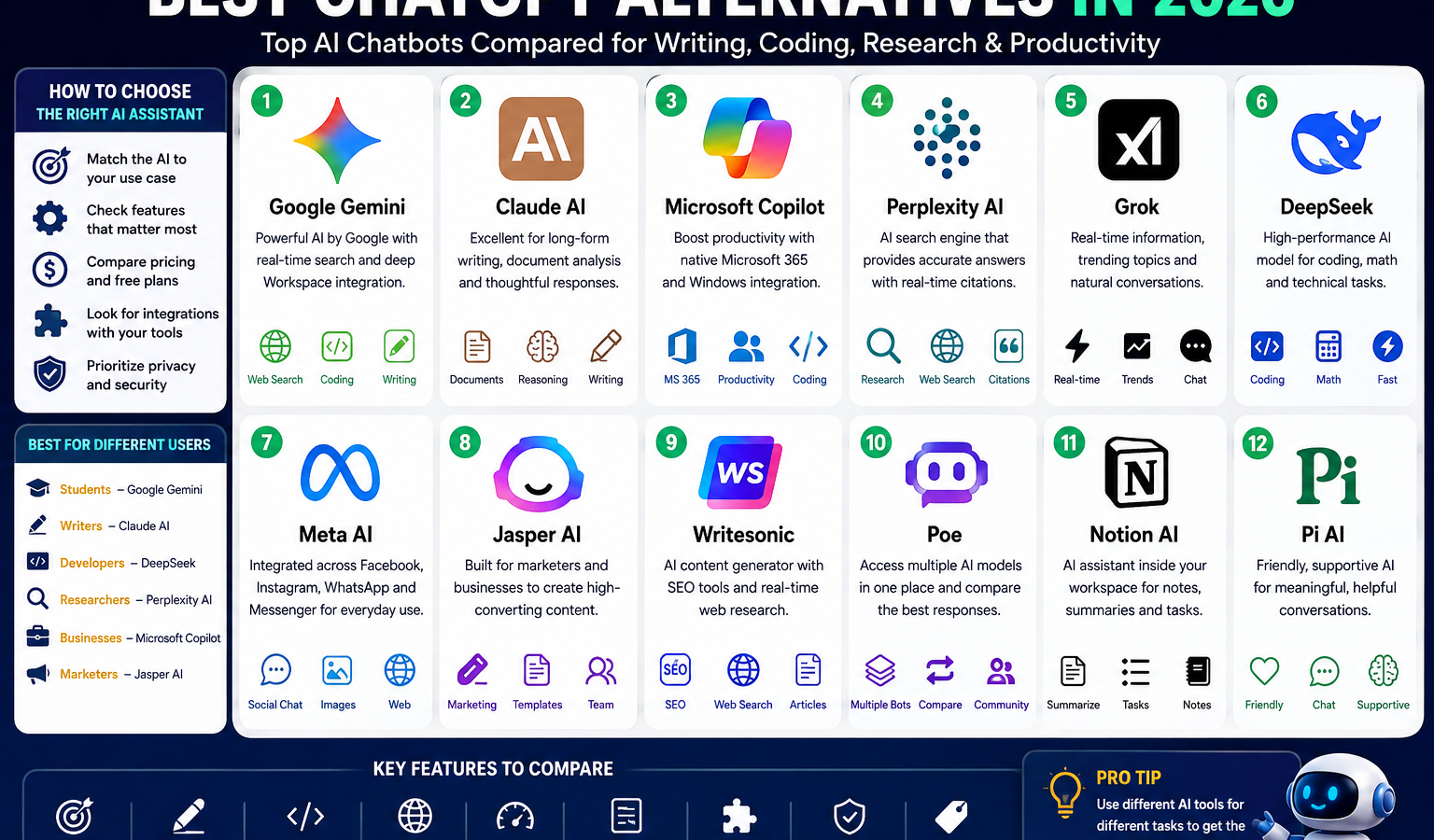

Artificial intelligence has transformed how people work, learn, create content, write code, conduct research, and manage businesses. While ChatGPT remains one of the most popular AI assistants in the world, it isn’t the only option available. Today, numerous AI platforms offer unique capabilities that may better suit specific workflows, industries, or budgets.
Whether you’re a content creator, student, software developer, marketer, entrepreneur, or researcher, choosing the right AI assistant can significantly improve productivity and efficiency.
Some AI tools specialize in real-time web research. Others excel at long-form writing, programming assistance, document analysis, image generation, or enterprise collaboration. Many even integrate directly with productivity apps such as Microsoft Office, Google Workspace, Slack, and Notion.
This comprehensive guide compares the best ChatGPT alternatives available in 2026. You’ll learn each platform’s strengths, weaknesses, pricing, ideal use cases, and how to choose the right AI assistant for your needs.
Table of Contents
- What Makes a Good ChatGPT Alternative?
- Why People Look for ChatGPT Alternatives
- Quick Comparison Table
- 12 Best ChatGPT Alternatives
- Google Gemini
- Claude AI
- Microsoft Copilot
- Perplexity AI
- Grok
- DeepSeek
- Meta AI
- Jasper AI
- Writesonic
- Poe
- Notion AI
- Pi AI
- Which AI Assistant Is Best for Different Users?
- Expert Tips
- Common Mistakes to Avoid
- Frequently Asked Questions
- Final Verdict
What Makes a Good ChatGPT Alternative?
Not every AI chatbot is built for the same purpose. Some prioritize creative writing, while others focus on coding, business automation, or accurate web search.
Here are the most important features to evaluate before choosing an AI assistant.
Accuracy
Reliable responses are essential, especially for research, education, legal information, finance, and healthcare. AI systems that cite sources or access current web information generally provide more trustworthy answers.
Writing Quality
If you publish blogs, marketing copy, social media posts, or product descriptions, look for AI that produces natural, engaging, and well-structured content.
Key qualities include:
- Human-like tone
- Strong grammar
- Logical organization
- Multiple writing styles
- SEO-friendly output
Coding Support
Developers benefit from AI assistants that understand multiple programming languages and can:
- Explain code
- Debug errors
- Generate scripts
- Build applications
- Review code quality
- Suggest optimizations
Web Access
Many users need information beyond an AI model’s training data.
Modern AI assistants often provide:
- Live internet search
- Current news
- Source citations
- Market trends
- Product research
Speed
Fast responses improve productivity, especially when handling dozens of prompts each day.
Context Window
A larger context window allows AI to remember longer conversations and analyze lengthy documents without losing important details.
Integrations
Many professionals prefer AI that connects directly with existing tools such as:
- Google Docs
- Microsoft Word
- Excel
- Gmail
- Slack
- GitHub
- Notion
- Google Drive
Privacy and Security
Businesses should prioritize platforms that offer:
- Data encryption
- Enterprise security
- Compliance certifications
- Administrative controls
- Private workspaces
Why People Look for ChatGPT Alternatives
Although ChatGPT is highly capable, users often explore other AI assistants for specific reasons.
Better Real-Time Search
Some AI platforms search the internet while generating responses, making them better suited for breaking news, product research, and market analysis.
Different AI Models
Each company trains its models differently.
Some emphasize:
- Creativity
- Logical reasoning
- Coding
- Mathematics
- Scientific research
- Business communication
As a result, the same prompt can produce noticeably different outputs across platforms.
Lower Pricing
Many AI assistants offer generous free plans, making them attractive to freelancers, students, and small businesses.
Specialized Features
Certain platforms are designed specifically for:
- Academic research
- Marketing
- SEO
- Programming
- Customer support
- Business analytics
- Team collaboration
Quick Comparison Overview
| AI Tool | Best For | Free Plan | Web Search | Coding | Content Writing |
|---|---|---|---|---|---|
| ChatGPT | General AI | Yes | Yes | Excellent | Excellent |
| Google Gemini | Google ecosystem | Yes | Yes | Excellent | Excellent |
| Claude AI | Long documents | Yes | Limited | Excellent | Outstanding |
| Microsoft Copilot | Microsoft Office | Yes | Yes | Excellent | Very Good |
| Perplexity AI | Research | Yes | Excellent | Good | Very Good |
| Grok | Real-time information | Yes | Excellent | Good | Good |
| DeepSeek | Coding | Yes | Limited | Excellent | Good |
| Jasper AI | Marketing | No | Limited | Average | Excellent |
| Writesonic | SEO writing | Limited | Yes | Average | Excellent |
| Poe | Multiple AI models | Yes | Depends | Good | Good |
| Notion AI | Productivity | No | Limited | Basic | Good |
| Pi AI | Conversations | Yes | Limited | Basic | Good |
The 12 Best ChatGPT Alternatives
1. Google Gemini
Google Gemini has rapidly become one of the strongest competitors to ChatGPT. Built by Google DeepMind, Gemini integrates deeply with Google’s ecosystem, making it particularly useful for users who rely on Gmail, Google Docs, Sheets, Drive, Calendar, and Search.
Gemini stands out because it combines advanced reasoning with access to Google’s vast knowledge ecosystem. It can summarize emails, analyze documents stored in Google Drive, create presentations, assist with spreadsheets, and answer complex research questions using current web information.
Best Features
- Deep Google Workspace integration
- Real-time web search
- Image understanding
- Strong reasoning abilities
- Advanced coding assistance
- Long context window
- Multimodal capabilities
Pros
- Excellent for research
- Accurate factual responses
- Fast performance
- Great productivity features
- Strong coding support
Cons
- Some premium features require a paid subscription
- Best experience is within Google’s ecosystem
Best For
- Students
- Researchers
- Bloggers
- Developers
- Google Workspace users
- Business professionals
2. Claude AI
Developed by Anthropic, Claude AI has earned a reputation for producing exceptionally natural writing and handling extremely large documents with ease. It is particularly popular among authors, editors, legal professionals, consultants, and researchers who need thoughtful, detailed responses.
Claude excels at understanding context across lengthy conversations and can analyze long reports, contracts, books, research papers, and technical documentation without losing coherence. Its conversational tone feels polished and human-like, making it one of the strongest choices for long-form writing and professional communication.
Best Features
- Exceptional long-form writing
- Large context window
- Strong reasoning capabilities
- High-quality document analysis
- Natural conversational style
- Reliable summarization
Pros
- Excellent for professional writing
- Handles lengthy documents efficiently
- Clear and well-structured responses
- Great for brainstorming and editing
Cons
- Fewer built-in integrations than some competitors
- Certain advanced capabilities may require a paid plan
Best For
- Writers
- Editors
- Researchers
- Lawyers
- Consultants
- Business professionals
3. Microsoft Copilot
Microsoft Copilot has evolved into one of the most practical AI assistants for professionals and businesses. Built into the Microsoft ecosystem, it integrates seamlessly with Windows, Microsoft 365, Teams, Outlook, Word, Excel, PowerPoint, and Edge.
Its biggest advantage is productivity. Users can draft documents, summarize meetings, create presentations, analyze spreadsheets, and automate repetitive office tasks without switching between applications.
Best Features
- Native Microsoft 365 integration
- AI assistance in Word, Excel, and PowerPoint
- Email drafting in Outlook
- Meeting summaries in Teams
- Real-time web search
- Strong coding support
Pros
- Excellent for office productivity
- Enterprise-grade security
- Saves significant time
- Familiar interface for Microsoft users
Cons
- Best features require Microsoft 365 subscription
- Less flexible outside Microsoft’s ecosystem
Best For
- Businesses
- Corporate teams
- Office workers
- Project managers
- Students using Microsoft Office
4. Perplexity AI
Perplexity AI has become one of the most trusted AI-powered research assistants. Unlike traditional chatbots, it focuses on delivering factual answers backed by citations from reliable online sources.
This makes it particularly valuable for journalists, students, researchers, marketers, and professionals who need current and verifiable information.
Best Features
- Real-time web search
- Source citations
- Fast research summaries
- Academic-friendly responses
- File analysis
- Follow-up questions
Pros
- Highly accurate research
- Transparent sourcing
- Excellent for fact-checking
- Easy-to-read summaries
Cons
- Less creative than writing-focused AI
- Long-form content may require editing
Best For
- Researchers
- Journalists
- Students
- Bloggers
- SEO professionals
5. Grok
Developed by xAI, Grok is designed to provide conversational AI with strong real-time awareness. It excels at discussing current events, technology trends, sports, finance, and social media topics.
Its ability to analyze recent information makes it useful for users who frequently need up-to-date insights.
Best Features
- Real-time information
- Strong reasoning
- Coding assistance
- Natural conversations
- Image generation support
Pros
- Excellent for trending topics
- Fast responses
- Easy to use
- Handles technical questions well
Cons
- Smaller ecosystem than competitors
- Some premium features require subscription
Best For
- Tech enthusiasts
- Investors
- Content creators
- Social media managers
6. DeepSeek
DeepSeek has quickly gained popularity among developers due to its impressive coding performance and affordability.
It performs exceptionally well when generating code, debugging software, solving mathematical problems, and explaining technical concepts.
Best Features
- Strong programming support
- Excellent mathematics reasoning
- Code debugging
- API access
- Fast responses
Pros
- Great value
- Excellent coding quality
- Handles complex algorithms
- Useful for developers
Cons
- Less polished for creative writing
- Smaller ecosystem
Best For
- Developers
- Engineers
- Computer science students
- Data analysts
7. Meta AI
Meta AI is integrated into Facebook, Instagram, Messenger, and WhatsApp, making it one of the most accessible AI assistants worldwide.
It can answer questions, generate images, brainstorm ideas, and assist with everyday productivity directly within Meta’s apps.
Best Features
- Social media integration
- Image generation
- Quick answers
- Everyday productivity
- Free access
Pros
- Convenient
- Easy to access
- Good conversational abilities
- Strong multimodal features
Cons
- Limited advanced productivity tools
- Not ideal for enterprise workflows
Best For
- Casual users
- Social media creators
- Everyday assistance
8. Jasper AI
Jasper AI remains one of the leading AI writing platforms for marketers and businesses.
Unlike general-purpose chatbots, Jasper focuses on creating marketing content that converts.
Best Features
- Marketing templates
- Brand voice
- SEO-friendly writing
- Campaign creation
- Team collaboration
Pros
- Outstanding marketing content
- Excellent workflow tools
- Built for businesses
- Consistent brand messaging
Cons
- Premium pricing
- Less suited for coding
Best For
- Marketing agencies
- Copywriters
- Businesses
- Ecommerce brands
9. Writesonic
Writesonic combines AI writing with SEO optimization and live web research.
It is widely used for creating blog posts, landing pages, advertisements, and product descriptions.
Best Features
- AI article writer
- SEO optimization
- Landing page generation
- Product descriptions
- Real-time web research
Pros
- Excellent SEO features
- Fast article generation
- Beginner friendly
- Multiple templates
Cons
- Some outputs need editing
- Premium plans unlock the best features
Best For
- Bloggers
- Affiliate marketers
- SEO professionals
- Small businesses
10. Poe
Poe offers something unique—it lets users interact with multiple AI models from one platform.
Instead of committing to a single assistant, users can compare responses from different leading models.
Best Features
- Multiple AI models
- Fast switching
- Custom bots
- Simple interface
- Mobile friendly
Pros
- Flexible
- Great for experimentation
- Supports many AI models
- Active community
Cons
- Usage limits on free plan
- Features vary by model
Best For
- AI enthusiasts
- Researchers
- Developers
- Students
11. Notion AI
Notion AI enhances productivity by bringing AI directly into your workspace.
Users can summarize meeting notes, rewrite documents, brainstorm ideas, create project plans, and organize information without leaving Notion.
Best Features
- Workspace integration
- Note summarization
- Task generation
- Document writing
- Knowledge management
Pros
- Improves team productivity
- Simple interface
- Great organization tools
- Saves time
Cons
- Requires Notion workspace
- Limited outside productivity tasks
Best For
- Teams
- Project managers
- Startups
- Knowledge workers
12. Pi AI
Pi AI focuses on supportive, conversational interactions rather than productivity alone.
It is designed to be friendly, engaging, and emotionally intelligent, making it ideal for brainstorming, casual conversations, and personal development.
Best Features
- Natural conversations
- Friendly personality
- Thoughtful responses
- Brainstorming support
Pros
- Human-like communication
- Easy to use
- Great conversational flow
Cons
- Limited business features
- Not designed for complex coding
Best For
- Everyday users
- Students
- Personal productivity
- Brainstorming
Detailed Feature Comparison
| AI Assistant | Writing | Coding | Research | Web Search | Image Support | Best For |
|---|---|---|---|---|---|---|
| ChatGPT | ⭐⭐⭐⭐⭐ | ⭐⭐⭐⭐⭐ | ⭐⭐⭐⭐☆ | Yes | Yes | Overall productivity |
| Google Gemini | ⭐⭐⭐⭐⭐ | ⭐⭐⭐⭐⭐ | ⭐⭐⭐⭐⭐ | Yes | Yes | Google users |
| Claude AI | ⭐⭐⭐⭐⭐ | ⭐⭐⭐⭐☆ | ⭐⭐⭐⭐⭐ | Limited | Limited | Long-form writing |
| Microsoft Copilot | ⭐⭐⭐⭐☆ | ⭐⭐⭐⭐⭐ | ⭐⭐⭐⭐☆ | Yes | Yes | Office productivity |
| Perplexity AI | ⭐⭐⭐⭐☆ | ⭐⭐⭐⭐☆ | ⭐⭐⭐⭐⭐ | Excellent | Limited | Research |
| Grok | ⭐⭐⭐⭐☆ | ⭐⭐⭐⭐☆ | ⭐⭐⭐⭐☆ | Excellent | Yes | Current events |
| DeepSeek | ⭐⭐⭐☆☆ | ⭐⭐⭐⭐⭐ | ⭐⭐⭐⭐☆ | Limited | No | Coding |
| Meta AI | ⭐⭐⭐⭐☆ | ⭐⭐⭐☆☆ | ⭐⭐⭐☆☆ | Yes | Yes | Social media |
| Jasper AI | ⭐⭐⭐⭐⭐ | ⭐⭐☆☆☆ | ⭐⭐⭐☆☆ | Limited | No | Marketing |
| Writesonic | ⭐⭐⭐⭐⭐ | ⭐⭐☆☆☆ | ⭐⭐⭐⭐☆ | Yes | Yes | SEO content |
| Poe | ⭐⭐⭐⭐☆ | ⭐⭐⭐⭐☆ | ⭐⭐⭐⭐☆ | Depends | Depends | Multi-model access |
| Notion AI | ⭐⭐⭐⭐☆ | ⭐⭐☆☆☆ | ⭐⭐⭐☆☆ | Limited | No | Workspace productivity |
Which ChatGPT Alternative Is Best for You?
Best for Students
- Google Gemini
- Claude AI
- Perplexity AI
Best for Bloggers
- Writesonic
- Jasper AI
- Claude AI
Best for Developers
- DeepSeek
- ChatGPT
- Microsoft Copilot
Best for Researchers
- Perplexity AI
- Google Gemini
- Claude AI
Best for Businesses
- Microsoft Copilot
- Jasper AI
- ChatGPT
Best Free Option
- Google Gemini
- DeepSeek
- Meta AI
- Perplexity AI
Expert Tips for Choosing the Best ChatGPT Alternative
Selecting an AI assistant isn’t just about choosing the most popular platform. The right choice depends on your goals, workflow, and budget.
1. Match the AI to Your Primary Use Case
Different AI tools excel in different areas.
- Writers should prioritize natural language generation.
- Developers need strong coding and debugging capabilities.
- Researchers benefit from AI with source citations and live web search.
- Businesses should focus on collaboration, integrations, and security.
2. Test Multiple AI Assistants
Most leading AI platforms offer free plans. Spend a few days using each one with the same prompts to compare:
- Response quality
- Accuracy
- Speed
- Ease of use
- Creativity
- Reliability
3. Don’t Rely on AI Alone
AI can significantly improve productivity, but it should complement—not replace—human judgment. Always review AI-generated content for factual accuracy, clarity, and originality before publishing or making important decisions.
4. Protect Sensitive Information
Avoid sharing confidential business data, passwords, financial details, or personal information unless you’re using a platform that meets your organization’s privacy and compliance requirements.
5. Stay Updated
AI evolves rapidly. New features, pricing, integrations, and models are released frequently. Review your preferred tools periodically to ensure they still meet your needs.
Common Mistakes to Avoid
Many users fail to get the most from AI because of avoidable mistakes.
Using Vague Prompts
Generic prompts often produce generic results.
Instead of:
Write an article.
Try:
Write a 2,500-word SEO-optimized article for beginners on renewable energy trends, using H2 and H3 headings, FAQs, and a conversational tone.
Expecting Perfect Accuracy
AI can make mistakes or present outdated information. Always verify facts, statistics, and citations—especially for finance, healthcare, law, or academic work.
Choosing Based Only on Price
A free tool may be sufficient for casual use, but professionals often benefit from premium features such as larger context windows, better reasoning, team collaboration, and advanced integrations.
Ignoring Integrations
If you already use Microsoft 365, Google Workspace, or Notion, choosing an AI assistant that integrates with those tools can save significant time.
Publishing AI Content Without Editing
Search engines and readers value high-quality, trustworthy content. Review every AI-generated draft to add personal insights, improve readability, and ensure originality.
Frequently Asked Questions (FAQs)
1. What is the best alternative to ChatGPT?
There is no single best option for everyone. Google Gemini is excellent for Google Workspace users, Claude AI excels at long-form writing, Perplexity AI is ideal for research, and Microsoft Copilot is a strong choice for business productivity.
2. Are ChatGPT alternatives free?
Many AI assistants offer free plans with optional premium subscriptions. Free tiers typically include usage limits, while paid plans unlock advanced models, higher limits, and additional features.
3. Which AI chatbot is best for content writing?
Claude AI, Jasper AI, Writesonic, ChatGPT, and Google Gemini are among the strongest options for creating blog posts, marketing copy, emails, and other long-form content.
4. Which AI assistant is best for coding?
ChatGPT, DeepSeek, Google Gemini, and Microsoft Copilot provide robust support for code generation, debugging, explanations, and software development workflows.
5. Which AI tool is best for research?
Perplexity AI stands out for research because it combines conversational answers with citations to current online sources. Google Gemini is also a strong choice for information gathering and analysis.
6. Can AI replace human writers?
AI is a powerful writing assistant, but it cannot fully replace human creativity, expertise, critical thinking, and editorial judgment. The best results come from combining AI assistance with human review.
7. Is it safe to use AI chatbots?
Reputable AI platforms implement security measures, but users should avoid sharing confidential or sensitive information unless they understand the platform’s privacy practices and organizational safeguards.
8. Which ChatGPT alternative is best for businesses?
Microsoft Copilot is a leading choice for organizations using Microsoft 365, while Jasper AI is well suited for marketing teams. Google Gemini is an excellent option for businesses that rely on Google Workspace.
Final Verdict
The AI landscape has grown far beyond a single chatbot. While ChatGPT remains one of the most capable all-around AI assistants, several alternatives now offer specialized strengths that may better suit your workflow.
If your priority is productivity within the Google ecosystem, Google Gemini is a compelling option. For long-form writing and document analysis, Claude AI consistently delivers high-quality results. Researchers can benefit from Perplexity AI’s citation-focused approach, while Microsoft Copilot integrates seamlessly into business environments. Developers may appreciate DeepSeek’s coding capabilities, and marketers can streamline content creation with Jasper AI or Writesonic.
Rather than searching for one “perfect” AI assistant, consider using different tools for different tasks. Combining the strengths of multiple platforms can help you write faster, research more effectively, automate routine work, and improve overall productivity.
As AI technology continues to advance, staying informed about new features and updates will help you make the most of these powerful tools.
Call to Action
Have you tried any of these ChatGPT alternatives? Share your experience in the comments below and let us know which AI assistant has transformed your workflow. If you found this guide helpful, share it with your colleagues, friends, or team members who are looking for the best AI tools to boost productivity in 2026.