
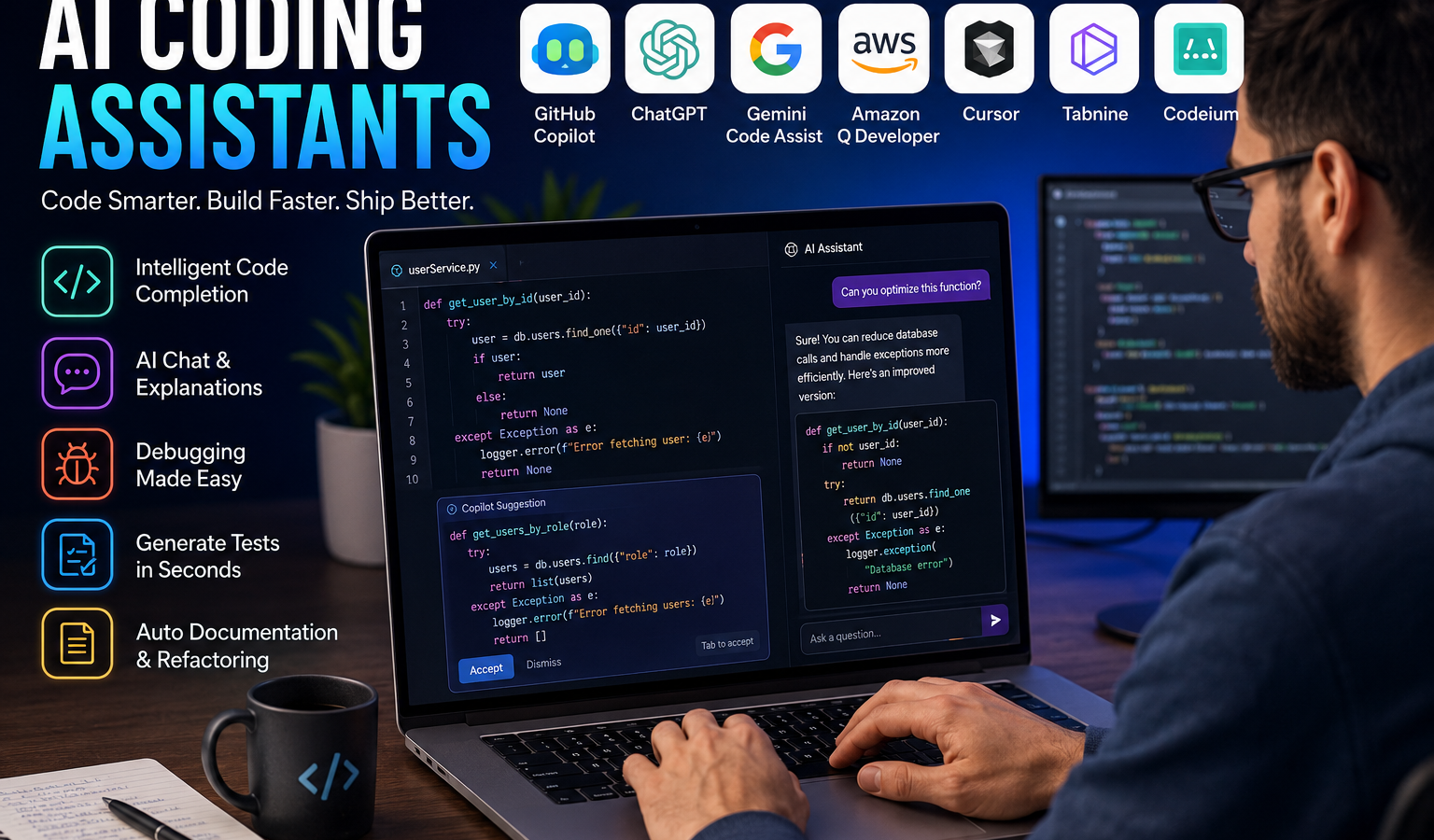

Artificial intelligence has transformed software development. Instead of spending hours writing repetitive code, searching documentation, or debugging errors manually, developers now rely on AI coding assistants to accelerate every stage of programming.
Modern AI coding assistants act like intelligent pair programmers. They suggest code in real time, explain complex functions, generate tests, identify bugs, write documentation, and even help developers learn new programming languages. Whether you’re building websites, mobile applications, enterprise software, or machine learning models, AI-powered coding tools can dramatically improve productivity.
The adoption of AI coding assistants continues to grow across startups, enterprises, and independent developers. Recent industry surveys indicate that a majority of professional developers now use AI-assisted programming tools regularly, reporting significant reductions in development time and improvements in code quality. While these tools do not replace experienced engineers, they have become an essential part of the modern software development workflow.
In this comprehensive guide, you’ll learn how AI coding assistants work, compare the leading platforms, understand their strengths and weaknesses, and discover best practices for integrating them into your daily development process.
Table of Contents
- What Are AI Coding Assistants?
- How AI Coding Assistants Work
- Why Developers Are Using AI Coding Assistants
- Key Features to Look For
- Best AI Coding Assistants in 2026
- AI Coding Assistants Comparison
- Choosing the Right Assistant
- Expert Tips
- Common Mistakes
- Frequently Asked Questions
- Conclusion
What Are AI Coding Assistants?
AI coding assistants are software tools powered by large language models (LLMs) and machine learning algorithms that help developers write, review, optimize, and debug code.
Unlike traditional autocomplete systems that predict only the next word or syntax, AI coding assistants understand the broader context of your project. They analyze surrounding files, function names, project structure, comments, and documentation to generate meaningful code suggestions.
These assistants support numerous programming languages, including:
- Python
- JavaScript
- TypeScript
- Java
- C#
- C++
- Go
- PHP
- Rust
- Swift
- Kotlin
- SQL
Most AI coding assistants integrate directly into popular development environments, allowing developers to receive suggestions without leaving their editor.
How AI Coding Assistants Work
AI coding assistants use advanced transformer-based language models trained on massive datasets containing publicly available code, documentation, programming tutorials, and technical references.
When a developer begins writing code, the assistant analyzes several factors simultaneously:
- Current function
- Project structure
- Variable names
- Imported libraries
- Existing classes
- Comments
- Programming language
- Coding style
Using this context, the AI predicts the developer’s intent and generates relevant suggestions.
For example, if you’re building a REST API, the assistant may automatically suggest route handlers, validation logic, database queries, authentication middleware, and error handling—all tailored to your existing codebase.
Many modern assistants also provide conversational interfaces. Developers can ask questions such as:
- “Explain this function.”
- “Optimize this SQL query.”
- “Find security vulnerabilities.”
- “Convert this JavaScript to TypeScript.”
- “Write unit tests.”
- “Refactor this class.”
The AI responds with code, explanations, or recommended improvements, making development faster and more accessible.
Why Developers Are Using AI Coding Assistants
Software development involves more than writing code. Developers spend considerable time debugging, reading documentation, reviewing pull requests, writing tests, and maintaining legacy applications.
AI coding assistants reduce much of this repetitive work.
Faster Development
One of the biggest advantages is speed.
Instead of typing every line manually, developers can generate complete functions, API endpoints, database models, and configuration files within seconds.
This allows teams to focus more on solving business problems rather than repetitive implementation.
Improved Code Quality
Many AI assistants recommend coding best practices while generating code.
They often include:
- Better naming conventions
- Cleaner architecture
- Proper error handling
- Security improvements
- Performance optimizations
This helps developers produce cleaner, more maintainable software.
Easier Learning
Beginners often struggle with syntax, libraries, and framework conventions.
AI coding assistants provide explanations alongside code suggestions, making them valuable educational tools.
Rather than copying code blindly, learners can understand why the code works and how different approaches compare.
Reduced Context Switching
Developers frequently interrupt their workflow to search documentation or visit forums.
AI assistants answer many questions directly inside the IDE, reducing distractions and helping developers stay focused.
Better Collaboration
Teams can maintain more consistent coding standards by using AI suggestions aligned with project conventions.
This consistency improves readability and simplifies code reviews.
Key Features to Look for in an AI Coding Assistant
Not every AI coding assistant offers the same capabilities.
Before choosing one, evaluate these important features.
Intelligent Code Completion
Look for assistants that understand your entire project instead of completing only the current line.
Context-aware suggestions significantly improve productivity.
Natural Language Commands
Modern assistants allow developers to describe what they want in plain English.
For example:
Create an authentication middleware with JWT validation.
The AI generates the implementation automatically.
Code Explanation
Understanding unfamiliar code is just as important as writing new code.
The best assistants explain:
- Algorithms
- Libraries
- APIs
- Design patterns
- Complex logic
This feature is especially valuable for onboarding new developers.
Debugging Assistance
Advanced tools can identify:
- Syntax errors
- Logic bugs
- Null pointer issues
- Performance bottlenecks
- Security vulnerabilities
Some assistants even suggest fixes automatically.
Test Generation
Writing tests is often time-consuming.
Many AI coding assistants generate:
- Unit tests
- Integration tests
- Mock data
- Edge-case scenarios
This improves software reliability while reducing development effort.
Documentation Generation
Maintaining documentation becomes much easier with AI.
Assistants can automatically create:
- Function comments
- API documentation
- README files
- Changelogs
- Usage examples
High-quality documentation improves collaboration across development teams.
Best AI Coding Assistants in 2026
The AI coding landscape has become increasingly competitive, with several powerful platforms serving different types of developers. While some tools focus on deep IDE integration, others emphasize conversational coding, enterprise security, or support for multiple AI models.
Best AI Coding Assistants in 2026 (Continued)
The market for AI coding assistants has evolved rapidly. Today’s leading platforms do far more than autocomplete code—they can understand large codebases, generate features from natural language, review pull requests, detect vulnerabilities, and even help plan software architecture.
Below are the most popular AI coding assistants available in 2026.
1. Copilot
GitHub Copilot remains one of the most widely used AI coding assistants. Built into popular IDEs such as Visual Studio Code and JetBrains products, it offers intelligent code completion, chat-based assistance, and project-aware suggestions.
Key Features
- Context-aware code completion
- AI chat inside the IDE
- Code explanation
- Pull request assistance
- Test generation
- Documentation support
- Multi-language support
Best For
- Professional developers
- Enterprise teams
- Open-source contributors
Pros
- Excellent code suggestions
- Strong IDE integration
- Reliable documentation support
- Frequent updates
Cons
- Subscription required
- Suggestions still require human review
2. ChatGPT
ChatGPT has become much more than a conversational AI. Developers use it daily to write code, explain complex algorithms, generate documentation, optimize SQL queries, debug applications, and even design software architecture.
Unlike IDE-specific assistants, ChatGPT supports broader software engineering tasks.
Key Features
- Multi-language coding
- Architecture planning
- Debugging assistance
- Documentation generation
- API integration help
- Code explanation
- Refactoring suggestions
Best For
- Learning programming
- Full-stack development
- Research
- Problem solving
Pros
- Excellent explanations
- Supports virtually every programming language
- Strong reasoning capabilities
- Helpful for beginners and experts alike
Cons
- Requires careful prompt writing
- May need project context for optimal results
3. Gemini Code Assist
Google’s Gemini Code Assist has become a strong choice for developers working with Google Cloud services and enterprise applications.
Its strengths include cloud-native development, Kubernetes, APIs, and backend infrastructure.
Highlights
- Google Cloud integration
- AI chat
- Code completion
- Documentation lookup
- Cloud deployment assistance
- Security recommendations
4. Q Developer
Amazon Q Developer focuses on enterprise software development and AWS environments.
It helps developers write infrastructure code, deploy cloud resources, analyze logs, and troubleshoot production issues.
Ideal for:
- AWS developers
- DevOps engineers
- Cloud architects
- Enterprise applications
5. Cursor AI
Cursor AI combines a powerful code editor with integrated artificial intelligence.
Instead of adding AI as a plugin, Cursor places AI at the center of the development workflow.
Developers can:
- Edit multiple files simultaneously
- Generate new features
- Refactor large projects
- Search code semantically
- Ask questions about an entire repository
Cursor has become increasingly popular among startups because of its speed and workflow improvements.
6. Tabnine
Tabnine emphasizes privacy and enterprise deployment.
Organizations that cannot expose proprietary code to public AI services often choose Tabnine because it offers private deployment options.
Major strengths include:
- Private AI models
- Enterprise security
- Fast code completion
- Team customization
- On-premise deployment
7. Codeium
Codeium provides many AI coding features through a generous free tier.
Developers appreciate:
- Fast suggestions
- Chat assistance
- Large language support
- Multiple IDE integrations
- Good performance for individual developers
It has become a popular alternative for freelancers and students.
8. Replit AI
Replit AI focuses on browser-based development.
Users can build complete applications without installing local development environments.
Features include:
- AI code generation
- Deployment assistance
- Debugging
- Educational support
- Collaboration
It is particularly useful for learning programming and rapid prototyping.
AI Coding Assistants Comparison
| Feature | GitHub Copilot | ChatGPT | Gemini Code Assist | Amazon Q | Cursor AI | Tabnine | Codeium |
|---|---|---|---|---|---|---|---|
| Code Completion | Excellent | Good | Excellent | Excellent | Excellent | Excellent | Excellent |
| AI Chat | Yes | Excellent | Yes | Yes | Yes | Yes | Yes |
| Debugging | Excellent | Excellent | Very Good | Excellent | Excellent | Good | Very Good |
| Documentation | Excellent | Excellent | Good | Good | Good | Moderate | Good |
| Refactoring | Excellent | Excellent | Good | Good | Excellent | Moderate | Good |
| Learning Support | Good | Excellent | Good | Moderate | Good | Moderate | Good |
| Enterprise Features | Excellent | Excellent | Excellent | Excellent | Good | Excellent | Moderate |
How to Choose the Right AI Coding Assistant
Every developer has different needs.
Consider the following factors before selecting a tool.
Your Programming Language
Most assistants support common languages.
However, verify support for specialized technologies like:
- Rust
- Dart
- COBOL
- Scala
- Elixir
- Solidity
IDE Compatibility
Ensure your preferred editor is supported.
Common IDEs include:
- Visual Studio Code
- IntelliJ IDEA
- PyCharm
- Android Studio
- Eclipse
- Neovim
Pricing
Some assistants offer generous free plans.
Others provide enterprise subscriptions with:
- Team management
- Security controls
- Compliance
- Private models
- Dedicated support
Balance your budget against the features you need.
Privacy and Security
If you work with confidential source code, choose a platform that offers:
- Encryption
- Private repositories
- Data isolation
- Compliance certifications
- Enterprise governance
Team Collaboration
Large development teams benefit from assistants that support:
- Shared coding standards
- Pull request reviews
- Team knowledge
- Repository indexing
- Organization-wide customization
These capabilities improve consistency and reduce onboarding time for new developers.
Expert Tips for Using AI Coding Assistants
To maximize productivity, treat AI as a collaborative programming partner rather than a replacement for human expertise.
- Write clear and specific prompts to get better code suggestions.
- Break large development tasks into smaller, manageable requests.
- Review every AI-generated code snippet before deploying it.
- Use version control systems such as Git to track AI-assisted changes.
- Generate unit tests alongside new features to catch issues early.
- Ask the AI to explain unfamiliar code instead of copying it blindly.
- Keep your dependencies updated to reduce compatibility and security problems.
- Combine AI assistance with manual code reviews for the best results.
- Use static analysis and automated testing to validate AI-generated code.
- Continuously improve your prompting skills to receive more accurate and relevant outputs.
Common Mistakes to Avoid
Even the best AI coding assistants can produce inaccurate or inefficient code if used carelessly.
Avoid these common mistakes:
- Accepting code suggestions without reviewing them.
- Ignoring security vulnerabilities in generated code.
- Depending on AI for every programming decision.
- Skipping documentation because AI generated the implementation.
- Using outdated libraries suggested by the model.
- Forgetting to test edge cases and error handling.
- Sharing sensitive or proprietary code with services that do not meet your organization’s privacy requirements.
- Neglecting performance optimization and assuming AI-generated code is always efficient.
By combining AI assistance with critical thinking and software engineering best practices, developers can achieve higher productivity while maintaining code quality.
Frequently Asked Questions (FAQs)
1. What is an AI coding assistant?
An AI coding assistant is a software tool powered by artificial intelligence that helps developers write, complete, explain, debug, refactor, and optimize code. It acts as an intelligent programming partner by understanding the context of your project and providing relevant suggestions.
2. Are AI coding assistants suitable for beginners?
Yes. AI coding assistants are excellent learning tools for beginners. They can explain programming concepts, generate sample code, suggest best practices, and help learners understand syntax across multiple programming languages. However, beginners should still study programming fundamentals instead of relying entirely on AI-generated code.
3. Can AI coding assistants replace software developers?
No. AI coding assistants enhance developer productivity but do not replace human expertise. Developers are still responsible for designing software architecture, solving complex business problems, validating code quality, ensuring security, and making critical engineering decisions.
4. Which AI coding assistant is the best?
The best AI coding assistant depends on your needs:
- GitHub Copilot is ideal for professional software development.
- ChatGPT excels at explanations, debugging, and software design.
- Cursor AI is well-suited for AI-first coding workflows.
- Google Gemini Code Assist is a strong choice for Google Cloud projects.
- Amazon Q Developer is ideal for AWS-focused development.
- Codeium offers excellent value with a generous free plan.
5. Do AI coding assistants support multiple programming languages?
Yes. Most modern AI coding assistants support dozens of programming languages, including:
- Python
- JavaScript
- TypeScript
- Java
- C#
- C++
- PHP
- Go
- Rust
- Swift
- Kotlin
- SQL
Support varies by platform, so verify compatibility with your preferred language before choosing a tool.
6. Are AI-generated code suggestions secure?
AI can recommend secure coding practices, but it may also generate vulnerable or inefficient code. Always review AI-generated code, run security scans, perform code reviews, and test thoroughly before deploying applications to production.
7. Can AI coding assistants improve developer productivity?
Yes. Many organizations report noticeable productivity gains after adopting AI coding assistants. Developers spend less time writing repetitive code, searching documentation, debugging routine issues, and generating boilerplate, allowing them to focus on higher-value engineering tasks.
8. Should businesses invest in AI coding assistants?
For many organizations, the answer is yes. AI coding assistants can accelerate software delivery, improve developer efficiency, reduce repetitive work, support onboarding, and help maintain consistent coding standards. Businesses should also evaluate factors such as data privacy, compliance, integration with existing tools, and total cost of ownership before deployment.
Conclusion
AI coding assistants have become an integral part of modern software development. From generating boilerplate code and explaining complex algorithms to assisting with debugging, testing, documentation, and refactoring, these tools help developers work more efficiently while reducing repetitive tasks.
The best AI coding assistant depends on your workflow, programming languages, development environment, and organizational requirements. Professional developers may prefer GitHub Copilot for its deep IDE integration, while ChatGPT is a versatile option for coding, architecture discussions, learning, and troubleshooting. Enterprise teams often benefit from platforms like Google Gemini Code Assist, Amazon Q Developer, or Tabnine because of their security and governance features.
Despite their capabilities, AI coding assistants should complement—not replace—sound software engineering practices. Reviewing generated code, writing comprehensive tests, following secure coding standards, and applying human judgment remain essential for building reliable, maintainable applications.
As AI models continue to advance, coding assistants will play an even larger role in the software development lifecycle, enabling developers to innovate faster while maintaining high standards of quality and security.
Call to Action
Ready to boost your development workflow? Explore the leading AI coding assistants, compare their features, and choose the one that aligns with your projects and team requirements. Start with a free plan or trial, integrate AI into your daily coding routine, and discover how intelligent assistance can help you write cleaner code, solve problems faster, and deliver software more efficiently.
Whether you’re a beginner learning your first programming language or an experienced engineer building enterprise applications, adopting the right AI coding assistant can significantly improve your productivity and development experience.