
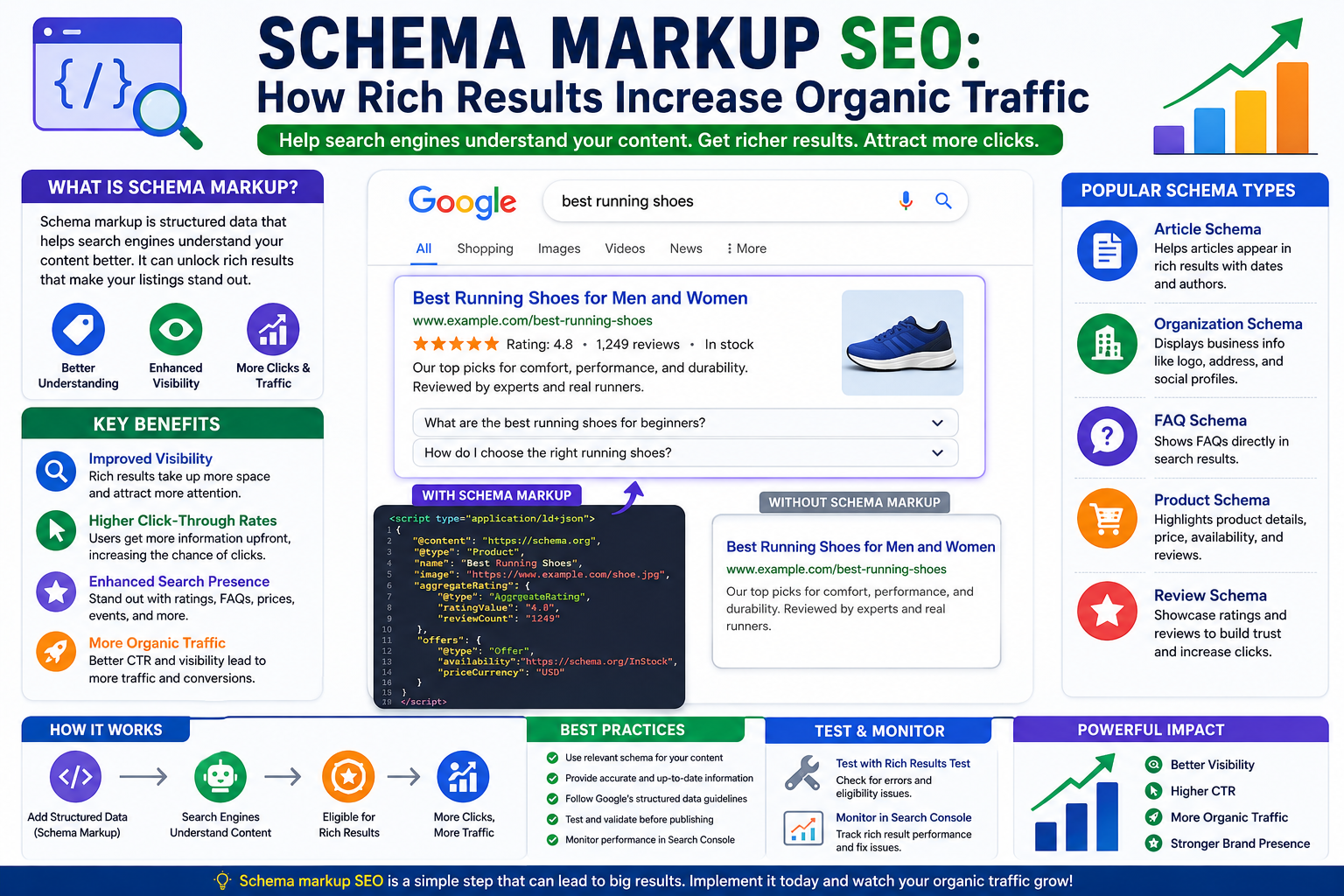

In today’s increasingly competitive search landscape, schema markup SEO has become one of the most valuable technical optimization strategies for improving visibility and attracting more organic traffic. While schema markup may not directly increase rankings, it helps search engines better understand your content and can unlock enhanced search features known as rich results.
Rich results make listings more attractive, informative, and engaging, which often leads to higher click-through rates and improved user engagement.
Whether you manage a blog, e-commerce store, local business website, or corporate platform, understanding schema markup can provide a significant SEO advantage.
What Is Schema Markup SEO?
Schema markup SEO refers to the practice of adding structured data to web pages using standardized vocabulary that helps search engines understand content more accurately.
Schema markup is based on the collaborative framework developed by and supported by major search engines.
Structured data helps identify:
- Articles
- Products
- Reviews
- FAQs
- Events
- Organizations
- Recipes
- Local businesses
Instead of guessing what content means, search engines receive clear signals about page elements.
Why Structured Data Matters for Search Engines
Search engines have become increasingly sophisticated, but structured data still provides valuable context.
Understanding Semantic Search
Modern search algorithms focus on meaning rather than exact keywords.
For example, search engines attempt to understand:
- Entities
- Relationships
- Context
- User intent
Schema markup supports these goals by clearly labeling important information.
How Google Interprets Content
Without structured data:
- Search engines infer meaning
With structured data:
- Search engines receive explicit meaning
This additional clarity improves content interpretation and eligibility for enhanced search features.
What Are Rich Results?
Rich results are enhanced search listings that display additional information beyond standard blue links.
Examples include:
- Star ratings
- FAQs
- Product pricing
- Event dates
- Recipe details
- Business information
These enhancements make listings more prominent in search results.
Rich Snippets vs Rich Results
Although often used interchangeably, there are subtle differences.
| Feature | Rich Snippets | Rich Results |
|---|---|---|
| Enhanced Display | Yes | Yes |
| Structured Data Required | Usually | Yes |
| Advanced Search Features | Limited | Extensive |
Google generally uses the term “rich results” for enhanced search experiences.
Common Rich Result Types
Popular rich result formats include:
- FAQ Results
- Product Results
- Review Results
- Recipe Results
- Event Results
- Video Results
- Organization Results
Each format serves different content types.
Benefits of Schema Markup SEO
The advantages of structured data extend beyond search engine understanding.
Improved Visibility
Rich results often occupy more space within search results pages.
This increased visibility can:
- Draw attention
- Improve brand recognition
- Enhance search presence
Larger search listings frequently outperform standard results.
Higher Click-Through Rates
Rich results provide users with more information before clicking.
Examples include:
- Ratings
- Prices
- Availability
- Event dates
These details help users make faster decisions.
Enhanced Search Presence
Schema markup can support:
- Knowledge panels
- Rich cards
- Featured elements
- AI-powered search summaries
A stronger search presence can lead to increased organic traffic.
How Schema Markup Works
Schema markup uses structured data formats that search engines can easily interpret.
Structured Data Formats
Three primary formats exist:
| Format | Recommendation |
|---|---|
| JSON-LD | Preferred |
| Microdata | Supported |
| RDFa | Supported |
Google strongly recommends JSON-LD.
JSON-LD Explained
JSON-LD stands for JavaScript Object Notation for Linked Data.
Benefits include:
- Easy implementation
- Cleaner code
- Better maintenance
- Search engine compatibility
Most modern SEO professionals prefer JSON-LD because it minimizes coding complexity.
Essential Schema Types for SEO
Different websites benefit from different schema types.
Article Schema
Article schema helps search engines understand:
- Headlines
- Authors
- Publication dates
- Article content
Ideal for:
- Blogs
- News websites
- Editorial content
Organization Schema
Organization schema identifies:
- Business name
- Logo
- Contact details
- Social profiles
This schema supports brand recognition.
FAQ Schema
FAQ schema allows common questions and answers to be understood more effectively by search engines.
Benefits include:
- Better content organization
- Increased visibility
- Enhanced user experience
Product Schema
E-commerce websites can use product schema to display:
- Prices
- Availability
- Reviews
- Product details
This often improves commercial search performance.
Review Schema
Review schema highlights:
- Ratings
- Reviews
- User feedback
Social proof can increase clicks and conversions.
Implementing Schema Markup
Adding schema markup can be straightforward when following best practices.
Manual Implementation
Developers can add structured data directly into website code.
Advantages:
- Maximum control
- Greater customization
- Flexible implementation
Disadvantages:
- Requires technical knowledge
- More time-intensive
Using Schema Generators
Many website owners prefer schema generation tools.
These tools help:
- Create JSON-LD code
- Reduce errors
- Simplify implementation
They are especially useful for beginners.
Testing and Validating Structured Data
Implementation alone is not enough.
Rich Results Test
Validation helps identify:
- Missing fields
- Syntax errors
- Eligibility issues
Always test markup before deployment.
Search Console Monitoring
Monitor structured data reports regularly.
Review:
- Warnings
- Errors
- Rich result eligibility
- Performance metrics
Ongoing monitoring helps maintain effectiveness.
Schema Markup Best Practices
Following best practices improves long-term success.
Accuracy and Relevance
Only mark up content that actually exists on the page.
Avoid:
- Misleading information
- Hidden content
- Inaccurate data
Google may ignore or penalize manipulative markup.
Keeping Structured Data Updated
Regular updates are essential.
Examples:
- Product prices
- Business hours
- Event schedules
- Availability status
Outdated structured data can reduce trust.
Common Schema Markup Mistakes
Many websites make avoidable errors.
Invalid Markup
Common problems include:
- Missing required properties
- Incorrect syntax
- Formatting errors
Validation tools help identify issues quickly.
Misleading Data
Schema should accurately reflect visible content.
Avoid marking up:
- Fake reviews
- Nonexistent products
- Hidden FAQs
Search engines increasingly detect manipulation.
Schema Markup and AI Search
AI-powered search experiences continue to evolve.
Structured Data in Generative Search
As AI search systems become more sophisticated, structured data helps machines understand content relationships and entities more effectively.
Potential benefits include:
- Improved AI citations
- Better content interpretation
- Enhanced knowledge extraction
Schema markup helps prepare websites for future search technologies.
Measuring Schema Performance
Track the impact of structured data using key metrics.
Monitor:
- Click-through rates
- Organic traffic
- Rich result impressions
- Search visibility
- Conversion rates
Compare performance before and after implementation to measure effectiveness.
For official implementation guidance, review .
Frequently Asked Questions
1. What is schema markup SEO?
Schema markup SEO involves adding structured data to web pages so search engines can better understand content and potentially display rich results.
2. Does schema markup improve rankings?
Schema markup is not a direct ranking factor, but it can improve visibility and click-through rates, which may indirectly support SEO performance.
3. What are rich results?
Rich results are enhanced search listings that display additional information such as ratings, FAQs, pricing, images, or event details.
4. What is the best schema format?
JSON-LD is Google’s preferred structured data format due to its simplicity and flexibility.
5. Which schema type is most useful?
The most useful schema depends on your website type. Article, Product, FAQ, Organization, and Review schema are among the most commonly used.
6. How do I test schema markup?
You can validate structured data using Google’s Rich Results Test and monitor performance through Google Search Console.
7. Can schema markup increase organic traffic?
Yes. Rich results often improve click-through rates by making search listings more attractive and informative.
8. Is schema markup important for AI search?
Increasingly, yes. Structured data helps AI systems understand content relationships and contextual information more accurately.
Conclusion
Schema markup SEO is one of the most effective technical optimization techniques for improving search visibility and enhancing user engagement. By providing search engines with clear, structured information, websites become eligible for rich results that attract attention and encourage more clicks.
From article schema and FAQs to product and review markup, structured data offers valuable opportunities to strengthen your search presence. As AI-driven search continues evolving, schema markup will likely become even more important for helping search engines understand and showcase high-quality content.
Businesses that invest in accurate, well-maintained structured data today will be better positioned to capture more organic traffic and stay competitive in the future of search.