
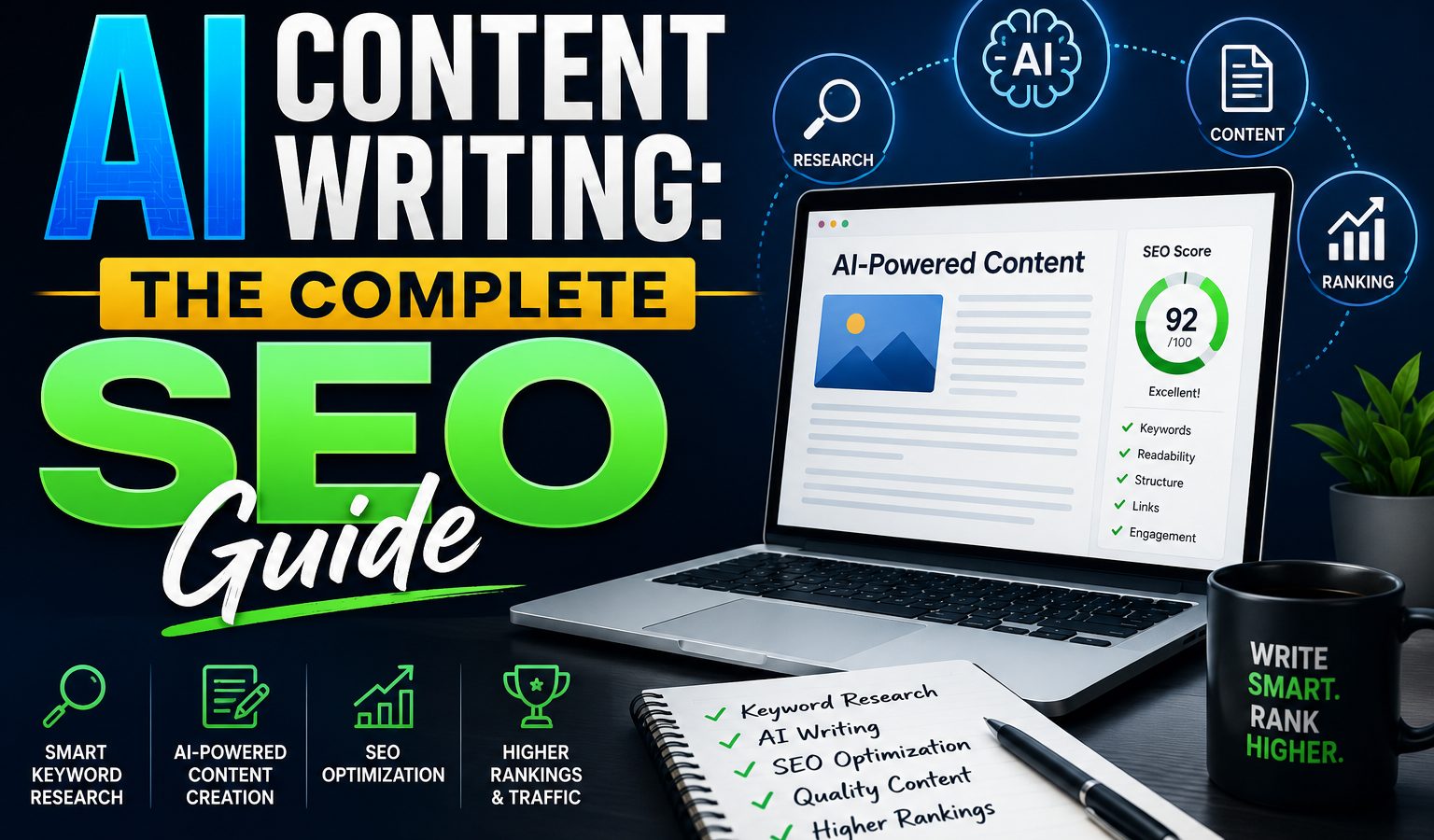

AI content writing has moved from a novelty to a real production workflow. Today, marketers, bloggers, agencies, and business owners use generative AI to draft outlines, research angles, rewrite sections, summarize sources, and speed up publishing. The winning approach is not to let AI replace expertise. It is to let AI support a stronger editorial process.
OpenAI describes ChatGPT as useful for drafting, rewriting, tightening, and turning rough notes into clear communication, while also stressing that outputs should be reviewed and treated as drafts rather than final authority. That matches how good SEO teams already work: plan, draft, revise, and package. The most effective content is still guided by human judgment, fact checking, and brand voice. citeturn994283search0turn994283search4
This guide breaks down how AI content writing works, where it helps, where it fails, and how to use it for search-friendly content that feels human, useful, and trustworthy. It also includes workflows, comparison points, common mistakes, FAQs, schema, and practical tips you can apply immediately.
Table of Contents
- What AI content writing means
- Why businesses use AI for content creation
- How AI supports SEO content
- Human editing vs. automated drafting
- Best practices for EEAT content
- Comparison table: human writing vs. AI-assisted writing
- Expert tips
- Common mistakes
- FAQs
- Conclusion and call to action
What Is AI Content Writing?
AI content writing is the process of using artificial intelligence tools to help create written content. That can include blog posts, landing pages, product descriptions, email copy, social captions, FAQs, scripts, and content briefs. In most professional workflows, AI is used to accelerate specific parts of the process, not to automate everything from idea to publication.
In practical terms, AI can help you brainstorm topics, build outlines, generate first drafts, improve clarity, and adapt tone. It can also help with keyword clustering, semantic coverage, and content refreshing. The best results happen when you give the model strong context, specific goals, and clear constraints. OpenAI’s guidance emphasizes precision, iteration, and tone control to improve response quality. citeturn994283search2turn994283search0
Why AI Content Writing Became So Popular
The main reason is speed. Content teams are under pressure to publish more, cover more keywords, and keep content fresh. AI shortens the time it takes to move from idea to draft. It also lowers the barrier for small businesses that do not have a large editorial team.
There is also a scaling advantage. A marketer can use AI to create a topic cluster, turn one article into multiple formats, and produce more variations for testing. A strategist can use it to create content briefs, content refresh plans, and FAQ expansions. A writer can use it to eliminate blank-page friction and focus more on the parts that require insight.
- Faster outlines and drafts
- More topic coverage
- Lower production costs
- Better consistency across teams
- More time for editing and strategy
How AI Content Writing Helps SEO
AI can support SEO in several useful ways. It helps writers expand a topic beyond the main keyword, which is important because modern search engines look for depth, relevance, and intent matching. It can suggest related entities, subtopics, and long-tail variations that make a page more comprehensive.
For example, a page targeting “AI content writing” may also need terms like AI writing tools, SEO content strategy, content optimization, generative AI, editorial workflow, fact checking, content briefs, and human editing. These related terms help search engines understand topical coverage. They also make the article more useful to readers.
AI also helps with content refreshes. Old content can be updated with new examples, revised statistics, and better structure. That matters because search performance often depends on freshness, usefulness, and clarity. Google has repeatedly stressed creating helpful content for people rather than content designed purely to manipulate rankings. citeturn994283search0turn994283search4
The Right Way to Use AI for Content Creation
1. Start with a clear brief
Good output begins with good input. Tell the AI who the audience is, what problem the article solves, which tone to use, how long the piece should be, and which sections are required. A detailed brief improves relevance and reduces generic wording. OpenAI’s writing guidance recommends giving context, constraints, and a clear format so the model can produce more useful drafts. citeturn994283search0turn994283search2
2. Ask for structure before prose
Instead of asking for a full article right away, ask for an outline first. This gives you a chance to shape the logic, remove repetition, and make sure the article covers the right angles. It is much easier to improve structure before a 3,000-word draft is generated.
3. Add human expertise
AI is strongest at pattern recognition and language generation. Humans are stronger at judgment, nuance, and verification. That means the best content usually comes from combining both. Add examples from your own work, real observations, case studies, screenshots, original opinions, and internal data whenever possible.
4. Edit for accuracy and voice
AI can be confident even when it is wrong. That is why every article needs fact checking. Read the draft line by line. Remove weak phrasing. Replace vague claims with specific details. Align the style with your brand voice so the article does not sound machine-made.
Human Writing vs AI-Assisted Writing
The real debate is not human versus AI. It is whether the workflow produces helpful, original, accurate content. The table below shows the practical difference.
| Factor | Human Writing | AI-Assisted Writing |
|---|---|---|
| Speed | Slower | Faster drafting |
| Original insight | Strong | Depends on input |
| Accuracy | Usually higher with expertise | Needs checking |
| Scalability | Limited by time | High |
| Voice consistency | Strong | Requires editing |
| SEO expansion | Manual research needed | Fast semantic coverage |
AI-assisted writing wins on speed and scale. Human writing wins on insight and accountability. The strongest process combines both.
Statistics and Industry Context
OpenAI says ChatGPT can support common workplace writing tasks such as drafting, rewriting, and refining. The company also notes that the best results come from iterative prompting and specific instructions. That is useful because content teams rarely produce a polished article in one pass. They shape it through multiple revisions. citeturn994283search0turn994283search2
On the SEO side, the broader content environment has become more competitive. Searchers expect clearer answers, stronger formatting, and better topical depth. Pages that are thin, repetitive, or overly generic tend to struggle. This is why AI should be used to improve breadth and structure, not to flood the web with shallow content.
Another important context point is trust. OpenAI’s responsible-use guidance warns that AI can produce incorrect information and should be used carefully. That means publishing workflows need a review stage, especially for statistics, technical instructions, medical content, finance, or legal topics. citeturn994283search4
Best Practices for EEAT-Optimized AI Content
Show experience
EEAT improves when the content reflects real experience. Add practical examples, results, workflows, and observations. Show how a method works in the real world, not just in theory.
Demonstrate expertise
Explain concepts clearly. Use correct terminology. Include specific details. If the article covers a technical topic, define terms where needed and avoid oversimplifying important concepts.
Increase authoritativeness
Link to reputable sources. Reference recognized organizations. Add internal links to related articles on your site. Strong internal linking helps establish topical authority and improves navigation for users.
Build trust
Be transparent about what AI did and what a human reviewed. Avoid exaggerated claims. Correct errors quickly. Use accurate citations and keep your content updated.
Comparison Table: Good AI Content vs Weak AI Content
| Element | Good AI Content | Weak AI Content |
|---|---|---|
| Intro | Clear, specific, audience-focused | Generic and repetitive |
| SEO use | Includes semantic terms naturally | Keyword stuffing |
| Readability | Short paragraphs and scannable sections | Long blocks of text |
| Trust | Checked facts and cited sources | Unsupported claims |
| Voice | Consistent and human-like | Flat and robotic |
| Value | Offers practical steps and examples | Explains little of substance |
Expert Tips for Better AI Content Writing
- Use AI for outlines, then write the strongest sections yourself.
- Feed the model real examples from your brand or niche.
- Ask for multiple headline options and choose the strongest one.
- Rewrite the opening paragraph manually for better voice.
- Add original insights, stats, and internal data before publishing.
- Run a final fact-check on every named tool, statistic, or claim.
- Use related phrases naturally instead of repeating the exact keyword too often.
Common Mistakes in AI Content Writing
- Publishing AI text without editing
- Using the same prompt for every article
- Keyword stuffing instead of natural language
- Ignoring fact-checking and source quality
- Writing for search engines only, not people
- Skipping internal links
- Making the content too broad
- Forgetting a clear call to action
These mistakes reduce trust, weaken readability, and make the page less useful. The goal is not to make content sound AI-generated. The goal is to make it sound polished, informed, and helpful.
Internal Linking Suggestions
- AI SEO tools
- SEO content writing tips
- WordPress content marketing
- How to write blog posts that rank
- Content optimization checklist
- Generative AI for business
External Authority Links
- OpenAI Writing with ChatGPT
- OpenAI Responsible and Safe Use
- OpenAI Prompt Engineering Best Practices
- Google Search Central helpful content guidance
FAQs
1. Is AI content writing good for SEO?
Yes, when it is edited well. AI helps you cover more subtopics, write faster, and improve structure. But the content still needs human review, originality, and accuracy checks.
2. Can Google detect AI-written content?
Search engines focus more on usefulness, originality, and trust than on whether AI was used. A well-edited article with real value can perform well.
3. What should AI be used for in content creation?
It is best for brainstorming, outlines, first drafts, rewrites, summaries, and content refreshes. It is not ideal as a replacement for expert review.
4. How do I make AI content sound human?
Use short paragraphs, varied sentence length, practical examples, and natural transitions. Remove repetitive patterns and rewrite the most important sections yourself.
5. Does AI content writing save time?
Yes. It speeds up drafting and reduces blank-page time. The biggest savings usually come from outlines, research support, and first-draft generation.
6. What is the biggest risk of AI writing?
The biggest risk is publishing inaccurate, shallow, or repetitive content without checking it. AI can sound confident even when it is wrong, so editing is essential. citeturn994283search4
7. How can AI improve content strategy?
It can help generate topic clusters, find content gaps, rewrite old posts, and expand FAQ sections. This makes it easier to build topical authority over time.
8. Should I disclose AI use in content?
Disclosure depends on your brand, industry, and audience expectations. In sensitive or expert-led niches, transparency about human review is usually a good trust signal.
Conclusion
AI content writing is not a shortcut to quality on its own. It is a workflow advantage. Used well, it helps writers think faster, draft faster, and publish stronger content. Used poorly, it creates generic pages that people do not trust.
The best strategy is simple: let AI handle speed, and let humans handle judgment. Use it for planning, structuring, and drafting. Then add expertise, citations, examples, and editorial care. That is how you create content that ranks and actually helps readers.
Call to Action
Use this guide to build a smarter AI content writing workflow for your website. Start with one article, improve your brief, and edit every draft with a human eye. Then scale what works.




Seriously, finding a clean yolo247 apk download is a mission. This site is a lifesaver, fingers crossed it works a charm! Download yolo247 apk here: yolo247 apk download