
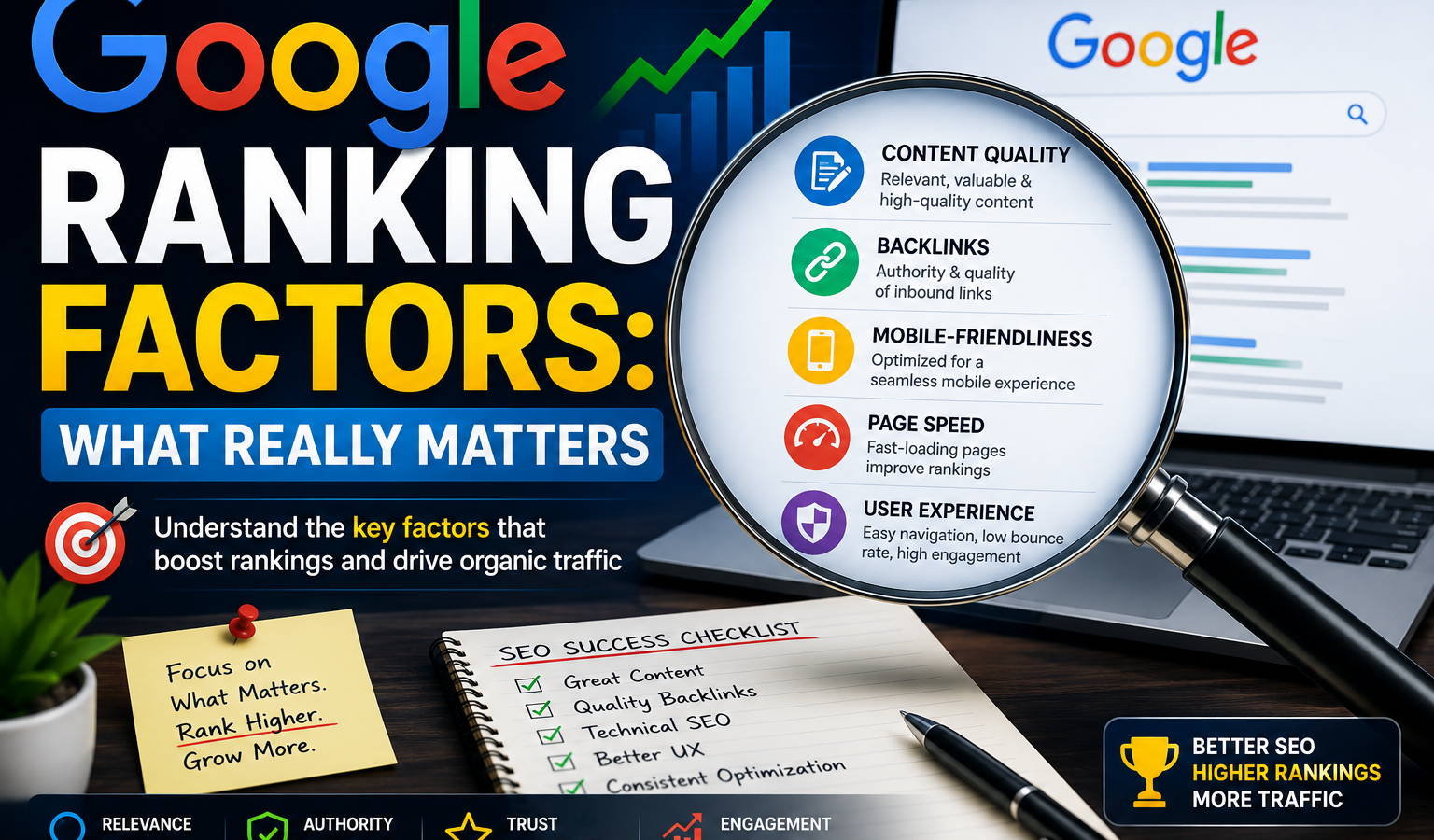

Google ranking factors are the signals and systems Google uses to decide which pages best satisfy a search query. The important idea is not that one single factor wins every time. Google says its systems use many different signals and ranking systems to show the most relevant, useful results. citeturn663698search1turn663698search2
That means the best SEO strategy is not chasing a checklist of tiny tricks. It is building pages that are genuinely helpful, technically sound, and trustworthy. Google’s own documentation repeatedly points creators toward people-first content, clear authorship, useful titles, and content that demonstrates experience, expertise, authoritativeness, and trustworthiness. citeturn663698search0turn663698search2
This article breaks down the ranking factors that matter most, explains how they work together, and shows how to build content that earns visibility without relying on guesswork. It also includes a comparison table, expert tips, common mistakes, FAQs, and practical internal and external linking suggestions.
Table of Contents
- What Google ranking factors actually are
- Why people-first content matters
- The most important ranking systems and signals
- Content quality and search intent
- E-E-A-T and trust
- Page experience and technical SEO
- Links, freshness, and relevance
- Comparison table
- Expert tips
- Common mistakes
- FAQs
- Conclusion and call to action
What Are Google Ranking Factors?
Google ranking factors are the many signals used by search systems to sort pages in search results. These signals are not all equal, and they are not all public. Some are tied to content quality, some to relevance, some slot gacor to links, and some to page experience. Google says its ranking systems work on the page level and use a variety of signals and systems to understand how to rank individual pages. citeturn663698search1
It helps to think of ranking factors in categories rather than as a single master list. A page can rank well because it matches intent, because it is fresh, because it has strong authoritative references, because it loads well, or because it answers the question better than competitors. Often, the strongest pages win because they perform well across several categories at once.
Why Google Rewards People-First Content
Google Search Central says its automated ranking systems are designed to prioritize helpful, reliable information created to benefit people, not content created mainly to manipulate rankings. That is one of the clearest clues about what matters most. If a page is written for search engines first, it is at risk of underperforming. citeturn663698search0turn663698search2
People-first content usually has a real audience, a clear purpose, useful detail, and original value. It answers the question well. It also feels complete enough that someone could bookmark it or share it with another person. Google’s guidance explicitly asks whether content provides original information, substantial coverage, and a satisfying experience for readers. citeturn663698search0
- It solves a real user problem.
- It avoids thin or repetitive explanations.
- It includes original insight or analysis.
- It is written clearly and accurately.
- It feels useful without needing a lot of extra searching.
The Most Important Google Ranking Factors
1. Content relevance
Relevance means how closely your page matches the intent behind the query. If someone searches for “Google ranking factors,” they probably want a clear explanation of the main signals, not a vague definition or a list of unrelated SEO tips. Your title, headings, introduction, and body content should all make that relevance obvious.
Google Search Essentials says creators should use words people would actually use and place them in prominent locations such as the title, main heading, alt text, and link text. That does not mean stuffing keywords. It means making relevance easy to understand. citeturn663698search2
2. Content quality
Quality matters because searchers want the best answer, not the fastest answer. Google’s helpful content guidance asks whether content offers original research, complete coverage, and substantial additional value beyond what is already out there. citeturn663698search0
High-quality content is accurate, well organized, and specific. It avoids filler. It uses examples where useful. It explains concepts in a way that helps the reader move forward. On competitive topics, quality often separates the good results from the great ones.
3. Search intent match
Search intent is the reason behind the query. Some searches are informational. Some are transactional. Some are navigational. Google’s systems are built to identify what kind of result best serves the searcher. A page that matches the wrong intent can lose even if it is well written.
For example, someone searching “Google ranking factors” likely wants an informational guide, not a product page. If your article reads like a sales pitch, it will not satisfy the intent as well as a neutral, comprehensive explanation.
4. E-E-A-T and trust
Google says E-E-A-T is not a single ranking factor, but it is useful because multiple signals help systems identify content with good experience, expertise, authoritativeness, and trustworthiness. Google also says trust is the most important of the four. citeturn663698search0
For SEO, that means readers should quickly understand who wrote the content, why they should trust it, and whether the information is backed by reliable sources. This matters even more for YMYL topics, where inaccurate content can affect health, finances, safety, or wellbeing. citeturn663698search0
- Clear bylines
- Strong source citations
- Evidence of firsthand knowledge
- Accurate claims
- Transparent editing or review process
5. Link signals
Links remain important because they help Google understand what pages are about and which pages appear more authoritative. Google’s ranking systems guide says link analysis systems, including PageRank, continue to be part of its core ranking systems. citeturn663698search1
Not all links are equal. Relevant, editorial links from trusted pages tend to be more valuable than weak or manipulative links. The best links are earned naturally because the content deserves reference.
6. Page experience
Google says site owners should provide a good page experience across many aspects, not just one or two. Page experience includes things like mobile usability, loading performance, visual stability, and safe browsing basics. citeturn663698search0turn663698search1
A page that is slow, hard to read, or cluttered can struggle even if the content itself is strong. Good SEO works best when the content and the experience support each other.
7. Freshness
Google uses freshness systems for queries where newer information is more helpful. For example, recent news, trends, or changing topics often deserve newer results. citeturn663698search1
This does not mean every page must be constantly rewritten. It means you should update content when the topic changes, the data becomes old, or a better explanation is available. Freshness helps most when it improves usefulness.
8. Title and heading clarity
Google advises using descriptive, helpful titles and headings. A strong title tells the searcher exactly what the page covers. A weak title wastes the opportunity to match both relevance and intent. citeturn663698search0turn663698search2
For example, “Google Ranking Factors: What Really Matters” is clearer than “SEO Secrets You Need to Know.” Specific language usually performs better because it reduces ambiguity.
Comparison Table: Strong vs Weak Ranking Signals
| Signal | Strong Page | Weak Page |
|---|---|---|
| Relevance | Directly matches the query intent | Broad, vague, or off-topic |
| Content depth | Complete and useful coverage | Thin, repetitive, or shallow |
| E-E-A-T | Clear author, trusted sources | No evidence of expertise |
| Links | Earned and relevant | Manipulative or low-quality |
| Page experience | Fast, clean, mobile-friendly | Slow and cluttered |
| Freshness | Updated when needed | Outdated and unchanged |
How Google Understands Helpful Content
Google’s helpful content guidance gives creators a strong framework for evaluating their pages. It asks whether the page provides substantial value, original information, and a satisfying experience. It also asks whether the content is made primarily for people or for search engines. citeturn663698search0turn663698search2
This matters because Google’s systems are increasingly designed to reward content that solves the user’s problem efficiently and credibly. A page does not need to be long to rank. It needs to be useful, trustworthy, and the best answer for the query.
What Google Says About AI and Content Quality
Google does not reject content simply because AI was involved. The key question is whether the content is helpful, original, and created for people. Google also notes that if automation is used substantially, it can be useful to explain how and why it was used. citeturn663698search0
This is important for modern SEO workflows. AI can accelerate outlines, drafts, and rewriting, but the final content should still be fact-checked and improved by a human. A weak AI article usually feels generic, repetitive, or unsupported. A strong AI-assisted article feels polished, original, and edited with care.
Expert Tips for Improving Google Rankings
- Write for the searcher’s intent first.
- Use a title that clearly states the topic.
- Add original examples, explanations, or data.
- Include internal links to related pages.
- Use external links to trusted sources.
- Refresh content when facts or trends change.
- Make the page easy to scan on mobile.
- Show the author and build trust signals.
Common Mistakes That Hurt Rankings
- Keyword stuffing
- Thin content with little value
- Duplicate or heavily rewritten pages
- Ignoring search intent
- No internal linking
- Bad titles and headings
- Outdated information
- Weak trust signals
These mistakes hurt both users and search engines. The most common problem is trying to rank before helping. When the article is useful first, SEO usually improves as a result.
Internal Linking Suggestions
- SEO content writing tips
- AI content writing
- WordPress SEO checklist
- How to write blog posts that rank
- Content optimization checklist
- On-page SEO guide
External Authority Links
- Google Search Central: Creating helpful, reliable, people-first content
- Google Search Central: A guide to Google Search ranking systems
- Google Search Essentials
- Google Search Quality Rater Guidelines update
FAQs
1. What are the most important Google ranking factors?
The most important factors are relevance, content quality, search intent match, trust, links, page experience, and freshness. Google uses many signals together, not one magic metric. citeturn663698search1turn663698search2
2. Is E-E-A-T a ranking factor?
Google says E-E-A-T itself is not a single ranking factor, but many signals help systems identify strong experience, expertise, authority, and trust. Trust is the most important of the four. citeturn663698search0
3. Does Google care about keywords?
Yes, but not in the old stuffing sense. Google wants words people naturally use in important locations like the title, heading, and relevant body content. citeturn663698search2
4. Do backlinks still matter?
Yes. Google’s ranking systems still use link analysis, including PageRank, as part of its core systems. The strongest links are relevant and earned naturally. citeturn663698search1
5. Can a page rank without backlinks?
It can, especially for low-competition queries or highly specific searches. But strong content alone is not always enough on competitive topics. Links still help with authority and discovery.
6. How important is page speed?
Page speed matters as part of page experience. It is not the only factor, but a slow page can weaken performance and user satisfaction. citeturn663698search0turn663698search1
7. Does fresh content rank better?
Fresh content performs better when the query deserves freshness. That is especially true for news, trends, and rapidly changing topics. citeturn663698search1
8. What is the fastest way to improve rankings?
The fastest meaningful improvements usually come from better intent matching, clearer titles, stronger content depth, and improved trust signals. Quick fixes help less than making the page genuinely better.
Conclusion
Google ranking factors are best understood as a system, not a shortcut. Relevance, quality, trust, links, and page experience all work together. Google’s own guidance is clear: create helpful, reliable, people-first content, make your page easy to understand, and build trust through original value. citeturn663698search0turn663698search1turn663698search2
If you focus on the reader first, the SEO usually follows. The best ranking strategy is still the simplest one: publish something useful, make it easy to trust, and keep improving it over time.
Call to Action
Review your current pages against these ranking factors today. Improve the title, add depth, strengthen links, and update anything outdated. Then track which pages respond best and build more content like them.