
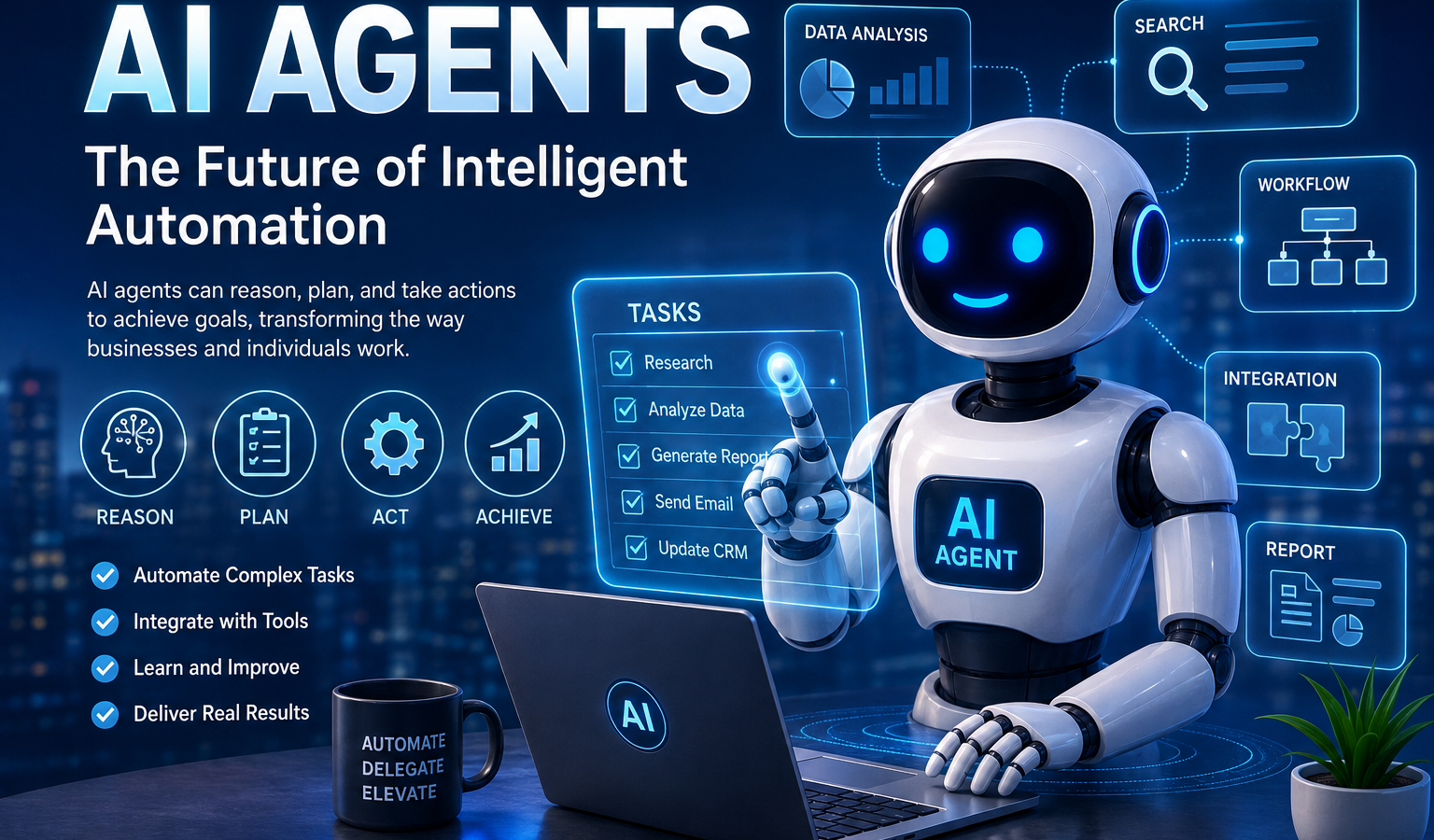

Artificial intelligence continues to evolve at an incredible pace, but one innovation is changing how businesses and individuals interact with technology more than most—AI agents.
Unlike traditional AI tools that simply respond to prompts, AI agents can reason, plan, make decisions, and complete complex tasks with minimal human intervention. They are quickly becoming the foundation of next-generation automation, powering customer service, software development, healthcare, finance, education, and countless other industries.
Organizations are rapidly investing in intelligent automation. Industry reports estimate that AI adoption has exceeded 70% among businesses worldwide, while autonomous AI systems are expected to generate billions of dollars in economic value over the next decade.
This comprehensive guide explains everything you need to know about AI agents, including how they work, their different types, real-world applications, advantages, challenges, and future trends.
Table of Contents
- What Are AI Agents?
- How AI Agents Work
- Key Components of an AI Agent
- Types of AI Agents
- AI Agents vs Traditional AI
- AI Agents vs AI Assistants
- Benefits of AI Agents
- Real-World Applications
- Popular AI Agent Frameworks
- Comparison Table
- Best Practices
- Common Mistakes
- Future of AI Agents
- Frequently Asked Questions
- Conclusion
What Are AI Agents?
AI agents are intelligent software systems capable of perceiving their environment, analyzing information, making decisions, and performing actions to achieve specific goals.
Unlike standard AI chatbots that only answer questions, AI agents can:
- Plan multiple steps
- Use external tools
- Search databases
- Access APIs
- Write code
- Analyze files
- Make decisions
- Improve based on feedback
- Collaborate with other AI agents
An AI agent operates similarly to a human employee who receives a goal, creates a plan, gathers information, completes tasks, and reports the results.
For example:
Goal: Increase website traffic by 20%.
An AI agent could:
- Research keywords
- Analyze competitors
- Generate content
- Publish articles
- Monitor rankings
- Adjust strategy automatically
How AI Agents Work
AI agents generally follow a continuous decision-making cycle.
1. Perception
The agent collects information from various sources such as:
- User prompts
- Documents
- Databases
- APIs
- Sensors
- Websites
2. Reasoning
Large language models and machine learning algorithms analyze the information to determine the best action.
3. Planning
Instead of solving only one problem, AI agents create multi-step plans.
Example:
Task: Launch a blog.
Plan:
- Research keywords
- Write content
- Optimize SEO
- Generate images
- Publish posts
- Share on social media
4. Action
The agent performs actions using tools such as:
- Browsers
- Databases
- CRM software
- WordPress
- Code editors
- APIs
5. Learning
Modern AI agents continually improve by analyzing previous outcomes and refining future decisions.
Key Components of an AI Agent
Every intelligent AI agent includes several essential components.
Goal
Defines the desired outcome.
Example:
Generate qualified sales leads.
Memory
Stores previous conversations, decisions, and historical information.
Memory allows long-term context instead of restarting every interaction.
Planning Engine
Breaks large tasks into manageable subtasks.
Reasoning Model
Evaluates available options before selecting the best course of action.
Tool Integration
AI agents become far more capable when connected to tools like:
- WordPress
- Google Workspace
- GitHub
- Slack
- CRM systems
- Email services
- Payment gateways
- Cloud storage
Feedback Loop
Evaluates completed work and improves future performance.
Types of AI Agents
1. Simple Reflex Agents
These respond only to current inputs.
Example:
Spam filters.
Advantages:
- Fast
- Efficient
- Easy to implement
2. Model-Based Agents
Maintain an internal understanding of their environment.
Used in:
- Robotics
- Autonomous vehicles
3. Goal-Based Agents
Designed to achieve specific objectives.
Examples include:
- Route planning
- Project management
- Business automation
4. Utility-Based Agents
Evaluate multiple possible outcomes and choose the most beneficial.
Common in:
- Financial trading
- Recommendation engines
5. Learning Agents
Continuously improve using new data.
Examples:
- Fraud detection
- Recommendation systems
- Predictive analytics
6. Multi-Agent Systems
Several AI agents collaborate to complete large tasks.
Applications include:
- Supply chain optimization
- Smart factories
- Logistics
- Enterprise automation
AI Agents vs Traditional AI
| Feature | Traditional AI | AI Agents |
|---|---|---|
| Responds to prompts | Yes | Yes |
| Plans tasks | No | Yes |
| Uses tools | Limited | Extensive |
| Multi-step reasoning | Rare | Yes |
| Learns continuously | Limited | Yes |
| Makes decisions | Limited | Advanced |
| Executes workflows | No | Yes |
| Autonomous | Low | High |
AI Agents vs AI Assistants
Many people confuse AI assistants with AI agents.
AI assistants primarily answer questions or generate content.
AI agents go much further.
AI agents can:
- Complete projects
- Execute workflows
- Coordinate multiple systems
- Make decisions
- Automate repetitive work
Think of it this way:
An AI assistant gives advice.
An AI agent performs the work.
Benefits of AI Agents
Increased Productivity
AI agents eliminate repetitive work and allow employees to focus on higher-value tasks.
Faster Decision-Making
Agents analyze massive datasets within seconds.
Reduced Costs
Businesses reduce operational expenses through automation.
24/7 Availability
AI agents never sleep, making them ideal for customer support and monitoring.
Better Customer Experience
AI agents provide instant responses, personalized recommendations, and faster issue resolution.
Scalability
Thousands of tasks can run simultaneously.
Improved Accuracy
Automated decision-making minimizes human error.
Real-World Applications
Customer Service
AI agents:
- Answer customer questions
- Handle refunds
- Process orders
- Escalate complex issues
Healthcare
Applications include:
- Medical scheduling
- Patient monitoring
- Diagnostic assistance
- Clinical documentation
Finance
Financial institutions use AI agents for:
- Fraud detection
- Risk assessment
- Loan processing
- Portfolio analysis
Marketing
Marketing teams use AI agents to:
- Research keywords
- Write SEO content
- Schedule campaigns
- Analyze competitors
- Optimize advertisements
Software Development
Development agents can:
- Generate code
- Fix bugs
- Run tests
- Deploy applications
- Review pull requests
Education
AI agents personalize learning experiences by:
- Recommending study plans
- Answering questions
- Tracking student progress
- Creating quizzes
E-commerce
Retailers use AI agents to:
- Recommend products
- Manage inventory
- Optimize pricing
- Handle returns
- Forecast demand
Popular AI Agent Frameworks
Several frameworks help developers build AI agents.
Popular options include:
- LangChain
- CrewAI
- AutoGen
- Semantic Kernel
- LlamaIndex
- OpenAI Agents SDK
- Haystack
Each framework offers different strengths, including memory, orchestration, tool use, and multi-agent collaboration.
AI Agent Framework Comparison
| Framework | Best For | Difficulty | Open Source |
|---|---|---|---|
| LangChain | General AI workflows | Medium | Yes |
| CrewAI | Team-based AI agents | Easy | Yes |
| AutoGen | Multi-agent conversations | Medium | Yes |
| Semantic Kernel | Enterprise integration | Medium | Yes |
| LlamaIndex | Data retrieval | Easy | Yes |
| OpenAI Agents SDK | AI applications | Easy | Yes |
| Haystack | Search systems | Medium | Yes |
Expert Tips
- Start with one clearly defined business problem.
- Connect AI agents to trusted data sources.
- Give agents access only to the tools they need.
- Use human approval for high-risk decisions.
- Monitor performance with analytics.
- Test thoroughly before production deployment.
- Update prompts and workflows regularly.
- Protect sensitive data with proper security controls.
Common Mistakes
Many organizations struggle because they:
- Expect full autonomy immediately.
- Ignore data quality.
- Skip security reviews.
- Build overly complex workflows.
- Fail to monitor agent performance.
- Neglect user feedback.
- Use AI without clear objectives.
- Forget to measure ROI.
Avoiding these mistakes leads to more reliable and effective AI deployments.
Future of AI Agents
AI agents are evolving rapidly.
Emerging trends include:
- Fully autonomous digital employees.
- Collaborative multi-agent ecosystems.
- Voice-first AI agents.
- Industry-specific AI specialists.
- Integration with robotics and IoT.
- Improved long-term memory.
- Stronger reasoning capabilities.
- Enhanced security and governance.
As models become more capable and tool integration improves, AI agents are expected to manage increasingly complex workflows across nearly every sector.
Frequently Asked Questions
1. What is an AI agent?
An AI agent is software that can perceive information, reason, plan, and take actions to achieve specific goals with minimal human intervention.
2. How are AI agents different from chatbots?
Chatbots mainly respond to user queries, while AI agents can plan, use tools, execute workflows, and complete tasks autonomously.
3. Can AI agents learn over time?
Many AI agents improve through feedback, updated data, or machine learning techniques, depending on their design.
4. Are AI agents suitable for small businesses?
Yes. Small businesses can use AI agents for customer support, marketing automation, scheduling, and administrative tasks without needing enterprise-scale infrastructure.
5. Which industries benefit the most from AI agents?
Healthcare, finance, e-commerce, education, manufacturing, software development, logistics, and customer service all benefit significantly.
6. Are AI agents secure?
They can be, but organizations should implement access controls, encryption, auditing, and human oversight for sensitive operations.
7. Do AI agents replace human workers?
AI agents are generally most effective when they automate repetitive work and assist people, allowing employees to focus on tasks that require judgment, creativity, and relationship-building.
8. What skills are needed to build AI agents?
Knowledge of programming, APIs, prompt engineering, machine learning concepts, workflow automation, and AI frameworks is helpful, though many no-code platforms are also available.
Conclusion
AI agents represent a significant step forward in artificial intelligence by combining reasoning, planning, memory, and tool use to complete complex tasks with increasing autonomy. They are already transforming industries by improving productivity, reducing costs, and enabling new ways of working.
Organizations that adopt AI agents thoughtfully—starting with clear objectives, reliable data, strong governance, and human oversight—will be better positioned to gain long-term value. Whether you are a business owner, developer, marketer, or technology enthusiast, understanding AI agents today can help you prepare for the next generation of intelligent automation.
Call to Action
Ready to harness the power of AI agents? Start by identifying a repetitive workflow in your business, evaluate the right AI framework or platform for your needs, and launch a small pilot project. As you measure results and refine your processes, you can confidently scale AI-driven automation across your organization and stay ahead in the rapidly evolving digital landscape.