
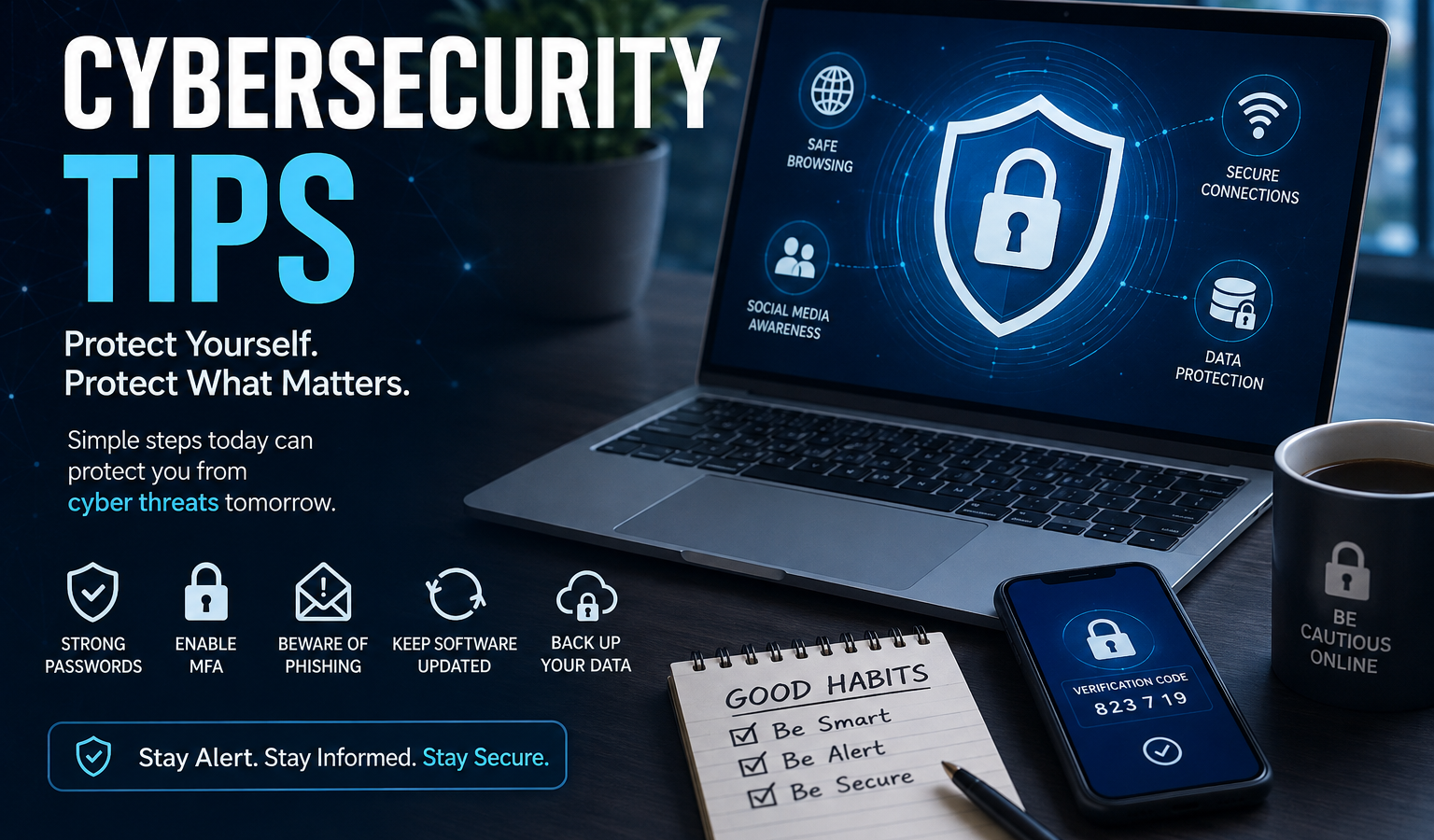

Cybersecurity is no longer only an IT concern. Phones, laptops, banking apps, social networks, cloud accounts, online stores, and business systems all contain information that criminals want to steal or misuse. A single compromised password, malicious attachment, fake website, or unpatched application can give an attacker a way into an account or network.
The good news is that effective cybersecurity does not always require expensive technology. Strong passwords, multi-factor authentication (MFA), timely software updates, secure backups, cautious browsing, and good security habits can eliminate many common attack opportunities.
Recent threat data shows why these habits matter. Verizon’s 2025 Data Breach Investigations Report analyzed more than 22,000 security incidents and 12,195 confirmed breaches across 139 countries. Verizon also reported that human involvement remained present in about 60% of breaches, while vulnerability exploitation continued to grow as an initial access method. citeturn0search37turn0search0
The FBI’s 2025 Internet Crime Report also recorded substantial losses associated with online crime. Among reported categories, cryptocurrency-related losses exceeded $4.3 billion, while investment fraud exceeded $3.5 billion. Phishing and spoofing complaints represented more than $77 million in reported losses. These figures reflect reported complaints, so they should not be interpreted as the full global cost of cybercrime. citeturn0search40
This guide explains practical cybersecurity tips for individuals, families, freelancers, and small businesses. The focus is on actions you can implement today without needing to become a cybersecurity professional.
Table of Contents
- Why Cybersecurity Matters
- Use Strong, Unique Passwords
- Enable Multi-Factor Authentication
- Keep Software and Devices Updated
- Learn to Recognize Phishing
- Verify Websites Before Entering Information
- Secure Your Wi-Fi Network
- Back Up Important Data
- Protect Your Personal Information
- Review Apps and Permissions
- Secure Your Phones and Computers
- Use Public Wi-Fi Carefully
- Strengthen Social Media Security
- Cybersecurity Tips for Small Businesses
- Expert Tips and Common Mistakes
- Frequently Asked Questions
- Conclusion
Why Cybersecurity Matters
Cybersecurity protects three core things: confidentiality, integrity, and availability. Confidentiality means unauthorized people cannot access private information. Integrity means information and systems are not secretly altered. Availability means you can access your files, services, and accounts when you need them.
Cybercriminals use many techniques to attack these areas. Common threats include phishing, credential theft, malware, ransomware, account takeover, malicious advertisements, social engineering, and exploitation of software vulnerabilities.
Modern attacks also increasingly use convincing impersonation. The FBI has warned about fraudulent websites, search advertisements, social media profiles, phone calls, and messages designed to make victims believe they are dealing with a legitimate organization. citeturn0search5turn0search8
Good security therefore depends on both technology and behavior. Security software can block some threats, but it cannot reliably compensate for reused passwords, careless clicking, or unrestricted account access.
1. Use Strong, Unique Passwords
Password reuse is one of the easiest ways for criminals to turn one compromised account into several compromised accounts. If the same password protects your email, social media, shopping account, and financial service, a breach at one service can create a chain reaction.
Create a different password for every important account. A password manager can generate and store long, random passwords so you do not have to memorize them all.
What makes a strong password?
- Use a long password or passphrase.
- Make it unique to that account.
- Avoid names, birthdays, phone numbers, and predictable words.
- Do not reuse passwords across important services.
- Never share passwords through ordinary messages or email.
Prioritize your email account, financial accounts, cloud storage, social media, and administrator accounts. Your primary email deserves special attention because it can often be used to reset other passwords.
2. Enable Multi-Factor Authentication
Multi-factor authentication adds another verification step after the password. Depending on the service, that second factor may be an authenticator app, security key, biometric check, or one-time code.
MFA is especially valuable when a password is exposed through phishing or a data breach. An attacker may possess the password but still be unable to complete the login process.
CISA recommends using MFA whenever possible, with particular emphasis on privileged, administrative, and remote-access accounts. citeturn0search39
Best practice
When several MFA methods are available, prefer phishing-resistant options such as hardware security keys or passkeys where supported. Authenticator apps are generally preferable to relying only on SMS when a stronger option is available.
3. Keep Software and Devices Updated
Software updates do more than introduce new features. They often repair security vulnerabilities that attackers can exploit.
Enable automatic updates for your operating system, browser, security software, mobile applications, plugins, and other important programs whenever practical. Replace software that has reached end of support.
This is particularly important for internet-facing systems such as routers, VPN appliances, web applications, content management systems, and remote-access tools. Verizon’s breach research has highlighted continued growth in vulnerability exploitation, including attacks against perimeter devices and VPNs. citeturn0search0
For WordPress users
- Keep WordPress core updated.
- Update themes and plugins promptly.
- Remove abandoned or unnecessary plugins.
- Use strong administrator passwords and MFA.
- Maintain reliable backups before major changes.
- Use reputable hosting and security controls.
4. Learn to Recognize Phishing
Phishing attempts to trick you into revealing information, clicking a malicious link, transferring money, or installing malware. The message may arrive by email, SMS, social media, messaging apps, phone calls, or even through search advertisements.
Do not judge a message only by its branding. Attackers can copy logos, language, signatures, website layouts, and even use AI-generated content to make impersonation more convincing.
Warning signs include:
- Urgent demands to act immediately.
- Unexpected password-reset messages.
- Requests for payment or cryptocurrency.
- Unusual login alerts that you did not initiate.
- Links with suspicious domains or misspellings.
- Attachments you were not expecting.
- Requests for passwords, PINs, recovery codes, or verification codes.
- Promises that seem unusually valuable or urgent.
When in doubt, contact the organization through a known official website, phone number, or app. Do not use contact information supplied by the suspicious message.
The FBI has specifically warned about criminals using malicious traffic distribution systems to redirect users toward fake login pages and fraudulent software updates. citeturn0search3
5. Verify Websites Before Entering Information
A professional-looking website is not proof that a website is legitimate. Attackers can create convincing copies of banking portals, government websites, shopping stores, login pages, and employee services.
Before entering a password, card number, identity document, or other sensitive information, check the domain name carefully. Watch for altered spellings, unexpected subdomains, suspicious domain extensions, and links reached through advertisements that you did not intentionally search for.
When accessing an important service, consider typing its known address manually or using a trusted bookmark rather than following an unexpected link.
6. Secure Your Wi-Fi Network
Your home router is a security boundary between your devices and the internet. Leaving default credentials or outdated firmware in place can create unnecessary risk.
- Change the router’s default administrator password.
- Use modern Wi-Fi security such as WPA2 or WPA3 where supported.
- Keep router firmware updated.
- Disable features you do not need, especially remote administration.
- Create a guest network for visitors and untrusted devices.
- Use a strong Wi-Fi password that is different from your other passwords.
IoT devices such as cameras, smart TVs, plugs, and home assistants should also be updated and protected with unique credentials.
7. Back Up Important Data
Backups are one of the most practical defenses against ransomware, hardware failure, accidental deletion, theft, and other forms of data loss.
CISA recommends automated and continuous backups for critical data and system configurations. citeturn0search39
A useful backup strategy
- Keep more than one copy of important files.
- Store backups in more than one location.
- Keep at least one backup isolated from everyday accounts or devices.
- Encrypt sensitive backups.
- Test restoration periodically.
A backup that has never been tested is not a complete recovery plan. Periodically restore a sample file and confirm that the process works.
8. Protect Your Personal Information
Personal information can be useful to attackers even when it does not appear financially valuable. Names, phone numbers, addresses, employment information, family details, photographs, and security-question answers can help criminals construct convincing impersonation attempts.
Share less publicly. Review the privacy settings of social networks and avoid publishing information that can help someone guess passwords or security questions.
Be particularly cautious with identity documents. Only provide them to legitimate organizations through verified channels, and understand why the information is required before submitting it.
9. Review Apps and Permissions
Every application you install creates another opportunity for misuse if it is malicious, compromised, outdated, or unnecessarily privileged.
Install applications from reputable stores and verify the developer name before downloading. Avoid modified or pirated applications because they may contain malware or hidden surveillance components.
Review permissions regularly
- Camera
- Microphone
- Contacts
- Location
- SMS
- Files and photos
- Accessibility services
If an application requests access that does not make sense for its purpose, investigate before granting permission. Remove applications you no longer use.
10. Secure Your Phones and Computers
Physical device security is part of cybersecurity. A stolen or unattended unlocked phone can expose email, banking, messaging, photos, authentication codes, and saved passwords.
- Use a strong screen lock.
- Enable device encryption when supported.
- Turn on the device-finding feature.
- Keep the operating system current.
- Install reputable security software where appropriate.
- Do not leave sensitive devices unattended in public.
- Enable remote lock or erase capabilities where available.
On computers, use a standard account for everyday work when practical and reserve administrator privileges for tasks that actually require them.
11. Use Public Wi-Fi Carefully
Public Wi-Fi is convenient, but you should not automatically treat every network as trustworthy. Attackers can create networks with names that resemble legitimate cafés, hotels, airports, or offices.
When using public networks, avoid performing highly sensitive activities unless you trust the connection and have appropriate security controls. Keep your device firewall enabled and disable automatic connection to unknown networks.
Remember that HTTPS protects the connection between your browser and an HTTPS-enabled website, but it does not make a malicious website legitimate. Always verify the destination itself.
12. Strengthen Social Media Security
Social media accounts are attractive targets because they contain personal information and can be used to impersonate you. A compromised account may also be used to scam your friends, customers, or followers.
- Use a unique password.
- Enable MFA.
- Review active sessions and logged-in devices.
- Remove unknown third-party applications.
- Limit public exposure of personal information.
- Be careful with direct messages containing links.
If a friend suddenly asks for money, a verification code, or an unusual favor, verify the request through another communication channel.
13. Cybersecurity Tips for Small Businesses
Small businesses often handle valuable customer, financial, employee, and operational data without having a large security department. A practical baseline can significantly reduce exposure.
Start with these controls
- Require MFA for email, cloud services, administrators, and remote access.
- Use unique accounts rather than shared administrator credentials.
- Apply least privilege so users receive only the access they need.
- Patch operating systems, applications, plugins, routers, and servers promptly.
- Back up critical business data and test restoration.
- Train staff to recognize phishing and business email compromise.
- Protect endpoint devices with appropriate security controls.
- Document how employees should report suspicious activity.
- Maintain an incident-response plan with emergency contacts.
- Review third-party vendors and the access they receive.
Third-party risk deserves special attention. Verizon’s 2025 DBIR reported that the percentage of breaches involving third parties had doubled, reinforcing the importance of understanding suppliers, partners, software providers, and cloud services. citeturn0search0
Cybersecurity Comparison: Weak Habits vs. Safer Habits
| Risk Area | Weak Habit | Safer Practice |
|---|---|---|
| Passwords | Reuse one password | Use unique passwords with a password manager |
| Login security | Password only | Enable MFA or passkeys |
| Updates | Ignore update notifications | Enable automatic updates where practical |
| Click urgent links immediately | Verify the sender and destination first | |
| Backups | Keep one copy on the computer | Maintain multiple tested backups |
| Apps | Install from unknown sources | Use reputable stores and verified developers |
| Wi-Fi | Use default router credentials | Change admin credentials and update firmware |
| Privacy | Overshare personal information | Limit public information and review privacy settings |
Expert Tips for Better Cybersecurity
Strong cybersecurity is a process, not a one-time setup. Use these expert-level habits to improve your security posture over time.
- Protect your email first: It is often the recovery gateway for other accounts.
- Use a password manager: This makes unique passwords practical at scale.
- Prefer phishing-resistant MFA: Use passkeys or security keys when supported.
- Follow least privilege: Do not use administrator access for routine tasks unless necessary.
- Segment important systems: Separate critical business or IoT devices from ordinary user networks when practical.
- Monitor account activity: Review login alerts, active sessions, and unfamiliar devices.
- Practice recovery: Test backups and incident-response procedures before an emergency occurs.
- Assume unexpected requests require verification: Especially when money, passwords, access codes, or sensitive data are involved.
- Keep a software inventory: You cannot patch or remove systems you do not know exist.
- Make security easy to follow: Good controls should fit normal workflows rather than encouraging users to bypass them.
Common Cybersecurity Mistakes to Avoid
- Using the same password everywhere.
- Disabling MFA because it feels inconvenient.
- Ignoring operating system and application updates.
- Trusting a message because it contains a familiar logo.
- Entering sensitive information after clicking an unexpected advertisement.
- Keeping sensitive files without reliable backups.
- Installing pirated or modified applications.
- Granting apps excessive permissions.
- Using shared administrator accounts in a business.
- Failing to test whether backups can actually be restored.
- Assuming antivirus software alone provides complete protection.
- Ignoring suspicious account notifications.
One important principle is worth remembering: cybersecurity tools reduce risk, but they do not eliminate it. Human verification, secure configuration, patching, monitoring, and recovery planning remain essential.
Frequently Asked Questions
1. What are the most important cybersecurity tips for beginners?
Start with unique passwords, a password manager, MFA, automatic updates, reliable backups, phishing awareness, and device screen locks. These controls address several common attack paths without requiring advanced technical knowledge.
2. Is antivirus software still necessary?
Security software can provide useful protection, particularly on computers, but it should be part of a layered approach. Keep your operating system updated, use MFA, avoid suspicious links and downloads, maintain backups, and apply secure account practices.
3. Can a strong password prevent hacking?
A strong unique password can significantly reduce password-guessing and credential-reuse risks, but it cannot protect against every threat. Phishing, malware, session theft, software vulnerabilities, and social engineering can bypass password strength. MFA adds another important layer.
4. What should I do if I click a suspicious link?
Do not enter additional information or download files. Close the page if appropriate. If you entered a password, change it immediately from a trusted device and enable MFA. If financial information was exposed, contact the relevant financial institution promptly. For a business device, report the incident to the person responsible for security or IT.
5. How often should I change my passwords?
Do not rely on arbitrary frequent password changes as your primary defense. Use strong, unique passwords and MFA. Change a password immediately if you suspect compromise, if the service reports a breach affecting your account, or if you accidentally disclosed it.
6. Is public Wi-Fi safe?
Public Wi-Fi can be used safely in many situations, but it should be treated as an untrusted network. Verify the network name, avoid automatic connections, keep your device protected, and confirm that sensitive websites use HTTPS. Do not assume a Wi-Fi network is legitimate simply because its name looks familiar.
7. How can I protect my small business from ransomware?
Prioritize MFA, timely patching, endpoint protection, least privilege, phishing training, network segmentation where appropriate, and tested offline or isolated backups. Also prepare an incident-response plan so staff know what to do if systems become unavailable.
8. What is the single best cybersecurity habit?
There is no single control that prevents every attack. However, consistently using MFA, unique passwords, prompt updates, tested backups, and deliberate verification of unexpected requests provides a strong practical foundation.
Conclusion
Effective cybersecurity begins with simple habits applied consistently. You do not need to become a security engineer to reduce your exposure to common cyber threats. Protect your most important accounts with unique passwords and MFA, update devices and software, verify unexpected messages and websites, control application permissions, secure your network, and maintain tested backups.
The threat landscape continues to change. Attackers now combine technical vulnerabilities with social engineering, impersonation, malicious advertising, and increasingly convincing digital content. The FBI’s recent warnings demonstrate that criminals are continually adapting how they reach victims, while Verizon’s breach research shows that both human behavior and technical weaknesses remain important parts of the risk picture. citeturn0search3turn0search0
Cybersecurity is therefore best approached as an ongoing practice. Review your accounts, devices, applications, permissions, backups, and recovery options regularly. Small improvements made today can prevent a much larger problem later.
Call to Action
Take 15 minutes today to improve your digital security. Enable MFA on your primary email, replace reused passwords, install pending updates, review your phone’s app permissions, and confirm that your important files are backed up. Then share these cybersecurity tips with your family, colleagues, or customers so they can strengthen their own security too.