
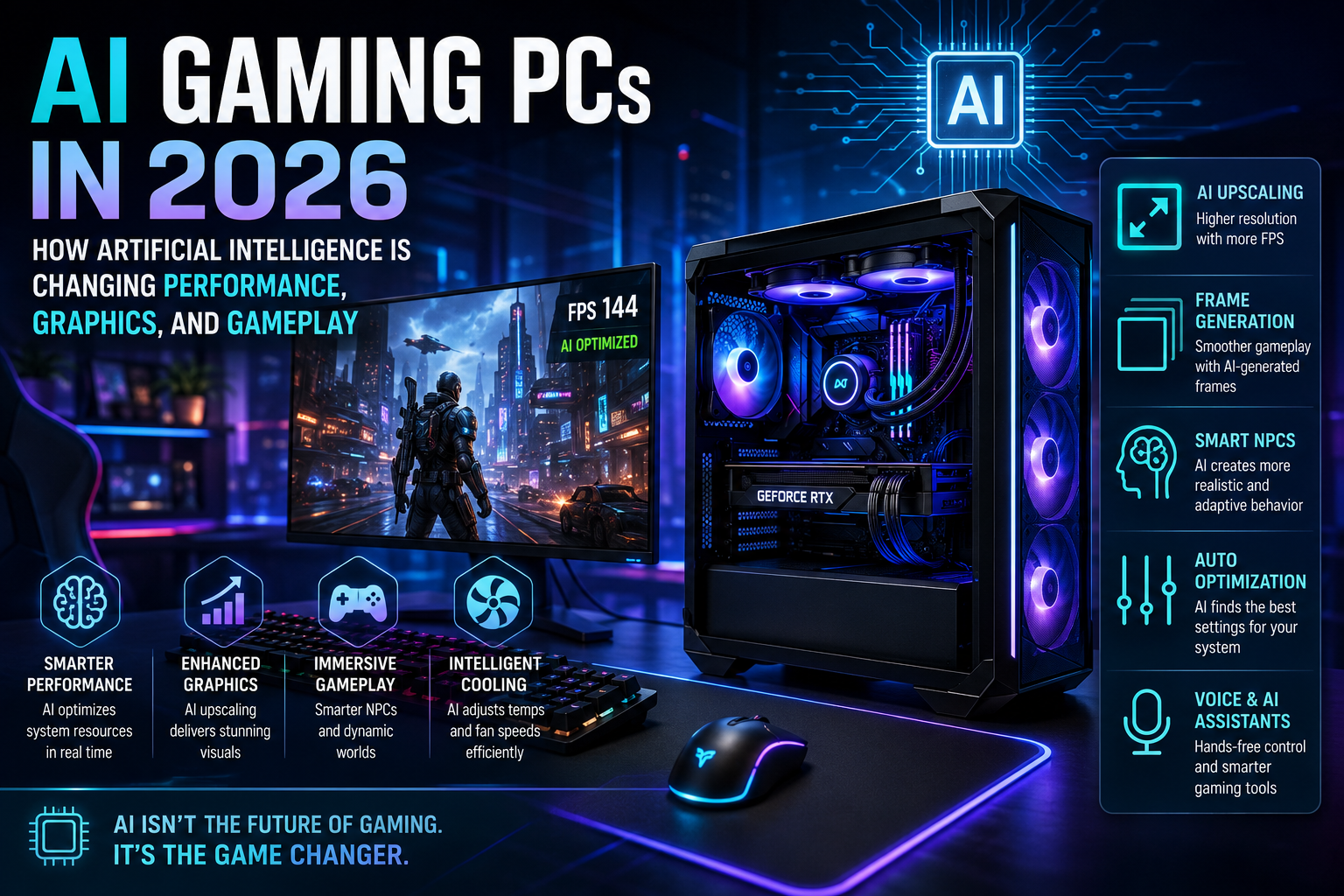

The rise of AI gaming PCs is transforming the way people experience PC gaming. Artificial intelligence is no longer limited to chatbots or image generation—it now plays a critical role in improving gaming performance, enhancing graphics quality, reducing latency, and even creating smarter in-game characters.
In 2026, modern gaming PCs use AI-powered technologies to deliver smoother gameplay, realistic visuals, and better system optimization than ever before. Whether you’re building a new gaming rig or upgrading your current setup, understanding how AI is changing PC gaming can help you make smarter purchasing decisions.
This guide explores the latest AI innovations in gaming hardware, graphics processing, software optimization, and gameplay while explaining what they mean for gamers today and in the future.
What Are AI Gaming PCs?
An AI gaming PC is a computer equipped with hardware and software designed to use artificial intelligence for improving gaming performance, visual quality, and overall user experience.
Unlike traditional gaming systems that rely solely on raw processing power, AI-enhanced systems intelligently optimize workloads in real time.
Common AI-powered technologies include:
- AI image upscaling
- AI frame generation
- Intelligent power management
- Automated game optimization
- AI-assisted cooling
- Voice-controlled gaming assistants
- Machine learning performance tuning
Rather than replacing powerful hardware, AI allows existing components to work more efficiently.
Why Artificial Intelligence Matters in Gaming
Gaming has become increasingly demanding. Modern titles feature:
- Massive open worlds
- Ray-traced lighting
- High-resolution textures
- Complex physics simulations
- Advanced NPC behaviors
Running these games smoothly requires significant computing resources.
Artificial intelligence helps by predicting workloads, optimizing graphics rendering, reducing unnecessary processing, and improving efficiency without sacrificing visual quality.
The result is:
- Higher frame rates
- Better graphics
- Lower latency
- Reduced power consumption
- Smoother gameplay
AI-Powered Graphics: A Major Leap Forward
Graphics processing has experienced one of the biggest AI revolutions.
Instead of rendering every pixel traditionally, modern GPUs use machine learning models trained on millions of images.
These AI models reconstruct high-quality visuals while requiring fewer computing resources.
Benefits include:
- Sharper images
- Better anti-aliasing
- Higher FPS
- Reduced GPU workload
- Improved visual clarity
This makes high-resolution gaming far more accessible than ever before.
AI Upscaling Technology
One of the biggest innovations in AI gaming PCs is intelligent upscaling.
Instead of rendering games at native 4K resolution, AI renders at a lower resolution before intelligently reconstructing the image.
Advantages include:
- Increased frame rates
- Lower GPU temperatures
- Improved power efficiency
- Better image quality
- More consistent gaming performance
For gamers, this means smoother gameplay without investing in ultra-expensive hardware.
Frame Generation
Frame generation is another breakthrough powered by AI.
Instead of rendering every frame conventionally, AI predicts and generates intermediate frames.
This creates:
- Higher perceived frame rates
- Smoother animations
- Reduced stuttering
- Improved responsiveness
While traditional rendering still handles core graphics, AI significantly boosts visual fluidity.
Smarter GPU Performance
Graphics cards are becoming increasingly intelligent.
Modern GPUs can now:
- Detect game workloads
- Allocate resources dynamically
- Optimize memory usage
- Reduce unnecessary processing
- Improve thermal efficiency
AI helps balance performance and power consumption automatically.
This allows gamers to enjoy demanding titles while maintaining stable temperatures and quieter systems.
AI Optimization for CPUs
Processors are also benefiting from machine learning.
Modern CPUs can intelligently prioritize workloads by:
- Allocating threads efficiently
- Managing background applications
- Optimizing cache usage
- Reducing latency
- Improving multitasking
These improvements help games run more smoothly, especially during streaming or multitasking.
AI Is Making NPCs Smarter
Artificial intelligence is also transforming gameplay itself.
Older games often relied on scripted NPC behavior.
Modern AI enables characters to:
- Learn player habits
- Adapt combat strategies
- React naturally
- Coordinate with teammates
- Create unpredictable encounters
This makes games feel more immersive and less repetitive.
Dynamic Worlds Powered by AI
Artificial intelligence now helps generate richer gaming environments.
Examples include:
- Procedural landscapes
- Dynamic weather
- Intelligent traffic systems
- Adaptive wildlife
- More realistic ecosystems
Instead of relying entirely on pre-designed events, games can react to player decisions in real time.
AI Audio Improvements
Immersive gaming isn’t only about visuals.
AI also improves audio by:
- Enhancing positional sound
- Reducing background noise
- Improving voice chat quality
- Creating realistic environmental effects
These features provide better communication during multiplayer games and improve immersion in story-driven experiences.
Automatic Performance Optimization
One of the most practical benefits of AI gaming PCs is automatic optimization.
Instead of manually adjusting dozens of graphics settings, AI can analyze your system and recommend ideal configurations.
It considers factors such as:
- GPU capability
- CPU performance
- Available RAM
- Display resolution
- Desired frame rate
This saves time while delivering excellent performance.
AI-Assisted Cooling and Power Management
Thermal management has also become smarter.
AI can monitor:
- CPU temperatures
- GPU temperatures
- Fan speeds
- Workload intensity
- Power consumption
It then adjusts cooling dynamically to maintain optimal performance while minimizing noise.
Benefits include:
- Longer hardware lifespan
- Lower electricity usage
- Reduced fan noise
- Improved stability
AI for Streamers and Content Creators
Gamers who stream or create videos also benefit from AI.
Modern software can:
- Remove background noise
- Blur or replace backgrounds
- Improve microphone quality
- Automatically edit highlights
- Generate subtitles
- Enhance webcam quality
These tools reduce production time while improving content quality.
How AI Improves Competitive Gaming
Competitive players demand consistency.
AI helps by providing:
- Lower input latency
- Stable frame rates
- Better image clarity
- Enhanced visibility
- Intelligent graphics balancing
These improvements can make gameplay feel smoother and more responsive.
Challenges of AI Gaming PCs
Despite the advantages, AI-powered gaming still has limitations.
Some concerns include:
Hardware Costs
New AI-capable GPUs often carry premium prices.
Software Support
Not every game supports advanced AI technologies.
Learning Curve
Some AI features require experimentation to achieve the best results.
Privacy
Certain AI-powered assistants process voice or gameplay data, making privacy settings important.
Who Should Buy an AI Gaming PC?
An AI gaming PC is an excellent investment for:
- Enthusiast gamers
- Competitive esports players
- Streamers
- Video creators
- Developers
- Early adopters
- Users planning long-term upgrades
Casual gamers can also benefit from AI optimization, especially when paired with mid-range hardware.
The Future of AI Gaming PCs
Artificial intelligence will continue shaping the future of gaming.
Upcoming developments may include:
- Fully adaptive NPC intelligence
- AI-generated game worlds
- Personalized game experiences
- Real-time texture generation
- Smarter graphics rendering
- Autonomous game optimization
- AI-assisted game development
As hardware evolves, AI will become a standard feature rather than a premium addition.
Frequently Asked Questions
What are AI gaming PCs?
AI gaming PCs are computers that use artificial intelligence to optimize graphics, improve gaming performance, automate settings, and enhance gameplay experiences.
Do AI gaming PCs improve FPS?
Yes. AI technologies such as frame generation and intelligent upscaling can significantly increase frame rates while maintaining excellent image quality.
Are AI gaming PCs only for high-end gamers?
No. Many mid-range systems now include AI-powered features that improve performance and efficiency.
Can AI replace powerful gaming hardware?
No. AI complements hardware by making it more efficient, but strong CPUs and GPUs remain essential for demanding games.
Do all games support AI technologies?
Not yet. Support depends on game developers and graphics technologies, although compatibility continues to expand.
Is buying an AI gaming PC worth it in 2026?
For gamers seeking better performance, future-ready hardware, and enhanced gaming experiences, AI gaming PCs represent a worthwhile investment.
Conclusion
Artificial intelligence is redefining modern PC gaming. From intelligent graphics rendering and frame generation to smarter NPCs and automated system optimization, AI gaming PCs deliver meaningful improvements that go far beyond higher frame rates.
As AI capabilities continue to evolve, gamers can expect increasingly immersive worlds, better visual fidelity, and more efficient hardware utilization. Whether you’re building your first gaming rig or upgrading an existing system, choosing AI-enabled components can help ensure your setup remains competitive and capable for years to come.
For additional reading, explore the NVIDIA Developer Blog for technical insights into AI-powered graphics technologies and machine learning in gaming. You may also find our related guide, Best Graphics Cards for Gaming, helpful when selecting hardware for your next build.