

Inflation gradually reduces the purchasing power of your money. As prices rise over time, the same amount of cash buys fewer goods and services. While keeping money in a savings account is important for emergencies, relying only on cash can make it harder to preserve and grow your wealth over the long term.
The good news is that certain investments have historically offered the potential to outpace inflation over extended periods. By investing consistently, diversifying wisely, and maintaining a long-term perspective, you can improve your chances of protecting your purchasing power while building lasting wealth.
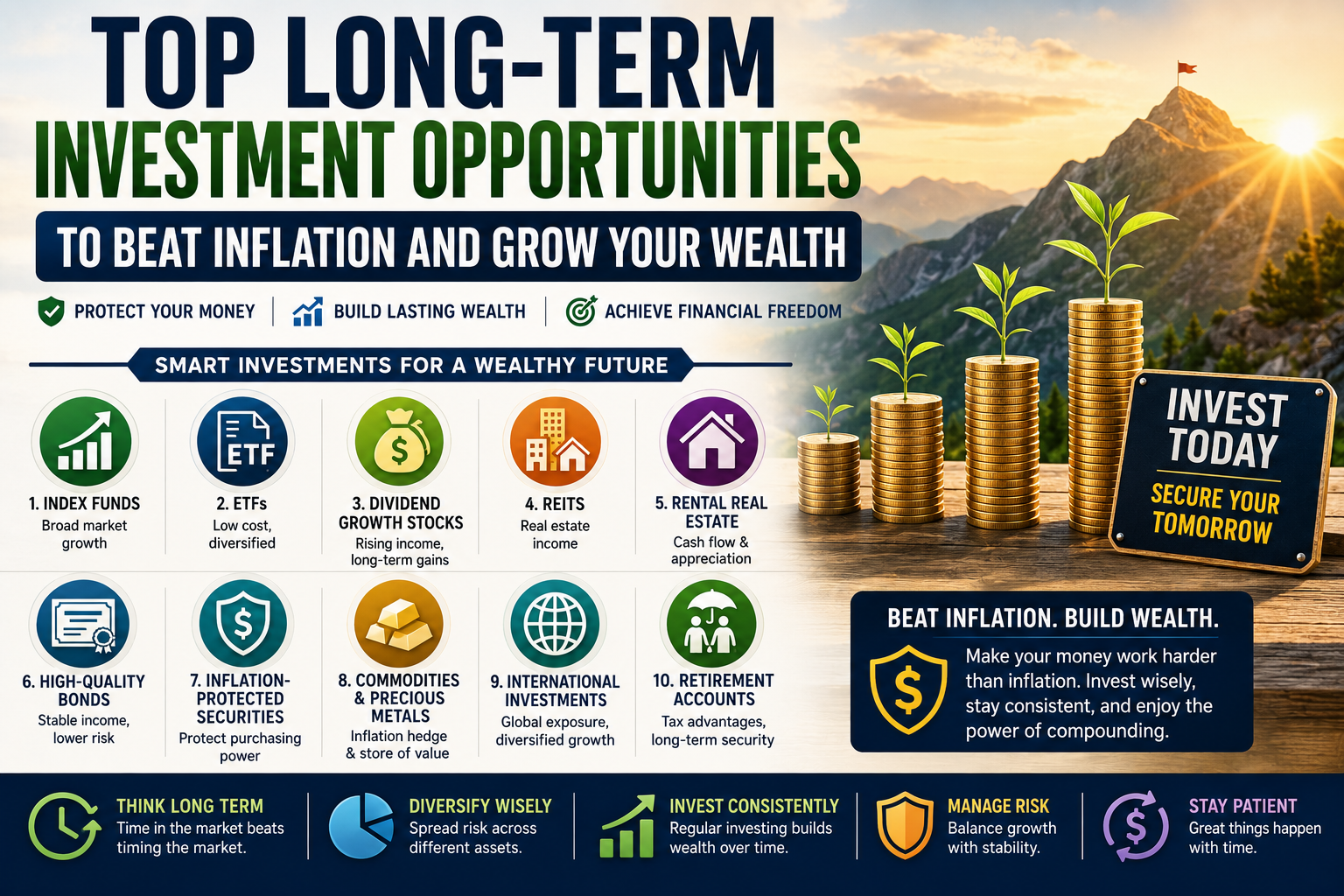
This guide explores the Top Long-Term Investment Opportunities to Beat Inflation and Grow Your Wealth, helping you understand how each investment works, its potential benefits, associated risks, and the types of investors it may suit best.
Understanding Inflation and Its Impact on Wealth
Inflation is the gradual increase in the prices of goods and services over time. Even moderate inflation can significantly reduce the value of money over decades.
For example:
- If inflation averages 3% per year, an item costing $100 today could cost more than $180 in about 20 years.
- Money that earns less than the inflation rate effectively loses purchasing power over time.
Why Inflation Matters
- Savings may lose real value.
- Retirement expenses become more expensive.
- Healthcare and education costs often rise faster than general inflation.
- Long-term financial goals require greater investment growth.
Investing is one of the most effective ways to help offset inflation’s long-term effects.
Why Long-Term Investing Is Essential
Long-term investing allows your portfolio to benefit from:
- Compound growth
- Dividend reinvestment
- Market recoveries
- Reduced impact of short-term volatility
Instead of trying to predict daily market movements, successful long-term investors typically focus on remaining invested and contributing consistently over many years.
Advantages of Long-Term Investing
| Benefit | Explanation |
|---|---|
| Compounding | Earnings generate additional earnings over time. |
| Lower Emotional Stress | Reduces the temptation to react to short-term market swings. |
| Inflation Protection | Growth assets have historically outpaced inflation over long periods. |
| Wealth Creation | Long investment horizons allow portfolios more time to grow. |
Investment Opportunity #1: Broad Market Index Funds
Broad market index funds track a large group of companies, offering instant diversification through a single investment.
These funds often follow major stock market indexes and are popular among long-term investors because of their low costs and broad exposure.
Benefits
- Diversification across hundreds of companies
- Low expense ratios
- Passive investment strategy
- Strong historical long-term performance
Potential Risks
- Market downturns affect overall returns.
- No opportunity to outperform the index through active management.
For many investors, broad market index funds form the foundation of a long-term portfolio.
Investment Opportunity #2: Exchange-Traded Funds (ETFs)
ETFs combine diversification with the flexibility of trading throughout the market day.
Investors can choose from a wide variety of ETFs, including those focused on:
- Total stock markets
- Technology
- Healthcare
- International markets
- Dividend income
- Bonds
- Commodities
Advantages
- Broad diversification
- Lower management fees
- Liquidity
- Transparency
ETFs can be an effective way to gain exposure to multiple sectors while keeping investment costs relatively low.
Investment Opportunity #3: Dividend Growth Stocks
Dividend growth stocks are companies with a history of increasing dividend payments over time.
These businesses often have:
- Stable earnings
- Strong cash flow
- Competitive market positions
- Disciplined management
Why They Can Help Beat Inflation
Growing dividend payments may help investors maintain purchasing power as living costs increase.
Benefits
- Potential capital appreciation
- Rising dividend income
- Long-term wealth accumulation
- Reinvestment opportunities through compounding
Dividend growth investing can be especially attractive for investors seeking both income and long-term growth.
Investment Opportunity #4: Real Estate Investment Trusts (REITs)
REITs provide exposure to income-producing real estate without requiring investors to purchase or manage physical properties.
Many REITs invest in:
- Apartment buildings
- Office space
- Shopping centers
- Industrial warehouses
- Healthcare facilities
- Data centers
Advantages
- Regular income distributions
- Professional management
- Diversification across multiple properties
- Potential hedge against inflation through rising rents
Risks
- Interest rate sensitivity
- Real estate market fluctuations
- Economic slowdowns affecting occupancy rates
REITs can complement a diversified portfolio by adding exposure to the real estate sector.
Investment Opportunity #5: Rental Real Estate
Owning rental properties can provide two potential sources of return:
- Rental income
- Long-term property appreciation
As inflation increases, property values and rental income may also rise over time, although this is not guaranteed.
Benefits
- Monthly cash flow
- Potential appreciation
- Diversification outside traditional financial markets
- Possible tax advantages, depending on local laws
Challenges
- Property maintenance
- Tenant management
- Vacancy periods
- Upfront capital requirements
Rental real estate may be suitable for investors willing to take on additional responsibilities in exchange for income and long-term growth.
Investment Opportunity #6: High-Quality Bonds
While stocks often receive the most attention, high-quality bonds can play an important role in a long-term investment strategy. Bonds provide regular interest payments and can help reduce overall portfolio volatility.
Types of Bonds
- Government bonds
- Investment-grade corporate bonds
- Municipal bonds (where applicable)
- International bonds
Benefits
- Predictable income
- Lower volatility than many stocks
- Portfolio diversification
- Capital preservation potential
Considerations
Bond prices can decline when interest rates rise, and long-term returns may not always outpace inflation. For this reason, many investors use bonds to balance risk rather than as their primary growth investment.
Investment Opportunity #7: Inflation-Protected Securities
Inflation-protected securities are designed to help preserve purchasing power by adjusting their value based on inflation measures.
These investments can serve as an additional layer of protection during periods of rising prices.
Advantages
- Inflation-linked principal adjustments
- Government backing in many cases
- Lower credit risk than many corporate bonds
- Portfolio diversification
Best For
- Conservative investors
- Retirement portfolios
- Long-term wealth preservation
Although they may not always produce the highest returns, they can provide valuable stability during inflationary periods.
Investment Opportunity #8: Commodities and Precious Metals
Commodities such as gold, silver, oil, and agricultural products have historically been used as inflation hedges.
Precious metals, especially gold, are often viewed as stores of value during periods of economic uncertainty.
Advantages
- Portfolio diversification
- Potential protection against inflation
- Exposure to global commodity markets
Potential Risks
- Price volatility
- No guaranteed income
- Sensitive to supply and demand dynamics
Because commodities can fluctuate significantly, many investors allocate only a modest portion of their portfolios to this asset class.
Investment Opportunity #9: International Investments
Investing internationally allows you to diversify beyond your home country’s economy.
International investments may include:
- Global equity ETFs
- International mutual funds
- Foreign stocks
- Emerging market funds
Benefits
- Geographic diversification
- Access to different industries and economic cycles
- Reduced dependence on one country’s market performance
Risks
- Currency fluctuations
- Political and regulatory changes
- Economic instability in some regions
International diversification can help reduce concentration risk in a long-term portfolio.
Investment Opportunity #10: Retirement Accounts
Tax-advantaged retirement accounts can enhance long-term wealth creation by allowing investments to grow more efficiently, depending on the rules in your country.
Benefits may include:
- Tax-deferred growth
- Tax-free growth in certain account types
- Employer contributions (where available)
- Automatic investing
Using retirement accounts effectively can improve long-term investment outcomes while helping you stay focused on future financial goals.
Building an Inflation-Resistant Portfolio
A diversified portfolio is often better positioned to manage inflation than one concentrated in a single asset class.
Example Long-Term Portfolio
| Investment | Suggested Allocation |
|---|---|
| Broad Market Index Funds | 35% |
| ETFs | 20% |
| Dividend Growth Stocks | 15% |
| REITs | 10% |
| Bonds | 10% |
| International Investments | 5% |
| Commodities/Precious Metals | 5% |
This sample allocation is for educational purposes only. Your ideal portfolio should reflect your financial goals, investment horizon, and tolerance for risk.
Portfolio Tips
- Invest consistently.
- Reinvest dividends when possible.
- Review your allocation annually.
- Increase diversification as your portfolio grows.
- Avoid making decisions based solely on short-term market news.
Common Mistakes to Avoid
Building long-term wealth requires patience and discipline. Avoid these common pitfalls:
1. Keeping Too Much Cash
Holding excessive cash for long periods may reduce purchasing power if inflation exceeds the interest earned.
2. Chasing Short-Term Trends
Buying investments simply because they are popular can expose you to unnecessary risk.
3. Ignoring Diversification
Concentrating investments in one company, sector, or asset class increases portfolio risk.
4. Trying to Time the Market
Consistently predicting market highs and lows is extremely difficult.
5. Forgetting About Fees
High management fees and trading costs can reduce long-term returns through compounding.
6. Investing Without Clear Goals
Your investment strategy should reflect your objectives, time horizon, and financial needs.
Frequently Asked Questions
1. What investment has historically performed best against inflation?
Historically, diversified stock investments have often outpaced inflation over long periods, although past performance does not guarantee future results.
2. Is real estate a good inflation hedge?
Real estate has the potential to provide inflation protection through property appreciation and rental income, but market conditions can vary.
3. Should I invest only in stocks?
A diversified portfolio that includes stocks and other asset classes may better manage risk than investing solely in stocks.
4. How often should I rebalance my portfolio?
Many investors review and rebalance their portfolios once or twice a year or when allocations drift significantly from their targets.
5. Can bonds beat inflation?
Some bonds may struggle to outpace inflation over long periods, while inflation-protected securities are specifically designed to help preserve purchasing power.
6. Is diversification really important?
Yes. Diversification helps reduce the impact of poor performance from any single investment and can improve the resilience of a long-term portfolio.
Conclusion
Protecting your purchasing power while growing your wealth requires a thoughtful, long-term investment strategy. The Top Long-Term Investment Opportunities to Beat Inflation and Grow Your Wealth include a mix of growth-oriented and income-producing assets that work together to balance opportunity and risk.
Key Takeaways
- Invest with a long-term perspective.
- Diversify across multiple asset classes.
- Use broad-market funds as a strong foundation.
- Include dividend-paying investments and real estate exposure where appropriate.
- Consider inflation-protected securities for added stability.
- Review your portfolio regularly and adjust it as your financial goals evolve.
There is no single investment that is ideal for every investor. A diversified portfolio tailored to your goals, time horizon, and risk tolerance offers the best chance of preserving purchasing power and building lasting wealth over time.
Further Reading
To continue expanding your investment knowledge, explore educational resources from your country’s financial regulator and reputable financial institutions. Topics such as asset allocation, retirement planning, tax-efficient investing, and behavioral finance can help you make more informed long-term investment decisions.