
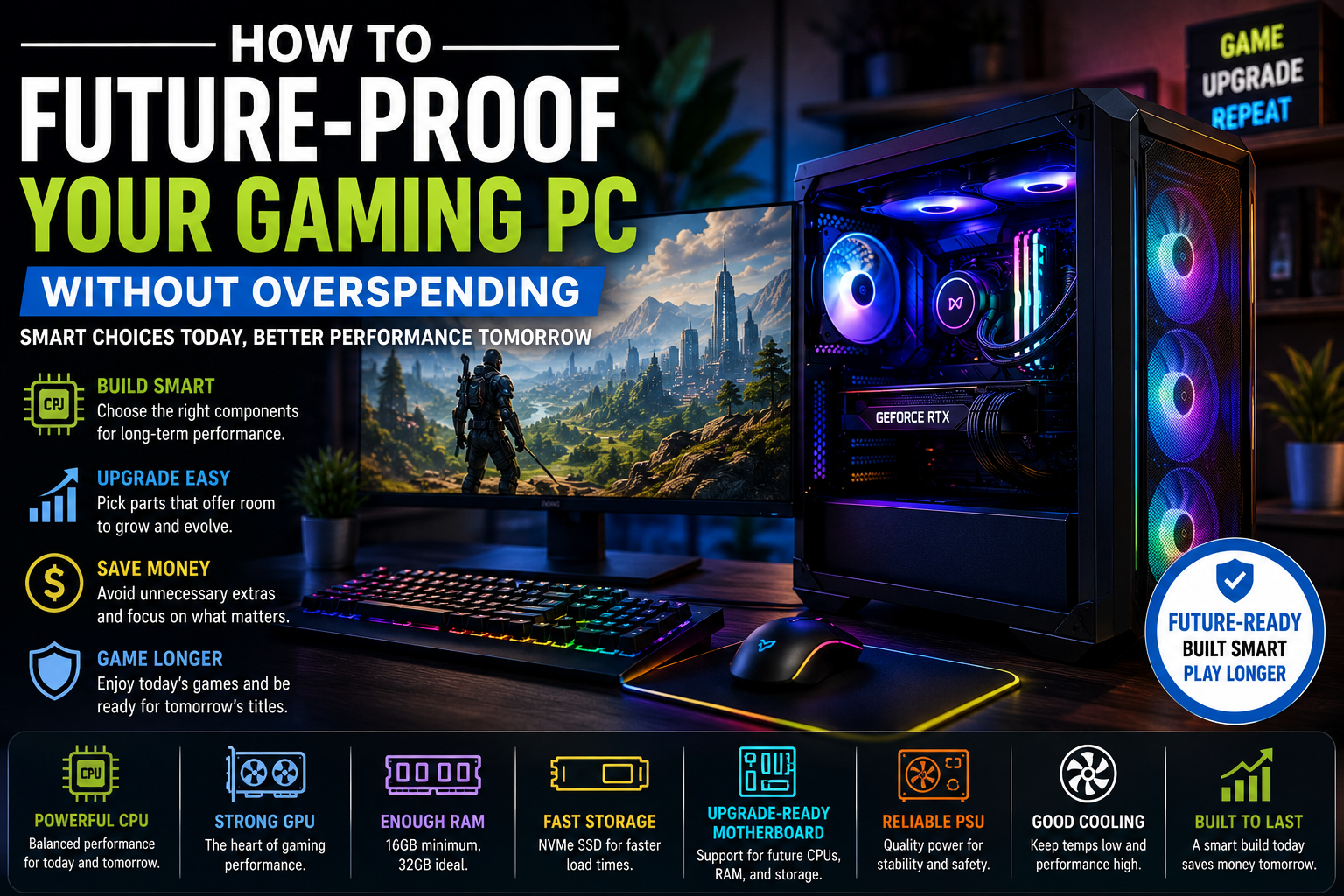

Building a gaming computer is one of the biggest investments many gamers make. With new processors, graphics cards, and gaming technologies launching every year, it’s easy to worry that your expensive PC could become outdated sooner than expected.
The good news is that creating a future-proof gaming PC doesn’t mean buying the most expensive hardware on the market. Instead, it means choosing components wisely, planning for future upgrades, and investing where it matters most. A well-balanced system can deliver excellent gaming performance for years while saving you hundreds of dollars compared to constantly chasing the latest hardware.
Whether you’re building your first gaming PC or upgrading an existing one, this guide will show you how to maximize performance, extend the life of your system, and avoid common mistakes that lead to unnecessary spending.
What Does a Future-Proof Gaming PC Really Mean?
The term future-proof gaming PC is often misunderstood. No computer is truly “future-proof” forever because technology evolves rapidly. However, you can build a system that remains capable of playing modern games for many years with only minor upgrades.
A future-ready gaming PC should:
- Handle today’s demanding games comfortably.
- Support upcoming hardware standards.
- Allow easy upgrades.
- Deliver strong value over time.
- Avoid unnecessary bottlenecks.
Rather than focusing on the most expensive parts, the goal is to build a balanced system that offers longevity.
Why Future-Proofing Matters
Many PC builders make one of two mistakes:
- Spending too little on critical components and needing to upgrade within a year.
- Overspending on flagship hardware whose premium features they may never fully use.
A smarter approach balances performance and budget. Future-proofing helps you:
- Reduce upgrade frequency.
- Save money over time.
- Increase resale value.
- Enjoy consistent gaming performance.
- Support newer game technologies as they become mainstream.
Start With a Realistic Budget
Before choosing any hardware, decide how much you’re comfortable spending.
A useful budget allocation might look like this:
| Component | Suggested Share of Budget |
|---|---|
| Graphics Card (GPU) | 35–45% |
| Processor (CPU) | 20–25% |
| Motherboard | 10–15% |
| RAM | 8–10% |
| Storage | 8–10% |
| Power Supply | 8–10% |
| Case & Cooling | 5–10% |
This balance ensures no single component limits the others.
Choose the Right CPU
The processor is one of the most important long-term investments.
Buying the absolute fastest CPU available often provides diminishing returns for gaming. Instead, choose a modern processor with enough cores and strong single-core performance to handle current and future titles.
When evaluating CPUs, consider:
- Core count
- Thread count
- Gaming benchmarks
- Platform longevity
- Upgrade path
- Power efficiency
Many mid-range processors now offer exceptional gaming performance at a fraction of flagship prices.
For additional recommendations, see our related guide: Best Budget Gaming CPUs.
How Many CPU Cores Do Gamers Need?
Modern games increasingly take advantage of multiple cores, but more isn’t always better.
As of 2026:
- 6 cores remain suitable for entry-level gaming.
- 8 cores provide an excellent balance for most gamers.
- 12 cores or more mainly benefit creators, streamers, and professionals who multitask heavily.
Choosing a processor with room to grow helps extend your system’s lifespan without overspending.
Invest Wisely in Your Graphics Card
For most gaming builds, the graphics card has the greatest impact on performance.
Rather than chasing the latest flagship GPU, look for a model that delivers strong value in your target resolution.
Recommended Resolution Targets
- 1080p Gaming: Mid-range GPU
- 1440p Gaming: Upper mid-range GPU
- 4K Gaming: High-end GPU
Buying slightly above your current needs can provide extra longevity without paying the premium associated with top-tier models.
Avoid Overspending on High-End GPUs
Flagship graphics cards often cost significantly more than mid-range alternatives while delivering relatively smaller gains in real-world gaming performance.
Instead of paying a premium for the fastest card available, consider:
- Price-to-performance ratio
- VRAM capacity
- AI-powered upscaling support
- Ray tracing performance
- Driver stability
- Power consumption
Choosing a GPU that offers excellent value today leaves room in your budget for future upgrades.
Select a Motherboard With an Upgrade Path
The motherboard forms the foundation of your gaming PC. While it doesn’t directly improve frame rates, it determines how easily your system can evolve.
Look for features such as:
- Support for current and upcoming processors
- Multiple M.2 NVMe slots
- PCIe Gen4 or Gen5 support
- High-speed USB ports
- Reliable power delivery (VRMs)
- Wi-Fi and Bluetooth (if needed)
Avoid paying extra for features you won’t use, but don’t sacrifice upgrade flexibility.
Don’t Ignore the Power Supply
The power supply (PSU) is one of the most overlooked components.
A quality PSU can last through multiple upgrades, making it a worthwhile investment.
Choose a unit that offers:
- 80 Plus Gold efficiency or better
- Adequate wattage for future GPUs
- Strong manufacturer warranty
- High-quality internal components
- Built-in safety protections
A dependable power supply protects your hardware and reduces the likelihood of costly failures.
Install Enough RAM
Memory requirements continue to increase as games become more demanding.
General recommendations:
- 16 GB – Good for many current games.
- 32 GB – The sweet spot for long-term gaming and multitasking.
- 64 GB – Best reserved for professional workloads and advanced content creation.
Buying a motherboard with additional RAM slots also makes future upgrades easier.
Use Fast NVMe SSD Storage
Traditional hard drives are no longer ideal for gaming as primary storage.
An NVMe SSD provides:
- Faster boot times
- Reduced loading screens
- Improved asset streaming
- Better overall responsiveness
A practical approach is to install:
- A fast NVMe SSD for Windows and your favorite games.
- An additional SSD for expanding your library as needed.
This setup balances performance with cost.
Prioritize Airflow and Cooling
Good cooling protects your investment.
Effective airflow helps maintain stable temperatures, reduces thermal throttling, and extends component lifespan.
Choose a case with:
- Mesh front panel
- Multiple fan mounting points
- Cable management features
- Space for future cooling upgrades
You don’t need an expensive liquid cooling system for every build. High-quality air coolers often provide excellent performance for gaming systems.
Plan for Future Upgrades
One of the best ways to future-proof your gaming PC is to think beyond today’s needs.
Ask yourself:
- Can I upgrade the CPU later?
- Is there room for a larger graphics card?
- Are there spare RAM slots?
- Does the power supply have enough capacity?
- Is additional storage easy to add?
Building with upgrades in mind helps avoid replacing the entire system later.
Avoid Common Future-Proofing Mistakes
Many builders waste money by focusing on specifications that offer little real-world benefit.
Common mistakes include:
- Buying an overpowered CPU for a mid-range GPU.
- Spending excessively on RGB lighting instead of performance.
- Choosing a low-quality power supply.
- Purchasing more RAM than needed.
- Ignoring airflow.
- Buying a motherboard with limited upgrade options.
A balanced system almost always delivers better long-term value than one built around a single premium component.
Choose a Monitor That Matches Your Hardware
Many gamers spend thousands on a powerful PC but pair it with a display that limits the overall experience. Your monitor should complement your hardware and leave room for future upgrades.
1080p Gaming
Ideal for:
- Budget gaming PCs
- Competitive esports titles
- High refresh rates (144Hz–240Hz)
1440p Gaming
The sweet spot for most gamers.
Benefits include:
- Sharper visuals
- Better balance between performance and image quality
- Excellent long-term value
4K Gaming
Best suited for enthusiasts with high-end hardware.
While stunning visually, 4K gaming requires significantly more GPU power and can shorten the useful lifespan of mid-range graphics cards.
Tip: If you’re building a future-proof gaming PC, a quality 1440p monitor with a 144Hz or higher refresh rate offers one of the best long-term investments.
Take Advantage of AI-Powered Gaming Technologies
Artificial intelligence is changing how games are rendered and optimized. AI-assisted features allow gamers to enjoy better performance without constantly upgrading hardware.
Modern technologies can:
- Increase frame rates using AI-generated frames
- Improve image quality through intelligent upscaling
- Reduce GPU workload
- Optimize graphics settings automatically
- Enhance streaming and recording quality
As more games adopt AI-powered rendering techniques, even mid-range systems can remain competitive for longer.
Don’t Chase Every Hardware Release
One of the fastest ways to overspend is upgrading every time a new CPU or GPU launches.
Hardware manufacturers introduce incremental improvements each generation, but not every release offers meaningful real-world gains.
Before upgrading, ask yourself:
- Are my favorite games struggling to run?
- Am I limited by my monitor?
- Will the upgrade noticeably improve my experience?
- Is the performance increase worth the cost?
Often, skipping one or two hardware generations provides much better value.
Build Around Your Gaming Habits
Every gamer has different needs.
Competitive Gamers
Prioritize:
- High frame rates
- Fast CPUs
- Low latency
- High-refresh monitors
Single-Player Gamers
Focus on:
- Graphics quality
- Larger SSDs
- Better GPUs
- Quiet cooling
Content Creators
Consider:
- Additional CPU cores
- More RAM
- Faster storage
- Reliable cooling
Matching your hardware to your actual usage prevents unnecessary spending.
When Should You Upgrade?
A planned upgrade strategy is far more cost-effective than replacing an entire system.
Every 2–3 Years
- Upgrade your graphics card if needed.
Every 4–5 Years
- Evaluate your processor and motherboard platform.
Every 5–7 Years
- Replace the power supply if it’s nearing the end of its warranty or showing signs of wear.
As Needed
- Add more SSD storage.
- Increase RAM if your workload requires it.
- Improve cooling for newer components.
This staggered approach keeps your PC current without large one-time expenses.
Sample Budget Allocation for a Future-Proof Gaming PC
The exact components will vary over time, but this balanced allocation helps maximize long-term value.
| Component | Budget Allocation |
|---|---|
| Graphics Card | 40% |
| Processor | 22% |
| Motherboard | 12% |
| Memory | 8% |
| Storage | 8% |
| Power Supply | 7% |
| Cooling & Case | 3% |
The graphics card remains the most important gaming investment, while the processor and motherboard should provide a clear upgrade path.
Money-Saving Tips Without Sacrificing Performance
Building a long-lasting gaming PC doesn’t always mean spending more. Consider these practical strategies:
- Buy during seasonal sales and promotional events.
- Compare price-to-performance instead of buying flagship components.
- Reuse quality cases, power supplies, or storage when upgrading.
- Avoid paying extra for cosmetic features if performance is your priority.
- Upgrade one component at a time rather than replacing your entire system.
- Read independent reviews before making purchasing decisions.
These habits can save hundreds of dollars over the life of your PC.
Signs Your Gaming PC Is No Longer Future-Ready
Even a well-planned build will eventually show its age. Common indicators include:
- Modern games require significantly reduced graphics settings.
- Frequent frame drops or stuttering.
- Insufficient storage for new game installations.
- Long loading times despite software optimization.
- Inability to support newer graphics technologies.
- Lack of compatibility with current hardware standards.
Recognizing these signs early allows you to upgrade strategically rather than waiting for a complete system failure.
Frequently Asked Questions
What is a future-proof gaming PC?
A future-proof gaming PC is a system built with components that can handle current games while remaining easy to upgrade for future hardware and software demands.
How much should I spend on a future-proof gaming PC?
The ideal budget depends on your gaming goals, but a balanced mid-range build often provides the best value and longevity without overspending.
Is 32GB of RAM enough for future gaming?
Yes. For most gamers in 2026, 32GB offers an excellent balance between performance, multitasking, and long-term usability.
Should I spend more on the CPU or GPU?
For gaming, the graphics card generally has the greatest impact on performance. However, pairing it with a capable processor ensures a balanced system without bottlenecks.
How often should I upgrade my gaming PC?
Most gamers can keep their systems current by upgrading the graphics card every few years and evaluating the CPU platform every four to five years, depending on performance needs.
Is building a gaming PC cheaper than buying a prebuilt system?
In many cases, yes. Building your own PC allows you to select higher-quality components, avoid unnecessary extras, and upgrade individual parts over time, often resulting in better long-term value.
Conclusion
Building a future-proof gaming PC is less about buying the most expensive hardware and more about making informed decisions that balance performance, upgradeability, and budget. By investing in a capable processor, a value-focused graphics card, fast NVMe storage, sufficient memory, and a reliable power supply, you can create a gaming system that remains enjoyable for years.
Technology will continue to evolve, but thoughtful planning can dramatically reduce the need for frequent upgrades. Focus on components that offer strong price-to-performance ratios, choose a motherboard with room to grow, and resist the temptation to chase every new hardware release.
With a smart upgrade strategy and a balanced build, you’ll enjoy smooth gameplay, better value, and the confidence that your PC is ready for the games of today—and those still to come.
For additional hardware guidance, visit the Intel Gaming Resource Center for processor recommendations and gaming optimization tips. You can also explore our companion article, Best Budget Gaming CPUs, to find processors that deliver outstanding gaming performance without exceeding your budget.