

Table of Contents
- What on-page SEO is and why it matters
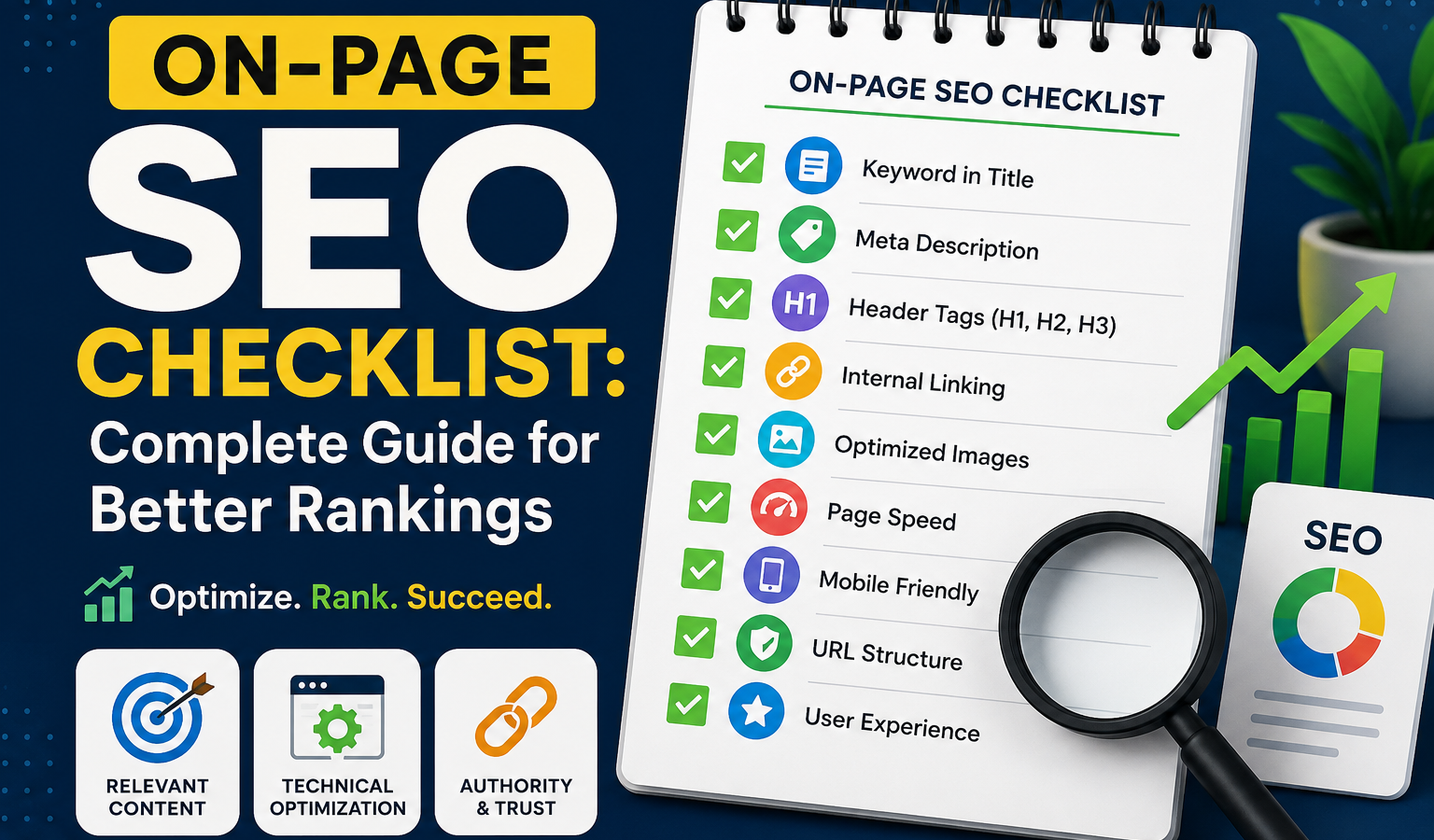
- The complete on-page SEO checklist
- Comparison table: good vs poor optimization
- Expert tips for higher impact
- Common mistakes to avoid
- Frequently asked questions
- Conclusion and call to action
What Is On-Page SEO?
On-page SEO is the practice of optimizing the elements on a web page so search engines can understand the topic and users can find value quickly. It includes the page title, headings, content quality, internal links, images, URL structure, meta description, and overall readability.
Google’s guidance emphasizes helpful, reliable, people-first content. In practice, that means your page should satisfy the search intent better than competing pages, not simply repeat keywords. Google also notes that meta descriptions can influence snippets, but search results are primarily generated from page content.
Ahrefs’ Site Audit surfaces 170+ issues across titles, descriptions, H1s, content, indexability, links, images, and structured data, which reflects how broad on-page optimization really is.
Complete On-Page SEO Checklist
1. Match Search Intent First
Before you optimize anything else, make sure the page answers the real reason behind the search query. A checklist article should give practical steps, examples, and a clear sequence of actions. If the searcher wants a checklist, do not bury the list under vague theory.
- Identify informational, transactional, or navigational intent.
- Study the top-ranking pages for structure and depth.
- Cover the topic fully without padding.
- Make the first screen useful immediately.
2. Write a Strong SEO Title
Your title tag is one of the strongest on-page signals for both users and search engines. Keep it concise, specific, and clickable. Google says page titles should be descriptive and useful, not exaggerated.
- Place the primary keyword near the beginning.
- Keep it under 60 characters where possible.
- Use a benefit or angle that makes the page stand out.
- Avoid stuffing multiple keywords into one title.
Example: On-Page SEO Checklist: 25 Steps to Rank Better
3. Craft a Clear Meta Description
Meta descriptions do not directly control rankings, but they can improve click-through rates by helping people understand what the page offers. Google may use them for snippets when they describe the page better than the content itself.
- Write 150–160 characters when possible.
- Summarize the page in plain language.
- Include the primary keyword naturally.
- Focus on value, not keyword repetition.
4. Use a Clean, SEO-Friendly URL Slug
Short URLs are easier for users to scan and for search engines to interpret. Google recommends persistent, readable URL structures and warns against temporary parameters that create duplicate or short-lived URLs. citeturn149508search3
- Use lowercase letters and hyphens.
- Keep the slug short and meaningful.
- Remove stop words when they add no value.
- Avoid dates unless the content is time-sensitive.
5. Place One Clear H1 on the Page
The H1 should tell visitors exactly what the page is about. It can be similar to the title tag, but it should not be identical if a better on-page version exists. The H1 supports topic clarity and improves content structure.
- Use only one H1.
- Keep it aligned with the search intent.
- Make sure it is visible without scrolling.
6. Organize Content With Logical H2s and H3s
Headings help readers scan the page and help search engines understand the information hierarchy. Ahrefs’ on-page reports specifically analyze heading structure because it is a practical indicator of content organization.
- Use H2s for major sections.
- Use H3s for supporting details and steps.
- Keep headings descriptive, not clever for the sake of style.
- Include semantic keyword variations naturally.
7. Write Comprehensive, Helpful Content
Google’s helpful content guidance stresses originality, depth, and usefulness. Strong pages provide complete answers, not thin rewrites of other pages.
- Cover the topic from beginner to practical use.
- Include examples, checklists, and action steps.
- Add original observations or workflows.
- Keep paragraphs short and easy to read.
8. Use the Primary Keyword Naturally
Keyword placement still matters, but density matters less than relevance and clarity. Use the main keyword in the title, H1, intro, one or two subheadings, and naturally throughout the body. Then support it with semantically related terms such as page optimization, meta tags, internal links, content structure, and search intent.
- Write for humans first.
- Use variations, not repetition.
- Include related entities and concepts.
- Avoid awkward keyword stuffing.
9. Add Internal Links Strategically
Internal links guide users to related content and help search engines discover page relationships. Use descriptive anchor text and connect the article to relevant cornerstone pages. A smart internal linking structure can improve crawl efficiency and support topical authority.
- Link to related tutorials and service pages.
- Use anchors that explain the destination.
- Link from high-traffic pages to important pages.
- Keep links contextually relevant.
10. Optimize Images for SEO and Accessibility
Image SEO is more than naming files. Google recommends using HTML image elements, proper alt text, and responsive images so visual content can be understood and indexed correctly. Mobile pages should also use the same descriptive alt text as desktop pages.
- Use descriptive file names.
- Write concise, helpful alt text.
- Compress images for speed.
- Use modern formats and responsive sizes where possible.
11. Improve Readability and Layout
Readability affects engagement, and engagement affects whether a visitor keeps reading. Use short sentences, short paragraphs, bullets, and clear transitions. A page that is easy to scan usually performs better than a dense wall of text.
- Keep paragraphs to 2–4 sentences.
- Use bullets for steps and feature lists.
- Break long sections with helpful subheadings.
- Use plain English where possible.
12. Add Relevant External Authority Links
Linking to authoritative sources can improve trust and show readers that your content is grounded in reliable guidance. Use them sparingly and only when they strengthen the article.
- Google Search Central documentation
- Google developers accessibility and image guidance
- Ahrefs site audit and SEO research tools
- Other respected industry references when relevant
On-Page SEO Checklist Comparison Table
| Element | Good Optimization | Poor Optimization |
|---|---|---|
| Title | Clear, concise, keyword-focused | Too long, vague, stuffed with keywords |
| Meta Description | Useful summary with a clear benefit | Generic or copied from another page |
| Headings | Logical H2/H3 structure | Random, missing, or overused |
| Content | Comprehensive and original | Thin, repetitive, or duplicated |
| Images | Compressed with descriptive alt text | Heavy files and empty alt text |
| Internal Links | Contextual and useful | Few links or irrelevant anchors |
Expert Tips for Better On-Page SEO
- Write the page for one primary intent, not multiple unrelated intents.
- Use the first 100 words to confirm the topic and value quickly.
- Add one unique insight, framework, or checklist item that competitors missed.
- Use keyword variations and entity-rich language to improve topical coverage.
- Review your page with a content audit tool before publishing.
A practical benchmark is to ask whether the page would still be worth reading if the keyword were removed. If the answer is yes, the page is usually on the right track.
Common On-Page SEO Mistakes
- Writing for algorithms instead of readers
- Using the same title and meta description on many pages
- Forgetting to add internal links
- Publishing pages with weak or missing H1s
- Using generic alt text like “image” or “photo”
- Overloading content with repeated keywords
- Ignoring mobile readability and image quality
- Leaving thin pages live without improving them
Frequently Asked Questions
1. What is an on-page SEO checklist?
It is a structured list of page-level optimization tasks such as title tags, headings, content quality, internal links, image SEO, and meta descriptions.
2. Does on-page SEO still matter in 2026?
Yes. On-page SEO remains essential because search engines still need clear signals about topic, structure, and value, especially for competitive keywords.
3. How long should an SEO title be?
A practical target is under 60 characters so the title is less likely to be truncated, though exact display length can vary by device and query.
4. Do meta descriptions improve rankings?
Not directly. They are mainly useful for improving click-through rates and helping search engines and users understand the page.
5. How many times should I use the keyword?
Use it naturally in important places, then rely on related terms and clear writing. There is no fixed magic number.
6. Are internal links important for SEO?
Yes. Internal links help users navigate and help search engines understand which pages are related and important.
7. Should every page have images?
Not every page needs images, but useful visuals can improve understanding, engagement, and accessibility when they support the content.
8. What is the biggest on-page SEO mistake?
The biggest mistake is creating content that looks optimized but does not genuinely satisfy the reader’s intent.
Conclusion
A strong on-page SEO checklist is not about adding more keywords. It is about building a page that is useful, structured, fast, easy to understand, and aligned with search intent. When you optimize titles, headings, content, links, and images together, you create a better experience for readers and a clearer signal for search engines.
Use this checklist before every important post or landing page, and revisit it during content updates. Small improvements to page structure and clarity often create the biggest gains over time.
Call to Action
Apply this on-page SEO checklist to your next post, then audit your existing pages and improve the ones with the most potential first. Start with titles, content depth, internal links, and image optimization for the fastest wins.