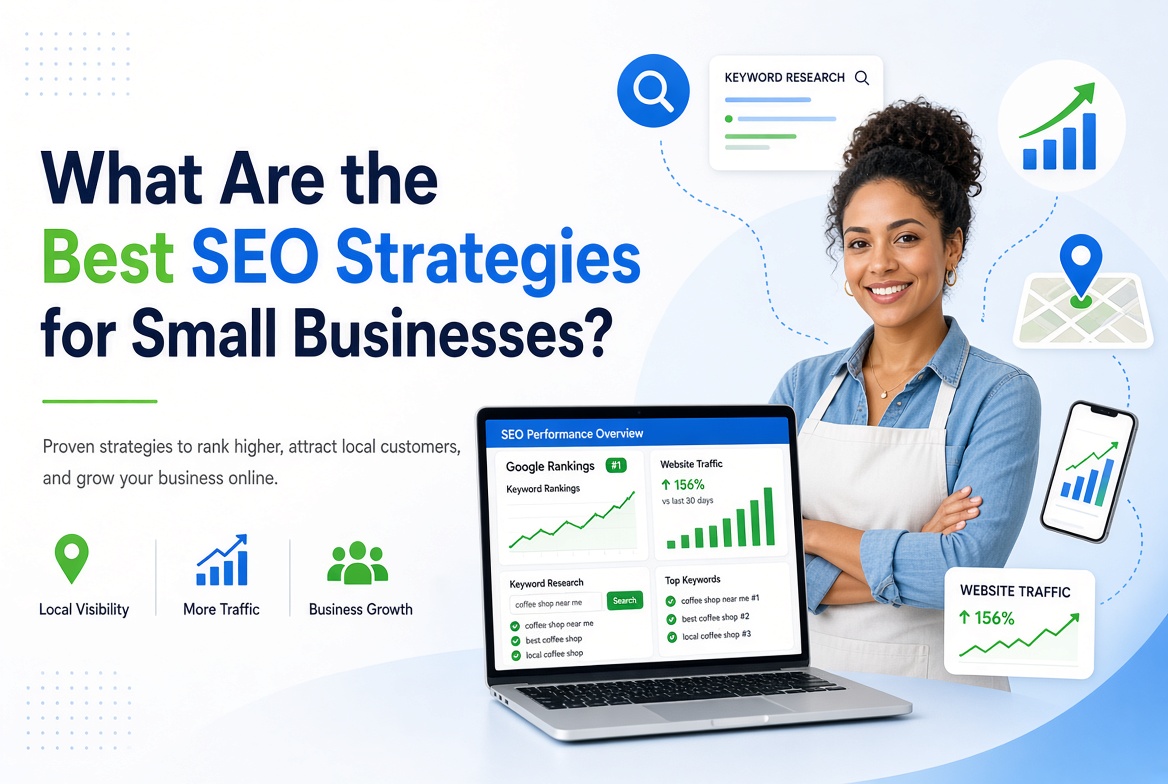

छोटे व्यवसायों को एक सामान्य चुनौती का सामना करना पड़ता है: बिना विज्ञापन पर बहुत खर्च किए ग्राहकों को आकर्षित करना। चाहे आप एक स्थानीय दुकान, पेशेवर सेवा, ऑनलाइन दुकान, या डिजिटल एजेंसी का संचालन कर रहे हैं, आपकी क्षमता प्रासंगिक खोज परिणामों में दिखाई देने की संभावना संभावित ग्राहकों के आपके व्यवसाय को खोजने में प्रभावित कर सकती है।
यही वह जगह है जहाँ सर्च इंजन ऑप्टिमाइजेशन (SEO) महत्वपूर्ण हो जाता है।
छोटे व्यवसायों के लिए सबसे अच्छी SEO रणनीतियाँ सही लोगों को आपकी वेबसाइट ढूंढने, आपकी सेवाओं को समझने, और कार्रवाई करने में मदद करने पर केंद्रित होती हैं। शुरू करने के लिए आपको एक विशाल मार्केटिंग बजट की आवश्यकता नहीं है। इसके बजाय, आपको एक स्पष्ट रणनीति, उपयोगी सामग्री, एक तकनीकी रूप से मजबूत वेबसाइट, और लगातार प्रयास की आवश्यकता है।
स्थानीय SEO और कीवर्ड अनुसंधान से लेकर सामग्री विपणन और लिंक निर्माण तक, कई व्यावहारिक तकनीकें हैं जो आपकी ऑनलाइन दृश्यता को सुधारने और अधिक प्रभावी ढंग से प्रतिस्पर्धा करने में मदद कर सकती हैं।
इस गाइड में, आप 12 प्रभावी छोटे व्यवसाय SEO रणनीतियों के बारे में जानेंगे, सामान्य गलतियों से बचने के लिए, और आपकी वेबसाइट के प्रदर्शन में सुधार करने के लिए व्यावहारिक कदम क्या हो सकते हैं।
विषय-सूची
- छोटे व्यवसाय SEO क्या है?
- छोटे व्यवसायों के लिए SEO क्यों महत्वपूर्ण है
- छोटे व्यवसायों के लिए सबसे अच्छे SEO रणनीतियाँ क्या हैं?
- एक किफायती छोटे व्यवसाय SEO योजना कैसे बनाएं
- छोटे व्यवसायों के लिए आवश्यक SEO उपकरण
- बेहतर SEO परिणामों के लिए विशेषज्ञ सुझाव
- छोटे व्यवसायों को बचने चाहिए सामान्य SEO गलतियाँ
- अक्सर पूछे जाने वाले प्रश्न
- निष्कर्ष
छोटे व्यवसाय SEO क्या है?
छोटे व्यवसाय SEO एक कंपनी की वेबसाइट और ऑनलाइन उपस्थिति को सुधारने की प्रक्रिया है ताकि संभावित ग्राहक इसके उत्पादों, सेवाओं, और जानकारी को खोज इंजनों के माध्यम से खोज सकें।
इसमें कीवर्ड अनुसंधान, वेबसाइट पृष्ठों का अनुकूलन, सहायक सामग्री बनाना, वेबसाइट प्रदर्शन में सुधार करना, प्रासंगिक बैकलिंक प्राप्त करना, और स्थानीय व्यावसायिक लिस्टिंग का प्रबंधन करना जैसी गतिविधियाँ शामिल हैं।
उदाहरण के लिए, लागोस में एक प्लंबिंग कंपनी चाह सकती है कि जब कोई “लागोस में आपातकालीन प्लंबर” की खोज करें तो वह दिखाई दे। एक कपड़ों का रिटेलर उन लोगों को आकर्षित करना चाहता है जो “ऑनलाइन किफायती महिलाओं के कपड़े” की खोज कर रहे हैं।
दोनों मामलों में, SEO व्यवसाय को उन लोगों से जोड़ने में मदद करता है जो पहले से ही प्रासंगिक उत्पादों या सेवाओं की तलाश में हैं।
छोटे व्यवसाय SEO कैसे काम करता है?
खोज इंजन स्वचालित प्रणालियों का उपयोग करते हैं ताकि पृष्ठों को खोज सकें, उनकी सामग्री को समझ सकें, और यह निर्धारित कर सकें कि विशिष्ट खोज के लिए कौन से परिणाम सबसे उपयोगी हैं।
आपकी वेबसाइट को खोज इंजनों के लिए यह आसान बनाना चाहिए:
- महत्वपूर्ण पृष्ठों का पता लगाना।
- समझें कि आपका व्यवसाय क्या पेशकश करता है।
- इसके बारे में बताएँ कि आपकी सामग्री किन विषयों को कवर करती है।
- प्राविधिक बाधाओं के बिना आपकी वेबसाइट को एक्सेस करें।
- आपके उत्पादों और सेवाओं की प्रासंगिक जानकारी को समझें।
हालांकि, SEO केवल एक वेबसाइट को खोज इंजनों के लिए आकर्षक बनाने के बारे में नहीं है। यह आगंतुकों के लिए एक उपयोगी अनुभव बनाने के बारे में भी है।
गूगल मददगार, विश्वसनीय, लोगों-प्रथम सामग्री तैयार करने और इसकी स्थापित खोज सर्वोत्तम प्रथाओं का पालन करने की सिफारिश करता है।
आप गूगल की आधिकारिक सिफारिशों की समीक्षा कर सकते हैं SEO स्टार्टअप गाइड.
छोटे व्यवसायों के लिए SEO क्यों महत्वपूर्ण है
SEO छोटे व्यवसायों को बिना पूरी तरह से विज्ञापन पर निर्भर हुए एक मजबूत ऑनलाइन उपस्थिति बनाने में मदद कर सकता है।
हालांकि जैविक दृश्यता विकसित करने में समय लगता है, एक अच्छी तरह से अनुकूलित वेबसाइट व्यक्तिशः प्रकाशित पृष्ठों के बाद भी प्रासंगिक आगंतुकों को आकर्षित कर सकती है।
यहाँ कुछ मुख्य लाभ हैं।
1. ग्राहकों तक पहुंचें जो सक्रिय रूप से खोज रहे हैं
खोज ट्रैफ़िक मूल्यवान हो सकता है क्योंकि उपयोगकर्ता अक्सर जानकारी की आवश्यकता होने पर, उत्पादों की तुलना करने के लिए, या सेवा खरीदने के लिए तैयार होने पर खोज करते हैं।
उदाहरण के लिए, “अबुजा में शादी के फोटोग्राफर की भर्ती करें” के लिए खोज करने वाला व्यक्ति किसी सामान्य फोटोग्राफी सामग्री को ब्राउज़ करने वाले व्यक्ति की तुलना में एक अधिक विशिष्ट इरादा रखता है।
प्रासंगिक खोज शब्दों को लक्षित करना आपके व्यवसाय को उन लोगों तक पहुँचाने में मदद करता है जिनकी आवश्यकताएँ आपकी सेवाओं से मेल खाती हैं।
2. भुगतान किए गए विज्ञापनों पर निर्भरता घटाएँ
भुगतान किए गए विज्ञापन तात्कालिक दृश्यता उत्पन्न कर सकते हैं, लेकिन एक विज्ञापन अभियान से ट्रैफ़िक सामान्यतः निरंतर व्यय पर निर्भर करता है।
SEO में अनुसंधान, सामग्री, तकनीकी सुधार और निरंतर रखरखाव में निवेश की आवश्यकता होती है। हालाँकि, सफल जैविक पृष्ठ बिना हर क्लिक के लिए भुगतान किए आगंतुकों को आकर्षित करना जारी रख सकते हैं।
SEO समय या संसाधनों के मामले में निःशुल्क नहीं है, और परिणाम कभी भी सुनिश्चित नहीं होते। इसका लाभ यह है कि यह प्रासंगिक ट्रैफ़िक का एक स्थायी स्रोत विकसित करने का अवसर प्रदान करता है।
3. ब्रांड जागरूकता और विश्वास बनाएं
ग्राहक अक्सर व्यवसायों को संपर्क करने से पहले शोध करते हैं।
एक वेबसाइट जो उपयोगी जानकारी प्रदान करती है, अपने सेवाओं को स्पष्ट रूप से समझाती है, वास्तविक ग्राहक समीक्षाएँ प्रदर्शित करती है, और पारदर्शी संपर्क विवरण प्रदान करती है, विश्वास बनाने में मदद कर सकती है।
नियमित रूप से प्रासंगिक सामग्री प्रकाशित करना आपके व्यवसाय को आपकी उद्योग में एक उपयोगी संसाधन के रूप में स्थापित भी कर सकता है।
4. बड़े व्यवसायों से प्रतिस्पर्धा करें
छोटे व्यवसायों को अपनी उद्योग में हर व्यापक कीवर्ड को लक्षित करने की आवश्यकता नहीं है।
इसके बजाय, वे विशिष्ट ग्राहक आवश्यकताओं, स्थानीय खोजों, विशेषज्ञ सेवाओं, और अनदेखे विषयों पर ध्यान केंद्रित कर सकते हैं।
उदाहरण के लिए, एक छोटे अकाउंटिंग फर्म “इबादान में छोटे व्यवसायों के लिए अकाउंटेंट” के लिए अधिक प्रभावी ढंग से प्रतिस्पर्धा कर सकता है बनाम उच्च प्रतिस्पर्धी शब्द “अकाउंटिंग सेवाएँ।”
लक्ष्य यह है कि खोज के अवसरों की पहचान की जाए जो आपकी विशेषज्ञता और व्यवसाय के उद्देश्यों के अनुकूल हों।
छोटे व्यवसायों के लिए सबसे अच्छे SEO रणनीतियाँ क्या हैं?
The most effective approach combines keyword research, on-page optimization, local visibility, useful content, technical SEO, and performance measurement.
The following 12 strategies provide a practical starting point.
1. सामग्री बनाने से पहले कीवर्ड रिसर्च करें
Keyword research helps you understand the words and phrases potential customers use when searching for your products or services.
Without research, you may spend time publishing content that attracts little relevant traffic.
Start by identifying your primary products, services, customer problems, and locations.
Then expand these ideas into specific search terms.
संबंधित कीवर्ड कैसे खोजें
Use the following methods:
- Google autocomplete suggestions.
- Google’s related search suggestions.
- Google Search Console performance reports.
- Google Keyword Planner.
- Keyword research tools such as Ahrefs and Semrush.
- Questions customers frequently ask.
- Search terms used by relevant competitors.
For example, a digital marketing agency could research keywords such as:
- SEO services for small businesses.
- Affordable SEO services.
- Local SEO for small businesses.
- How to improve website rankings.
- Small business keyword research.
- SEO consultant for local businesses.
These keywords represent different needs and search intentions.
खोज इरादे पर ध्यान केंद्रित करें
Search intent describes what a person hopes to accomplish with a search.
Common types include:
Informational intent: The user wants to learn something.
Example: “How does SEO work?”
Commercial investigation: The user is comparing potential solutions.
Example: “Best SEO tools for small businesses.”
Transactional intent: The user is ready to take action.
Example: “Hire an SEO consultant.”
Navigational intent: The user wants to find a particular website or business.
Example: Searching for a company’s name.
Choose keywords that match your page’s purpose. A service page should focus on attracting potential customers, while an educational article should answer a relevant question.
विशेषज्ञ टिप
Create a keyword map that assigns one primary search topic to each important page. This helps you avoid publishing several pages that compete for the same search intent.
Do not force keywords into every paragraph. Google can understand related terminology, so write naturally and address the subject comprehensively.
2. अपने Google व्यवसाय प्रोफ़ाइल को ऑप्टिमाइज़ करें
Local SEO is especially important for businesses that serve customers in a particular city, region, or service area.
A complete and accurate Google Business Profile can help eligible businesses appear in Google Maps and local search results.
For example, a bakery in Abuja may want to appear when people search for “bakery near me” or “birthday cakes in Abuja.”
अपने Google व्यवसाय प्रोफ़ाइल को सुधारने के लिए
Start by claiming or creating your profile through Google’s official Business Profile service.
Then take these steps:
- Enter your correct business name.
- Choose the most relevant primary business category.
- Add accurate contact information.
- Maintain consistent opening hours.
- Describe your products and services clearly.
- Upload genuine photographs of your business.
- Add your website address.
- Keep holiday hours updated.
- Respond professionally to customer reviews.
- Use available features to share relevant business updates.
If your business serves customers at their locations, configure the service areas accurately.
Do not create fake locations or use a virtual address that violates Google’s eligibility requirements.
ग्राहक समीक्षाएँ क्यों महत्वपूर्ण हैं
Reviews help prospective customers evaluate your business before contacting you.
Ask satisfied customers to leave honest feedback. Respond to positive and negative reviews professionally, and avoid offering incentives in exchange for reviews where platform policies prohibit them.
Never purchase fake reviews or write reviews for your own business under misleading identities.
3. Optimize Your Website’s On-Page SEO
On-page SEO involves improving individual pages so visitors and search engines can understand their purpose.
Your website’s title, main heading, content, URL, internal links, and images should communicate the page’s subject clearly.
SEO शीर्षकों का ऑप्टिमाइज़ करें
Every important page should have a unique, descriptive title.
उदाहरण के लिए:
Weak title: “Our Services”
Better title: “Affordable Plumbing Services in Abuja”
The second title identifies the service and location, making the page’s purpose clearer.
Place your primary keyword naturally in the title when it accurately describes the content.
उपयोगी मेटा विवरण लिखें
A meta description summarizes a page’s content and may appear as the snippet in search results.
उदाहरण के लिए:
“Explore affordable plumbing services in Abuja, including leak repairs, pipe installation, emergency assistance, and routine maintenance.”
Write a unique description for each important page. Make it accurate and useful rather than filling it with repeated keywords.
Google may generate a different snippet based on the user’s search, so a meta description does not guarantee a particular search result.
हेडिंग के साथ सामग्री को संरचित करें
Use a clear heading hierarchy:
- H1: The main page title.
- H2: Major sections.
- H3: Supporting subsections.
Headings should help readers navigate the page.
For example, an article about small business accounting might use sections such as “Choosing Accounting Software,” “Managing Business Expenses,” and “Preparing Financial Reports.”
छवियों को ऑप्टिमाइज़ करें
Images can improve the user experience, but unnecessarily large files can slow down your website.
Use these practices:
- Compress images before uploading them.
- Choose suitable image dimensions.
- वर्णनात्मक फ़ाइल नामों का उपयोग करें।
- Add meaningful alternative text to informative images.
- Use modern image formats where appropriate.
- Avoid adding keywords to alt text when they do not describe the image.
For example, an image showing a bakery counter might use the alt text “Freshly baked bread displayed at a local bakery.”
Do not use generic alt text for every image. Describe each image according to its actual content and purpose.
4. लगातार मददगार, मूल सामग्री प्रकाशित करें
Content marketing is an important part of a sustainable SEO strategy.
Your website should answer the questions customers ask, explain your services, and help people make informed decisions.
Publishing more articles is not automatically better. Focus on usefulness, accuracy, originality, and relevance.
विषयों का चयन करें जो आपके ग्राहक की परवाह करते हैं
Start with real customer questions.
A small accounting firm might publish:
- How to Prepare Your Business for Tax Season.
- Common Bookkeeping Mistakes Small Businesses Make.
- How to Separate Personal and Business Finances.
- When Should a Small Business Hire an Accountant?
- Accounting Software Features to Consider.
A web design company might publish:
- How Much Does a Small Business Website Cost?
- Essential Pages Every Business Website Needs.
- How to Improve Website Loading Speed.
- Website Design Mistakes That Reduce Conversions.
- How to Choose a Domain Name for Your Business.
Each article should address a specific problem and provide practical guidance.
अनुभव और विशेषज्ञता प्रदर्शित करें
Google’s quality guidance emphasizes helpful, reliable content.
To strengthen your articles:
- Include practical examples from relevant work.
- Explain recommendations clearly.
- Use trustworthy sources for factual claims.
- Attribute statistics and research.
- Keep time-sensitive information updated.
- Identify authors accurately.
- Disclose commercial relationships where relevant.
- Avoid unsupported claims about guaranteed outcomes.
Only describe experience, qualifications, or results that you can substantiate.
विषय क्लस्टर बनाएं
A topic cluster connects a central resource with related supporting articles.
For example, a central guide about small business SEO could link to articles about keyword research, local SEO, technical SEO, and link building.
Each supporting article should provide distinct value rather than repeating the central guide.
Use descriptive internal links to connect related pages and help readers discover relevant information.
5. Improve Your Website’s Technical SEO
Technical SEO helps search engines access, crawl, understand, and index your website.
Even excellent content may struggle to attract organic traffic if important pages cannot be accessed or indexed correctly.
एक XML साइटमैप प्रस्तुत करें
An XML sitemap lists important URLs that you want search engines to discover.
Many content management systems, including WordPress with suitable SEO plugins, can generate a sitemap automatically.
Check that your sitemap:
- Contains the correct canonical URLs.
- Includes important pages intended for indexing.
- Excludes unnecessary URLs where appropriate.
- Updates when relevant content changes.
- Returns a successful response.
Submit the sitemap through Google Search Console.
A sitemap helps discovery, but it does not guarantee that every listed page will be indexed.
इंडेक्सिंग समस्याओं की जाँच करें
Google Search Console helps website owners monitor search performance and investigate indexing issues.
Use the URL Inspection tool to examine important pages.
Check for problems such as:
- Accidental noindex directives.
- Incorrect canonical tags.
- Pages blocked by robots.txt.
- Broken internal links.
- Redirect chains.
- Server errors.
- Duplicate or low-value pages.
Correct problems according to their cause rather than making technical changes without understanding their effects.
HTTPS का उपयोग करें
HTTPS protects data exchanged between a visitor’s browser and your website.
Install and maintain a valid SSL/TLS certificate, redirect HTTP URLs to their HTTPS equivalents when appropriate, and ensure internal links use the correct version of your website.
This improves connection security and helps prevent visitors from encountering browser security warnings.
एक तार्किक वेबसाइट संरचना बनाएँ
Organize pages around your products, services, and important topics.
उदाहरण के लिए:
- Homepage
- Services
- Services > SEO Consulting
- Services > Website Optimization
- Blog
- Blog > Local SEO
- Blog > Technical SEO
- Contact
Use descriptive URLs that help users understand what a page contains.
A clear structure also makes it easier to create relevant internal links.
6. अपनी वेबसाइट को तेज और मोबाइल-अनुकूल बनाएं
Many potential customers access websites through smartphones. A poor mobile experience can make it difficult for them to read content, navigate pages, or contact your business.
Website performance also contributes to the overall user experience.
वेबसाइट की गति में सुधार कैसे करें
Consider the following improvements:
- Compress oversized images.
- अनावश्यक प्लगइन्स और स्क्रिप्ट्स को हटा दें।
- Use reliable hosting.
- Enable appropriate browser caching.
- Minify CSS and JavaScript where beneficial.
- Reduce unnecessary third-party tracking scripts.
- Use a content delivery network when appropriate.
- Avoid excessive animations and intrusive pop-ups.
Do not install multiple optimization plugins that perform overlapping functions without testing their compatibility.
कोर वेब विटल्स पर नज़र रखें
Google’s Core Web Vitals help assess important aspects of real-world user experience.
The main metrics are:
सबसे बड़ा कंटेंटफुल पेंट (LCP): Measures how quickly the main content becomes visible. Google’s good target is 2.5 seconds or less.
अंतरक्रिया से अगले चित्रण तक (INP): Measures responsiveness to user interactions. A good target is 200 milliseconds or less.
संचयी लेआउट परिवर्तन (CLS): Measures unexpected visual movement. A good target is 0.1 or less.
These targets are assessed at the 75th percentile of page visits, segmented by mobile and desktop where data is available.
Use पृष्ठ गति अंतर्दृष्टि to test individual URLs and identify performance opportunities.
Prioritize meaningful improvements rather than chasing a perfect score at the expense of usability.
7. उच्च गुणवत्ता वाले बैकलिंक्स बनाएँ
Backlinks are links from other websites to yours.
Relevant, editorially earned links can help search engines discover your content and may contribute to your site’s authority and visibility.
However, not all backlinks provide equal value, and acquiring large quantities of low-quality links does not guarantee improved rankings.
बैकलिंक्स कमाने के व्यावहारिक तरीके
Consider these legitimate approaches:
- Publish original research or useful industry statistics.
- Create comprehensive resources that other websites may reference.
- Contribute expert commentary to relevant publications.
- Participate in legitimate industry associations.
- Build relationships with complementary businesses.
- Develop useful local resources.
- Reclaim unlinked brand mentions when appropriate.
- Write genuine guest contributions for relevant websites.
For example, a small business consultant could publish an original survey about challenges facing local businesses. Industry publications may reference the findings when discussing the same topic.
This approach creates a reason for other websites to link to the resource.
जोखिम भरे लिंक-निर्माण प्रथाओं से बचें
Do not rely on schemes involving paid links intended to manipulate rankings, automated link creation, private blog networks, or large-scale irrelevant guest posts.
Google’s spam policies address link practices designed primarily to manipulate search rankings.
A backlink campaign should prioritize relevance, editorial quality, and genuine value rather than simply counting links.
8. स्थानीय कुंजीशब्दों और स्थान विशेष खोजों के लिए अनुकूलन करें
A local SEO strategy should reflect where your customers live, work, and search for services.
This is particularly important for restaurants, repair businesses, consultants, medical practices, retail shops, and other businesses serving defined geographic areas.
स्थान कुंजीशब्दों का स्वाभाविक रूप से उपयोग करें
If you serve customers in Abuja, relevant topics might include:
- Website Design Services in Abuja.
- Digital Marketing Agency in Abuja.
- Affordable Office Cleaning in Abuja.
- Business Consulting for Abuja Entrepreneurs.
Create dedicated location pages only when they provide genuinely useful information about your services in those areas.
Avoid creating dozens of nearly identical pages that change only the city name. Such pages can provide little value and may fall within doorway-page abuse if designed to manipulate search results.
व्यवसाय की जानकारी को सुसंगत रखें
Maintain accurate business details across your website and legitimate business directories.
Pay particular attention to:
- Business name.
- Address, where publicly applicable.
- Phone number.
- Website URL.
- Opening hours.
- Service descriptions.
Correct inconsistencies when you find them.
For businesses that operate entirely online or do not serve customers at a physical location, focus on the SEO techniques appropriate to their business model rather than creating an ineligible local profile.
9. आंतरिक लिंकिंग को मजबूत करें
Internal links connect pages within your website.
They help users discover related information and help search engines find additional pages.
A thoughtful internal linking strategy can also guide visitors toward useful resources, service pages, and conversion opportunities.
आंतरिक लिंकिंग में सुधार कैसे करें
Whenever you publish a new article:
- Identify existing articles that cover related subjects.
- Add relevant links from those pages to the new article.
- Link from the new article to useful supporting resources.
- Connect educational articles to relevant service pages where appropriate.
- Review important pages for broken links.
- Use descriptive anchor text.
For example, an article about keyword research could link to a guide about on-page SEO.
An article about local SEO could link to a service page explaining your local SEO offering.
Avoid adding links simply to increase their number. Every link should help readers navigate or understand the subject.
10. उत्पाद और सेवा पृष्ठों को रूपांतरण के लिए अनुकूलित करें
SEO should attract relevant visitors, but your website must also help them take the next step.
A visitor who cannot understand your offer or find your contact information may leave without becoming a customer.
अपनी सेवा पृष्ठों में सुधार करें
An effective service page should explain:
- What the service includes.
- Which customer problems it solves.
- Who the service is suitable for.
- How your process works.
- What differentiates your business.
- What customers can expect.
- How to request a quotation or consultation.
Use genuine testimonials, case studies, or examples where available and permitted.
Do not invent customer feedback or exaggerate results.
स्पष्ट कॉल टू एक्शन का उपयोग करें
Every important commercial page should make the next step obvious.
उदाहरणों में शामिल हैं:
- Request a Quote.
- Book a Consultation.
- Contact Our Team.
- Shop Available Products.
- Schedule a Service.
Make contact forms easy to complete and ensure that phone numbers, email addresses, and buttons work correctly on mobile devices.
Track meaningful actions such as qualified enquiries, purchases, and completed bookings rather than evaluating success solely by website traffic.
11. जहां उपयुक्त हो, संरचित डेटा का उपयोग करें
Structured data is a standardized format that helps search engines interpret information about a page.
Depending on your website, suitable schema types may include Organization, LocalBusiness, Article, Product, or BreadcrumbList.
For example, a business website may use Organization structured data to describe its identity and official website.
A qualifying local business may use an appropriate LocalBusiness subtype.
संरचित डेटा के सर्वोत्तम अभ्यास
Follow these guidelines:
- Choose schema types that accurately describe the page.
- Ensure the markup reflects visible, genuine information.
- Validate the implementation.
- Correct errors and warnings where relevant.
- Keep structured data consistent with the actual page content.
- Avoid adding unsupported claims or misleading review markup.
Use Google’s Structured Data documentation to identify suitable implementations.
Structured data can make a page eligible for certain enhanced search appearances, but it does not guarantee rich results or higher rankings.
12. एसईओ प्रदर्शन को मापें और अपनी रणनीति में सुधार करें
SEO should be an ongoing process of measurement, learning, and refinement.
Without performance data, you may continue investing in pages that attract irrelevant visitors while overlooking content with genuine business potential.
गूगल सर्च कंसोल सेट करें
Google Search Console is a free tool that helps website owners understand how their websites perform in Google Search.
It provides information about:
- Search queries that generate impressions.
- Clicks from search results.
- Average search position.
- Click-through rate.
- Indexing and crawling issues.
- Sitemap processing.
- Certain website experience reports.
Review this information regularly to identify opportunities.
For example, a page receiving many impressions but relatively few clicks may benefit from a clearer title or a more relevant description.
A page receiving relevant clicks but generating few enquiries may need clearer service information or a better call to action.
व्यवसाय के परिणामों को ट्रैक करें
Search rankings are useful indicators, but they are not the ultimate objective.
Depending on your business, measure:
- Organic sessions.
- Qualified leads.
- Contact form submissions.
- Telephone enquiries.
- Online sales.
- Booking requests.
- Conversion rate.
- Revenue attributable to organic search, where measurement is reliable.
Use Google Analytics or another suitable analytics platform to understand visitor behaviour, subject to applicable privacy requirements.
परिणामों की नियमित समीक्षा करें
Create a monthly review process.
Ask yourself:
- Which pages attracted the most relevant organic visitors?
- Which queries generated impressions but few clicks?
- Which pages produced leads or sales?
- Are important pages indexed?
- Have technical problems appeared?
- Which older articles need updating?
- What customer questions remain unanswered?
Use the answers to prioritize the next round of improvements.
SEO results can take weeks or months to become apparent, depending on the website, competition, and changes made. Evaluate trends over an appropriate period instead of expecting every optimization to produce immediate results.
एक किफायती छोटे व्यवसाय SEO योजना कैसे बनाएं
Small businesses do not need to implement every SEO tactic at once.
A practical plan starts with the activities most likely to improve visibility for relevant customers.
The following schedule provides a manageable starting point.
सप्ताह 1: अपने SEO आधार को स्थापित करें
Focus on understanding your current website.
Tasks:
- Set up Google Search Console.
- Check whether important pages appear in Google Search.
- Identify your main products and services.
- Research relevant keywords.
- Review your website’s titles and meta descriptions.
- Check for obvious mobile usability problems.
- Confirm that HTTPS works correctly.
Goal: Identify the most important opportunities and technical issues.
सप्ताह 2: महत्वपूर्ण पृष्ठों में सुधार करें
Prioritize your homepage and key service or product pages.
Tasks:
- Improve page titles.
- Rewrite unclear headings.
- Make service descriptions more specific.
- Add useful internal links.
- Optimize relevant images.
- Improve contact information and calls to action.
Goal: Make your most commercially important pages clearer and more useful.
सप्ताह 3: स्थानीय दृश्यता और सामग्री में सुधार करें
Tasks:
- Review your Google Business Profile eligibility.
- Correct inaccurate business details.
- Ask satisfied customers for honest reviews.
- Publish one or two useful articles.
- Link new content to relevant existing pages.
- Identify local organizations or publications worth approaching.
Goal: Strengthen local visibility and create useful resources for potential customers.
सप्ताह 4: मापें और प्राथमिकता दें
Tasks:
- Review Search Console data.
- Check for indexing problems.
- Test important pages with PageSpeed Insights.
- Review enquiries and other conversion data.
- Identify pages that need further improvement.
- Prepare priorities for the following month.
Goal: Establish a repeatable process for improving SEO performance.
This is a suggested starting schedule, not a guarantee that rankings or traffic will improve within 30 days.
छोटे व्यवसायों के लिए आवश्यक SEO उपकरण
Several tools can help you manage SEO without committing to expensive software immediately.
| उपकरण | Main Purpose | Best Starting Use |
|---|---|---|
| गूगल सर्च कंसोल | Search performance and indexing | Monitor clicks, impressions, and indexing issues |
| गूगल एनालिटिक्स | Website traffic and behaviour | Understand visitor engagement and conversions |
| Google Business Profile | Eligible local business visibility | Manage business details and customer reviews |
| Google Keyword Planner | Keyword discovery and advertising research | Explore keyword ideas and estimated search demand |
| पृष्ठ गति अंतर्दृष्टि | Performance analysis | Identify page speed and Core Web Vitals issues |
| Google Trends | Search interest over time | Explore topic seasonality and changing interest |
| Ahrefs | SEO research and backlink analysis | Research keywords, competitors, and links |
| Semrush | SEO research and competitive analysis | Investigate keyword opportunities and site performance |
| SEOPress | WordPress SEO management | Manage titles, meta descriptions, sitemaps, and supported schema features |
Some tools provide free functionality, while others require paid subscriptions or account access.
Start with the free tools that address your immediate needs. Upgrade only when the additional data or features justify the cost.
बेहतर छोटे व्यवसाय SEO परिणामों के लिए विशेषज्ञ सुझाव
Use these practical recommendations to improve your SEO workflow.
उच्च मूल्य के पृष्ठों को प्राथमिकता दें
Do not spread your resources evenly across every URL.
Start with pages that explain your main services, attract relevant search demand, or already receive meaningful impressions.
मौजूदा सामग्री को रणनीतिक रूप से अपडेट करें
Before creating a new article, check whether an existing page already addresses the topic.
Improve outdated information, add missing explanations, correct inaccurate claims, and strengthen internal links when these changes genuinely help readers.
Avoid changing publication dates simply to make content appear fresh.
गैप्स की पहचान के लिए प्रतियोगी अनुसंधान का उपयोग करें
Review competing websites to understand which subjects they cover and which questions they answer.
Look for areas where your business can provide clearer explanations, original examples, more useful resources, or better service information.
Do not copy competitor content.
अपने प्रतिष्ठा में निवेश करें
Encourage genuine customer feedback, maintain accurate business information, and publish evidence-based explanations of your services.
A credible business reputation can help visitors make informed decisions and support your wider marketing efforts.
गरंटी रैंकिंग वादों से बचें
No SEO consultant can legitimately guarantee a specific Google ranking.
Google itself explains that following SEO best practices does not guarantee that a page will be crawled, indexed, or shown in search results.
Choose SEO providers who explain their methods, set realistic expectations, and report measurable progress.
साक्ष्य का उपयोग करके निर्णय लें
Use search data, customer feedback, conversion reports, and technical audits to guide your next steps.
Do not change your entire strategy because of a short-term ranking fluctuation.
Focus on sustained improvements that support your business objectives.
छोटे व्यवसायों को बचने चाहिए सामान्य SEO गलतियाँ
Even businesses that invest in SEO can waste resources through ineffective practices.
Avoid the following mistakes.
1. कीवर्ड स्टफिंग
Repeating a keyword unnaturally throughout an article makes content harder to read and can violate search spam policies.
Use your target phrase naturally and include related terms where they genuinely fit.
2. पतली या दोहराई जाने वाली सामग्री प्रकाशित करना
Publishing dozens of articles that provide little original value is unlikely to create a strong resource for customers.
Prioritize useful information, practical explanations, and distinct search intent.
3. स्थानीय SEO की अनदेखी करना
Businesses that serve local customers can miss relevant opportunities if their business details are inaccurate or their website does not clearly communicate where they operate.
Maintain eligible local listings and provide useful location-specific information.
4. स्पैमी बैकलिंक्स खरीदना
Large quantities of irrelevant or manipulative links can expose your website to search spam risks.
Prioritize genuine relationships, relevant editorial links, and useful resources that deserve to be referenced.
5. मोबाइल उपयोगकर्ताओं की अनदेखी करना
A website that is difficult to use on a smartphone may frustrate potential customers.
Test menus, buttons, forms, images, and important page layouts on mobile devices.
6. तकनीकी समस्याओं की अनदेखी करना
Broken pages, incorrect canonical tags, accidental noindex directives, and server errors can interfere with search visibility.
Check technical health regularly and investigate significant problems promptly.
7. तात्कालिक परिणामों की अपेक्षा करना
SEO takes time, and outcomes vary.
Evaluate performance over suitable periods and make improvements based on evidence rather than expecting every new page to rank immediately.
8. केवल रैंकिंग पर ध्यान केंद्रित करना
Higher rankings do not automatically translate into profitable sales.
Monitor relevant traffic, qualified leads, conversions, and revenue where possible.
9. डुप्लिकेट स्थान पृष्ठों का उपयोग करना
Creating many nearly identical pages for different cities can produce a poor user experience and may violate Google’s doorway abuse policies when used to manipulate search results.
Create location pages only when each page serves a genuine purpose and provides useful, distinct information.
10. पुरानी सामग्री को अपडेट करना भूलना
Outdated prices, discontinued services, broken links, and obsolete recommendations can reduce a page’s usefulness.
Review important content periodically and update it when meaningful changes are needed.
अक्सर पूछे जाने वाले प्रश्न
1. छोटे व्यवसायों के लिए सबसे अच्छे SEO रणनीतियाँ क्या हैं?
The best SEO strategies include keyword research, on-page optimization, local SEO, helpful content creation, technical SEO, mobile optimization, relevant backlink acquisition, internal linking, and performance tracking.
The right priorities depend on your business model, target audience, competition, and current website condition.
2. क्या एक छोटे व्यवसाय को एजेंसी की मदद के बिना SEO कर सकता है?
Yes. Many small businesses can handle essential SEO tasks themselves.
Free tools such as Google Search Console, Google Analytics, Google Business Profile, and PageSpeed Insights can help with research, performance monitoring, and basic optimization.
However, businesses with complex technical problems, highly competitive markets, or limited internal resources may benefit from professional assistance.
3. छोटे व्यवसाय के लिए SEO काम करने में कितना समय लगता है?
SEO timelines vary according to competition, website history, technical condition, content quality, and the work completed.
Some changes may be reflected relatively quickly, while meaningful improvements in organic visibility can take several months or longer.
Google recommends allowing time to assess the effects of SEO changes rather than expecting immediate results.
4. छोटे व्यवसाय को SEO पर कितना खर्च करना चाहिए?
There is no universal SEO budget that suits every small business.
Your costs may include content creation, software, technical maintenance, professional services, and link-building outreach.
Start by identifying your most important objectives and available resources. Then allocate spending to activities that address real opportunities and can be evaluated through meaningful results.
5. क्या स्थानीय SEO छोटे व्यवसायों के लिए महत्वपूर्ण है?
Local SEO is particularly important for businesses that serve customers in specific geographic areas.
Accurate business information, an eligible Google Business Profile, genuine customer reviews, useful location-specific content, and relevant local references can help improve local visibility.
Businesses that operate exclusively online should prioritize the SEO methods most appropriate to their service model.
6. क्या SEO बिना भुगतान वाली विज्ञापन के ग्राहकों को उत्पन्न कर सकता है?
Yes. Organic search can attract potential customers without requiring a payment for each click.
However, SEO still requires time and resources, and organic visibility is not guaranteed.
Combining SEO with other suitable marketing channels may help businesses reach customers more consistently.
7. शुरुआती के लिए कौन-से SEO उपकरण सबसे अच्छे हैं?
Google Search Console, Google Analytics, Google Business Profile, Google Keyword Planner, Google Trends, and PageSpeed Insights are useful starting points.
WordPress website owners can also use SEOPress to manage important on-page SEO settings and related technical features.
Choose tools based on your actual requirements rather than subscribing to every available platform.
8. क्या अधिक ब्लॉग पोस्ट प्रकाशित करने से SEO रैंकिंग में सुधार होता है?
Not automatically.
Publishing useful, original, relevant articles can help a business address customer questions and attract search traffic.
However, content volume alone does not guarantee rankings. Focus on satisfying search intent, demonstrating relevant expertise, maintaining accuracy, and providing information that helps readers.
निष्कर्ष
The best SEO strategies for small businesses combine useful content, targeted keyword research, effective on-page optimization, local visibility, technical improvements, and ongoing performance measurement.
You do not need to implement every tactic at once.
Begin by identifying your most valuable services, researching what your customers search for, and improving the pages that matter most to your business. Then strengthen your technical foundation, publish genuinely helpful content, and monitor the results.
Remember that successful SEO is not about manipulating search engines or chasing every ranking fluctuation. It is about making your business easier to discover and providing a better experience for the people who visit your website.
With a focused strategy and consistent effort, small businesses can build a stronger online presence and create more opportunities to attract relevant customers.
कार्रवाई के लिए आह्वान (CTA)
Ready to improve your small business SEO?
Start with a simple action today: review your website’s most important page, improve its title and content, and check its performance in Google Search Console.
If you need help developing a stronger SEO strategy, improving your website’s visibility, or identifying optimization opportunities, consider working with an experienced SEO professional.
Take the first step toward building a more discoverable, useful, and competitive business website.



Hi there, I’d like to receive a quote for your services and understand the typical timeline. Looking forward to your response. Have a great day!