
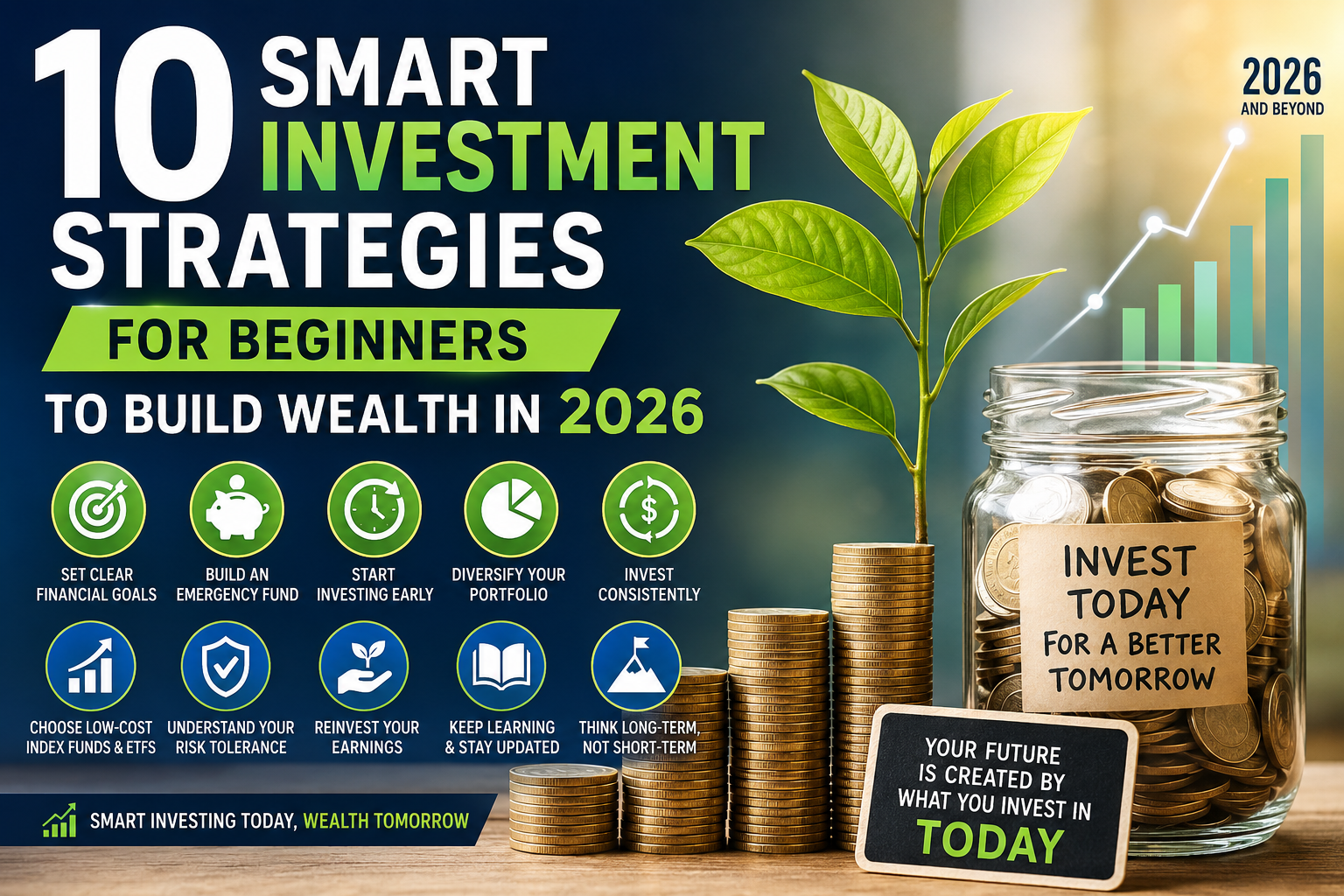

Building wealth is no longer reserved for financial experts or people with large amounts of money. In 2026, technology has made investing easier, more affordable, and more accessible than ever before. Whether you’re saving for retirement, buying a home, funding your children’s education, or simply achieving financial independence, investing is one of the most effective ways to grow your money over time.
The biggest misconception among beginners is believing they need thousands of dollars before they can start investing. In reality, many investment platforms now allow you to begin with as little as $10 or $20. What matters most isn’t how much you invest initially—it’s developing smart habits and remaining consistent.
This guide on 10 Smart Investment Strategies for Beginners to Build Wealth in 2026 will help you understand the essential principles of successful investing. You’ll learn practical strategies that can reduce risk, maximize returns, and build a solid financial future regardless of your income level.
Why Investing Matters More Than Ever in 2026
The financial landscape continues to evolve rapidly. Inflation, technological innovation, and global economic shifts have changed the way people save and grow their money.
Simply keeping cash in a traditional savings account often fails to keep pace with inflation, reducing purchasing power over time. Investing offers an opportunity to earn returns that can outpace inflation and help preserve your wealth.
Benefits of Investing
- Builds long-term wealth
- Generates passive income
- Helps beat inflation
- Supports retirement planning
- Creates financial security
- Takes advantage of compound growth
People who invest consistently over many years often accumulate significantly more wealth than those who rely solely on saving.
Understanding the Basics of Investing
Before selecting investments, it’s important to understand several key concepts.
| Investment Term | Meaning |
|---|---|
| Asset | Something that can increase in value over time |
| Portfolio | Your collection of investments |
| Diversification | Spreading investments across different assets |
| Compound Interest | Earning returns on previous returns |
| Risk | Possibility of losing money |
| Return | Profit earned from investments |
Knowing these fundamentals helps beginners make informed decisions instead of emotional ones.
Strategy #1: Set Clear Financial Goals
Every successful investment plan begins with a purpose.
Ask yourself:
- Why am I investing?
- When will I need this money?
- How much do I want to accumulate?
- How much risk can I tolerate?
Your answers determine your investment strategy.
Examples of Investment Goals
| Goal | Time Horizon |
|---|---|
| Vacation | 1–3 years |
| Buying a Home | 5–10 years |
| College Fund | 10–18 years |
| Retirement | 20–40 years |
SMART Goals Work Best
Instead of saying:
“I want to become rich.”
Try:
“I will invest $300 every month for the next 20 years to build a retirement portfolio worth over $250,000.”
Specific goals help maintain discipline during market fluctuations.
Strategy #2: Build an Emergency Fund Before Investing
One of the most overlooked investment strategies is preparing for emergencies first.
Without an emergency fund, unexpected expenses may force you to sell investments during market downturns.
Experts generally recommend saving:
- 3 months of expenses (minimum)
- 6 months (ideal)
- 12 months (if self-employed)
Keep emergency savings in easily accessible accounts rather than high-risk investments.
Benefits include:
- Peace of mind
- Financial flexibility
- Reduced investment stress
- Better long-term decision making
Strategy #3: Start Investing Early
Time is one of the greatest advantages an investor can have.
The earlier you begin, the more time compound growth has to work in your favor.
Example
Investor A:
- Starts at age 25
- Invests $300/month
- Stops at age 35
Investor B:
- Starts at age 35
- Invests $300/month
- Continues until retirement
Despite investing for fewer years, Investor A may accumulate more wealth because their investments had an extra decade to grow through compounding.
Why Compound Growth Matters
Imagine planting a tree.
The first few years show little visible growth, but over decades it becomes much larger. Investments often behave the same way—growth accelerates over time as returns generate additional returns.
Starting small today is generally more valuable than waiting until you can invest larger amounts later.
Strategy #4: Diversify Your Investment Portfolio
One of the oldest and most effective investment principles is diversification.
Diversification means spreading your money across different asset classes so that poor performance in one area may be offset by stronger performance in another.
Examples of Asset Classes
- Stocks
- Bonds
- Real Estate
- Exchange-Traded Funds (ETFs)
- Index Funds
- Cash Equivalents
- Commodities
Example Beginner Portfolio
| Asset | Allocation |
|---|---|
| Index Funds | 45% |
| ETFs | 20% |
| Bonds | 20% |
| International Stocks | 10% |
| Cash | 5% |
Diversification doesn’t eliminate risk, but it can reduce the impact of market volatility on your portfolio.
Strategy #5: Invest Consistently with Dollar-Cost Averaging
Trying to predict the perfect time to invest is difficult, even for professionals. A practical alternative is Dollar-Cost Averaging (DCA).
With DCA, you invest a fixed amount at regular intervals—such as weekly or monthly—regardless of market conditions. When prices are high, your fixed amount buys fewer shares. When prices are low, it buys more shares. Over time, this approach can reduce the impact of short-term market fluctuations.
Benefits of Dollar-Cost Averaging
- Encourages disciplined investing
- Reduces emotional decision-making
- Eliminates the need to time the market
- Helps smooth out purchase prices over time
For example, investing $200 every month into a diversified index fund can be an effective strategy for beginners looking to build wealth steadily.
Continuing from Part 1…
Strategy #6: Choose Low-Cost Index Funds and ETFs
For beginners, one of the smartest ways to invest is through index funds and exchange-traded funds (ETFs). These investment vehicles provide instant diversification by tracking a market index, such as the S&P 500, rather than relying on the performance of a single company.
Low-cost funds typically have lower expense ratios, meaning more of your money stays invested and continues to grow over time.
Why Index Funds and ETFs Are Beginner-Friendly
- Broad market diversification
- Lower management fees
- Reduced investment risk compared to individual stocks
- Easy to buy and sell
- Strong historical long-term performance
Index Funds vs. ETFs
| Feature | Index Funds | ETFs |
|---|---|---|
| Trading | End of trading day | Throughout the trading day |
| Minimum Investment | May require a minimum amount | Often available by the share or fractional share |
| Expense Ratio | Generally low | Generally low |
| Best For | Long-term investors | Flexible investors |
Tips for Choosing Funds
When selecting a fund, consider:
- Expense ratio
- Historical performance (without assuming it will continue)
- Fund size and liquidity
- Investment objective
- Diversification across sectors and regions
Remember, lower fees can have a meaningful impact on long-term returns.
Strategy #7: Understand Your Risk Tolerance
Every investment involves some level of risk. Understanding how much risk you are comfortable taking is essential before investing your money.
Your risk tolerance depends on factors such as:
- Age
- Income stability
- Financial goals
- Time horizon
- Personal comfort with market fluctuations
Risk Levels
| Investor Type | Risk Level | Typical Investments |
|---|---|---|
| Conservative | Low | Bonds, Money Market Funds |
| Moderate | Medium | Balanced Funds, ETFs |
| Aggressive | High | Stocks, Growth Funds |
For example, someone in their 20s saving for retirement may be able to accept more short-term volatility than someone planning to retire within five years.
Managing Risk
- Diversify investments.
- Avoid putting all your money into one asset.
- Review your portfolio periodically.
- Stay invested during normal market fluctuations.
- Invest only money you won’t need in the short term.
Strategy #8: Reinvest Your Earnings
Many investments generate income through dividends or interest payments. Instead of spending this income, consider reinvesting it to purchase additional shares or units.
This strategy allows you to benefit from compound growth, where your earnings begin generating their own earnings over time.
Benefits of Reinvesting
- Accelerates portfolio growth
- Increases ownership over time
- Builds wealth without increasing monthly contributions
- Maximizes the power of compounding
Illustration
Suppose you invest $10,000 in a fund that pays a 3% annual dividend. If you reinvest those dividends each year, your investment may grow faster than if you took the cash payments.
Many brokerage platforms offer automatic dividend reinvestment programs (often called DRIPs), making this process simple and hands-free.
Strategy #9: Keep Learning About Investing
Successful investors understand that investing is a lifelong learning journey.
Markets change, new investment products emerge, and economic conditions evolve. Staying informed helps you make better decisions and avoid costly mistakes.
Ways to Improve Your Financial Knowledge
- Read reputable investing books.
- Follow trusted financial news.
- Listen to educational finance podcasts.
- Take online investment courses.
- Learn basic financial statements.
- Understand economic trends.
Topics Worth Studying
- Asset allocation
- Inflation
- Interest rates
- Taxes
- Retirement planning
- Behavioral finance
- Portfolio rebalancing
The more you learn, the more confident and disciplined you can become as an investor.
Strategy #10: Think Long-Term Instead of Chasing Quick Profits
Many beginners are tempted by promises of fast returns or the latest “hot” investment. While some investments may deliver rapid gains, they also often carry significant risk.
Building wealth usually requires patience, consistency, and a long-term perspective.
Characteristics of Long-Term Investors
- Invest regularly.
- Ignore short-term market noise.
- Maintain diversified portfolios.
- Focus on financial goals.
- Avoid emotional buying and selling.
Why Patience Pays
Historically, financial markets have experienced periods of growth as well as declines. Investors who stay invested through market cycles are often better positioned to benefit from long-term growth than those who frequently buy and sell based on short-term events.
Common Investment Mistakes Beginners Should Avoid
Avoiding common mistakes can be just as important as choosing the right investments.
1. Waiting Too Long to Start
Delaying investing reduces the time available for compound growth.
2. Investing Without a Plan
A clear investment strategy helps you stay focused during market ups and downs.
3. Trying to Time the Market
Consistently predicting market highs and lows is extremely difficult.
4. Ignoring Diversification
Concentrating your investments in one company or sector increases risk.
5. Letting Emotions Drive Decisions
Fear during market declines and excitement during rallies can lead to poor decisions.
6. Overlooking Fees
High investment fees can reduce long-term returns.
7. Failing to Review Your Portfolio
Your financial goals and circumstances may change over time. Reviewing your portfolio periodically helps ensure it remains aligned with your objectives.
Sample Beginner Investment Portfolio for 2026
The following example illustrates one possible diversified allocation. It is not personalized financial advice but demonstrates how different asset classes can work together.
| Investment Type | Suggested Allocation |
|---|---|
| Broad Market Index Funds | 40% |
| International Equity Funds | 20% |
| Bond Funds | 20% |
| Real Estate Investment Trusts (REITs) | 10% |
| Cash or High-Yield Savings | 10% |
This balanced approach aims to combine growth potential with risk management. Your ideal allocation will depend on your goals, investment horizon, and tolerance for risk.
Frequently Asked Questions (FAQs)
1. How much money do I need to start investing?
Many investment platforms allow beginners to start with as little as $10 to $100, especially through fractional shares or automatic investment plans.
2. What is the safest investment for beginners?
No investment is completely risk-free. However, diversified index funds, high-quality bond funds, and insured savings accounts generally carry lower risk than individual stocks.
3. Should I pay off debt before investing?
If you have high-interest debt, such as credit card balances, paying it down is often a priority. Balancing debt repayment with investing depends on your financial situation.
4. How often should I review my investments?
Reviewing your portfolio once or twice a year is sufficient for many long-term investors. Avoid checking it so frequently that short-term market movements influence your decisions.
5. Is investing better than saving?
Saving is important for short-term goals and emergencies, while investing is generally better suited for long-term wealth building because it offers the potential for higher returns, though with greater risk.
6. Can beginners invest during market downturns?
Yes. Market declines can provide opportunities to purchase investments at lower prices, particularly if you continue investing consistently and maintain a long-term perspective.
Conclusion
Building wealth is a marathon, not a sprint. By following these 10 Smart Investment Strategies for Beginners to Build Wealth in 2026, you can create a strong foundation for long-term financial success.
To recap:
- Set clear financial goals.
- Build an emergency fund.
- Start investing as early as possible.
- Diversify your portfolio.
- Invest consistently using dollar-cost averaging.
- Choose low-cost index funds and ETFs.
- Understand your risk tolerance.
- Reinvest your earnings.
- Continue learning about investing.
- Stay focused on long-term growth rather than short-term market movements.
The most important step is simply to begin. Even small, consistent investments can grow substantially over time through the power of compounding. Stay disciplined, review your strategy periodically, and adjust your investments as your financial goals evolve.
Further Reading
To deepen your understanding of investing and personal finance, consider exploring educational resources from organizations such as:
- The Investor.gov website operated by the U.S. Securities and Exchange Commission (SEC)
- Financial education materials from reputable investment firms and government financial regulators in your country
These resources provide beginner-friendly guidance on budgeting, investing, diversification, and avoiding investment scams.