
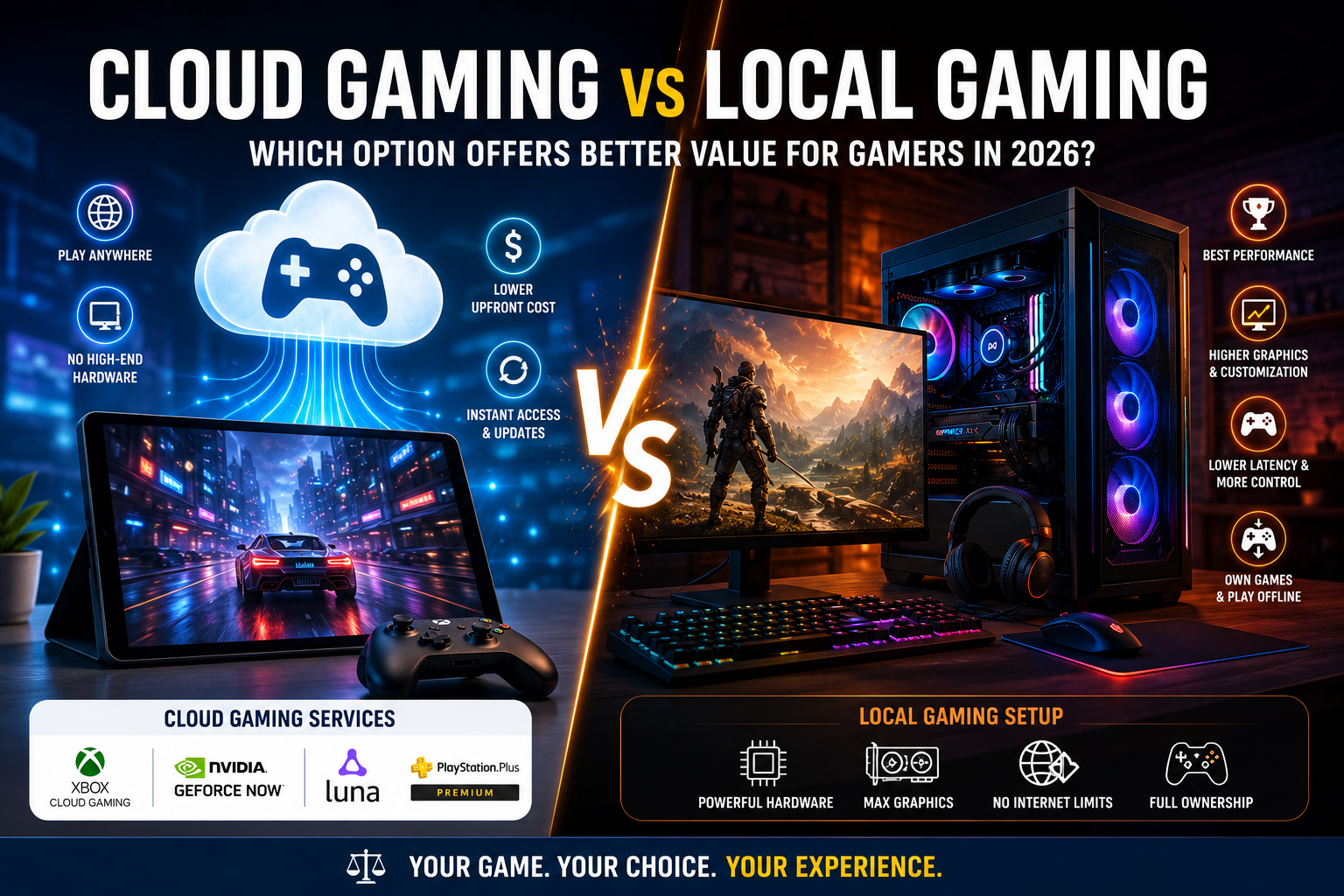

The debate over cloud gaming vs local gaming has become more relevant than ever in 2026. As internet speeds improve and game streaming platforms mature, gamers now have more choices than simply buying expensive gaming hardware.
Cloud gaming promises instant access to high-end gaming without powerful PCs or consoles, while local gaming continues to offer unmatched performance, reliability, and ownership. Each option has unique strengths and weaknesses, making the right choice dependent on your gaming habits, budget, and internet connection.
Whether you’re a competitive esports player, a casual gamer, or someone looking to save money, this guide compares cloud gaming and local gaming across performance, cost, graphics quality, convenience, and long-term value.
What Is Cloud Gaming?
Cloud gaming allows players to stream games from powerful remote servers instead of running them directly on their own hardware.
Your device acts mainly as a display and input controller while the game runs in a data center.
Popular cloud gaming services include:
- Xbox Cloud Gaming
- GeForce NOW
- Amazon Luna
- PlayStation Plus Cloud Streaming
- Boosteroid
Because the heavy processing happens remotely, gamers can play demanding titles on laptops, tablets, smartphones, smart TVs, and low-powered PCs.
What Is Local Gaming?
Local gaming means games run directly on your own hardware, such as:
- Gaming PCs
- PlayStation consoles
- Xbox consoles
- Nintendo Switch
- Gaming handhelds
Your CPU, GPU, RAM, and storage handle all game processing locally, giving you full control over performance and settings.
Performance Comparison
Performance remains one of the biggest deciding factors.
Cloud Gaming
Advantages:
- No hardware upgrades required
- High-end graphics available on inexpensive devices
- Automatic server maintenance
- No lengthy game downloads
Disadvantages:
- Dependent on internet quality
- Compression may reduce image quality
- Possible server congestion during peak hours
Local Gaming
Advantages:
- Native graphics rendering
- Consistent frame rates
- Minimal input delay
- Offline gaming support
- Full graphics customization
Disadvantages:
- Expensive hardware
- Regular upgrades may be necessary
- Storage management is required
Winner: Local gaming offers the best raw performance.
Gaming Latency
Latency refers to the delay between pressing a button and seeing the action on screen.
Cloud Gaming
Latency depends on:
- Internet speed
- Distance from the server
- Wi-Fi quality
- Network congestion
Even small delays can affect competitive games.
Local Gaming
Because everything runs directly on your device, latency is significantly lower and more consistent.
Winner: Local gaming.
Graphics Quality
Modern cloud gaming services have improved significantly.
Many now support:
- 1080p streaming
- 1440p gaming
- 4K streaming (select services)
- HDR
- High refresh rates
However, streamed video is compressed, meaning visual quality may not match native rendering.
Local gaming delivers:
- Sharper textures
- Better image clarity
- Native resolution
- Advanced graphics settings
- Superior ray tracing performance
Winner: Local gaming.
Game Library and Ownership
One major difference is ownership.
Cloud Gaming
Some platforms require:
- Monthly subscriptions
- Separate game purchases
- Rotating game catalogs
Games may leave a service over time.
Local Gaming
Buying locally often means:
- Permanent ownership (subject to platform licensing)
- Offline access for many titles
- Greater flexibility with mods on PC
- Physical editions (for supported consoles)
Winner: Local gaming for long-term ownership.
Cost Comparison
Initial Investment
Cloud Gaming
Typically requires:
- A compatible device
- Controller or keyboard and mouse
- Stable internet
- Monthly subscription
Hardware costs remain low.
Local Gaming
Requires:
- Gaming PC or console
- Monitor or TV
- Peripherals
- Storage upgrades (optional)
Initial costs are much higher.
Long-Term Costs
Cloud gaming subscriptions can accumulate over several years.
Local gaming involves larger upfront costs but may become more economical over time, especially if hardware remains usable for many years.
Winner: Depends on usage.
- Casual gamers may save with cloud gaming.
- Frequent gamers often gain better value from local gaming.
Internet Requirements
Cloud gaming relies heavily on internet quality.
Recommended connections:
| Resolution | Recommended Speed |
|---|---|
| 720p | 10 Mbps |
| 1080p | 20 Mbps |
| 1440p | 35 Mbps |
| 4K | 50 Mbps or higher |
A wired Ethernet connection generally provides the most stable experience.
For more networking advice, see our related guide: Best Internet Speed for Gaming.
Convenience and Accessibility
Cloud gaming excels in convenience.
Benefits include:
- Play instantly
- No installations
- Automatic updates
- Cross-device support
- Continue games across multiple devices
Local gaming requires:
- Downloads
- System updates
- Hardware maintenance
- Storage management
Winner: Cloud gaming.
Competitive Gaming
Esports players typically prioritize:
- Low latency
- High frame rates
- Stable connections
- Native graphics
Even slight streaming delays can affect reaction times.
For competitive shooters, fighting games, and racing simulators, local gaming remains the preferred option.
Who Should Choose Cloud Gaming?
Cloud gaming is ideal for:
- Casual gamers
- Travelers
- Students
- Players without gaming PCs
- Families sharing multiple devices
- Gamers with reliable high-speed internet
Who Should Choose Local Gaming?
Local gaming is best suited for:
- Competitive gamers
- PC enthusiasts
- Content creators
- Streamers
- Modding communities
- Players seeking maximum performance
Pros and Cons
Cloud Gaming
Pros
- Low upfront cost
- Play on multiple devices
- No expensive GPU required
- Instant access
- Automatic updates
Cons
- Internet dependency
- Subscription costs
- Potential latency
- Compressed visuals
- Limited offline play
Local Gaming
Pros
- Maximum performance
- Better graphics
- Lower latency
- Offline gaming
- Greater ownership and customization
Cons
- Expensive hardware
- Upgrade costs
- Downloads and updates
- Higher power consumption
Future of Gaming in 2026 and Beyond
Cloud gaming continues to improve thanks to:
- Faster broadband
- Expanded fiber networks
- Lower-latency streaming technology
- Improved server infrastructure
At the same time, local gaming benefits from:
- More powerful GPUs
- AI-assisted graphics
- Faster SSDs
- Advanced ray tracing
- Smarter system optimization
Rather than replacing one another, cloud gaming and local gaming are likely to coexist, serving different types of players.
Frequently Asked Questions
Is cloud gaming better than local gaming?
It depends on your priorities. Cloud gaming offers affordability and convenience, while local gaming provides superior performance, lower latency, and greater control.
Can cloud gaming replace a gaming PC?
For casual gaming, yes. For competitive gaming, content creation, or maximum graphical quality, a dedicated gaming PC still offers the best experience.
Does cloud gaming require fast internet?
Yes. A stable, high-speed internet connection is essential for smooth streaming and responsive gameplay.
Is cloud gaming more affordable?
Cloud gaming generally has a lower upfront cost, but ongoing subscription fees can add up over time.
Which is better for competitive gaming?
Local gaming remains the preferred choice because it minimizes latency and delivers more consistent performance.
Will cloud gaming become the future of gaming?
Cloud gaming will continue to grow, but local gaming is expected to remain the benchmark for enthusiasts and competitive players due to its performance advantages.
Conclusion
When comparing cloud gaming vs local gaming, there is no universal winner. Cloud gaming offers unmatched convenience, accessibility, and a lower barrier to entry, making it an attractive option for casual players and those without high-end hardware.
Local gaming, however, continues to lead in performance, graphics quality, responsiveness, and long-term flexibility. Gamers who value competitive play, native visuals, and hardware customization will likely find greater value in owning a gaming PC or console.
Ultimately, the best choice depends on your budget, internet connection, gaming preferences, and long-term goals. As streaming technology evolves and gaming hardware becomes even more capable, many players may find that a combination of cloud and local gaming offers the most flexible experience.
For more information about Microsoft’s game streaming platform, consult the Microsoft Xbox Cloud Gaming Documentation. If you’re considering cloud gaming, you should also read our companion guide, Best Internet Speed for Gaming, to ensure your connection can deliver a smooth, low-latency experience.