
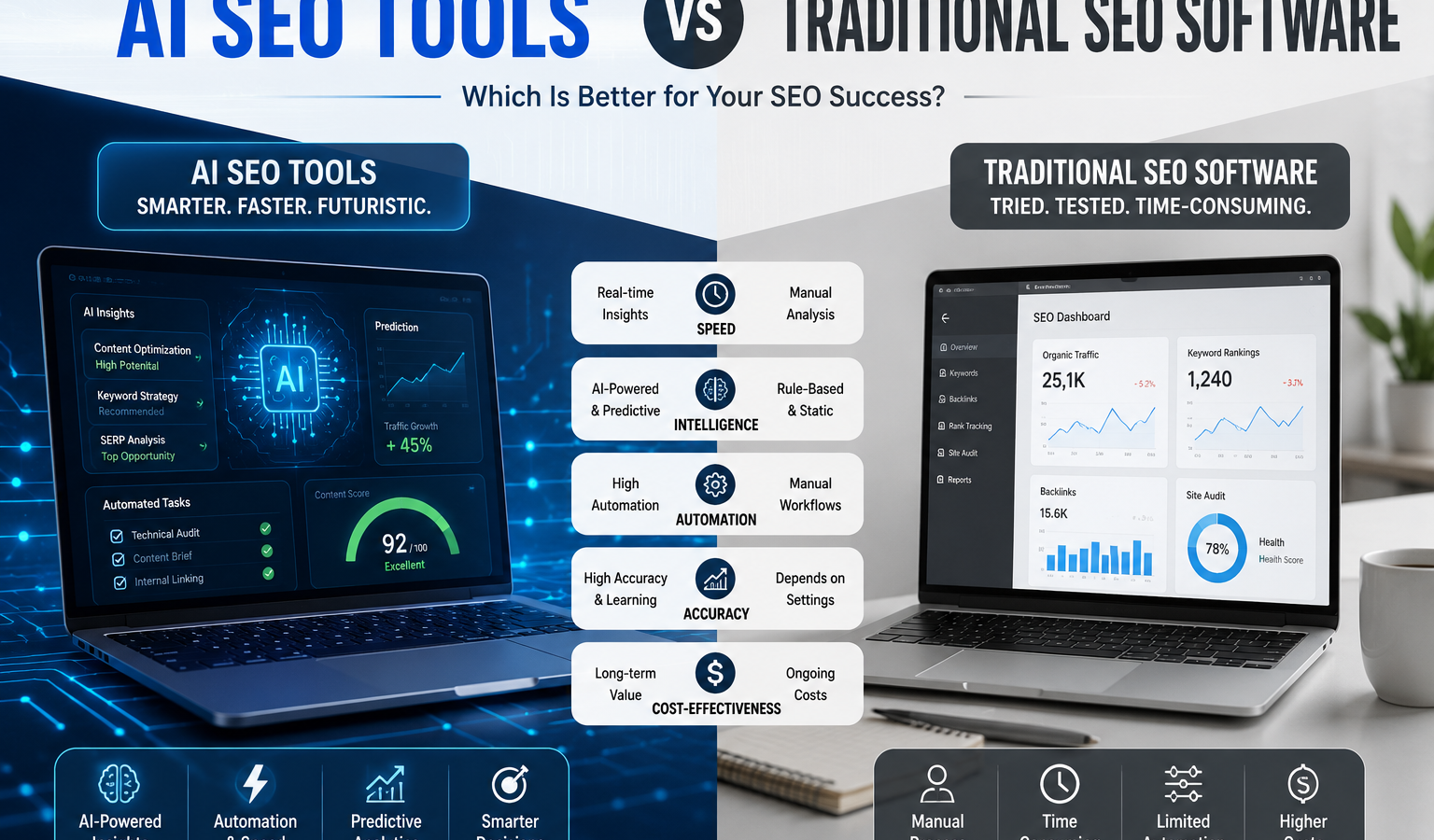

AI SEO Tools vs Traditional SEO Software: Which Workflow Wins in 2026?
The SEO industry has reached a turning point. A few years ago, most teams relied almost entirely on traditional SEO software for keyword research, competitor analysis, site audits, backlink tracking, and rank monitoring. Today, AI SEO tools have entered the workflow and changed how fast teams can move from data to action. The result is not a simple battle between old and new. It is a decision about how to build the most effective SEO system for 2026.
Traditional SEO software still gives marketers the measurements they need to understand what is happening on a website. AI SEO tools, however, help teams interpret those measurements, generate ideas, create content briefs, optimize on-page elements, and speed up repetitive tasks. One category is strong at precision and reporting. The other is strong at speed and production. The best workflow in 2026 depends on how those strengths are combined.
For businesses, bloggers, agencies, and in-house content teams, this is no longer a theoretical discussion. Search results are more competitive, user expectations are higher, and content quality matters more than ever. The brands that win are usually the ones that can analyze faster, write better, optimize consistently, and measure outcomes with discipline. That is why understanding both AI SEO tools and traditional SEO software is essential.
What traditional SEO software is designed to do
Traditional SEO software was built to collect, organize, and report search data. These platforms help you see how your site is performing in search engines, where technical problems exist, what your competitors are ranking for, which pages attract links, and how your rankings change over time. In many cases, the most valuable part of a traditional SEO platform is not the interface itself, but the depth and consistency of the data behind it.
This kind of software is especially useful when you need objective information. A rank tracker can tell you whether a keyword moved up or down. A site audit tool can expose crawl errors, broken links, duplicate metadata, missing alt text, redirect chains, and thin pages. A backlink tool can reveal how a site’s authority is growing, where links are coming from, and whether a competitor has built a stronger off-page profile. These insights make strategic decisions more reliable.
Traditional tools also provide historical data, which is one of their strongest advantages. SEO is not a one-day activity. It is a long-term game that depends on trends, patterns, and comparisons over time. Historical data helps you answer practical questions such as which content types bring the most clicks, which pages are declining, which keywords are becoming harder to rank for, and whether a technical change caused a traffic shift. Without this baseline, optimization becomes guesswork.
Where AI SEO tools add a new advantage
AI SEO tools are changing the pace of work. Instead of spending hours manually comparing pages, rewriting headings, brainstorming outlines, or summarizing competitor content, teams can generate first drafts and optimization suggestions in minutes. This makes the workflow much faster, especially for content-heavy websites that need to publish often and maintain quality across many pages.
AI is particularly useful when the task requires interpretation rather than raw measurement. For example, if you already know a page is underperforming, AI can help you understand why the content may not match intent, how the structure could be improved, what missing subtopics should be added, and how to rewrite the page for clarity. Traditional tools tell you what happened. AI tools help you decide what to do next.
Another major advantage is scale. A single marketer can now review dozens of pages, generate content briefs, create title variations, compare topic clusters, or draft meta descriptions far faster than before. That does not eliminate the need for human judgment, but it lowers the time cost of producing useful SEO work. For growing sites, that efficiency can make the difference between keeping up with competitors and falling behind them.
Why the debate matters in 2026
SEO in 2026 is more demanding than basic keyword placement or repeated content production. Search engines are better at understanding intent, evaluating usefulness, and identifying whether a page genuinely satisfies a query. That means the old habit of publishing large volumes of shallow content is much less effective than it used to be. Teams now need content that is well researched, clearly structured, and aligned with user intent.
At the same time, competition has increased. More businesses are publishing content, many are using AI to speed up production, and many websites are targeting the same search topics. In this environment, it is not enough to simply have tools. You need a workflow that helps you discover opportunities, produce helpful content, and iterate quickly when rankings shift. That is why the question is not “AI or traditional SEO software?” but rather “Which combination creates the strongest workflow?”
The answer depends on the stage of SEO work. Discovery, diagnosis, planning, writing, editing, optimization, publishing, and reporting all require slightly different tools. Traditional software often wins in diagnostic and reporting tasks. AI often wins in drafting and content support. Together, they create a system that is faster and more complete than either one alone.
What traditional SEO software does better than AI tools
Traditional SEO platforms usually outperform AI tools in areas that depend on structured, verifiable data. They are better for exact rank tracking, backlink analysis, crawl diagnostics, log analysis, and technical site monitoring. If you need to know whether a page is indexed, whether a redirect is broken, or whether a keyword moved by two positions, traditional software is the better source of truth.
They are also better at benchmarking. A content team may believe a page is doing well simply because it looks polished, but historical SEO data might show that impressions are declining, search demand is shifting, or a competitor has overtaken the page with fresher content. Traditional tools expose these patterns clearly. That kind of evidence is essential before you make strategic changes.
Another advantage is consistency. SEO software usually pulls from repeatable data sources, which means the output is less likely to vary from one prompt to another. AI can be incredibly helpful, but it can also produce generic or overconfident recommendations if the inputs are weak. Traditional software acts as an anchor. It ensures the workflow starts from facts rather than assumptions.
What AI SEO tools do better than traditional software
AI SEO tools are better at turning information into usable work. Once the data has been gathered, AI can summarize findings, cluster keywords, propose headings, rewrite intros, suggest internal links, improve readability, and draft meta descriptions. It can also help content teams create multiple versions of the same asset for testing and refinement. This turns SEO from a slow manual process into a more agile production system.
AI is especially strong in ideation. Many SEO tasks begin with a blank page problem: what topic should this article target, what subheadings should it include, which questions should it answer, and how should the content be structured to satisfy search intent? AI tools can create a starting framework quickly, which helps teams avoid wasted time and move straight into refinement.
They are also useful for content consistency. If a website needs a standard format for title tags, meta descriptions, FAQ sections, or content outlines, AI can help apply that format across a large number of pages. For teams managing many articles, many category pages, or many service pages, this repeatability is valuable. It reduces the amount of time spent on repetitive writing tasks while keeping output aligned with a strategy.
The strongest SEO workflow is usually hybrid
In most real-world situations, the strongest SEO workflow in 2026 is a hybrid one. Traditional software should be used to gather hard data, identify problems, and measure performance. AI should then be used to speed up interpretation, content planning, optimization, and drafting. Human editors should review the final output to make sure it is accurate, original, useful, and aligned with the brand voice.
This workflow is powerful because each part solves a different problem. Traditional software prevents blind decisions. AI reduces production time. Human judgment protects quality. When all three work together, the final result is often better than relying on one system alone.
For example, a marketer might begin with a site audit from a traditional SEO platform. After identifying pages with weak metadata or thin content, the marketer can use AI to generate improved titles, rewrite page introductions, suggest missing sections, and build a content brief for a full refresh. A human editor then checks the final draft for accuracy, nuance, and tone. After publishing, the team returns to the traditional toolset to monitor ranking changes, traffic shifts, and crawl improvements.
How content teams can use AI SEO tools effectively
AI SEO tools are most effective when they are used with clear instructions and strong inputs. The better the prompt, data, or brief, the better the result. This means content teams should not treat AI as a magic button. Instead, they should treat it like a fast assistant that performs best when guided by strategy, examples, and constraints.
A practical workflow might begin with keyword research from a traditional tool, followed by an AI-generated outline built around search intent. Then the team can use AI to generate supporting sections, FAQs, and metadata. After that, an editor checks for duplicate phrasing, factual issues, and weak transitions. This process gives you speed without losing control.
Teams should also use AI to support internal linking. When writing a new article, AI can suggest related pages on the same website that should be linked from the content. This can improve crawl paths, distribute authority, and help readers navigate the site more naturally. Internal linking is often overlooked, but it remains one of the simplest ways to improve SEO structure at scale.
How agencies can combine both approaches
Agencies often benefit the most from a blended workflow because they manage multiple clients, multiple industries, and multiple content types. Traditional SEO software helps them build reports, show progress, audit technical issues, and compare competitors. AI helps them produce deliverables faster, whether that means content briefs, FAQ sections, page copy suggestions, or executive summaries for clients.
This combination is especially useful in client communication. Many clients do not want raw data dumps. They want clear recommendations, easy-to-understand summaries, and a plan of action. AI can help transform data into a cleaner narrative, while traditional software supplies the evidence behind that narrative. That makes reports more useful and more persuasive.
Agencies can also use AI for faster content scaling during campaigns. When launching a large content cluster, for example, AI can help with title variation testing, outline creation, and first-draft generation. Traditional tools then validate whether the campaign is producing search impressions, backlinks, and ranking improvements. The agency stays efficient while still protecting quality control.
The risks of relying too much on AI
Although AI SEO tools are powerful, they are not perfect. One risk is generic output. If a prompt is too vague, the tool may create content that sounds polished but lacks originality or strategic depth. Another risk is factual inaccuracy. AI can misstate details, misread search intent, or produce confident-sounding recommendations that are not actually helpful. That is why human review matters.
Another issue is over-automation. SEO still depends on real audience understanding. A page can be technically optimized and still fail if it does not answer the user’s question in a meaningful way. AI can assist with the process, but it cannot replace genuine subject knowledge, editorial judgment, or business context. A good SEO strategy still needs a human mind behind it.
There is also the risk of creating sameness across the web. If too many websites use the same prompts and workflows, their content may begin to sound identical. That makes differentiation harder. To avoid this, teams should inject original data, real experience, screenshots, case studies, and brand-specific insights into the final content. AI should support uniqueness, not erase it.
The risks of relying too much on traditional SEO software
Traditional SEO software is extremely valuable, but it can also slow teams down if it becomes the only focus. A site can spend too much time analyzing charts, audits, and reports without actually improving the content or user experience. In that case, the team has data but no momentum. SEO should produce action, not just more dashboards.
Another limitation is that traditional software usually does not help with writing or ideation in a meaningful way. It can tell you a page is underperforming, but it will not always help you quickly produce the revised content needed to fix it. That means teams may still face bottlenecks when it is time to execute. AI fills that gap.
There is also the cost factor. Some traditional SEO platforms are expensive, especially for small businesses and independent publishers. AI tools can sometimes provide a cheaper way to accelerate work, though they should not be used to replace reporting entirely. The best value usually comes from choosing the right tool for the right part of the job.
Which workflow wins for different types of users?
For bloggers, AI SEO tools can be a huge time saver because they help with outlines, metadata, and internal linking. However, bloggers still need traditional tools to understand which topics are worth targeting and which pages need improvement. A simple but effective setup is often enough: one reliable SEO platform plus one AI writing and optimization assistant.
For eCommerce brands, traditional SEO software is essential for technical monitoring, product page performance, and keyword tracking, while AI helps scale descriptions, FAQs, and category content. For agencies, both matter equally because client reporting and content production must happen at speed. For publishers and affiliate sites, the hybrid workflow is especially powerful because it supports rapid publishing while still making room for analytical review.
In-house marketing teams often sit somewhere in the middle. They need reliable measurement, but they also need repeatable production. AI can help them move faster without hiring a large team, while traditional software ensures that those efforts are actually contributing to business goals. In almost every case, the winners are the teams that build a process, not the teams that simply buy software.
A practical 2026 SEO workflow
- Use traditional SEO software to find technical issues, keyword gaps, and ranking opportunities
- Use AI to turn the findings into content briefs, outlines, and optimization suggestions
- Draft the content with human oversight and real expertise
- Edit for accuracy, originality, brand tone, and search intent
- Publish the page and monitor results using traditional reporting tools
- Improve the page again based on new data, user behavior, and ranking changes
This workflow is repeatable, scalable, and practical. It allows teams to work from evidence while also moving quickly enough to compete. It also prevents the common mistake of treating SEO as either a purely technical discipline or a purely creative one. In reality, it is both.
How to choose the right tool stack
If you are building an SEO tool stack for 2026, start by identifying your main bottleneck. If your problem is not enough data, better reporting, or technical visibility, prioritize traditional SEO software. If your problem is slow content production, weak page optimization, or too much repetitive work, prioritize AI SEO tools. Most businesses will need both at some level.
When choosing tools, consider ease of use, integration with your workflow, quality of support, and how well the tool fits your team’s skill level. A complicated platform is not always better than a simple one. The ideal stack is the one your team will actually use consistently. Consistency matters more than novelty.
It also helps to define clear responsibilities. Traditional software should handle analysis and reporting. AI should support drafting and optimization. Humans should make final decisions. That division keeps the process efficient and reduces confusion about what each tool is supposed to do.
Final verdict: which workflow wins?
If the goal is measurement, traditional SEO software still wins. If the goal is speed, content support, and faster execution, AI SEO tools are the better option. But for most websites, the real winner is not one category over the other. The real winner is a hybrid workflow that combines precise data with fast action and human editing.
In 2026, SEO success belongs to teams that know how to use both types of tools strategically. Traditional software shows what is happening. AI helps explain what to do. Humans make sure the final result is useful, trustworthy, and aligned with the brand. When those three pieces work together, SEO becomes more efficient and more effective.
So the answer is not AI versus traditional SEO software. The answer is AI plus traditional SEO software, supported by a thoughtful workflow. That combination is the most realistic path to better rankings, better content, and better results in 2026.
Recommended internal links
- Technical SEO Audit Checklist for Faster Rankings and Better UX
- Schema Markup SEO: How Rich Results Increase Organic Traffic
- WordPress SEO: The Complete 2026 Guide
FAQ
Should I replace my SEO software with AI?
No. AI is best used as part of a broader workflow. It improves speed and productivity, but it should not replace reliable measurement and reporting tools.
Do AI SEO tools improve rankings directly?
Not directly. They help you create and optimize content faster, which can improve page quality and search performance over time.
What is the biggest advantage of AI SEO tools?
The biggest advantage is speed. They help move from research to execution much faster than a manual-only process.
What is the biggest advantage of traditional SEO software?
The biggest advantage is reliable data. Traditional tools are excellent for measurement, technical audits, and long-term performance tracking.