

Table of Contents
- What Is a Fuel Injector?
- How Does a Fuel Injector Work?
- Main Parts of a Fuel Injector
- How the ECU Controls Fuel Injectors
- What Is Injector Pulse Width?
- How Fuel Injection Works Step by Step
- Types of Fuel Injection Systems
- Port Fuel Injection vs Direct Injection
- How Diesel Fuel Injectors Work
- Why Fuel Injector Spray Pattern Matters
- Symptoms of a Bad Fuel Injector
- Common Fuel Injector Problems
- How to Diagnose a Faulty Fuel Injector
- Can Fuel Injectors Be Cleaned?
- How Fuel Injectors Affect Fuel Economy
- Expert Tips for Maintaining Fuel Injectors
- Common Mistakes When Dealing With Fuel Injectors
- When Should Fuel Injectors Be Replaced?
- Frequently Asked Questions
- Conclusion
What Is a Fuel Injector?
A fuel injector is a precision component in an engine’s fuel system that delivers a controlled quantity of fuel into the engine.
Unlike older carburetor systems, modern fuel-injected engines use electronically controlled injectors to meter fuel more accurately. The injector opens and closes rapidly according to commands from the engine control unit, commonly called the ECU or engine control module (ECM).
The basic purpose sounds simple: get fuel into the engine.
However, the injector has to perform this job with considerable precision. It needs to deliver the correct quantity of fuel, at the correct pressure, at the correct time, and with an appropriate spray pattern.
The amount of fuel required changes constantly. An engine starting on a cold morning needs different fueling from one cruising on a highway or accelerating hard.
The fuel injector works with the ECU, fuel pump, sensors, throttle system, and other components to accommodate these changing conditions.
How Does a Fuel Injector Work?
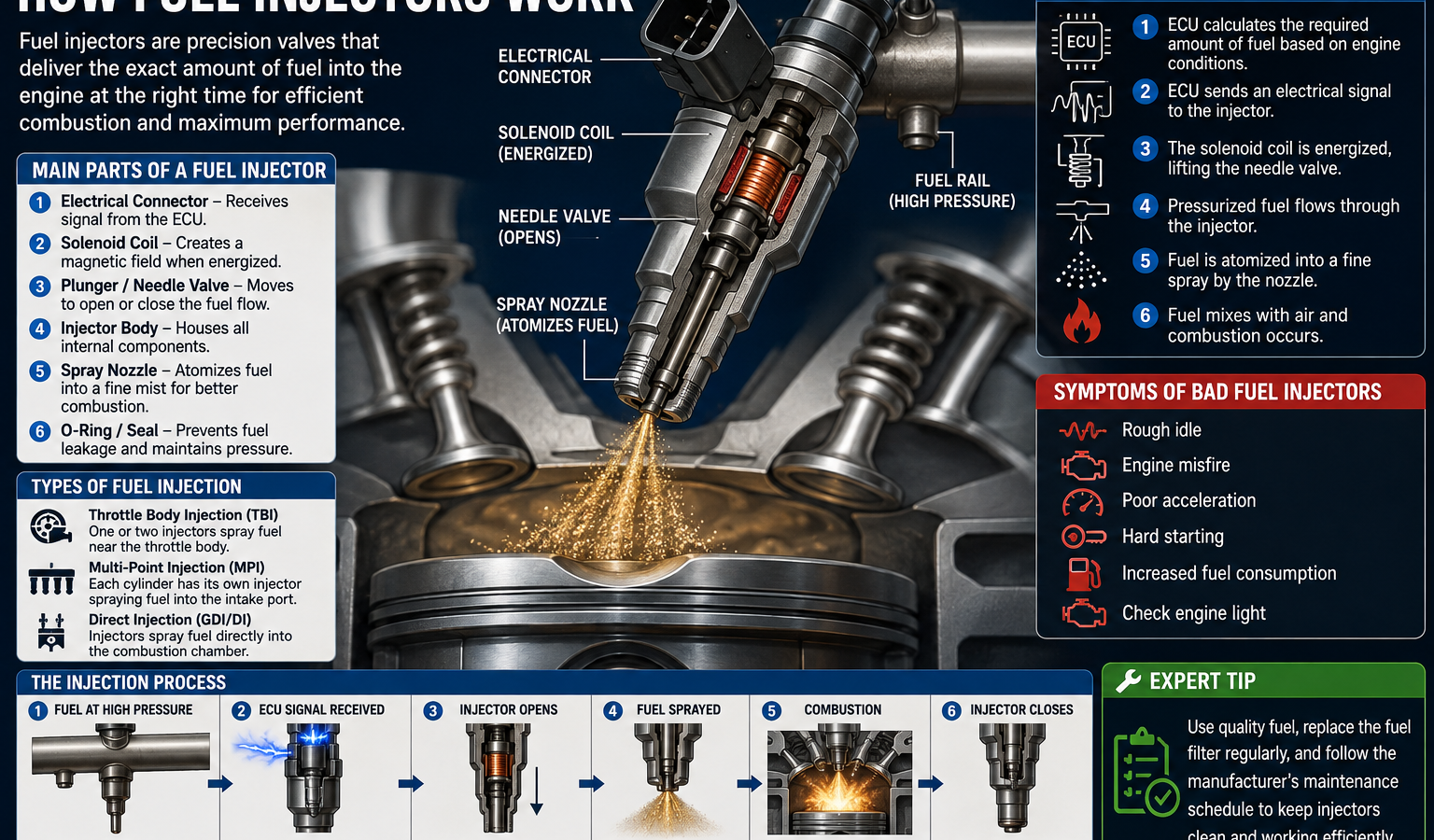
The easiest way to understand how fuel injectors work is to think of the injector as a very fast electronic valve.
Pressurized fuel reaches the injector. The ECU then sends an electrical signal telling the injector to open.
When the injector opens, fuel passes through a tiny nozzle. The nozzle breaks the fuel into a controlled spray of small droplets.
The injector then closes when the ECU removes the electrical signal.
This process happens extremely quickly and repeatedly.
The basic process is:
- The fuel pump pressurizes the fuel.
- Pressurized fuel reaches the injector.
- Engine sensors send information to the ECU.
- The ECU calculates the required amount of fuel.
- The ECU sends an electrical signal to the injector.
- The injector opens.
- Fuel passes through the nozzle.
- The fuel is atomized into a spray.
- The injector closes.
- The process repeats as required.
The exact operating strategy varies depending on the engine and fuel-injection system.
Main Parts of a Fuel Injector
Although fuel injectors are relatively small, they contain several important components.
Injector Body
The injector body houses the internal mechanism and provides the connection between the fuel supply and the engine.
It must withstand fuel pressure, temperature changes, vibration, and continuous operation.
Electrical Connector
The electrical connector receives the control signal from the vehicle’s wiring harness.
A damaged connector or wiring problem can prevent an otherwise functional injector from operating correctly.
Solenoid
Many gasoline fuel injectors use an electromagnetic solenoid.
When electrical current passes through the solenoid, it generates a magnetic field. This magnetic force moves an internal component and opens the fuel passage.
When the electrical signal stops, the internal mechanism returns to its closed position.
Needle or Valve
The internal needle or valve controls the flow of fuel through the injector.
It must open and close consistently because even small differences in fuel delivery can affect engine operation.
Nozzle
The nozzle is one of the most important parts of the injector.
It contains very small openings designed to create a particular spray pattern. The size and arrangement of these openings depend on the engine’s design.
Seals and O-Rings
Fuel injectors normally use seals or O-rings to prevent fuel or air leaks.
A damaged seal can create problems even when the injector’s internal electrical and mechanical components are working correctly.
How the ECU Controls Fuel Injectors
The engine control unit is essentially the brain behind electronic fuel injection.
It receives information from multiple sensors and uses that information to determine how much fuel the engine needs.
Depending on the vehicle, the ECU may consider information from:
- Crankshaft position sensor
- Camshaft position sensor
- Throttle position sensor
- Mass airflow sensor
- Manifold absolute pressure sensor
- Engine coolant temperature sensor
- Intake air temperature sensor
- Oxygen sensor
- Air-fuel ratio sensor
- Accelerator position
- Engine speed
- Engine load
The ECU processes these inputs and determines when and how long the injectors should operate.
For example, pressing the accelerator increases engine demand. The ECU detects the changing operating conditions and adjusts fuel delivery accordingly.
During steady cruising, fuel requirements are generally different from those during hard acceleration.
What Is Injector Pulse Width?
One of the most important concepts in understanding how fuel injection works is injector pulse width.
Pulse width refers to the amount of time the ECU commands an injector to remain open during an injection event.
A longer pulse generally allows more fuel to flow.
A shorter pulse generally allows less fuel to flow.
For example, if the ECU determines that the engine needs more fuel, it can increase injector opening time.
However, fuel quantity isn’t determined by pulse width alone. Fuel pressure, injector design, electrical characteristics, and other factors also influence the actual amount delivered.
This is why simply installing a physically similar injector does not necessarily mean it will work correctly in an engine.
How Fuel Injection Works Step by Step
Let’s examine the complete process in more detail.
Step 1: Fuel Is Stored in the Tank
Fuel begins its journey inside the vehicle’s fuel tank.
The tank stores the fuel and is connected to the fuel delivery system.
Modern vehicles commonly use an electric fuel pump located inside or near the tank.
Step 2: The Fuel Pump Creates Pressure
The fuel pump moves fuel through the fuel system and creates the pressure required by the engine.
The required pressure depends on the vehicle’s fuel-system design.
Some systems use a fuel-pressure regulator to maintain the appropriate pressure.
Step 3: Fuel Reaches the Injector
Pressurized fuel travels through fuel lines or a fuel rail until it reaches the injectors.
In many gasoline engines, multiple injectors are mounted along a fuel rail.
Step 4: Sensors Monitor Engine Conditions
Sensors continuously provide information about the engine.
The ECU uses these measurements to estimate the amount of air entering the engine and determine the appropriate fuel quantity.
Step 5: The ECU Activates the Injector
The ECU sends an electrical signal to the injector.
In a solenoid-type injector, the electrical current creates a magnetic field that moves the internal mechanism.
Step 6: The Injector Opens
The internal valve moves away from its seat, allowing pressurized fuel to pass through the injector.
Step 7: Fuel Is Atomized
Fuel exits through the nozzle.
The nozzle is designed to create a controlled spray rather than simply allowing fuel to pour out.
Atomization helps fuel mix with air more effectively.
Step 8: Combustion Takes Place
Depending on the injection system, the fuel enters either the intake port or directly into the combustion chamber.
The fuel eventually mixes with air and participates in combustion.
Step 9: The Injector Closes
The ECU ends the electrical command.
The injector closes and stops fuel flow.
This cycle repeats continuously while the engine is operating.
Types of Fuel Injection Systems
Fuel-injection technology has evolved significantly over the years.
Several different configurations are used in gasoline and diesel engines.
Throttle-Body Injection
Throttle-body injection, or TBI, places one or more injectors around the throttle-body area.
The system is relatively simple compared with modern multi-point and direct-injection systems.
It was used in many older electronically fuel-injected engines.
Multi-Point Fuel Injection
Multi-point fuel injection, commonly called MPFI, uses individual injectors for the engine’s cylinders.
Each injector is generally positioned near its corresponding intake port.
This allows more precise distribution of fuel compared with a single-point system.
Port Fuel Injection
Port fuel injection places the injector near the intake valve.
Fuel is sprayed into the intake port before entering the combustion chamber.
This system has been widely used because it provides effective fuel metering and relatively straightforward system architecture.
Gasoline Direct Injection
Gasoline direct injection (GDI) places the injector inside the combustion chamber.
Instead of spraying fuel into the intake port, the injector delivers fuel directly into the cylinder.
This allows engineers to control injection timing and fuel distribution very precisely.
However, direct-injection systems are more complex and generally operate at substantially higher fuel pressures than traditional port-injection systems.
Port Fuel Injection vs Direct Injection
| Feature | Port Fuel Injection | Direct Injection |
|---|---|---|
| Injector location | Intake port | Combustion chamber |
| Fuel pressure | Generally lower | Generally higher |
| System complexity | Lower | Higher |
| Injection control | Precise | Highly precise |
| Combustion control | Good | Very advanced |
| Common application | Many gasoline engines | Modern gasoline engines |
Neither system is universally “better.” Manufacturers select injection technology based on factors such as efficiency, emissions, performance, packaging, and cost.
How Diesel Fuel Injectors Work
Diesel fuel injection operates differently from conventional gasoline port injection.
Modern diesel engines commonly use common-rail direct injection.
In a common-rail system, a high-pressure pump supplies fuel to a common rail. Electrically controlled injectors then deliver fuel directly into the combustion chambers.
Diesel injectors must operate under extremely demanding conditions.
They need to:
- Handle very high fuel pressure
- Open and close extremely quickly
- Deliver accurately measured fuel quantities
- Produce the required spray pattern
- Operate reliably at high temperatures
- Support multiple injection events
Modern diesel engines may use several injection events during a combustion cycle.
These can include:
- Pilot injection
- Main injection
- Post injection
Multiple injection events can help manufacturers manage combustion noise, power, emissions, and efficiency.
Why Fuel Injector Spray Pattern Matters
A fuel injector does not simply need to deliver fuel.
It must deliver fuel in the correct spray pattern.
The nozzle is engineered to produce a specific distribution of fuel droplets.
The spray pattern affects how effectively fuel mixes with air.
A damaged or partially blocked nozzle can distort the spray. The injector might still open and close, but the engine may not receive the fuel in the intended way.
Potential consequences include:
- Poor combustion
- Misfires
- Rough idle
- Increased emissions
- Reduced performance
- Increased fuel consumption
This is one reason professional injector testing can be more useful than simply checking whether an injector makes an electrical connection.
Symptoms of a Bad Fuel Injector
A faulty fuel injector can produce several noticeable symptoms.
However, these symptoms can also be caused by other engine problems.
Common symptoms include:
- Rough idle
- Engine misfire
- Difficult starting
- Poor acceleration
- Engine hesitation
- Reduced power
- Increased fuel consumption
- Check-engine light
- Uneven engine operation
- Fuel odor
- Excessive exhaust smoke in some situations
Rough Idle
If an injector isn’t delivering the correct amount of fuel, one cylinder may produce less power than the others.
The result can be an unstable or rough idle.
Engine Misfire
A restricted, electrically failed, or otherwise malfunctioning injector can contribute to a cylinder misfire.
However, ignition components such as spark plugs and ignition coils can produce similar symptoms.
Poor Fuel Economy
A leaking or incorrectly flowing injector can disturb the intended air-fuel mixture.
This can increase fuel consumption.
Hard Starting
An injector that leaks or fails to deliver sufficient fuel can cause starting difficulties.
Fuel pressure and ignition problems can produce similar symptoms, so testing is important.
Common Fuel Injector Problems
1. Clogged Injector
Deposits or contamination can restrict the injector nozzle.
This can reduce fuel flow or alter the spray pattern.
2. Leaking Injector
An injector that doesn’t seal properly may allow too much fuel into the engine.
This can cause poor combustion and potentially create more serious problems if left unresolved.
3. Electrical Failure
The injector’s coil, connector, wiring, or control circuit can fail.
In this situation, the injector may not open at all.
4. Sticking Injector
Internal contamination or mechanical wear can cause the injector valve to stick.
It may open slowly, remain partially open, or fail to open.
5. Incorrect Flow Rate
Injectors can sometimes develop differences in flow performance.
Two injectors that appear identical externally may not deliver exactly the same amount of fuel if one has become contaminated or worn.
How to Diagnose a Faulty Fuel Injector
Replacing an injector should ideally come after proper diagnosis.
Check the Diagnostic Trouble Codes
A scan tool can identify codes related to misfires, fuel mixture, or injector circuits.
However, a diagnostic code doesn’t automatically prove that the injector itself has failed.
Check Fuel Pressure
Incorrect fuel pressure can affect multiple injectors.
Compare measured pressure with the manufacturer’s specification.
Inspect Wiring
Check the injector connector and wiring for:
- Corrosion
- Loose terminals
- Broken wires
- Damaged insulation
- Poor electrical connections
Test Injector Operation
Depending on the vehicle, a technician may use specialized electrical testing equipment, a scan tool, an oscilloscope, or other diagnostic tools.
Perform an Injector Balance or Flow Test
A professional flow test can compare injector output.
This can help identify an injector that is flowing significantly differently from the others.
Can Fuel Injectors Be Cleaned?
Yes, some fuel injectors can be cleaned.
However, cleaning isn’t a universal solution.
If deposits are restricting a healthy injector, cleaning may restore proper flow.
But cleaning may not repair:
- Damaged injector coils
- Broken electrical connections
- Severe mechanical wear
- Physically damaged nozzles
- Serious corrosion
- Certain internal failures
Professional injector cleaning equipment can test flow and spray characteristics before and after cleaning.
That provides a much better indication of whether cleaning actually solved the problem.
How Fuel Injectors Affect Fuel Economy
Fuel injectors play an important role in fuel efficiency because they determine how much fuel enters the engine.
If an injector delivers too much fuel, the engine may operate with an overly rich mixture.
If it delivers too little fuel, combustion may become unstable or the engine may operate too lean under certain conditions.
Modern ECUs can compensate for some fueling variations using feedback from oxygen or air-fuel-ratio sensors.
However, compensation has limits.
A severe injector problem can therefore increase fuel consumption, reduce performance, and increase emissions.
Expert Tips for Maintaining Fuel Injectors
1. Use the Correct Fuel
Follow the fuel requirements specified by the vehicle manufacturer.
2. Replace Fuel Filters as Recommended
A properly maintained filtration system helps protect fuel-system components from contamination.
3. Don’t Ignore Engine Warning Lights
A persistent check-engine light should be investigated.
Continuing to drive with an unresolved engine problem can sometimes turn a relatively minor fault into a more expensive repair.
4. Keep the Fuel System Clean
Follow manufacturer recommendations for fuel-system maintenance.
Avoid assuming that frequent use of aftermarket cleaning additives is necessary unless the product and application are appropriate.
5. Diagnose Before Replacing
Don’t automatically replace injectors because an engine is misfiring.
Check ignition, fuel pressure, sensors, compression, wiring, and other possible causes.
6. Use Manufacturer Specifications
Fuel-system pressure, injector resistance, flow characteristics, and testing procedures vary between vehicles.
Always use specifications appropriate to the particular engine.
Common Mistakes When Dealing With Fuel Injectors
Replacing Injectors Without Diagnosis
This is one of the most expensive mistakes.
A misfire doesn’t automatically mean the injector is defective.
The problem could be a spark plug, ignition coil, vacuum leak, compression issue, sensor, wiring fault, or fuel-pressure problem.
Relying Only on Electrical Resistance
Checking injector resistance can identify certain electrical failures, but it doesn’t necessarily prove that the injector has the correct mechanical flow or spray pattern.
Ignoring Fuel Pressure
Low fuel pressure can affect the entire fuel system.
Replacing individual injectors won’t solve a fuel-pressure problem.
Using the Wrong Injector
Injectors need to match the engine’s electrical and flow requirements.
Installing an injector based only on physical appearance can cause serious fueling problems.
Reusing Damaged Seals
Fuel injector seals should be inspected carefully and replaced when required by the manufacturer’s service procedure.
When Should Fuel Injectors Be Replaced?
There is no universal mileage interval for fuel injector replacement.
Injector lifespan depends on several factors, including:
- Engine design
- Fuel quality
- Maintenance
- Operating conditions
- Contamination
- Injector construction
- Fuel-system pressure
- Driving environment
An injector should generally be replaced when testing confirms a failure that cannot be reliably corrected through an appropriate service procedure.
Replacement may be necessary when an injector has excessive leakage, electrical failure, severe internal wear, a damaged nozzle, or unacceptable flow characteristics.
Fuel Injector vs Carburetor
| Feature | Fuel Injection | Carburetor |
|---|---|---|
| Fuel control | Electronic/mechanical precision | Primarily mechanical |
| Sensor integration | Extensive in modern systems | Limited |
| Fuel metering | Highly precise | Less precise |
| Cold starting | Automatically managed in modern systems | Often requires enrichment/choke |
| Emissions control | Designed for modern systems | More limited |
| Modern vehicle use | Very common | Mostly older vehicles |
Fuel injection offers significant advantages in controlling fuel delivery across changing engine conditions.
Frequently Asked Questions About Fuel Injectors
1. How does a fuel injector work?
A fuel injector works as a precision valve. The ECU sends an electrical signal that opens the injector for a controlled period. Pressurized fuel then passes through a small nozzle and is sprayed into the intake port or combustion chamber.
2. What causes a fuel injector to fail?
Injectors can fail because of contamination, deposits, electrical faults, mechanical wear, damaged wiring, corrosion, fuel-system problems, or physical damage.
3. Can a bad fuel injector cause a misfire?
Yes. An injector that delivers too much, too little, or improperly atomized fuel can contribute to a cylinder misfire. However, ignition and compression problems can cause similar symptoms.
4. How do I know if my fuel injectors need cleaning?
Possible indicators include rough running, poor acceleration, reduced fuel economy, or injector flow irregularities. Proper diagnosis should be performed before assuming deposits are responsible.
5. How long do fuel injectors last?
There is no single lifespan that applies to every injector. Service life depends on the engine, fuel system, fuel quality, maintenance, operating conditions, and injector design.
6. Are gasoline and diesel fuel injectors the same?
No. Diesel injectors operate under different conditions and pressures and are designed for diesel combustion systems. Modern common-rail diesel injectors require highly precise control.
7. Can fuel injectors improve fuel economy?
Properly functioning injectors help the engine maintain the intended fuel delivery. A damaged or dirty injector can reduce efficiency, but simply replacing injectors doesn’t guarantee better fuel economy if they were already operating correctly.
8. Can a fuel injector damage an engine?
A severe injector fault can potentially contribute to engine damage. Excessive fueling, poor combustion, or fuel entering areas where it shouldn’t can create serious problems. Prompt diagnosis is recommended when significant injector symptoms appear.
Conclusion
Understanding how fuel injectors work provides a better picture of how modern engines control fuel delivery.
A fuel injector is essentially a precision-controlled valve, but its role is far more sophisticated than simply releasing fuel. It must deliver a carefully measured quantity at the appropriate time while producing a spray pattern suited to the engine’s combustion system.
The ECU coordinates injector operation using information from numerous sensors. Depending on the vehicle, fuel may be injected into an intake port or directly into the combustion chamber. Diesel common-rail systems take the concept even further by using extremely high fuel pressures and highly precise electronic control.
When an injector becomes clogged, leaks, sticks, or develops an electrical fault, symptoms such as rough idle, misfires, hard starting, poor acceleration, and increased fuel consumption can occur.
The key lesson is that injector symptoms should be diagnosed rather than guessed. Checking diagnostic codes, fuel pressure, wiring, injector operation, and flow performance can help identify the actual cause.
With proper maintenance and timely diagnosis, the fuel-injection system can continue delivering the precise fueling modern engines require.
Call to Action
If you’re experiencing rough idling, poor acceleration, hard starting, or unusual fuel consumption, don’t immediately assume that the fuel injectors are bad. Start with a systematic diagnosis and use your vehicle manufacturer’s specifications to determine the correct repair.
If this guide helped you understand how fuel injectors work, share it with other vehicle owners, automotive students, mechanics, and DIY enthusiasts who want to learn more about modern engine technology.