
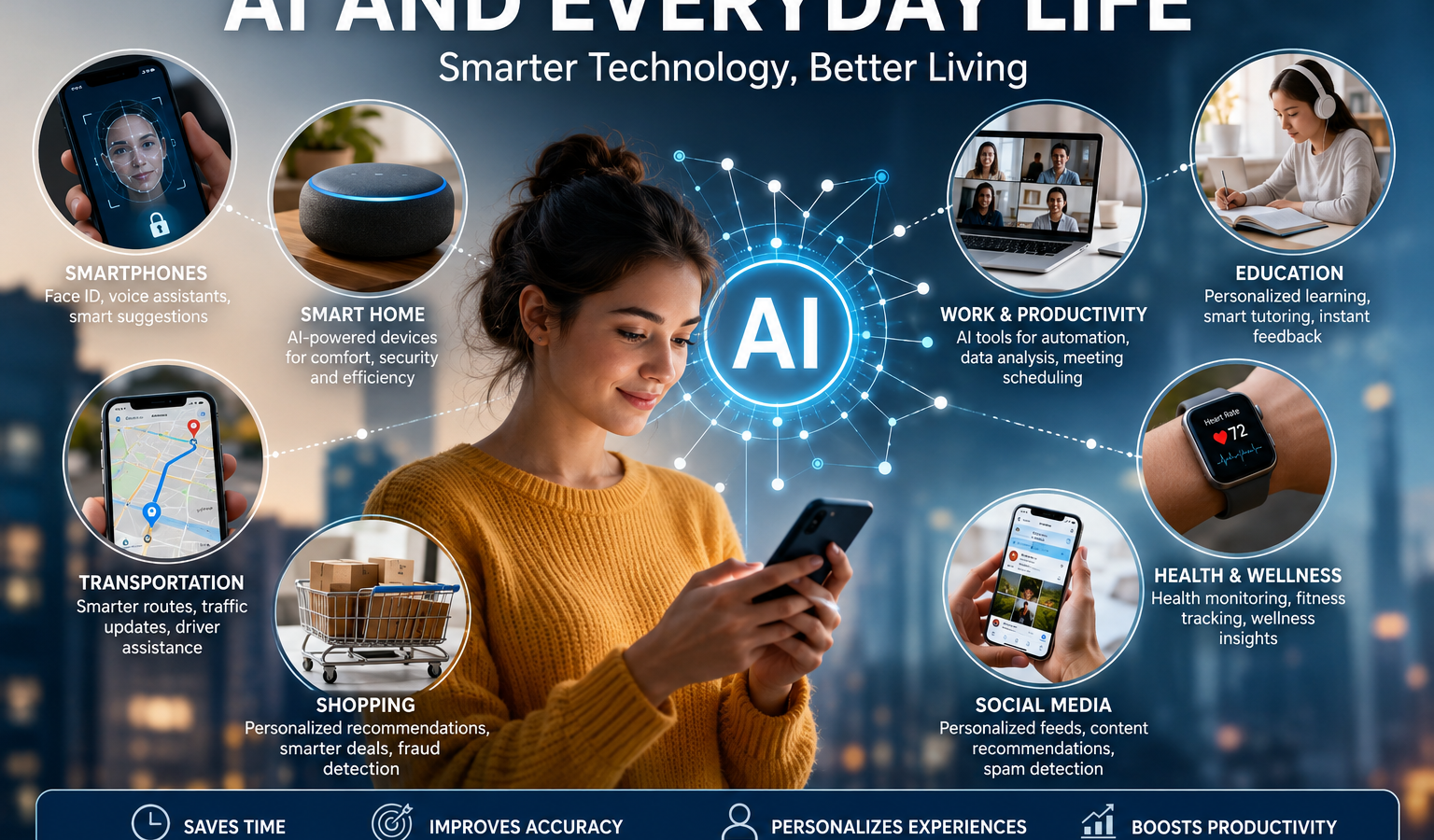

Artificial intelligence is no longer a futuristic idea reserved for sci-fi movies, research labs, or advanced tech companies. It is now part of everyday life in ways many people use without even noticing. From the moment you unlock your phone with face recognition to the time you ask a voice assistant for the weather, AI is already helping shape your routine. It powers the apps you use, the videos you watch, the products you buy, the routes you drive, and the messages you read.
For many people, AI still sounds complicated, but in reality, it has become one of the most practical technologies in modern life. It helps save time, reduces repetitive tasks, improves convenience, and supports better decisions. At the same time, it raises important questions about privacy, jobs, trust, and human creativity. Understanding AI and everyday life means looking at both sides: the benefits it brings and the changes it creates.
What AI Really Means in Daily Life
Artificial intelligence is the ability of machines or software to perform tasks that normally require human intelligence. These tasks include understanding language, recognizing images, making predictions, learning from data, and responding to questions. In simple terms, AI helps computers act in smarter and more useful ways.
In daily life, AI is often hidden inside tools people already use. It may recommend a song on Spotify, suggest the next word in a text message, filter spam from your email, or show you the fastest route on Google Maps. These systems learn patterns from data and use that information to make their results more relevant.
AI in everyday life is not about robots taking over normal routines. It is about invisible systems making ordinary tasks smoother, faster, and more personalized.
AI in Smartphones and Communication
One of the clearest places to see AI is in smartphones. Your phone may use AI for face unlock, voice recognition, camera enhancement, autocorrect, battery optimization, and smart suggestions. When your camera automatically brightens a dark photo or sharpens a portrait, AI is likely involved.
Messaging apps also rely on AI. They can predict what you are trying to type, translate messages, or identify spam and scam attempts. Voice assistants such as Siri, Google Assistant, and Alexa use AI to understand spoken commands and respond with useful information. People use them to set reminders, play music, make calls, control smart devices, or check the news.
This kind of support may seem small, but it adds up. Over time, AI reduces friction in communication and helps people get more done with less effort.
AI at Home
AI is becoming a normal part of home life. Smart speakers can play music, answer questions, or turn on lights. Smart thermostats can learn your temperature preferences and adjust settings automatically. Security cameras can detect movement and send alerts when something unusual happens. Even robot vacuum cleaners use AI to move around rooms more efficiently.
Streaming platforms are another major example. Services like Netflix, YouTube, and Disney+ use AI to recommend shows and videos based on your watching history. Shopping platforms also use AI to recommend items you may want to buy. These personalized suggestions are designed to make the user experience more relevant and engaging.
At home, AI can make life easier, more comfortable, and more efficient. It helps people manage routines, save energy, and enjoy more convenience with less manual effort.
AI in Transportation and Travel
AI is also changing how people move from one place to another. Navigation apps use AI to analyze traffic data, estimate travel times, and suggest better routes. Ride-sharing platforms use algorithms to match drivers and passengers. Some modern cars include AI-powered features like lane assist, adaptive cruise control, parking assistance, and collision warnings.
Travel apps use AI to recommend hotels, find cheaper flights, and predict delays. Language translation tools help travelers communicate in foreign countries. These tools make travel less stressful and more accessible, especially for people who rely on technology to plan efficiently.
As transportation systems become smarter, AI could play an even bigger role in the future, including in self-driving vehicles and intelligent traffic management. For now, its everyday role is already significant.
AI in Shopping and Online Recommendations
Online shopping is one of the biggest areas where AI influences everyday decisions. When a website recommends products based on your previous searches, that is AI at work. When customer support chats with you through a bot, AI may be behind the conversation. When a store shows personalized discounts or predicts what item you might need next, AI is helping guide the process.
Retailers use AI to understand customer behavior, manage stock, detect fraud, and improve delivery systems. For shoppers, this can mean faster service and more relevant recommendations. For businesses, it can mean better sales and fewer wasteful operations.
This convenience comes with a trade-off, though. The same systems that make shopping easier also collect data about user behavior. That is why people should pay attention to privacy settings and understand how their data is being used.
AI in Work and Productivity
AI is transforming the workplace in nearly every industry. It is helping workers write emails, summarize reports, analyze data, schedule meetings, and automate repetitive tasks. In offices, AI tools can speed up research, improve presentation design, and assist with customer service. In creative fields, AI can help generate ideas, edit content, or produce drafts.
For small business owners and freelancers, AI can be especially useful. It can help with marketing, social media captions, content planning, bookkeeping, and customer support. Tasks that once took hours can now be completed in minutes with the help of AI tools.
Still, AI is not a full replacement for human judgment. It can produce useful drafts and suggestions, but people still need to review, refine, and approve the results. In the workplace, the best use of AI is usually as an assistant, not a total substitute.
AI in Education and Learning
Education is another area where AI is becoming increasingly important. Students use AI tools to explain difficult concepts, summarize notes, practice languages, and get writing support. Teachers use AI to prepare lesson plans, grade simpler assignments, and personalize learning materials.
One major benefit of AI in education is accessibility. Students with different learning styles can receive support in ways that fit them better. AI can offer extra explanations, practice questions, and instant feedback. This can make learning more flexible and engaging.
At the same time, schools must handle AI carefully. Students should not rely on it to do their work without understanding the material. Learning should still involve thinking, problem-solving, and creativity. Used wisely, AI can support education without replacing the learning process itself.
AI in Health and Wellness
AI is also becoming part of health and wellness. Fitness apps use it to track activity, recommend workouts, and analyze habits. Wearable devices can monitor heart rate, sleep patterns, and daily movement. Some health systems use AI to help identify patterns in medical data, support diagnosis, or reduce administrative workload.
For ordinary people, this means better access to health information and more personalized wellness support. AI-powered apps can remind users to drink water, move more often, or stick to a routine. They can help people track progress and make healthier choices over time.
But health-related AI should always be used carefully. It may be helpful for general guidance, but it should not replace professional medical advice when serious issues are involved.
AI and Social Media
Social media platforms depend heavily on AI. Algorithms decide which posts appear on your feed, which videos go viral, and which ads you see. AI also helps detect harmful content, spam, fake accounts, and misinformation.
For users, this creates a highly personalized experience. You see more of the content that matches your interests. For creators and businesses, AI helps content reach the right audience more efficiently.
However, social media AI also has downsides. It can create echo chambers by showing people more of what they already agree with. It can also encourage endless scrolling by optimizing attention. That is why digital awareness is important. People should understand that what they see online is often shaped by AI-driven systems.
The Benefits of AI in Everyday Life
AI offers many benefits that make modern life easier. Some of the biggest include convenience, speed, personalization, and efficiency. It helps people save time on repetitive tasks and allows services to respond more quickly. It can also improve accuracy in areas like navigation, spam filtering, and data analysis.
Another major benefit is accessibility. AI tools can help people with disabilities through speech-to-text, text-to-speech, image recognition, and translation. This makes digital experiences more inclusive for a wider range of users.
AI also supports better decision-making by processing large amounts of information faster than humans can. That can be useful in business, education, health, logistics, and everyday planning.
The Challenges and Risks of AI
As useful as AI is, it also brings real challenges. One concern is privacy. Many AI systems depend on collecting and analyzing data, which can make users uneasy about how their information is stored and used.
Another concern is bias. AI systems learn from data, and if the data contains unfair patterns, the system may repeat them. This can affect hiring, lending, recommendations, and other important decisions.
There is also the issue of overdependence. If people trust AI blindly, they may stop checking information carefully. AI can be powerful, but it can also make mistakes. It may generate incorrect answers, misunderstand context, or sound confident even when it is wrong.
Jobs are another major concern. AI can automate some roles and reduce demand for certain kinds of work. At the same time, it also creates new opportunities in areas like AI training, data analysis, digital strategy, and prompt design. The challenge is helping workers adapt.
How to Use AI Wisely
Using AI wisely means treating it as a tool, not an authority. It is best used to support human work, not replace human thinking. People should verify important information, protect their privacy, and stay aware of what data they share.
A few smart habits can help. Review AI-generated content before using it. Check facts from reliable sources. Adjust privacy settings on apps and devices. Be careful with sensitive personal or financial information. And most importantly, remember that AI works best when guided by human judgment.
The Future of AI in Everyday Life
AI will almost certainly become even more common in the coming years. Homes, phones, cars, schools, hospitals, and workplaces will likely become smarter and more connected. Many routine tasks may become more automated, while new types of digital support will continue to appear.
The future of AI is not just about technology. It is about how people choose to use it. If developed responsibly, AI can make life more efficient, accessible, and productive. If used carelessly, it can create privacy problems, misinformation, and unfair outcomes. The goal should be to keep the human being at the center.
Conclusion
AI and everyday life are already deeply connected. Even if people do not notice it, artificial intelligence is helping shape how they communicate, shop, travel, learn, work, and relax. It is one of the most influential technologies of our time because it quietly improves so many daily routines.
The most important thing to understand is that AI is not simply a trend. It is a major shift in how modern systems operate. As more tools become intelligent, people will need to learn how to use them responsibly and confidently. AI can be a powerful partner in everyday life, as long as humans remain thoughtful, informed, and in control.