
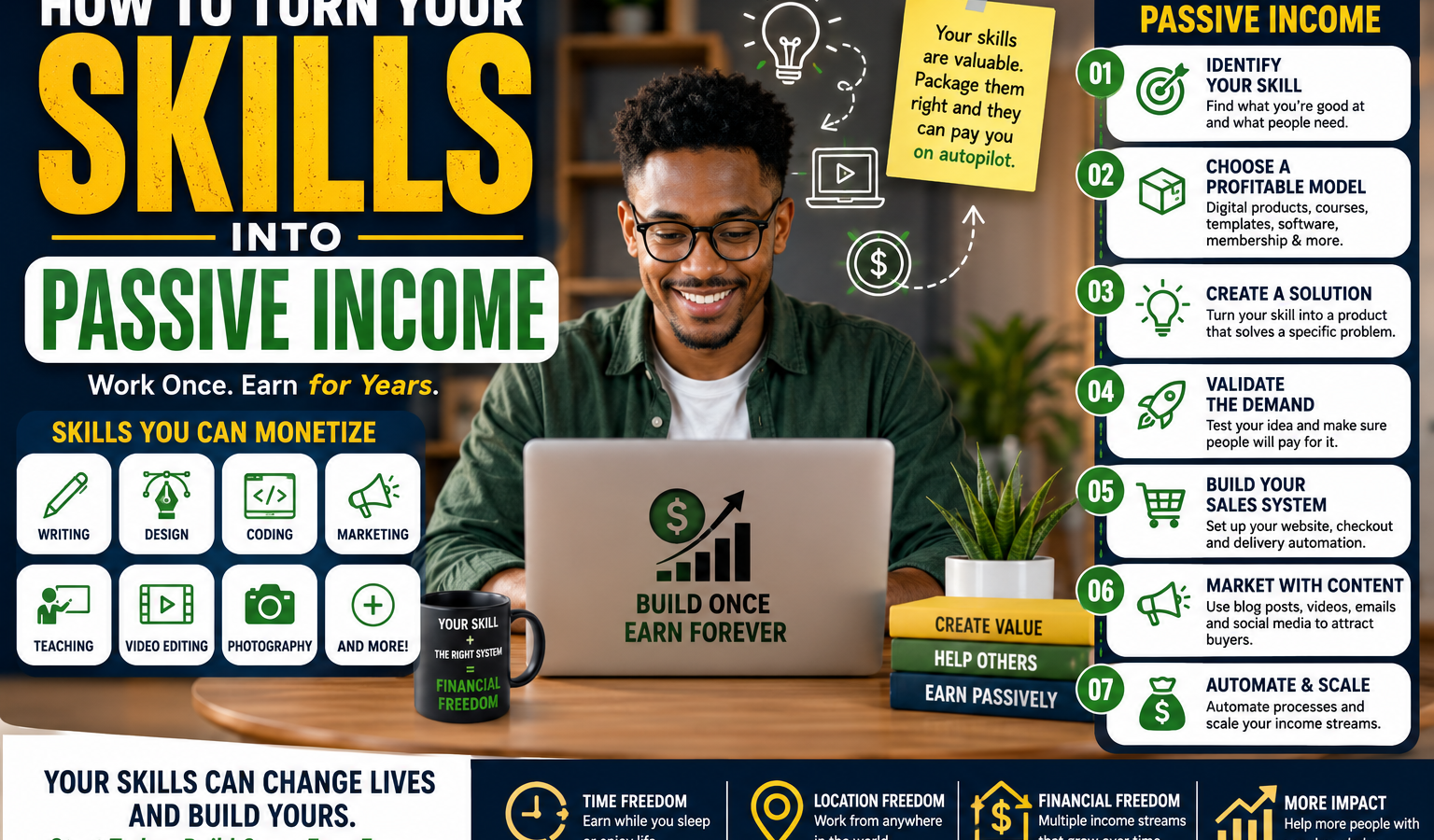

Building passive income is one of the most appealing ways to create financial freedom, but the phrase itself is often misunderstood. Passive income does not usually mean money flowing in with zero effort forever. In most cases, it means doing focused work upfront, building a system that can keep earning, and then maintaining it occasionally over time. That is where your skills become powerful.
If you already know how to write, design, code, teach, edit videos, manage social media, create music, build websites, or solve problems, you are sitting on income-producing assets. The challenge is not whether your skills have value. The challenge is learning how to package those skills into products, systems, or digital assets that can continue generating revenue after the initial work is done.
In this guide, you will learn exactly how to turn your skills into passive income, what models work best, how to get started with little or no budget, and how to build something that can grow over time.
What Passive Income Really Means
Passive income is money earned with limited day-to-day involvement after the initial setup. It usually comes from assets you create once and sell many times. These assets may include eBooks, online courses, templates, stock photos, software, membership content, printables, digital downloads, or automated services.
The key idea is leverage. Instead of exchanging every hour directly for money, you create something that keeps earning while you sleep, work on another project, or serve new customers. That is what makes passive income so attractive. It gives your knowledge more scale than a one-on-one service model.
That said, passive income is rarely fully passive at the beginning. You need effort to build the product, test demand, and set up the sales process. Once it starts working, though, the effort often drops dramatically.
Step 1: Identify Skills That Can Be Monetized
Almost every useful skill can be turned into income if you think about it the right way. The first step is to list what you are good at. This may include both professional skills and personal strengths.
Examples of monetizable skills include writing, graphic design, coding, public speaking, photography, social media management, data analysis, video editing, teaching, marketing, SEO, copywriting, illustration, translation, music production, and project management.
Then ask yourself three questions:
What problems can I solve? Who needs this skill the most? Can this skill be packaged into something people can buy without direct one-to-one time?
That last question matters. A skill becomes passive-income-friendly when it can be transformed into a product, system, or digital asset instead of only a service.
For example, a writer can create blog templates, eBooks, email swipes, or content packs. A designer can sell logo kits, social media templates, or brand style guides. A coder can sell plugins, scripts, SaaS tools, or website themes. A teacher can create recorded lessons or digital worksheets. The goal is to shift from service to scalable product.
Step 2: Choose a Passive Income Model
There are many ways to earn passive income from your skills, but some models are more practical than others. The best one depends on what you know and what your audience needs.
One common model is digital products. These are one-time creations that can be sold repeatedly. Examples include eBooks, templates, checklists, design assets, guides, presets, and spreadsheets. Digital products are often the easiest way to start because they do not require inventory or shipping.
Another strong model is online courses. If you can explain a topic clearly, you can package your knowledge into video lessons, worksheets, or mini training programs. Courses work well when your skill solves a specific problem people are already willing to pay to fix.
Membership content is another option. This works well if you can provide ongoing value, such as tutorials, exclusive downloads, community access, or premium tips. While memberships require more maintenance, they can create recurring income.
Software and apps can also be powerful passive-income tools. If you know how to code or can partner with a developer, you can create a tool that solves a repeated problem. Subscriptions and licenses can bring in consistent revenue.
Affiliate content is another model. If you create content around your skills, such as blogs, videos, or newsletters, you can recommend tools or products and earn commissions. This is not pure passive income at the start, but good evergreen content can continue earning for a long time.
Step 3: Turn Your Skill Into a Product
This is where many people get stuck. They know they have a useful skill, but they do not know how to turn it into something sellable. The easiest method is to think in terms of transformation.
Ask: what result does my skill produce?
A graphic designer does not just make graphics. They help businesses look professional. A copywriter does not just write words. They help brands sell more. A fitness coach does not just create workouts. They help people get healthier and more confident. A web developer does not just code. They help businesses build online presence and generate leads.
Once you understand the result, you can package that outcome into a product. For example, a copywriter could create a swipe file of high-converting headlines. A designer could sell social media kits for small businesses. A developer could build a WordPress theme or a plugin. A teacher could create a course on beginner SEO. A photographer could sell stock images or Lightroom presets.
The more specific the outcome, the easier it is to sell.
Step 4: Validate Demand Before You Build Too Much
One of the biggest mistakes people make is spending too long creating something nobody wants. Before you invest weeks into a product, test the idea.
Look at online marketplaces, forums, search results, social media, and competitor products. Are people already buying similar items? Are there questions, complaints, or gaps in the market? If yes, that is a good sign.
You can also validate with a simple landing page, a preorder offer, or a small audience survey. Ask what problem people want solved and what format they would prefer. Sometimes a small digital product outperforms a big one because it is more focused and useful.
Validation saves time. It helps you avoid building the wrong thing and increases the chance of making sales faster.
Step 5: Build a Simple System for Sales
Passive income only works well when the sales process is simple. You need a way for people to discover your product, understand its value, and buy it easily.
A basic system may include content marketing, a landing page, a checkout page, email follow-up, and delivery automation. For example, a blog post can attract search traffic, send readers to a product page, and deliver the digital product automatically after payment.
Social media, email newsletters, YouTube videos, and SEO can all drive traffic. The best channel is usually the one you can keep using consistently. If you are strong at writing, blogging and email may work best. If you are good on camera, YouTube may be stronger. If you prefer visuals, Pinterest or Instagram may help. The channel matters less than consistency and fit.
Step 6: Start With What You Already Know
You do not need to invent a brand-new business model. In fact, the smartest way to start is usually by using a skill you already have and solving a small, clear problem.
If you are good at writing, create blog templates, content calendars, or prompt packs. If you are good at design, create Canva templates, social media kits, or presentation themes. If you are good at marketing, create ad copy formulas, lead magnet templates, or strategy guides. If you are good at teaching, create short courses, checklists, or beginner guides. If you are good at coding, create scripts, plugins, automation tools, or small apps.
The advantage of starting simple is speed. You can launch faster, learn from real customers, and improve over time.
Step 7: Use Content to Multiply Your Reach
Content is one of the most powerful tools for passive income. A single blog post, video, or guide can attract traffic for months or years. Evergreen content is especially useful because it keeps bringing in new visitors long after you publish it.
For example, if you write about “how to create a budget spreadsheet” and then sell a spreadsheet template, the content supports the product naturally. If you make a YouTube tutorial on “how to design an ebook cover” and link to your cover template pack, the content becomes a sales channel.
This is how passive income becomes easier over time. Your content works as a distribution engine for your products.
Step 8: Automate as Much as Possible
Automation is what makes passive income feel more passive. Use tools that handle product delivery, email responses, scheduling, and payment processing. This reduces manual work and lets the system run smoothly.
For example, a customer can buy a digital file and receive it instantly. A new subscriber can join your email list and get an automated welcome sequence. A content calendar can help you plan posts in advance. Booking tools and auto-replies can save hours of back-and-forth communication.
Automation does not remove the need for maintenance, but it does remove much of the repetitive work.
Step 9: Improve and Expand Over Time
Your first version does not need to be perfect. In fact, it is better to launch a simple offer and improve it based on feedback. Customers will show you what needs to change. Their questions may reveal what to add. Their behavior may reveal what sells best.
As your products grow, you can expand into bundles, premium versions, memberships, or related offers. A single template can become a full pack. A short guide can become a course. A course can become a subscription community. One product can lead to many others if you continue solving the same customer problem at deeper levels.
That is where the real long-term value comes from. Not just one product, but a small ecosystem of products.
Common Mistakes to Avoid
Many people give up too early because they expect instant income. Passive income takes time to build. Another mistake is choosing a skill that is too broad and trying to sell to everyone. Specific offers usually perform better.
Some people also wait too long to launch because they want everything to be perfect. It is better to start with a simple version and improve later. Others build products without thinking about marketing. A great product without traffic will still struggle.
Avoid copying competitors blindly. Use them as inspiration, but make your offer clearer, more useful, or more targeted. And do not forget to protect your energy. Passive income should reduce stress over time, not create a project you cannot maintain.
Final Thoughts
Turning your skills into passive income is one of the smartest ways to build financial flexibility. It allows you to stop trading all your time for money and start creating assets that keep working for you. The process begins with identifying what you know, choosing the right model, packaging your skill into a product, validating demand, and building a simple sales system.
You do not need a large budget to start. You do not need to be famous. You do not need perfect timing. You only need a useful skill, a clear audience, and the discipline to turn knowledge into something valuable.
The people who succeed with passive income are usually not the ones with the most talent. They are the ones who consistently package their skills, publish useful products, and improve over time. Your skills can become income-producing assets. The only question is whether you will turn them into something people can buy.