
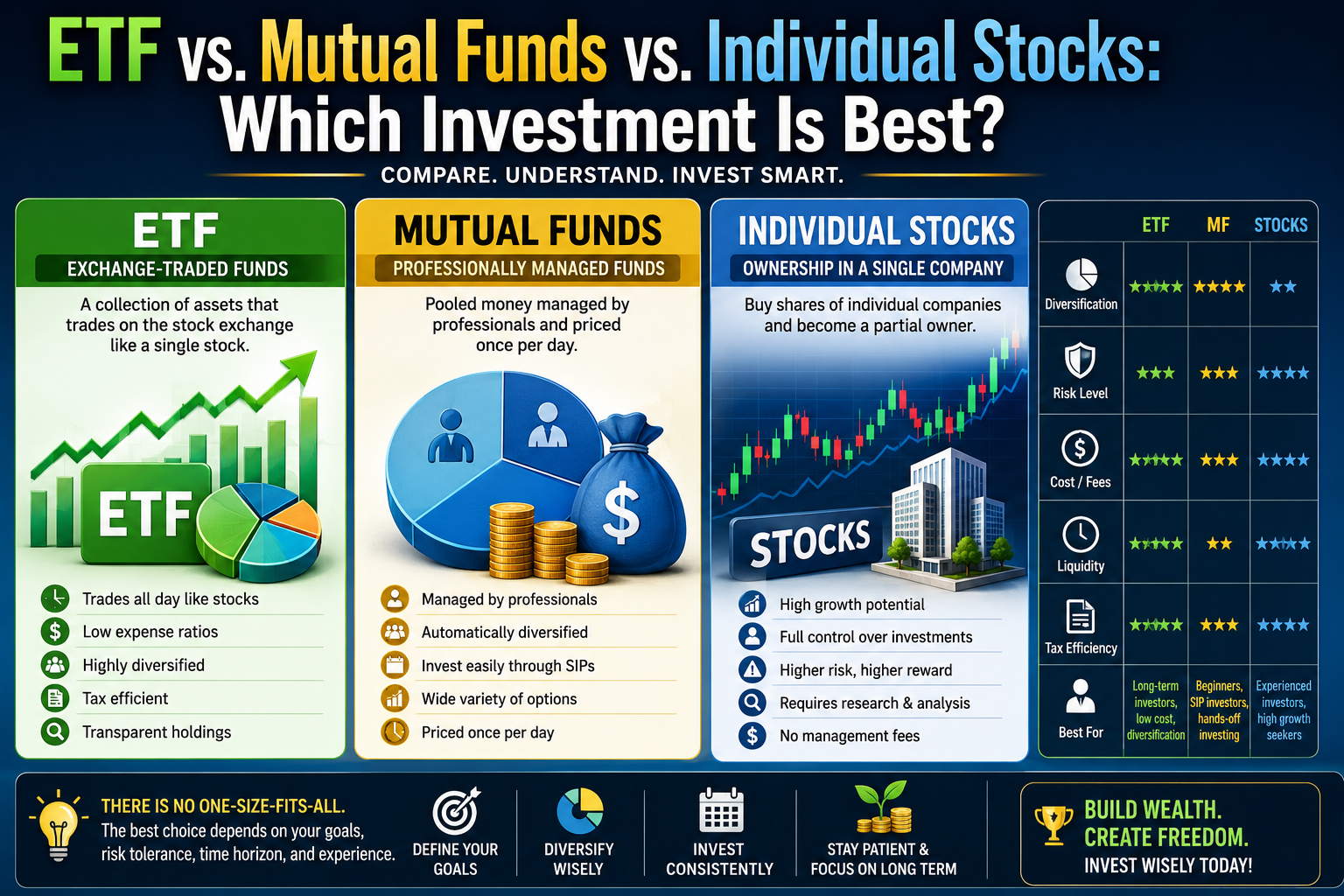

Choosing the right investment vehicle is one of the most important financial decisions you’ll make. While Exchange-Traded Funds (ETFs), mutual funds, and individual stocks all offer opportunities to grow your wealth, they differ significantly in cost, diversification, trading flexibility, and risk.
Understanding these differences can help you select investments that match your financial goals, experience level, and risk tolerance.
In this guide, we’ll compare ETF vs. Mutual Funds vs. Individual Stocks to help you determine which option is best for building long-term wealth in 2026.
Understanding the Basics of Investing
Investing means putting your money into assets with the expectation that they will grow in value or generate income over time.
Three of the most popular investment choices are:
- Exchange-Traded Funds (ETFs)
- Mutual Funds
- Individual Stocks
Although each can play an important role in a portfolio, they serve different purposes and appeal to different types of investors.
What Are ETFs?
An Exchange-Traded Fund (ETF) is an investment fund that holds a collection of assets such as stocks, bonds, or commodities and trades on a stock exchange like an individual stock.
For example, a broad-market ETF may own hundreds of companies across multiple industries, providing instant diversification through a single investment.
Advantages of ETFs
- Broad diversification
- Low expense ratios
- Intraday trading flexibility
- Transparency of holdings
- Tax efficiency in many jurisdictions
Potential Drawbacks
- Market prices fluctuate throughout the trading day.
- Some specialized ETFs may carry higher risks.
- Investors may pay brokerage commissions or bid-ask spreads, depending on the platform.
What Are Mutual Funds?
A mutual fund pools money from many investors and is managed by professional portfolio managers.
Unlike ETFs, most mutual funds are priced once per day after the market closes.
Benefits
- Professional management
- Diversification
- Automatic investment options
- Suitable for long-term investing
Drawbacks
- Higher management fees in many actively managed funds
- Less trading flexibility
- Some funds require minimum investments
Mutual funds are popular among retirement savers and investors who prefer a hands-off approach.
What Are Individual Stocks?
Buying an individual stock means purchasing ownership in a single publicly traded company.
Your investment performance depends largely on the success or failure of that specific business.
Benefits
- Potential for significant long-term growth
- Dividend income from some companies
- Voting rights (for many common stocks)
- Greater control over your portfolio
Risks
- Higher volatility
- Company-specific risk
- Requires ongoing research
- Less diversification unless many stocks are held
Individual stocks may be suitable for investors willing to dedicate time to researching businesses and managing their portfolios.
ETF vs. Mutual Funds vs. Individual Stocks: Key Differences
| Feature | ETFs | Mutual Funds | Individual Stocks |
|---|---|---|---|
| Diversification | High | High | Low (per stock) |
| Professional Management | Usually Passive | Often Active | Self-Managed |
| Trading | Throughout the day | End of trading day | Throughout the day |
| Expense Ratios | Generally Low | Often Higher | None (fund fee), but trading costs may apply |
| Minimum Investment | Often Low | May Have Minimums | Cost of one share or fractional share |
| Suitable for Beginners | Excellent | Excellent | Moderate |
Costs and Fees Comparison
Investment costs directly affect long-term returns. Even seemingly small annual fees can reduce portfolio growth over decades.
ETF Costs
Typical expenses include:
- Low expense ratios
- Brokerage commissions (if applicable)
- Bid-ask spreads
Many broad-market ETFs are designed to be cost-efficient.
Mutual Fund Costs
Possible expenses include:
- Expense ratios
- Management fees
- Sales loads (for some funds)
- Redemption fees (in certain cases)
Index mutual funds generally have lower fees than actively managed mutual funds.
Individual Stock Costs
Common costs may include:
- Brokerage commissions (depending on the broker)
- Taxes on gains or dividends
- Opportunity costs from poor diversification
Although individual stocks have no annual management fee, building and maintaining a diversified portfolio may require additional research and trading.
Risk and Diversification
Risk varies significantly among these investment options.
ETFs
Because many ETFs hold dozens or even hundreds of securities, they reduce company-specific risk through diversification.
Mutual Funds
Mutual funds also provide diversification, especially when investing across industries or geographic regions.
Individual Stocks
Owning only a few individual stocks exposes investors to greater risk if one company performs poorly.
Risk Comparison
| Investment | Diversification | Relative Risk |
|---|---|---|
| ETF | Excellent | Moderate |
| Mutual Fund | Excellent | Moderate |
| Individual Stock | Limited | Higher |
Diversification cannot eliminate market risk, but it can help reduce the impact of problems affecting individual companies.
Liquidity and Trading Flexibility
Liquidity refers to how easily an investment can be bought or sold.
ETFs
- Trade throughout market hours
- Prices update continuously
- Suitable for investors seeking flexibility
Mutual Funds
- Purchased or redeemed at the end-of-day net asset value (NAV)
- Less suitable for intraday trading
Individual Stocks
- Bought and sold throughout the trading day
- Wide range of order types available
- High liquidity for most large companies
For long-term investors, these trading differences may be less important than factors such as diversification and costs.
Tax Efficiency
Taxes can affect your long-term investment returns, so it’s important to understand how each investment type is generally taxed. Tax rules vary by country, so always consult a qualified tax professional or your local tax authority.
ETFs
ETFs are often considered tax-efficient because many use an in-kind creation and redemption process that may reduce taxable capital gains distributions to investors.
Advantages
- Fewer taxable distributions in many cases
- Lower portfolio turnover
- Suitable for long-term taxable accounts
Mutual Funds
Mutual funds, especially actively managed funds, may generate taxable capital gains distributions even if you haven’t sold your shares.
Considerations
- Higher portfolio turnover can increase taxable events.
- Tax efficiency varies depending on the fund’s investment strategy.
Individual Stocks
With individual stocks, investors generally control when they realize capital gains by deciding when to sell.
However, dividends and realized gains may still be taxable depending on your jurisdiction.
Tax Efficiency Comparison
| Feature | ETFs | Mutual Funds | Individual Stocks |
|---|---|---|---|
| Investor Control Over Capital Gains | High | Lower | High |
| Tax Efficiency | Generally High | Moderate | High (when held long term) |
| Dividend Tax Considerations | Applicable | Applicable | Applicable |
Which Investment Is Best for Beginners?
For new investors, simplicity and diversification are often the highest priorities.
ETFs
ETFs are an excellent starting point because they offer:
- Instant diversification
- Low costs
- Easy trading
- Exposure to hundreds of companies with one purchase
Mutual Funds
Mutual funds are also beginner-friendly, particularly for those who:
- Prefer professional management
- Want automatic investing
- Are investing regularly for retirement
Individual Stocks
Individual stocks may be appropriate once you’ve developed a solid understanding of:
- Financial statements
- Company valuation
- Industry trends
- Portfolio diversification
Many experienced investors begin with diversified funds before adding carefully selected individual stocks.
Which Investment Fits Your Financial Goals?
Your investment choice should align with your objectives, risk tolerance, and time horizon.
If Your Goal Is Long-Term Wealth
Best Choice:
- Broad-market ETFs
- Index mutual funds
These options provide diversification and historically have been effective vehicles for long-term investing.
If You Want Passive Investing
Choose investments requiring minimal ongoing management, such as:
- Index ETFs
- Target-date mutual funds
- Broad-market index funds
If You Enjoy Researching Companies
Individual stocks may appeal to investors who enjoy:
- Reading annual reports
- Following company earnings
- Evaluating competitive advantages
- Monitoring industry developments
If You’re Saving for Retirement
A diversified mix of ETFs or mutual funds can simplify retirement investing while reducing company-specific risk.
Sample Portfolio Allocations
The following examples are for educational purposes and are not personalized financial advice.
Conservative Investor
| Investment | Allocation |
|---|---|
| Bond Funds | 40% |
| Broad-Market ETFs | 40% |
| Dividend Stocks | 10% |
| Cash | 10% |
Moderate Investor
| Investment | Allocation |
|---|---|
| ETFs | 50% |
| Mutual Funds | 20% |
| Individual Stocks | 20% |
| Bonds | 10% |
Growth-Oriented Investor
| Investment | Allocation |
|---|---|
| Growth ETFs | 50% |
| Individual Stocks | 35% |
| International Funds | 10% |
| Cash | 5% |
These allocations should be adjusted over time as your financial goals and risk tolerance change.
Common Investing Mistakes
Avoiding common mistakes can improve your long-term investment results.
1. Investing Without Diversification
Putting all your money into one company increases risk significantly.
2. Chasing Recent Performance
Strong recent returns don’t guarantee future success.
3. Ignoring Fees
High expense ratios and unnecessary trading costs can reduce long-term returns.
4. Trying to Time the Market
Consistently predicting market highs and lows is extremely difficult, even for professionals.
5. Letting Emotions Drive Decisions
Fear during market declines and excitement during rallies often lead to poor investment decisions.
6. Failing to Review Your Portfolio
Periodic reviews help ensure your investments remain aligned with your financial goals.
Frequently Asked Questions
1. Are ETFs safer than individual stocks?
ETFs generally reduce company-specific risk because they hold many securities. However, they are still subject to overall market risk.
2. Can I own ETFs, mutual funds, and individual stocks together?
Yes. Many investors combine all three to balance diversification, professional management, and opportunities for individual stock selection.
3. Which investment has the lowest fees?
Broad-market index ETFs often have some of the lowest expense ratios available. Costs vary by provider and investment strategy.
4. Are mutual funds still worth investing in?
Yes. Many mutual funds remain suitable for long-term investors, particularly those who value professional management or automatic investment plans.
5. Should beginners buy individual stocks?
Beginners may benefit from starting with diversified ETFs or mutual funds before adding individual stocks as they gain knowledge and experience.
6. Which investment has the greatest growth potential?
Individual stocks can deliver higher returns but also carry higher risk. Diversified ETFs and mutual funds generally provide steadier long-term growth with lower company-specific risk.
Conclusion
When comparing ETF vs. Mutual Funds vs. Individual Stocks, there is no single option that’s best for everyone. The right choice depends on your investment goals, experience, risk tolerance, and time horizon.
Quick Summary
| Investment Type | Best For |
|---|---|
| ETFs | Beginners, long-term investors, low-cost diversification |
| Mutual Funds | Hands-off investors and retirement savers |
| Individual Stocks | Experienced investors seeking greater control and higher growth potential |
For many investors, a balanced portfolio works best. Broad-market ETFs or index mutual funds can serve as a strong foundation, while carefully selected individual stocks can complement your holdings if you’re comfortable with additional research and risk.
Successful investing isn’t about finding the “perfect” investment—it’s about staying disciplined, diversifying wisely, investing consistently, and maintaining a long-term perspective.
Further Reading
Expand your investing knowledge through educational resources from your country’s financial regulator, reputable investment firms, and trusted personal finance organizations. Topics such as asset allocation, diversification, risk management, and retirement planning can help you make more informed investment decisions over time.