
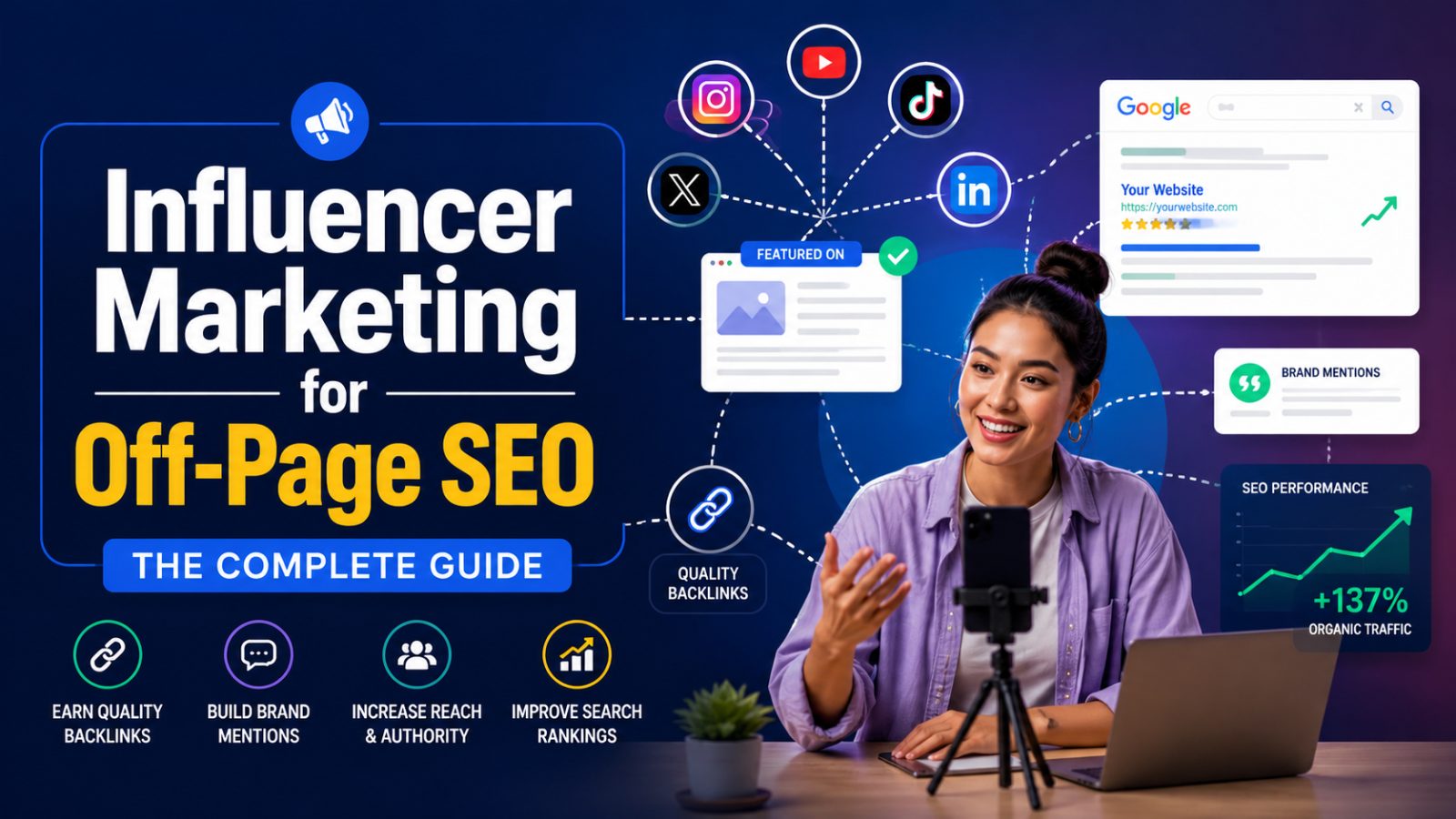

Influencer marketing can do more for SEO than generate social engagement. When the right creator introduces your brand to a relevant audience, that exposure can lead to brand mentions, editorial coverage, referral traffic, expert relationships, and—when earned naturally—valuable backlinks. That makes influencer marketing a powerful supporting tactic for off-page SEO.
This guide explains how to leverage influencer marketing for off-page SEO without turning creator partnerships into manipulative link schemes. Google emphasizes helpful, reliable, people-first content and warns against buying or exchanging links for ranking purposes. Paid placements can still be used for advertising, but paid links should be qualified with rel="sponsored" or rel="nofollow". citeturn219940search0turn236017search2turn219940search2
Table of Contents
- What Is Influencer Marketing for Off-Page SEO?
- How Influencer Marketing Supports Off-Page SEO
- How to Choose the Right Influencers
- Step-by-Step Influencer SEO Strategy
- Content Formats That Earn Attention and Links
- Influencer Links: What Is Safe for SEO?
- How to Measure Results
- Common Mistakes to Avoid
- Expert Tips
- Frequently Asked Questions
- Conclusion
What Is Influencer Marketing for Off-Page SEO?
Influencer marketing is a partnership between a brand and a creator or trusted industry personality who can reach a relevant audience. Off-page SEO covers authority-building activities that happen beyond your own website, including earning mentions, relationships, editorial links, citations, and attention from authoritative sources.
The important distinction is this: influencer marketing should not be built around the promise of a dofollow backlink. The strongest SEO outcome comes when creator exposure causes other people—publishers, bloggers, journalists, communities, researchers, or customers—to discover your brand and reference it because they find it useful.
Why this matters in 2026
Creator marketing has moved into mainstream marketing budgets. Sprout Social reported that 86% of U.S. marketers partnered with influencers in 2025, while its industry data projected the influencer marketing market at roughly $32.6 billion in 2025. CreatorIQ separately reported a 171% year-over-year increase in average reported annual influencer marketing budgets, with 71% of organizations increasing investment. These figures show why brands need a disciplined strategy rather than one-off creator promotions. citeturn236017search1turn236017search4
How Influencer Marketing Supports Off-Page SEO
1. It expands content discovery
A strong creator can place your content in front of people who would never encounter it through your own channels. More qualified exposure increases the probability that useful assets will be discussed, bookmarked, cited, or shared.
2. It creates link-earning opportunities
Influencer campaigns can put original research, tools, data studies, guides, and case studies in front of potential linkers. The influencer does not need to provide the SEO value directly. Their role can be to start the chain of discovery that leads to natural editorial links.
3. It strengthens brand visibility
Repeated mentions by credible voices can make your brand more recognizable within a niche. That can support branded searches, direct visits, referral traffic, and broader awareness even when the social post itself contributes no traditional link equity.
4. It builds relationships with authoritative people
Good influencer campaigns are relationship programs as much as distribution campaigns. A creator may become a source for future expert commentary, podcast guest, webinar partner, reviewer, or connector to other publishers and specialists.
5. It amplifies digital PR
Influencers can help new studies, launches, surveys, original tools, and expert commentary reach the people most likely to care. This makes influencer outreach a useful companion to digital PR for SEO.
For broader context on how social distribution can support search visibility indirectly, see our guide to social media and SEO.
How to Choose the Right Influencers
Follower count alone is a poor selection criterion. For off-page SEO, relevance, credibility, audience quality, publishing habits, and the creator’s ability to produce useful content matter more.
Evaluate these factors
- Topical relevance: The creator should consistently discuss subjects related to your niche.
- Audience fit: Check whether the audience matches your target customers, professionals, or publishers.
- Engagement quality: Look for meaningful comments and discussion rather than inflated interaction.
- Content quality: Review whether the creator produces original, useful, and credible work.
- Authority: Look for creators who are cited, invited to industry events, interviewed, or trusted by relevant communities.
- Platform fit: Choose channels that match the format and buying journey of your audience.
Micro vs. macro influencers for SEO objectives
| Influencer type | Typical strength | Best SEO use | Main caution |
|---|---|---|---|
| Micro creator | Focused, niche audience | Expert content, community discovery, high relevance | Smaller total reach |
| Mid-tier creator | Balance of reach and relevance | Campaign amplification and niche authority | Higher coordination cost |
| Macro creator | Large-scale awareness | Brand exposure and launch visibility | Audience can be less specialized |
| Industry expert | High credibility | Thought leadership, citations, PR, expert commentary | Often harder to secure |
Step-by-Step Influencer SEO Strategy
Step 1: Set a measurable off-page goal
Start with a business outcome. Examples include earning mentions from industry publications, increasing qualified referral traffic, attracting natural backlinks to a research report, or expanding awareness in a new market.
Step 2: Create something worth sharing
Do not send an influencer a generic sales page and expect SEO value. Build a resource with a genuine reason to be referenced, such as:
- Original survey results
- Industry benchmarks
- Interactive calculators or tools
- Expert roundups with real contributions
- Detailed case studies
- Original visual data
- Practical research reports
Step 3: Build an influencer prospect list
Use niche searches, podcast directories, YouTube channels, LinkedIn, industry newsletters, specialist communities, and creator databases. Record the creator’s niche, audience, platform, recent content, contact method, and any relevant publication relationships.
Step 4: Personalize outreach
Reference a specific piece of the creator’s work and explain why your resource fits their audience. Avoid generic mass emails and never make a campaign sound like a backlink purchase.
Step 5: Give creators editorial freedom
Creators usually produce better content when they can use their own voice. Provide accurate claims, product details, evidence, brand guidelines, and required disclosures, but avoid forcing unnatural anchor text or keyword-stuffed copy.
Step 6: Amplify the campaign
Repurpose creator content into your own channels. A useful interview can become a written article, short video, quote graphic, newsletter feature, podcast clip, or expert commentary asset.
Step 7: Conduct secondary outreach
This is where influencer marketing becomes especially useful for off-page SEO. When a respected creator publishes or discusses your research, contact relevant publishers who cover that subject. Pitch the underlying data or insight, not the influencer’s audience alone.
Step 8: Track earned outcomes
Record new referring domains, brand mentions, referral sessions, assisted conversions, branded search growth, content engagement, and the quality of new relationships. SEO impact can take time, so avoid judging the campaign only by immediate ranking movement.
Content Formats That Earn Attention and Links
Original research
Statistics and first-party findings give publishers a reason to cite your work. Present methodology clearly and make the source easy to reference.
Expert interviews
Interview respected specialists and turn the discussion into a useful editorial asset. Each participant can become a distribution partner, while the finished resource may attract citations from other writers.
Data-driven visual content
Charts, maps, benchmark graphics, and concise data summaries can make complex information easier to quote and share. Keep the underlying source data available so readers can verify the claims.
Tools and calculators
Interactive resources can earn repeat attention when they solve a real problem. Influencers can introduce the tool while journalists and bloggers may reference it as a useful resource.
Influencer Links: What Is Safe for SEO?
This is the most important compliance point in an influencer SEO strategy. Google states that exchanging money, goods, or services for links intended to manipulate rankings is a link spam practice. At the same time, Google recognizes paid advertising and sponsorships as legitimate web activities when those links are appropriately qualified. citeturn236017search2turn219940search2
Use the right link attribute
| Situation | Recommended attribute | Reason |
|---|---|---|
| Paid sponsorship or advertisement | rel="sponsored" |
Clearly identifies a paid placement |
| Untrusted or unendorsed link | rel="nofollow" |
Signals that you do not want to associate the site with the link |
| User-generated link | rel="ugc" |
Identifies user-generated content links |
| Independent editorial link | No special rel required | Normal editorial links can be crawled normally |
Do not demand exact-match anchor text
Asking creators to publish keyword-heavy anchors across multiple sites makes a campaign look engineered. A better approach is to give people the freedom to describe the resource naturally.
Disclose commercial relationships
Influencer disclosure rules also matter. The U.S. Federal Trade Commission says material connections such as payment, free products, employment, or other valuable benefits should be disclosed clearly and conspicuously. Local advertising and consumer-protection laws may also apply, so brands should check the rules in every market they target. citeturn219940search1
How to Measure Influencer Marketing for Off-Page SEO
Build a reporting model that separates exposure from SEO outcomes. CreatorIQ notes that measurement has become a central challenge in creator marketing, which reinforces the need for standardized performance tracking. citeturn236017search6
Core metrics
- Referring domains: Count relevant, reputable sites that begin linking to your assets.
- Brand mentions: Monitor linked and unlinked references across the web.
- Referral traffic: Measure visits generated by creators and secondary coverage.
- Conversions: Track leads, purchases, sign-ups, or other business outcomes.
- Branded search interest: Watch for changes in searches for your brand and key products.
- Content engagement: Compare clicks, watch time, saves, comments, and shares with campaign benchmarks.
Simple campaign scorecard
| Goal | Primary KPI | Secondary KPI |
|---|---|---|
| Earn links | New quality referring domains | Unique publisher mentions |
| Increase authority | Relevant brand mentions | Expert invitations and citations |
| Drive traffic | Qualified referral sessions | Engagement and assisted conversions |
| Generate revenue | Tracked conversions | Revenue per creator |
Common Mistakes to Avoid
Buying backlinks from influencers
Paying for promotion is not the same as buying ranking credit. Keep the commercial purpose transparent and qualify paid links correctly. citeturn236017search2
Choosing creators solely by follower count
A creator with 20,000 highly relevant followers may be more useful than a celebrity with millions of unrelated followers.
Promoting weak content
No creator can manufacture lasting authority around a resource that adds little value. Google explicitly encourages original, substantial, people-first content rather than content made primarily to manipulate rankings. citeturn219940search0
Using the same message everywhere
Audiences vary by platform. Adapt the hook, format, and call to action while keeping the underlying evidence consistent.
Ignoring brand safety
Review creator history, audience quality, past sponsorships, and public behavior. A poor-fit partnership can create reputational risk that outweighs any traffic benefit.
Measuring likes instead of business value
Engagement is useful, but it should not be the final KPI for an SEO campaign. Connect creator activity to discovery, mentions, referring domains, qualified traffic, leads, and revenue where possible.
Expert Tips
- Invest in assets before outreach: Strong research gives creators and publishers a reason to talk about you.
- Build long-term creator relationships: Repeated collaboration can be more valuable than a single sponsored post.
- Prioritize relevance over reach: The closer the audience is to your niche, the greater the chance of qualified discovery.
- Use influencer content as a PR signal: A creator mention can become the starting point for journalist and publisher outreach.
- Keep links natural: Let editorial context determine whether a link is included and how it is described.
- Document methodology: Research-backed campaigns become much easier for others to trust and cite.
Frequently Asked Questions
1. Does influencer marketing directly improve Google rankings?
Not necessarily. Influencer marketing is better viewed as an indirect off-page SEO accelerator. It can increase discovery, brand mentions, relationships, referral traffic, and opportunities to earn editorial links.
2. Can influencers give my website backlinks?
They can publish links, but the SEO treatment depends on the relationship and purpose. Paid links should be qualified with rel="sponsored" or rel="nofollow". citeturn219940search2
3. Are social media links valuable for SEO?
Social links can be valuable for discovery, referral traffic, branding, and relationships even when they do not pass traditional ranking credit.
4. Should I choose micro-influencers or macro-influencers?
Choose based on the campaign objective. Micro-influencers often provide stronger niche relevance, while macro-influencers can provide broader awareness. For off-page SEO, relevance and credibility usually matter more than raw audience size.
5. What type of content works best with influencers?
Original research, expert interviews, useful tools, data visualizations, case studies, and genuinely helpful guides are strong choices because they give audiences and publishers a reason to reference the underlying resource.
6. How do I track influencer-driven backlinks?
Use link-monitoring and analytics tools to track new referring domains, referral sessions, landing pages, brand mentions, and conversions. Record the baseline before the campaign so you can compare changes afterward.
7. Is paying an influencer against Google’s link spam rules?
Paying for advertising or sponsorship is not automatically a violation. The risk comes when paid links are used to manipulate ranking signals without appropriate qualification. Google recommends rel="sponsored" for paid placements. citeturn236017search2turn219940search2
8. How long does influencer marketing take to produce SEO results?
There is no universal timeline. Immediate effects may include referral traffic and brand exposure, while earned mentions, editorial links, and broader authority can take weeks or months to develop. Measure leading and lagging indicators rather than expecting instant rankings.
Conclusion
Influencer marketing can be an effective part of an off-page SEO strategy when it is built around relevance, credibility, useful content, and genuine relationships. The goal is not to manufacture backlinks. The goal is to create enough value and visibility that other people have a reason to discover, discuss, cite, and recommend your work.
The strongest model is simple: create something worth referencing, partner with credible creators who reach the right audience, amplify the content, use the resulting attention to support digital PR and relationship building, and measure the earned outcomes. That approach aligns influencer marketing with long-term SEO rather than short-term link manipulation.
Call to Action
Ready to strengthen your off-page SEO? Start by choosing three highly relevant creators, give them one genuinely useful asset to share, and track the mentions, referrals, relationships, and editorial opportunities that follow. For more practical SEO strategies, explore our guides on earning high-quality backlinks and digital PR for SEO.