
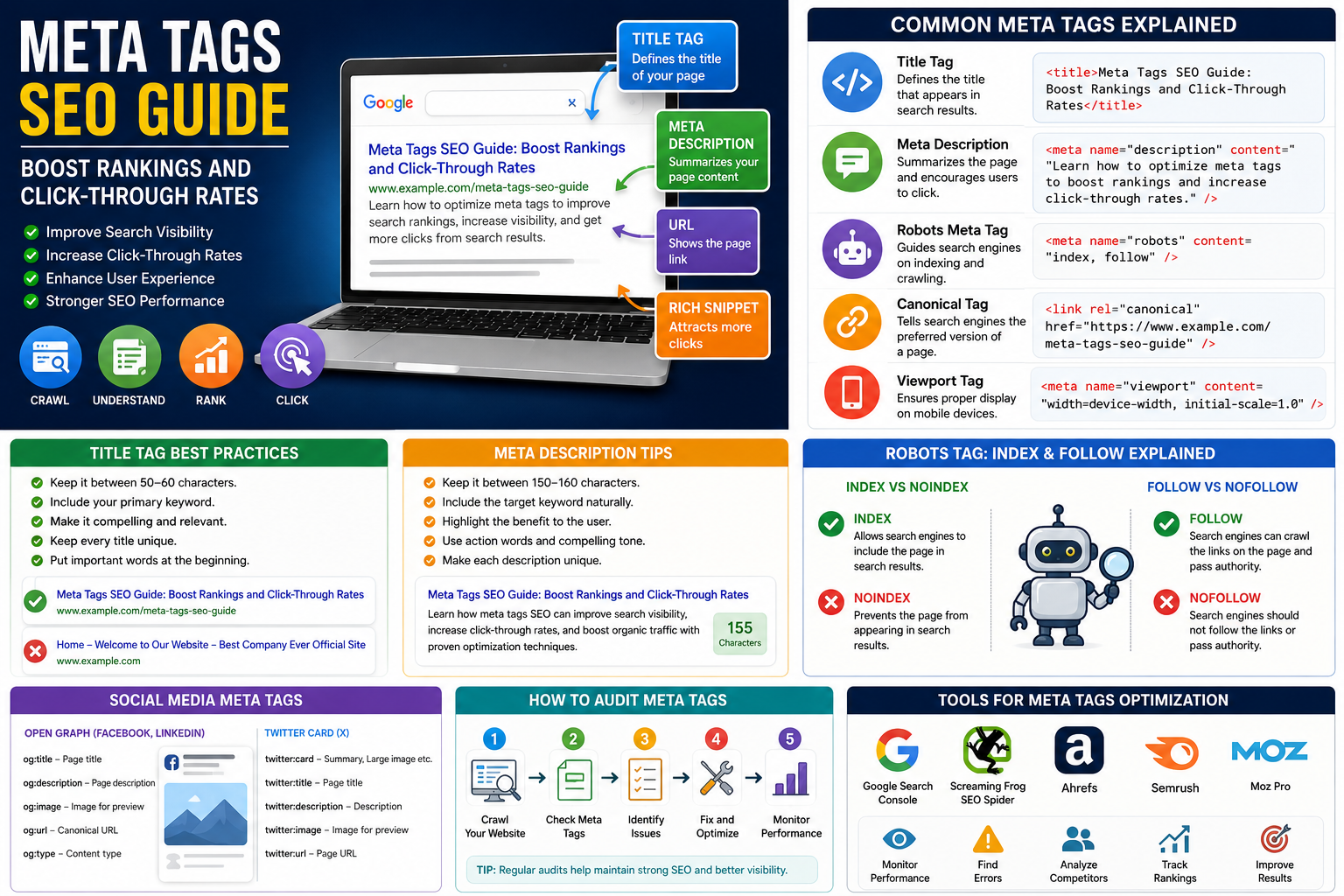

When it comes to improving website visibility in search engines, many website owners focus on content, backlinks, and technical optimization. While these elements are important, meta tags SEO remains one of the most fundamental components of an effective search engine optimization strategy.
Meta tags help search engines understand the purpose of a webpage. They also influence how your pages appear in search engine results pages (SERPs). Well-optimized meta tags can increase visibility, improve user engagement, and significantly boost click-through rates (CTR).
Although some meta tags have lost importance over the years, others continue to play a major role in SEO performance. Understanding which tags matter and how to optimize them can provide a competitive advantage in organic search.
What Are Meta Tags?
Meta tags are snippets of HTML code placed in the head section of a webpage. These tags provide information about the page to search engines, browsers, and social media platforms.
Unlike visible website content, meta tags generally remain hidden from visitors while communicating important details behind the scenes.
How Meta Tags Work
Meta tags help:
- Describe page content
- Guide search engine crawling
- Control indexing behavior
- Improve social sharing previews
- Enhance mobile responsiveness
Search engines analyze these signals to better understand and categorize web pages.
Why Search Engines Use Meta Information
Search engines process billions of pages. Meta tags offer quick contextual information that helps algorithms determine relevance and user intent.
Common uses include:
| Meta Tag Type | Purpose |
|---|---|
| Title Tag | Defines page title |
| Meta Description | Summarizes content |
| Robots Tag | Controls indexing |
| Canonical Tag | Prevents duplicate content |
| Viewport Tag | Improves mobile display |
| Open Graph Tags | Controls social sharing |
Importance of Meta Tags SEO
Impact on Rankings
Not all meta tags directly influence rankings, but some provide strong ranking signals.
For example:
- Optimized title tags improve relevance.
- Canonical tags prevent duplicate content issues.
- Robots tags ensure proper indexing.
Together, they support overall SEO performance.
Impact on Click-Through Rates
Even if rankings remain unchanged, compelling title tags and meta descriptions can dramatically increase clicks.
Higher CTR often results in:
- Increased organic traffic
- Better user engagement
- Improved conversion opportunities
Understanding Title Tags
The title tag is one of the most important elements in meta tags SEO.
It appears as:
- Search result headline
- Browser tab title
- Social sharing title in some cases
Best Practices for Title Tags
Follow these guidelines:
- Keep length between 50–60 characters.
- Include the target keyword near the beginning.
- Make titles compelling and relevant.
- Ensure every page has a unique title.
Example:
Meta Tags SEO Guide: Boost Rankings and Click-Through Rates
Common Title Tag Mistakes
Avoid:
- Keyword stuffing
- Duplicate titles
- Excessively long titles
- Generic titles such as “Home” or “Page 1”
Poor title optimization can reduce both rankings and CTR.
Optimizing Meta Descriptions
Meta descriptions summarize page content for users.
Although they are not direct ranking factors, they strongly influence click-through rates.
Writing Compelling Descriptions
Effective descriptions should:
- Include the target keyword naturally
- Explain the page benefit
- Encourage action
- Match search intent
Example:
Learn how meta tags SEO can improve search visibility, increase click-through rates, and boost organic traffic with proven optimization techniques.
Character Limits and Formatting
Best practices include:
- 150–160 characters
- Clear messaging
- Action-oriented language
- Unique descriptions for every page
Robots Meta Tags Explained
Robots tags instruct search engines how to handle webpages.
Index vs Noindex
Index
Allows search engines to include the page in search results.
Noindex
Prevents the page from appearing in search results.
Common uses for noindex include:
- Thank-you pages
- Login pages
- Internal search results
Follow vs Nofollow
Follow
Permits search engines to crawl page links.
Nofollow
Suggests that search engines should not pass authority through certain links.
Viewport Meta Tags and Mobile SEO
Mobile optimization is essential in today’s search landscape.
The viewport tag tells browsers how to display content on different devices.
Example:
<meta name="viewport" content="width=device-width, initial-scale=1.0">
Benefits include:
- Better mobile usability
- Improved user experience
- Support for responsive design
Since Google primarily uses mobile-first indexing, viewport optimization is critical.
Canonical Tags and Duplicate Content
Duplicate content can confuse search engines.
Canonical tags identify the preferred version of a page.
Example:
<link rel="canonical" href="https://example.com/page">
Benefits include:
- Consolidated ranking signals
- Improved crawl efficiency
- Prevention of duplicate content penalties
Open Graph Meta Tags for Social Sharing
Open Graph tags were introduced by to improve content sharing.
Important Open Graph tags include:
<meta property="og:title">
<meta property="og:description">
<meta property="og:image">
<meta property="og:url">
These tags control how content appears on social networks.
Twitter Card Meta Tags
Twitter Cards provide enhanced previews when content is shared on X (formerly Twitter).
Common tags include:
<meta name="twitter:card">
<meta name="twitter:title">
<meta name="twitter:description">
<meta name="twitter:image">
Benefits include:
- Better visibility
- Increased engagement
- Improved sharing performance
Schema Markup vs Meta Tags
Many marketers confuse schema markup with meta tags.
Meta Tags
Provide page-level information.
Schema Markup
Provides structured data that helps search engines understand content more deeply.
Examples include:
- Product schema
- FAQ schema
- Review schema
- Event schema
Using both together creates stronger search visibility.
Keyword Meta Tags: Do They Still Matter?
Years ago, keyword meta tags played an important role.
Today, major search engines largely ignore them due to historical abuse.
Most SEO professionals no longer prioritize:
<meta name="keywords" content="SEO, marketing, rankings">
Instead, focus on:
- Content quality
- Title tags
- Meta descriptions
- Structured data
Advanced Meta Tags SEO Techniques
Advanced optimization methods include:
Dynamic Meta Tag Generation
Useful for:
- Large eCommerce websites
- News portals
- Content-heavy platforms
Optimizing for Featured Snippets
Use clear:
- Headings
- Lists
- Tables
- Definitions
Improving Search Intent Matching
Align titles and descriptions with user expectations.
Higher relevance often leads to better engagement.
Common Meta Tag Errors to Avoid
Avoid these mistakes:
| Error | Impact |
|---|---|
| Missing Title Tags | Lower relevance |
| Duplicate Titles | Ranking confusion |
| Missing Descriptions | Reduced CTR |
| Incorrect Canonicals | Indexing issues |
| Over-Optimized Titles | Spam signals |
| No Mobile Viewport | Poor mobile experience |
How to Audit Meta Tags
Regular audits help identify optimization opportunities.
Audit checklist:
- Verify title tag uniqueness.
- Review description quality.
- Check canonical implementation.
- Validate robots directives.
- Test mobile responsiveness.
- Inspect social sharing tags.
Tools for Meta Tags Optimization
Popular SEO tools include:
- Google Search Console
- Screaming Frog SEO Spider
- Ahrefs
- Semrush
- Moz Pro
For official guidance, visit .
These tools simplify auditing and optimization processes.
Future of Meta Tags SEO
Search engines continue evolving, but meta tags remain essential.
Future trends include:
- AI-driven search experiences
- Greater focus on user intent
- Enhanced structured data integration
- Improved mobile-first optimization
- More personalized search results
Despite technological changes, properly optimized meta information will continue supporting search visibility.
Frequently Asked Questions
1. What are meta tags in SEO?
Meta tags are HTML elements that provide information about a webpage to search engines and browsers.
2. Do meta descriptions affect rankings?
Meta descriptions are not direct ranking factors, but they strongly influence click-through rates.
3. What is the ideal title tag length?
Generally, 50–60 characters helps prevent truncation in search results.
4. Are keyword meta tags still useful?
Most major search engines no longer use keyword meta tags as ranking signals.
5. What is a canonical tag?
A canonical tag tells search engines which version of a page should be treated as the primary version.
6. How often should I audit meta tags?
Quarterly audits are recommended, especially for large websites.
7. Which meta tag is most important for SEO?
The title tag is widely considered the most important SEO-related meta tag.
8. Do social media meta tags impact SEO?
They do not directly affect rankings but can improve visibility, engagement, and traffic from social platforms.
Effective meta tags SEO optimization remains a cornerstone of successful search engine marketing. While some tags have become less important, critical elements such as title tags, meta descriptions, canonical tags, viewport tags, and robots directives continue to influence visibility, user engagement, and search performance.
By implementing best practices, avoiding common mistakes, and regularly auditing your website, you can improve click-through rates, strengthen search relevance, and create a better experience for both users and search engines. In an increasingly competitive digital landscape, mastering meta tags is a simple yet powerful way to gain an SEO advantage.




11tt seems like a promising platform. Still exploring, but the initial impression is positive. The interface is clean and user-friendly. Check ’em out 11tt!