

Nigeria’s payment landscape has changed dramatically as smartphones, instant transfers, mobile wallets, agent banking and fintech platforms become part of everyday financial life. In 2025, mobile money operators processed ₦372.14 trillion across 28.74 billion transactions, according to figures from the Central Bank of Nigeria’s 2025 Annual Report.
This guide reviews major mobile payment solutions in Nigeria, explains what each type of service is best suited for, compares important features, and highlights the security and regulatory issues users should consider before choosing a payment app.
Table of Contents
- What Are Mobile Payment Solutions?
- The Growth of Mobile Payments in Nigeria
- Latest Mobile Payment Apps and Services
- Comparison of Popular Solutions
- How to Choose a Mobile Payment App
- Security and Consumer Protection
- Expert Tips
- Common Mistakes
- FAQs
What Are Mobile Payment Solutions?
Mobile payment solutions are digital services that allow people and businesses to send, receive, store or spend money through a mobile phone. They include bank apps, mobile wallets, payment apps, QR payments, USSD services, merchant payment platforms and agent-banking solutions.
Common mobile payment functions
- Instant bank transfers
- Wallet-to-wallet payments
- Airtime and data purchases
- Electricity and other bill payments
- Merchant payments
- QR and card payments
- POS and agent banking
- Savings and other financial services
The Growth of Mobile Payments in Nigeria
Nigeria has become one of Africa’s most active digital-payment markets. NIBSS reported that the NIBSS Instant Payments platform processed about 11 billion transactions in 2024, a 120% increase from 2022.
The broader ecosystem is expanding as well. NIBSS reported that the value of POS transactions reached ₦18.78 trillion in the first quarter of 2026, up 79.03% from the same period in 2025.
In July 2026, NIBSS also reported that its new National Payment Stack had recorded 26.55 million transactions worth ₦1.4 trillion across 48 participating institutions during its rollout.
Latest Mobile Payment Apps and Services in Nigeria
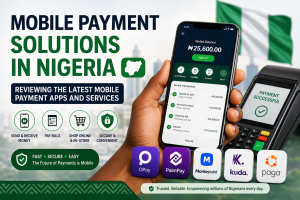
1. OPay
OPay is one of Nigeria’s largest consumer-focused fintech platforms, offering transfers, wallet services, airtime, bills, cards and other financial services. Recent reporting put its 2025 gross transaction value at $358 billion and monthly active users at 39.3 million.
Best for: frequent transfers, everyday payments, airtime and broad consumer financial services.
2. PalmPay
PalmPay combines mobile payments with services such as transfers, airtime, bills, savings and other financial products. The company reported more than 35 million registered users and up to 15 million transactions per day in 2025.
Best for: everyday consumer payments and users who want several financial services in one app.
3. Moniepoint
Moniepoint has a particularly strong presence among Nigerian businesses and agent-payment users. Its 2025 review says the platform served more than 6 million businesses and 16 million individuals, while processing more than ₦30 trillion in transactions according to its company-wide 2025 reporting.
Best for: merchants, small businesses, POS operations and business-focused banking.
4. Kuda
Kuda is a digital banking platform designed around mobile-first banking. It is particularly useful for users who want digital account management, transfers, cards and personal-finance tools without relying heavily on physical branches.
Best for: mobile-first personal banking.
5. Paga
Paga is a long-established Nigerian mobile-money platform that supports transfers, bill payments and other financial transactions through digital channels and agent networks.
Best for: users who value agent-assisted access and mobile-money services.
Mobile Payment Solutions Comparison
| Solution | Strongest Use Case | Typical User | Key Advantage |
|---|---|---|---|
| OPay | Everyday payments | Consumers and agents | Broad payment ecosystem |
| PalmPay | Consumer payments | Individuals and merchants | Payments plus financial services |
| Moniepoint | Business payments | SMEs and merchants | Strong business and POS focus |
| Kuda | Digital banking | Individuals | Mobile-first banking experience |
| Paga | Mobile money | Consumers and agents | Established agent network |
Features, fees, limits and availability can change. Users should confirm current terms inside the relevant app or through the provider’s official channels before making an important transaction.
How to Choose the Best Mobile Payment App in Nigeria
1. Check transaction fees
Compare transfer, withdrawal, card, bill-payment and other applicable charges. A service that looks inexpensive for one transaction may cost more when used frequently.
2. Check transfer reliability
Fast and reliable payments matter more than promotional rewards for most users. Consider how the provider handles failed transactions, reversals and customer complaints.
3. Examine security controls
Look for device binding, transaction PINs, biometric authentication, alerts and other safeguards. Never share your PIN, OTP or authentication code.
4. Consider your use case
- Choose a consumer wallet if you mainly make personal payments.
- Choose a business-focused platform if you receive frequent customer payments.
- Consider a bank app if you need traditional banking products alongside mobile payments.
- Consider agent-supported services if reliable physical access is important in your area.
Security and Consumer Protection
Convenience should not replace caution. Mobile payment accounts contain valuable financial information and can be targeted through phishing, social engineering, SIM-related attacks and fraudulent links.
Practical security checklist
- Use a strong, private transaction PIN.
- Enable biometric or other available authentication.
- Never disclose an OTP or authorization code.
- Install apps only from trusted app stores and verify the developer.
- Review transaction notifications promptly.
- Contact the provider quickly when a transaction is unauthorized or incorrect.
- Keep your phone and operating system updated.
Nigeria’s payment ecosystem is regulated and evolving, with the Central Bank of Nigeria and industry infrastructure organizations working on payment standards, interoperability and consumer protection. The continued development of the National Payment Stack also points toward a more integrated payment infrastructure.
Expert Tips for Using Mobile Payments
- Keep a backup option: Maintain access to another legitimate payment channel for urgent transactions.
- Separate business and personal finances: A dedicated business account can simplify reconciliation and record keeping.
- Track frequent charges: Small transaction fees can become significant over hundreds of payments.
- Do not choose an app only because of bonuses: Evaluate reliability, support, security and total cost.
- Keep transaction records: Save receipts for important payments and business reconciliation.
Common Mistakes to Avoid
- Choosing a payment app solely because it offers rewards.
- Sharing OTPs or transaction PINs with someone claiming to be support staff.
- Ignoring failed-transfer notifications.
- Using unofficial APK files or suspicious links.
- Failing to check the recipient’s account details before confirming a transfer.
- Keeping all available funds in one digital wallet without considering access and risk.
Frequently Asked Questions
1. What is the best mobile payment app in Nigeria?
There is no single best app for everyone. OPay and PalmPay are strong consumer options, while Moniepoint is particularly suited to many businesses and merchants. Your choice should depend on fees, reliability, features and support.
2. Are mobile payment apps safe in Nigeria?
Licensed and reputable providers use security controls, but users still need to protect their PINs, OTPs, devices and account information.
3. Can I use mobile payment apps without a bank branch?
Many fintech and mobile-money platforms are designed to provide digital or agent-assisted services without requiring frequent branch visits.
4. Can mobile payment apps be used for business?
Yes. Many platforms provide merchant accounts, POS services, payment collection, transfers and other business tools.
5. Which mobile payment service is best for POS businesses?
Business-focused platforms such as Moniepoint can be strong choices, but operators should compare current fees, terminal availability, settlement times, reliability and support before deciding.
6. Are mobile payment fees the same across providers?
No. Fees and limits vary by provider, transaction type, customer category and regulatory requirements. Always check the current fee schedule.
7. What should I do if a mobile transfer fails?
Keep the transaction reference, check whether the money was debited, and use the provider’s official support channel. Avoid sending the payment repeatedly until you understand the status.
8. Is mobile payment adoption growing in Nigeria?
Yes. Recent NIBSS and CBN data show substantial growth in instant payments, mobile money and POS activity, demonstrating continued expansion of digital payments.
Conclusion
Mobile payment solutions in Nigeria have moved from being optional conveniences to essential financial infrastructure. OPay, PalmPay, Moniepoint, Kuda, Paga and bank-led platforms each serve different needs, while the wider ecosystem continues to expand.
The best choice is not necessarily the app with the biggest user base or the most attractive promotion. Look at reliability, fees, security, customer support, transaction limits and the specific services you actually need.
As Nigeria’s payment infrastructure develops further, consumers and businesses should expect mobile payments to become even more integrated, interoperable and central to everyday commerce.
Call to Action
Before choosing a mobile payment solution, compare at least two providers and review their current fees, limits, security features and support options. If you already use a mobile payment app, review your security settings and transaction history today to make sure your account remains protected.
Financial information can change. This article is for general educational purposes and is not financial advice. Verify current fees, licensing status, transaction limits and terms directly with the relevant provider and Nigerian regulators before making financial decisions.