
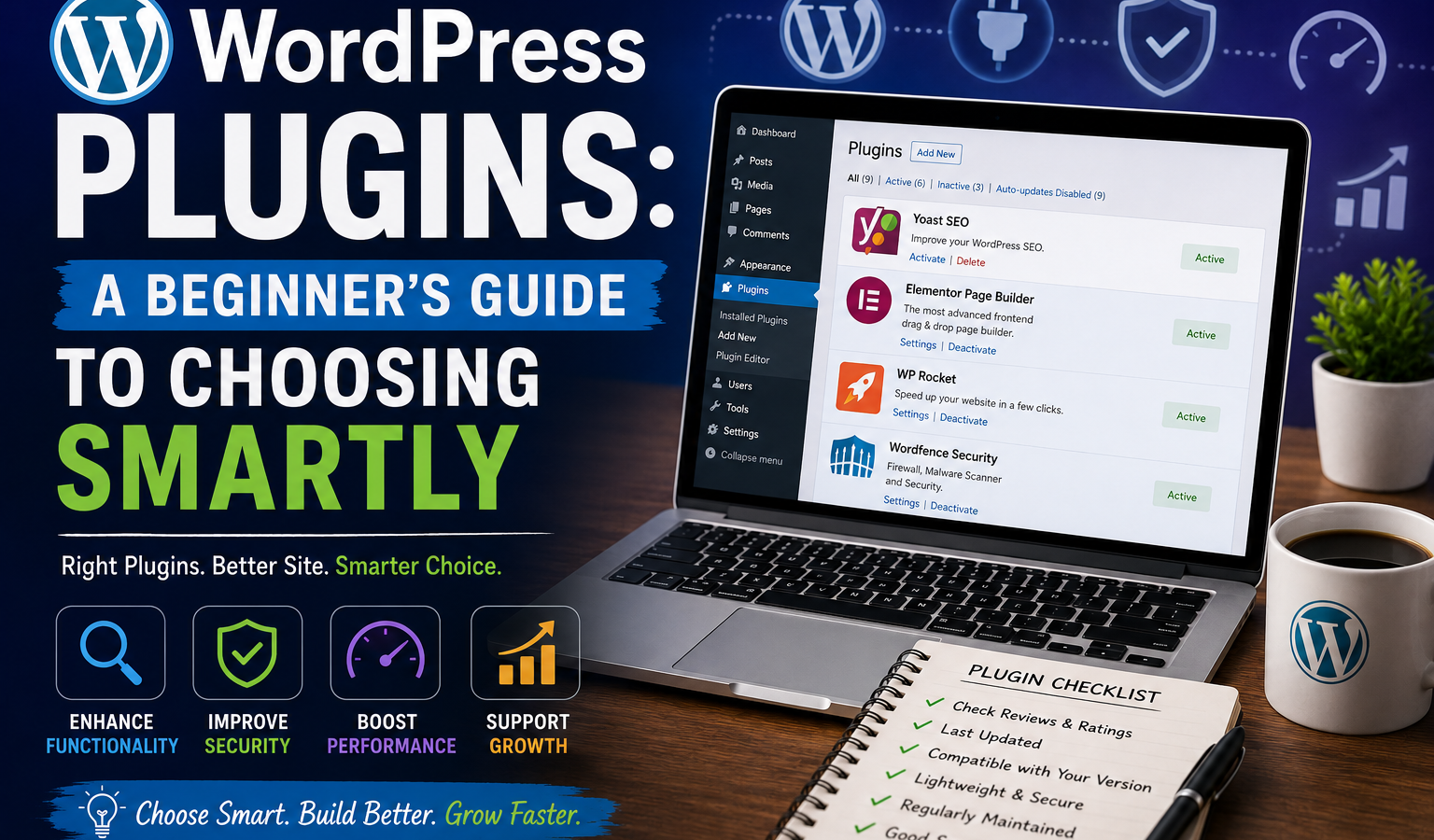

WordPress plugins are one of the main reasons WordPress remains the most flexible content management system on the web. They let you add features without rebuilding your site from scratch. With the right plugins, a simple website can become an online store, a lead-generation machine, a membership platform, or a fast-loading blog that ranks well in search.
That flexibility is powerful, but it also creates confusion. New users often install too many plugins, choose low-quality tools, or ignore security and performance. The result is slow pages, conflicts, broken layouts, and maintenance problems. This guide explains WordPress plugins in a practical way so beginners can make better decisions from the start.
According to the WordPress Plugin Handbook, plugins extend the core functionality of WordPress, and the official plugin directory exists to help users find and maintain them safely. The same handbook also stresses security, GPL compatibility, readable code, and responsible development practices. Those principles matter whether you are installing a plugin or building one.
Table of Contents
- What WordPress plugins are
- Why plugins matter
- How plugins work
- Types of WordPress plugins
- How to choose the right plugins
- Comparison table
- Best plugin selection tips
- Performance and security basics
- Expert tips
- Common mistakes
- FAQs
- Conclusion
- Call to action
What WordPress Plugins Are
WordPress plugins are packages of code that extend WordPress core. They add features that are not built into the platform by default. A plugin can be very small, such as a shortcode helper, or very large, such as a full e-commerce system, booking engine, or learning platform. The official handbook explains that plugins can include PHP, CSS, JavaScript, images, and other assets.
For beginners, the easiest way to think about plugins is this: WordPress gives you the base engine, and plugins give you the extra features. You can add contact forms, SEO tools, caching, page builders, security layers, spam filters, analytics, backups, and more without changing the core software.
That is why WordPress is so popular. It is not just a blogging tool. It is a modular system. You can start small and add only what your site needs. That flexibility helps new site owners launch faster and adjust over time.
Why Plugins Matter
Plugins matter because they save time, reduce development costs, and expand what your site can do. A business owner can add a booking form in minutes. A blogger can improve SEO without coding. A store owner can accept payments and manage products. A nonprofit can create donation flows and event calendars.
They also help you compete. A better search experience, faster page speed, stronger security, and clearer conversion tools can all improve results. In many cases, the difference between a weak website and a strong one is not the theme alone. It is the quality of the plugins and how well they are managed.
WordPress.org documentation also notes that plugins are managed from the admin screen, where they can be activated, deactivated, or deleted. That sounds simple, but it is an important reminder: plugin management is an ongoing site-maintenance task, not a one-time setup.
How WordPress Plugins Work
Plugins work by hooking into WordPress core at specific points. WordPress developers use actions and filters, collectively called hooks, to modify behavior without editing core files. The official hook documentation explains that hooks let one piece of code interact with another at predefined spots.
For example, a plugin can run code when a page loads, when a post is saved, when a form is submitted, or when a user logs in. It can also filter data before WordPress displays it. That is what makes plugins so powerful and so flexible.
Some plugins add settings pages to the dashboard. Others add blocks, widgets, shortcodes, custom post types, REST API endpoints, or automation features. The best plugins usually stay focused on one main job and do it well.
Types of WordPress Plugins
There are many plugin categories, but beginners usually need only a handful. The right mix depends on your site goal. A content site, business site, and store all need different tools.
- SEO plugins for metadata, schema, sitemaps, and content optimization
- Security plugins for login protection, malware scanning, and firewalls
- Cache and performance plugins for faster loading and asset optimization
- Backup plugins for scheduled restores and disaster recovery
- Form plugins for contact forms, lead capture, and inquiries
- Page builder plugins for visual design and layout control
- E-commerce plugins for products, payments, and orders
- Analytics plugins for tracking traffic and user behavior
- Spam protection plugins for comments and forms
- Membership and LMS plugins for gated content and courses
Some plugins are general-purpose, while others are highly specialized. Before installing anything, ask whether the plugin solves a real problem. If not, skip it.
How to Choose the Right Plugins
Choosing the right plugin starts with a simple question: what exact outcome do you need? Many beginners search for features first instead of goals first. That leads to unnecessary installs and clutter.
Here is a better process. Define the task. Search for a plugin that solves only that task. Review the plugin’s last update, active installations, user reviews, support response, and compatibility with your WordPress version. Then test it on a staging site if possible.
- Check the plugin’s last update date.
- Read recent reviews, not only overall ratings.
- Look at active installations as a trust signal.
- Review the support forum activity.
- Confirm compatibility with your WordPress version.
- Avoid plugins that duplicate the same feature.
- Prefer plugins with clear documentation.
- Test before using on a live site.
Also check whether the plugin follows WordPress best practices. The Plugin Directory guidelines emphasize GPL compatibility, stable versions, human-readable code, no deceptive behavior, and strong security standards. Those are not just developer concerns; they affect user safety and site reliability too.
Comparison Table: Free vs Premium Plugins
| Factor | Free Plugins | Premium Plugins |
|---|---|---|
| Cost | No upfront payment | Requires purchase or subscription |
| Support | Often community-based | Usually direct support |
| Features | Core features only | Advanced features and extras |
| Updates | Can be inconsistent | Often more frequent |
| Best for | Beginners and simple sites | Businesses and advanced sites |
| Risk level | Depends on maintenance | Depends on vendor quality |
Free plugins are excellent when you need a simple feature or are testing an idea. Premium plugins are better when the feature is central to your business and support matters. The right answer is not always free or always paid. It is the tool that solves the problem well.
Plugin Quality Signals to Check
A plugin’s quality is not always obvious from the sales page. Look deeper. Good plugin selection is part technical judgment and part risk management.
- Recent update activity
- Good support history
- Clear changelog
- Documentation or knowledge base
- Compatibility with your theme and core version
- Clean code practices
- Evidence of active development
- Transparent privacy and data handling
Security matters too. The WordPress Plugin Handbook includes sections on sanitizing data, validating data, escaping output, nonces, and user capabilities. Those practices reduce common vulnerabilities and protect your site from avoidable mistakes.
Performance and Security Basics
Every plugin adds some overhead. Some add only a little. Others load scripts, styles, database queries, and admin features that can slow your site. That is why performance should be part of the selection process.
Use only what you need. Remove inactive plugins you no longer use. Choose tools that are well-coded and actively maintained. Avoid stacking several plugins that do the same thing, such as multiple SEO tools or several caching systems at once.
Security is equally important. If a plugin asks for permissions, data access, or external API use, make sure the request makes sense. The official guidelines note that plugins may not track users without consent and must not send executable code through third-party systems.
When a plugin exposes forms, settings, or public inputs, it should sanitize and validate data correctly. When it outputs content, it should escape data properly. These are standard WordPress development expectations, and they are part of what keeps the ecosystem usable at scale.
Statistics and Why Plugins Deserve Attention
WordPress powers a large share of the web, which is one reason the plugin ecosystem is so influential. When a platform supports millions of websites, even small improvements in plugin quality, security, and maintenance have a massive effect on users worldwide. WordPress.org’s plugin directory exists specifically to provide a safe place for users to download plugins and to support developers through reviews, statistics, and forums.
Official WordPress documentation also emphasizes that plugins are a major part of the platform’s value. In practice, this means your plugin choices shape speed, security, user experience, and maintainability. For a business site, that can affect search visibility and conversions. For a content site, it can affect engagement and retention.
Best Practices for Managing Plugins
Good plugin management is ongoing. It is not enough to install a plugin and forget about it. You should review your plugin list regularly and remove anything you no longer need.
- Audit plugins monthly or quarterly.
- Deactivate and delete unused plugins.
- Update plugins promptly after testing.
- Keep a backup before major changes.
- Use staging for risky updates.
- Document which plugin does what.
- Monitor speed after new installs.
WordPress documentation explains that plugins can be activated, deactivated, or deleted from the admin screen, and must-use plugins behave differently because they live in a special directory and cannot be disabled from the normal plugins page. That distinction matters when troubleshooting.
Expert Tips
- Use fewer plugins and choose better ones.
- Read support forums before installing a plugin.
- Prefer plugins with a clear roadmap and changelog.
- Test updates one at a time on important sites.
- Match plugin features to your business goal, not trends.
- Choose plugins that follow WordPress coding standards and security practices.
- Keep a simple plugin inventory so troubleshooting is easier later.
- Use trusted sources, especially the official WordPress plugin directory.
Common Mistakes
- Installing too many plugins
- Using plugins with overlapping features
- Ignoring plugin update status
- Installing plugins from untrusted sources
- Failing to test on staging first
- Choosing features instead of outcomes
- Leaving inactive plugins installed
- Overlooking security and privacy concerns
One of the most common beginner mistakes is blaming WordPress itself when a plugin causes a problem. In reality, the issue is often poor selection, outdated code, or feature overlap. Careful plugin management prevents many of these headaches.
FAQs
1. What are WordPress plugins used for?
WordPress plugins are used to add new features to a site, such as SEO tools, contact forms, security protection, backups, analytics, and e-commerce functions.
2. How many plugins should I install?
There is no fixed number. A better rule is to install only the plugins you truly need and remove any unused ones. Quality matters more than quantity.
3. Are free plugins safe?
Many free plugins are safe, especially from trusted sources like the official plugin directory. Safety depends on the developer, update history, support, and code quality.
4. Can plugins slow down my site?
Yes. Some plugins add scripts, styles, or database queries that increase load time. That is why you should install only what you need and review performance regularly.
5. What is the safest place to get plugins?
The safest starting point is the official WordPress plugin directory or reputable developers with strong support, documentation, and update records.
6. What is the difference between a plugin and a theme?
A theme controls the design and layout of your site, while a plugin adds functionality. Themes handle appearance; plugins handle features.
7. Do plugins need to be updated often?
Yes. Updates can fix bugs, patch security issues, and improve compatibility. You should test updates and keep your site current.
8. Can I build a WordPress site with only a few plugins?
Absolutely. Many sites run well with a small, carefully chosen plugin set. The best setup is the one that meets your needs without creating clutter.
Conclusion
WordPress plugins make the platform flexible, powerful, and scalable. They let beginners build useful websites without advanced coding, but they also require discipline. Smart plugin choices improve speed, security, and usability. Poor choices create technical debt and frustration.
The key lesson is simple: choose plugins with purpose. Check quality signals, keep your stack lean, follow security best practices, and remove anything that no longer serves your goals. That approach gives you a stronger site and fewer problems later.
Call to Action
Review your current plugin list today. Keep the tools that help your site grow, remove the ones you do not need, and build a cleaner WordPress setup that is faster, safer, and easier to manage.