
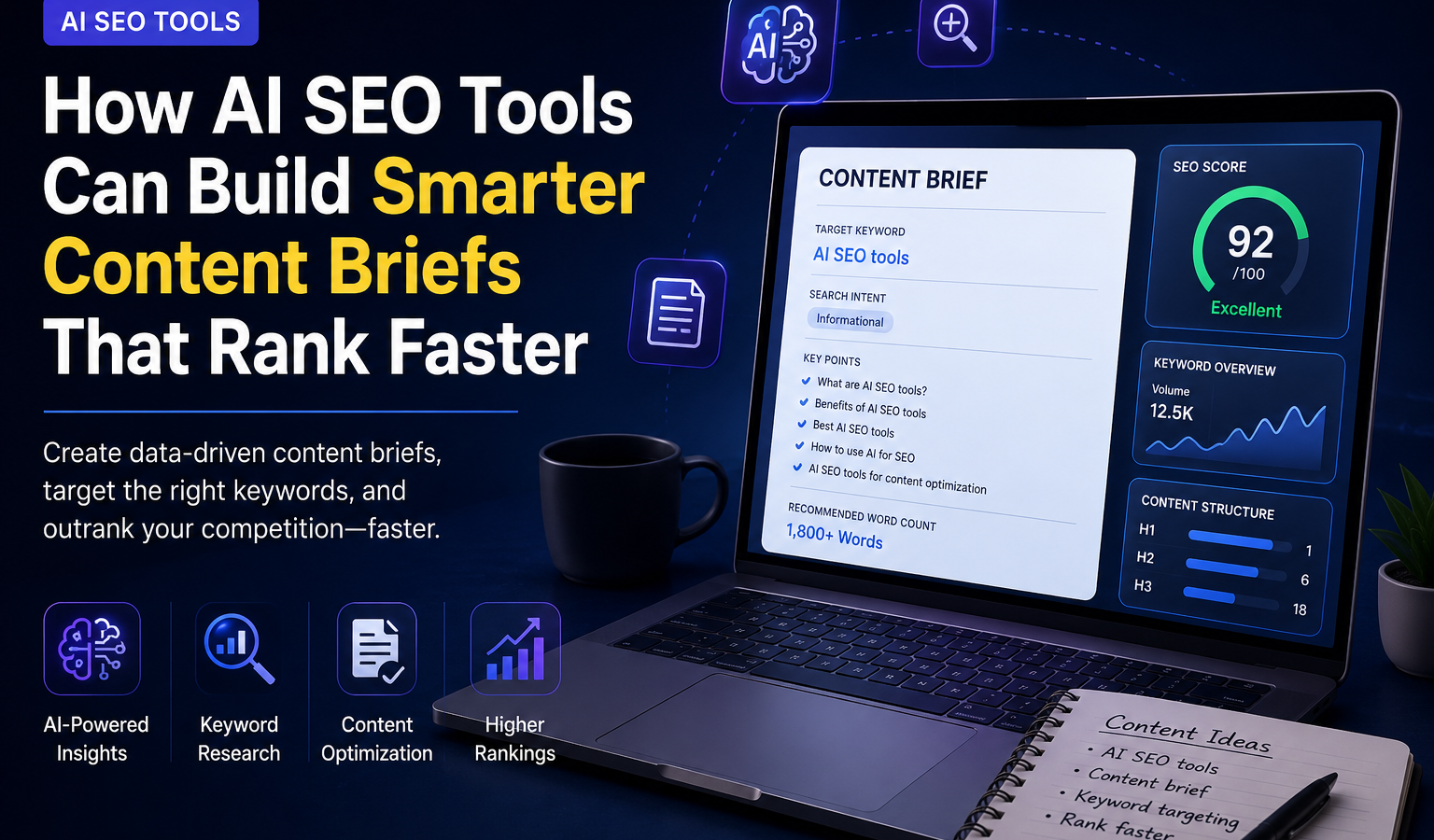

How AI SEO Tools Can Build Smarter Content Briefs That Rank Faster
AI SEO tools are changing one of the most time-consuming parts of content marketing: building a usable content brief. In the past, writers and marketers had to manually pull together keyword ideas, search intent notes, competitor headings, internal link opportunities, and outline suggestions. That process could take hours, and it was easy to miss important details. Today, AI-powered SEO platforms can assemble much of that research in minutes, helping teams move from idea to draft much faster.
The real value of AI SEO tools is not that they write everything for you. The better use case is that they help you make better decisions before writing begins. A strong brief keeps the article focused, prevents keyword stuffing, and gives the writer a clear route to satisfying search intent. When a brief is weak, even a good writer can produce content that ranks poorly because it answers the wrong question or misses the details users are actually searching for.
What a modern SEO brief should include
A strong brief usually includes the target keyword, search intent, secondary keywords, the ideal article length, suggested headings, questions to answer, internal links, and the content angle. AI SEO tools can scan the current search results and suggest all of these faster than a manual process. That is especially useful for websites publishing frequently, because consistency matters just as much as originality.
Some tools also recommend entities, topical subthemes, and semantic variations. This helps search engines understand that your article is not just repeating a phrase but covering a topic in depth. For example, instead of building a brief around a single keyword like “AI SEO tools,” the software may suggest related concepts such as content optimization, topic clustering, SERP analysis, keyword research automation, and on-page optimization. Those details make the final article stronger without sounding robotic.
Why briefs matter more than ever
Search engines reward usefulness, clarity, and depth. A brief helps a writer stay aligned with the searcher’s needs from the first paragraph to the conclusion. It also reduces editing time. Instead of rewriting an entire post after publication, editors can catch gaps earlier. That is one reason AI SEO tools are attractive to agencies, bloggers, and in-house teams alike: they improve workflow efficiency before the article is even drafted.
Another benefit is scalability. If your site publishes dozens of articles each month, briefs ensure every post has a similar level of strategic thinking. AI can help standardize the process while still allowing room for human creativity. The goal is not generic content. The goal is repeatable quality.
How to use AI without losing originality
The best-performing teams use AI as an assistant, not a replacement. They let it gather ideas, then they inject original examples, local context, expert commentary, and brand-specific insights. That keeps content fresh and reduces the risk of producing something that sounds like every other article online.
To make the article feel more human, vary the sentence rhythm, use real scenarios, and avoid repeating the same structure in every section. AI may suggest the framework, but the writer should still make the piece feel like it was created for actual readers. That balance is what turns a good brief into a great article.
Recommended internal links
- WordPress SEO: The Complete 2026 Guide
- Technical SEO Audit Checklist for Faster Rankings and Better UX
- Meta Tags SEO Guide: Boost Rankings and Click-Through Rates
FAQ
Do AI SEO tools replace keyword research?
No. They speed up research and surface opportunities, but human judgment is still needed to choose the best keyword strategy.
Can AI create a better content brief than a person?
AI can create a fast, detailed first draft of a brief, but the best briefs usually combine machine suggestions with human strategy and brand knowledge.
What makes a brief SEO-friendly?
It should match search intent, include relevant headings, cover secondary topics, and support internal linking.
How AI SEO Tools Improve Internal Linking and Topical Authority
Internal linking is one of the most underused SEO tactics on many websites. It sounds simple, but it has a big impact: it helps readers discover related content, guides search engines through your site, and strengthens the connection between pages that belong to the same topic cluster. AI SEO tools are making this process much easier by showing where links are missing and which pages should support each other.
For websites that publish regularly, internal links can become messy over time. New posts get added, old posts get buried, and important pages stop receiving enough attention. AI tools can scan the site structure and recommend relevant links based on topic, intent, and semantic overlap. That saves time and helps create a more organized content architecture.
Why internal linking affects SEO
Search engines use links to understand relationships between pages. A strong internal linking structure helps show which pages are most important and how different topics connect. It can also improve crawl efficiency, meaning search engines can find and process important content more easily. For users, the benefit is equally important: links create a smoother reading experience and help them keep exploring your site.
AI SEO tools are useful here because they reduce guesswork. Instead of manually searching your archive for possible link opportunities, the software can identify pages that naturally fit together. That leads to more relevant links and a better overall site structure.
What topical authority means in practice
Topical authority is built when a website covers a subject thoroughly and in a connected way. One page alone rarely establishes authority. It is the combined strength of multiple related pages, all supporting the same subject from different angles. Internal links help tie those pages together so both readers and search engines can see the depth of coverage.
For example, a site covering SEO might have one article on technical SEO, another on meta tags, another on schema, and another on content briefs. If those pages link to each other thoughtfully, they create a stronger topical map than if they were isolated posts. AI can help identify exactly where those connections should be made.
How AI helps with link placement
Good link placement matters. A link in the middle of a relevant sentence is usually more helpful than one dropped into a crowded list at the bottom of a page. AI SEO tools can suggest the most relevant anchor text and the best pages to link from and to. That can improve both usability and topical relevance.
Some tools also detect orphan pages, which are pages with few or no internal links pointing to them. These pages often underperform because they are harder to discover and less connected to the rest of the site. Fixing that issue can be one of the simplest ways to improve site health.
Best practices for AI-assisted internal linking
- Link only when the destination page truly adds value
- Use natural anchor text instead of repetitive exact-match phrases
- Support high-value pages with links from related posts
- Review orphan pages regularly
- Build topic clusters around main content pillars
These practices help keep your site organized and user-friendly. AI can assist, but the final judgment should always be based on relevance and reader value.
Internal links for this article
- WordPress SEO: The Complete 2026 Guide
- Schema Markup SEO: How Rich Results Increase Organic Traffic
- High-Quality Backlinks: 10 Sure Ways to Earn Them Naturally and Boost Your Rankings
FAQ
Can AI replace manual internal linking?
Not fully. AI can find opportunities quickly, but humans should still check relevance, context, and user experience.
What is an orphan page?
An orphan page is a page with little or no internal linking from the rest of the site, making it harder for users and search engines to find.
Why does topical authority matter?
It helps show that your site covers a subject in depth, which can improve credibility and search visibility.