

Table of Contents
- What dividend investing means
- What growth investing means
- Dividend investing vs. growth investing: the key differences
- How 2026 is shaping the debate
- Which strategy fits different investors
- Expert tips
- Common mistakes
- FAQs
- Conclusion
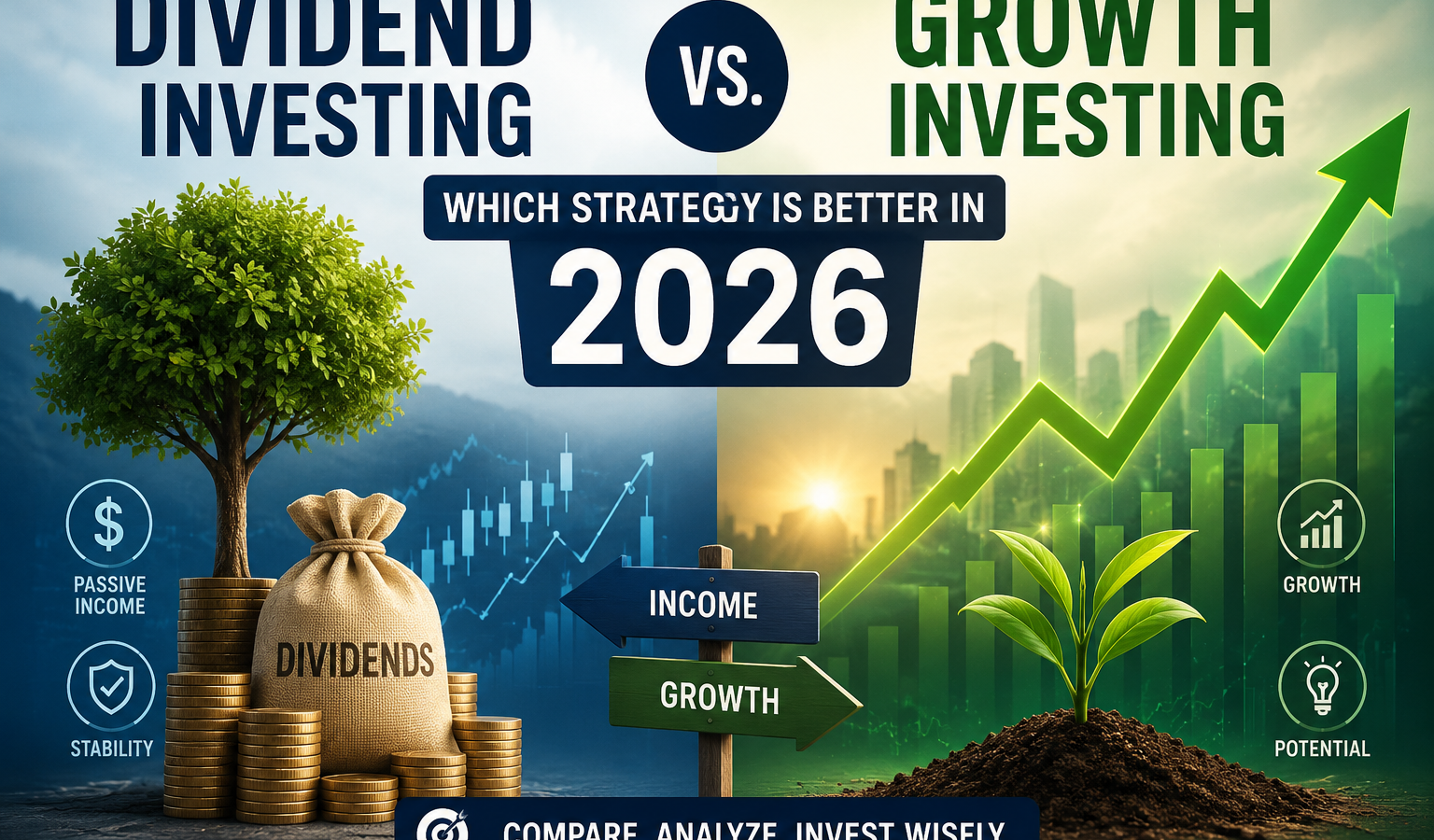
Dividend Investing vs. Growth Investing: Which Strategy Is Better in 2026?
Investors have debated dividend investing versus growth investing for decades, but the question feels especially relevant in 2026. Markets have been rotating, interest rates have shifted expectations, and investors are paying closer attention to total return, cash flow, and durability. The real answer is simple: neither strategy is universally better. The better choice depends on your goals, time horizon, tax situation, and risk tolerance.
Dividend investing focuses on companies that return part of their profits to shareholders as cash payments. Growth investing focuses on companies expected to expand sales, earnings, and market share faster than the market average, with most of the return coming from price appreciation rather than cash payouts. Fidelity describes growth stocks as businesses expected to grow sales and earnings faster than the market average, while Investor.gov notes that stocks historically offer the greatest potential for capital appreciation over the long haul. citeturn494269search0turn494269search1
In 2026, the most important shift is that investors are increasingly thinking in terms of total return rather than labels. Dividend stocks can offer income and resilience. Growth stocks can offer faster wealth building when earnings compound at a high rate. A smart portfolio often uses both, but the mix should reflect your personal objectives rather than market hype. Investor.gov emphasizes that asset allocation should be based on time horizon and risk tolerance, which is exactly why this debate cannot be answered with one blanket winner. citeturn494269search11turn494269search7
What Dividend Investing Is
How dividend investing works
Dividend investing targets companies that share a portion of earnings with shareholders on a regular basis, usually quarterly. These businesses are often mature, profitable, and more cash-generative than younger companies. Some are utilities, consumer staples, healthcare firms, or large financial companies. Many dividend investors focus on dividend growth, not just yield, because rising payouts can help fight inflation over time.
Morningstar’s dividend screens in 2026 highlight how serious dividend analysis has become. Its U.S. Dividend Yield Focus Index tracks the top 75 high-yielding stocks in a broad market universe that represents 97% of U.S. equity market capitalization, while still screening for quality and financial health. That matters because the highest yield is not always the safest income. citeturn861206search0turn861206search4
Why investors choose dividends
- Regular cash flow
- Potential downside cushion during volatile markets
- Psychological comfort from real income
- Potential for dividend reinvestment and compounding
- Often more mature business models
Dividends can also support long-term wealth building through reinvestment. The SEC has noted that dividends have been a meaningful component of long-term equity total returns, and reinvestment helps compound that effect over time. citeturn769077search0turn769077search9
What Growth Investing Is
How growth investing works
Growth investing seeks companies that can increase revenue and earnings at above-average rates. These businesses typically reinvest profits into product development, expansion, hiring, acquisitions, or technology rather than paying large dividends. Investors buy growth stocks because they expect future earnings power to lift the stock price over time.
That expectation is powerful, but it is not guaranteed. Fidelity warns that if a growth company fails to meet high expectations, its stock price can fall sharply. This is one of the biggest risks in growth investing: valuation can compress quickly when momentum slows. citeturn494269search0turn494269search10
Why investors choose growth
- Higher upside potential
- Strong compounding when earnings growth stays durable
- Better fit for long time horizons
- No reliance on cash payouts
- Useful for wealth accumulation rather than income
Investor.gov states that stocks have historically had the greatest risk and highest returns among major asset classes, which is one reason growth investors accept short-term volatility in exchange for a possible long-term payoff. citeturn494269search7turn494269search1
Dividend Investing vs. Growth Investing: The Core Differences
| Feature | Dividend Investing | Growth Investing |
|---|---|---|
| Primary goal | Income plus stability | Capital appreciation |
| Typical company type | Mature, profitable, cash-generative | Fast-growing, reinvesting profits |
| Cash return | Regular dividends | Usually none or very low |
| Volatility | Often lower, but not always | Often higher |
| Best for | Income seekers, retirees, conservative investors | Long-term accumulators, aggressive investors |
| Main risk | Dividend cuts, low growth, yield traps | Valuation risk, earnings misses, sharp drawdowns |
How 2026 Is Shaping the Debate
2026 has not been a one-way market. Rotation has mattered. Morningstar reported that the typical dividend-oriented strategy outperformed the U.S. broad stock market in the first half of 2026, reversing a long stretch of underperformance for many income styles. In another update, Morningstar noted that dividend stocks performed in line with the broad U.S. market in the first half of 2026, helped early in the year and then pressured when AI stocks rebounded. citeturn627858search0turn627858search1
That mixed performance is important. It shows there is no permanent winner. When investors rotate toward stability, dividends can shine. When they chase innovation and high earnings growth, growth stocks can regain leadership. Morningstar also noted in mid-2026 that value stocks outperformed the broader market and growth stocks in the first half of the year, which shows how style leadership can change quickly. citeturn627858search15turn627858search6
For dividend investors, 2026 has brought renewed interest in quality, payout durability, and valuation discipline. For growth investors, the year has reinforced a basic truth: the best growth businesses are not just fast growers, they are profitable, scalable, and able to justify their valuation. Morningstar’s 2026 content repeatedly emphasizes avoiding “juicy” but unsustainable yields and focusing on quality screens such as moat, financial health, and fair value. citeturn627858search17turn861206search0
Which Strategy Is Better for Different Investors?
Dividend investing is often better for:
- Retirees and near-retirees who need regular income
- Investors who value cash flow more than rapid appreciation
- People building a portfolio that can offset living expenses
- Conservative investors who want steadier holdings
- Anyone who plans to reinvest dividends for compounding
Growth investing is often better for:
- Young investors with a long time horizon
- People still building wealth
- Investors who can tolerate drawdowns
- Those seeking maximum capital appreciation
- Tax-aware investors who prefer fewer taxable cash distributions in taxable accounts
Investor.gov says your allocation should change with your time horizon and risk tolerance. That framework is more useful than trying to force every investor into a dividend or growth box. A younger investor saving for retirement decades away may lean growth-heavy. A retiree drawing portfolio income may lean dividend-heavy. Many people are best served by a blend. citeturn494269search11turn494269search7
Why Total Return Matters More Than Labels
The most common mistake in this debate is focusing only on dividend yield or only on share price growth. Real wealth comes from total return: price appreciation plus income. The SEC has emphasized that dividends can meaningfully contribute to long-term shareholder returns, especially when reinvested. At the same time, growth stocks may deliver little income but still create strong long-term wealth if the business keeps compounding. citeturn769077search0turn494269search9
That is why a 3% yield is not automatically better than a 0% yield. Nor is a high-growth company automatically superior because it does not pay dividends. The better question is: which strategy gives you the highest probability of meeting your goal with an acceptable level of risk?
Expert Tips for Choosing Between Dividend and Growth
- Choose quality first, then style.
- Look for durable earnings, not just headline yield.
- Reinvest dividends when you do not need the cash.
- Avoid overpaying for growth because valuation risk is real.
- Do not chase the highest dividend yield without checking payout safety.
- Use both styles if your goals are mixed.
Morningstar’s 2026 dividend coverage repeatedly warns that high yields can be illusory and that dividend durability often matters more than yield alone. Fidelity’s growth research likewise warns that growth expectations can disappoint quickly. The lesson is the same on both sides: quality beats hype. citeturn627858search17turn494269search0
Common Mistakes Investors Make
- Chasing the highest yield without checking the payout ratio
- Buying growth stocks only because they are popular
- Ignoring valuation and risk
- Failing to diversify across sectors and styles
- Using dividend stocks for growth goals without enough time horizon
- Assuming one style will always outperform
Another mistake is ignoring taxes and account placement. Dividend income can be less tax-efficient in taxable accounts depending on your situation, while growth investing may delay taxes until you sell. That does not make one strategy better for everyone, but it does make account type an important part of the decision.
FAQs
1. Is dividend investing safer than growth investing?
Not always. Dividend stocks can be more stable, but they still carry market risk and can suffer dividend cuts. Growth stocks can be more volatile, but many are financially strong. Safety depends on the company, valuation, and portfolio construction.
2. Can growth stocks pay dividends too?
Yes. Some growth companies pay small dividends, but the payout is usually not the main reason investors buy them. The main attraction is earnings and price growth.
3. Which strategy is better for retirement?
Dividend investing is often preferred in retirement because it can create income, but many retirees still keep some growth exposure to help portfolios outpace inflation. A balanced approach is often strongest.
4. Which strategy is better for young investors?
Growth investing is often more suitable for younger investors because they have a longer horizon and can tolerate more volatility. That said, dividend reinvestment can also be powerful over decades.
5. Do dividend stocks outperform growth stocks?
Sometimes, but not always. Style leadership changes over time. In 2026, dividend and value strategies have shown stronger stretches than in some prior years, but that does not guarantee future outperformance. citeturn627858search0turn627858search15
6. Are high-dividend stocks always good investments?
No. Very high yields can signal distress, falling share prices, or an unsustainable payout. Quality screening is essential. citeturn627858search17turn861206search0
7. Are growth stocks worth the risk in 2026?
They can be, especially for long-term investors. But growth stocks usually work best when the business has durable earnings power, a realistic valuation, and room to compound over many years. citeturn494269search0turn494269search10
8. Should I choose one strategy only?
Not necessarily. A blended portfolio can provide income, growth, and diversification at the same time. For many investors, that is the most practical answer.
Conclusion
Dividend investing and growth investing are not rivals in a winner-takes-all battle. They are tools for different goals. Dividend investing is better when you want income, cash-flow visibility, and a steadier profile. Growth investing is better when you want maximum capital appreciation and can tolerate more volatility. In 2026, the smartest investors are not asking which style is fashionable. They are asking which style fits their plan.
The best strategy is usually the one that helps you stay invested, stay disciplined, and stay aligned with your long-term goals. That may mean dividends, growth, or a carefully balanced mix of both.
Call to Action
Review your current portfolio today. Compare your income needs, time horizon, and risk tolerance, then decide whether dividend stocks, growth stocks, or a blend gives you the clearest path to your financial goals in 2026 and beyond.