

Table of Contents
- Introduction
- What makes a blue-chip stock?
- Top 20 blue-chip stocks to watch in 2026
- Comparison table
- Expert tips
- Common mistakes
- FAQs
- Conclusion
Blue-chip stocks remain a cornerstone of long-term investing because they combine scale, market leadership, and the discipline to survive across market cycles. In 2026, that matters more than ever. Investors are facing higher-for-longer interest rate risk, uneven consumer demand, rapid AI adoption, and a market that continues to reward companies with durable cash flow. The best blue-chip stocks are not just large companies. They are businesses with resilient earnings, strong balance sheets, and proven shareholder returns.
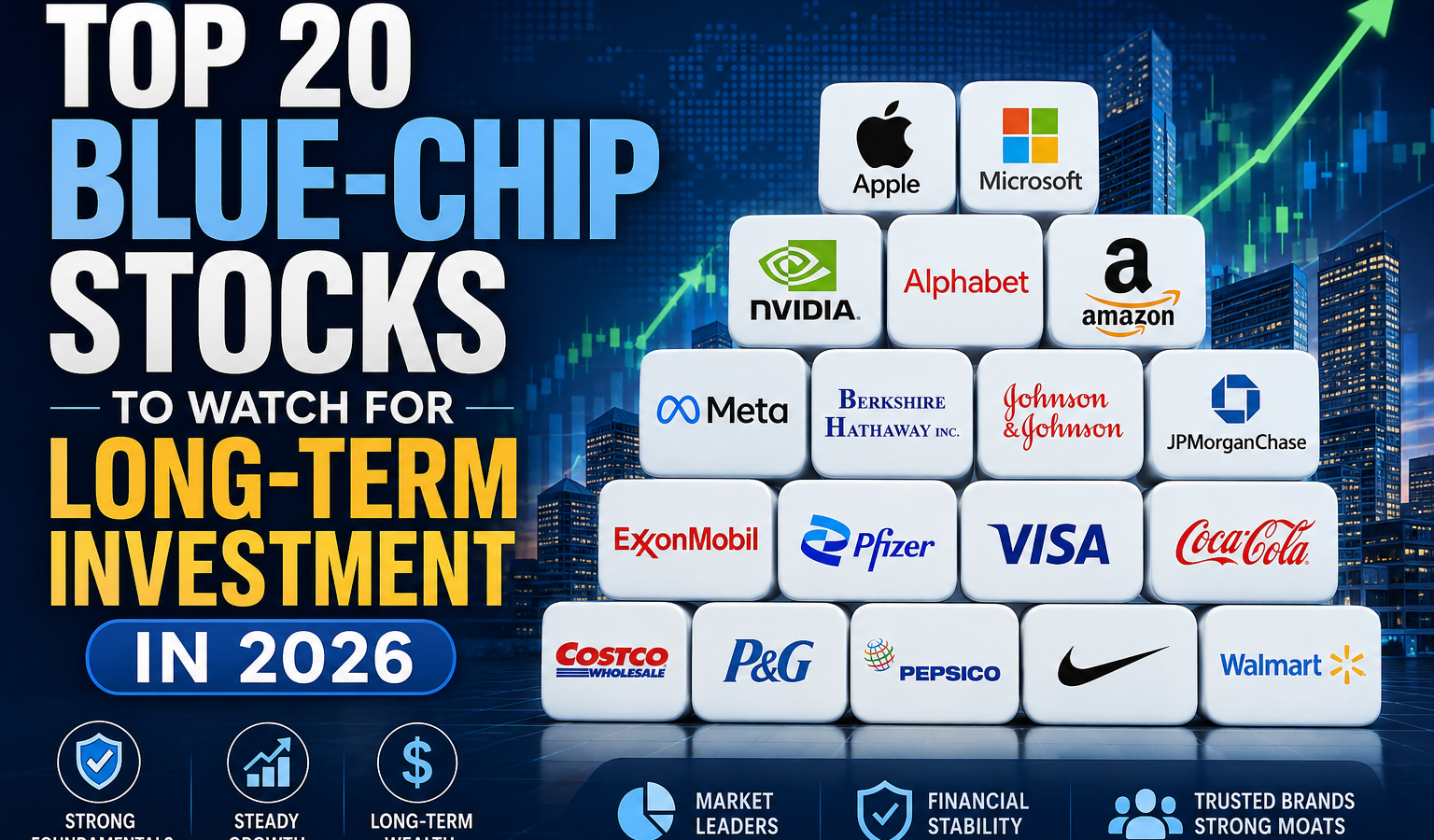
This guide reviews 20 blue-chip stocks that long-term investors may want to watch in 2026. The list is not a prediction. It is a research-backed watchlist built around market leadership, financial strength, dividend consistency, and future earnings power. Many of these names are among the world’s most valuable public companies by market capitalization, including Apple, Alphabet, Amazon, and NVIDIA. citeturn378048search10turn378048search12turn378048search14turn256145search0
What Is a Blue-Chip Stock?
A blue-chip stock is usually a large, established company with a strong reputation, predictable earnings, and a history of surviving recessions and industry shifts. These businesses often lead their sectors, generate large amounts of free cash flow, and return capital through dividends or buybacks. Many are included in major indexes and are widely held by institutions.
For long-term investors, blue chips can offer three major advantages: stability, compounding, and lower business-risk relative to smaller companies. That does not mean the share price cannot fall. It means the company is more likely to recover, adapt, and keep growing over time.
Why Blue-Chip Stocks Matter in 2026
Blue-chip investing is attractive in 2026 because investors want businesses that can handle both growth and uncertainty. The market is still rewarding companies with AI exposure, cloud scale, consumer ecosystems, healthcare resilience, and dependable cash generation. At the same time, defensive blue chips still matter because they can help reduce portfolio volatility.
Several of the companies in this article have recently reported strong revenue, earnings, and shareholder-return activity. NVIDIA reported record first-quarter fiscal 2027 revenue of $81.6 billion, up 85% year over year, while Apple continued its dividend program and reported a quarterly cash dividend of $0.27 in 2026. Johnson & Johnson highlighted more than 60 consecutive years of dividend increases, and Exxon Mobil reported 43 consecutive years of annual dividend per share growth. citeturn256145search0turn378048search9turn636140search0turn827721search7
Top 20 Blue-Chip Stocks to Watch for Long-Term Investment in 2026
The following watchlist blends growth, income, and defensive quality. It includes technology leaders, consumer giants, financial institutions, healthcare names, industrial champions, and energy leaders. For long-term investors, diversification across these groups can reduce concentration risk.
1. Apple (AAPL)
Apple remains one of the world’s most valuable companies, with a market cap of about $4.891 trillion as of July 2026. Its ecosystem, services revenue, hardware loyalty, and capital-return program make it a classic blue chip. Apple’s fiscal 2026 runs from September 27, 2025 through September 26, 2026, which is important when tracking earnings timing. citeturn378048search10turn378048search7
2. Microsoft (MSFT)
Microsoft remains a core blue-chip holding for investors who want exposure to cloud, enterprise software, AI tools, and strong recurring revenue. Its long-term strength comes from software lock-in, platform economics, and enterprise relationships. Microsoft is a prime example of a business that can grow while still behaving like a defensive compounder.
3. NVIDIA (NVDA)
NVIDIA is not a traditional dividend blue chip, but it has become one of the most important large-cap companies in the world. It sits at the center of AI infrastructure demand. NVIDIA reported first-quarter fiscal 2027 revenue of $81.6 billion, plus a quarterly dividend increase to $0.25 per share. That combination of growth and shareholder returns makes it one of the most watched stocks in 2026. citeturn256145search0
4. Alphabet (GOOG)
Alphabet remains a dominant blue chip because of Search, YouTube, Android, Google Cloud, and its balance sheet strength. Alphabet’s investor site shows active annual and quarterly reporting, and its 2025 results page confirms continued earnings visibility heading into 2026. Alphabet’s scale gives it a strong position in advertising and cloud computing. citeturn358390search0turn358390search4turn358390search8
5. Amazon (AMZN)
Amazon combines e-commerce scale with AWS cloud leadership, logistics infrastructure, and advertising growth. It has one of the widest competitive moats in the market. Amazon’s market cap was about $2.496 trillion in July 2026, showing how deeply investors value its global platform. citeturn378048search14
6. Berkshire Hathaway (BRK.B)
Berkshire Hathaway offers something rare: diversified exposure to insurance, railroads, utilities, industrial assets, and a huge equity portfolio. For long-term investors, it acts like an actively managed blue-chip holding company with significant capital discipline. It is especially useful for investors who want quality without chasing a single sector theme.
7. JPMorgan Chase (JPM)
JPMorgan Chase is one of the strongest banking franchises in the world. Large banks can benefit from net interest income, investment banking, credit card spending, and asset management. As a blue chip, JPMorgan is valued for scale, risk management, and leadership across multiple financial products.
8. Bank of America (BAC)
Bank of America remains a major U.S. financial blue chip. Its investor relations page lists 2025 annual report materials and 2026 proxy information, along with 2025 net income of $30.5 billion on its at-a-glance display. That scale matters for long-term investors who want a large, institutionally important bank. citeturn164153search0turn164153search3
9. Johnson & Johnson (JNJ)
Johnson & Johnson is a textbook defensive blue chip. The company highlights more than 60 consecutive years of dividend increases, more than 65% of five-year free cash flow returned to shareholders, and more than 75% of sales from number one or number two global market share positions. Those are strong indicators of quality and durability. citeturn636140search0turn636140search1
10. Exxon Mobil (XOM)
Exxon Mobil remains a powerful energy blue chip because of its scale, cash generation, and shareholder returns. Exxon reported $28.8 billion in 2025 earnings and $52 billion in cash flow from operations, while also noting 43 consecutive years of annual dividend per share growth. For investors who want energy exposure, Exxon is one of the strongest names to watch. citeturn827721search2turn827721search7
11. Chevron (CVX)
Chevron is another major energy blue chip with integrated operations, scale, and a shareholder-return focus. It appeals to investors who want income plus exposure to global energy demand. Like Exxon, Chevron is sensitive to commodity cycles, but its size and balance sheet make it a long-term watchlist candidate.
12. Procter & Gamble (PG)
Procter & Gamble is a consumer-staples blue chip built on brand power, global distribution, and repeat purchases. Its products are used every day, which helps stabilize revenue through downturns. Investors often like PG for its consistency, pricing power, and defensive cash flow profile.
13. Coca-Cola (KO)
Coca-Cola is one of the best-known dividend blue chips in the world. Its global brand, franchise model, and pricing power support long-term resilience. Coca-Cola tends to appeal to investors seeking reliable income and stability rather than aggressive growth.
14. PepsiCo (PEP)
PepsiCo combines beverages and snacks, which gives it broader consumer reach than a pure drinks company. Its investor relations site continues to publish annual reports and quarterly earnings. For long-term investors, that mix of resilient demand and brand strength makes PEP a durable blue chip. citeturn336856search1turn336856search4turn336856search7
15. Costco (COST)
Costco is a retail blue chip with one of the strongest membership models in the market. It reported fourth-quarter and fiscal-year 2025 net sales growth, with quarterly net sales of $84.4 billion and fiscal-year net sales of $269.9 billion. That kind of scale, combined with loyal members, gives Costco a strong long-term profile. citeturn336856search12turn336856search3
16. Visa (V)
Visa is a payment-network blue chip that benefits from the shift to digital transactions. It does not need to carry credit risk the way banks do, which makes its business model attractive. Visa’s investor relations site continues to publish annual report and quarterly earnings materials, reinforcing its steady reporting cadence. citeturn336856search2turn336856search5turn336856search8
17. Mastercard (MA)
Mastercard is another global payments leader with a powerful network effect. As commerce becomes more digital, Mastercard benefits from transaction growth, cross-border spending, and long-term cash generation. It is often viewed as a high-quality financial technology blue chip.
18. Caterpillar (CAT)
Caterpillar is a classic industrial blue chip tied to construction, mining, infrastructure, and equipment replacement cycles. It is useful for investors who want exposure to physical-world economic activity rather than only digital growth. Caterpillar can be cyclical, but its scale and reputation are hard to match.
19. 3M (MMM)
3M has a long history as an industrial and materials giant. It may not be as exciting as AI names, but blue-chip portfolios often benefit from companies with diversified product lines and global reach. For long-term investors, the appeal is turnaround potential plus industrial stability.
20. IBM (IBM)
IBM remains relevant as a blue-chip technology and enterprise services company. It has shifted heavily toward hybrid cloud, software, consulting, and AI-led enterprise solutions. IBM is not the fastest-growing tech stock, but it is still a large, established business with long-term strategic value.
Blue-Chip Stock Comparison Table
| Stock | Sector | Primary Strength | Investor Profile |
|---|---|---|---|
| Apple | Technology | Ecosystem and cash flow | Growth + quality |
| Microsoft | Technology | Cloud and AI | Long-term compounder |
| NVIDIA | Semiconductors | AI infrastructure demand | Growth-oriented |
| Alphabet | Technology | Search, cloud, YouTube | Growth + balance-sheet strength |
| Johnson & Johnson | Healthcare | Defensive cash flow | Income and stability |
| Exxon Mobil | Energy | Cash generation and dividends | Income + energy exposure |
| Costco | Retail | Membership model | Quality retail investor |
How to Choose the Best Blue-Chip Stocks
Not every large company is a great long-term investment. Some blue chips are mature but stagnant. Others are overvalued. A better approach is to look for a combination of quality, valuation, and future growth.
Check the balance sheet
Strong blue chips usually have manageable debt, consistent cash generation, and liquidity that can survive downturns. A strong balance sheet gives management more flexibility to invest, buy back shares, and maintain dividends.
Study cash flow, not just revenue
Revenue growth is helpful, but free cash flow tells you whether a company can fund dividends, reinvest in the business, and support future expansion. Companies like Johnson & Johnson and Exxon Mobil highlight this clearly in investor materials. citeturn636140search0turn827721search7
Look at dividend reliability
For income investors, dividend history matters. Long dividend streaks can signal resilience, but investors should still check whether the payout is covered by earnings and free cash flow. J&J and Exxon are strong examples of companies with long dividend records. citeturn636140search0turn827721search7
Expert Tips for Blue-Chip Investing in 2026
- Blend growth blue chips with defensive blue chips.
- Do not buy only because a company is famous.
- Watch valuation before adding to a position.
- Prefer businesses with pricing power and recurring revenue.
- Use dollar-cost averaging to reduce timing risk.
- Reinvest dividends when your goal is compounding.
One smart strategy is to build a core portfolio around durable leaders and then add a smaller allocation to higher-growth blue chips such as NVIDIA or Amazon. That way, you can seek upside without losing the stability that blue-chip investing is meant to provide.
Common Mistakes Investors Make
- Chasing hype instead of quality.
- Ignoring valuation completely.
- Putting too much money into one sector.
- Forgetting that even blue chips can underperform for years.
- Overlooking cash flow and debt levels.
The biggest mistake is assuming blue-chip stocks are risk-free. They are not. They are simply stronger businesses with a better chance of surviving, recovering, and compounding wealth over time.
FAQs
1. What is the safest blue-chip stock to buy in 2026?
There is no perfectly safe stock. However, defensive names like Johnson & Johnson, Procter & Gamble, Coca-Cola, and PepsiCo are often considered more stable than cyclical or high-growth blue chips.
2. Are blue-chip stocks good for beginners?
Yes. Blue-chip stocks can be a strong starting point because they are easier to understand, more established, and often less volatile than smaller growth stocks.
3. Do blue-chip stocks still grow?
Many do. Growth rates may be slower than small-cap stocks, but large leaders like Microsoft, Alphabet, Amazon, and NVIDIA still have significant expansion potential. citeturn358390search4turn378048search14turn256145search0
4. Should I buy blue chips for dividends or growth?
You can do both. Some blue chips are ideal for dividends, while others are better for capital appreciation. A balanced portfolio often includes both types.
5. How many blue-chip stocks should I own?
There is no exact number, but many investors prefer 10 to 20 high-quality holdings spread across sectors.
6. Are all large companies blue chips?
No. Market size alone does not make a company a blue chip. The business should also have durability, leadership, and financial strength.
7. Is valuation important for blue-chip stocks?
Absolutely. A great company can still be a poor investment if you overpay. Valuation should always be part of the decision.
8. Can blue-chip stocks protect me in a recession?
They can help, but they cannot eliminate risk. Defensive blue chips often hold up better than speculative stocks, but prices can still fall during recessions.
Conclusion
The best blue-chip stocks in 2026 offer more than name recognition. They offer durable economics, strong leadership, and long-term relevance. Apple, Microsoft, Alphabet, Amazon, NVIDIA, Johnson & Johnson, Exxon Mobil, Costco, Visa, and the other names in this watchlist stand out because they continue to prove their strength through earnings, scale, and shareholder returns. citeturn378048search10turn256145search0turn636140search0turn827721search7turn336856search12
For long-term investors, the goal is not to own every blue chip. The goal is to own the right mix of businesses that can keep compounding for years. Focus on quality, diversification, cash flow, and valuation, and blue-chip investing can become one of the most dependable parts of your wealth-building plan.
Call to Action
Review your portfolio, compare your current holdings with this watchlist, and build a plan around the blue-chip names that match your goals, risk level, and time horizon.