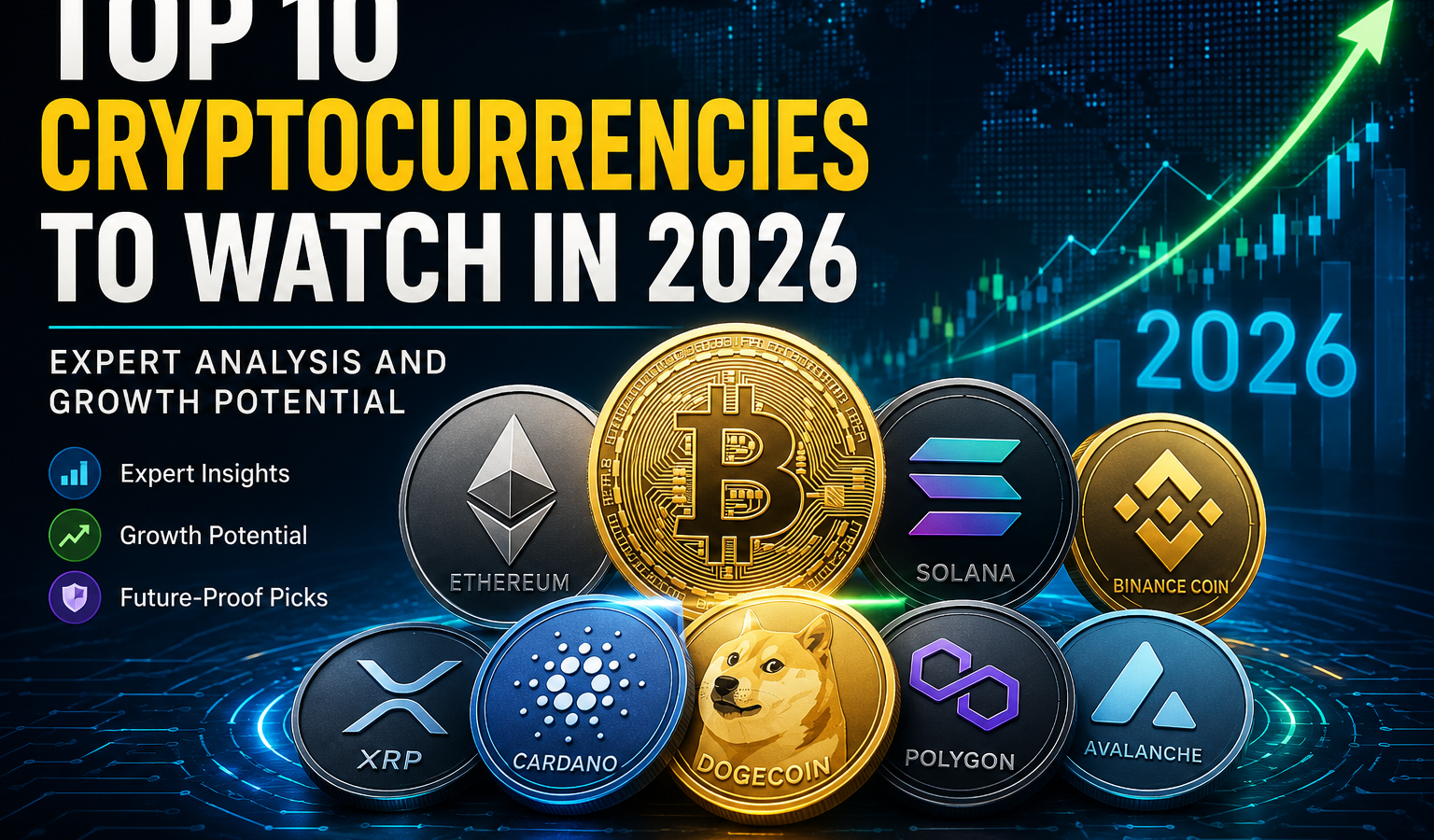

The crypto market enters 2026 with a very different tone than the speculative cycles that once defined the industry. Today, investors care more about real utility, institutional adoption, network security, tokenized assets, and whether a project can survive beyond hype. That shift matters. It means the best cryptocurrencies to watch in 2026 are not only the names with the loudest communities, but the ones with the strongest ecosystems, clearest use cases, and durable catalysts.
This guide breaks down ten cryptocurrencies that deserve close attention in 2026. It is built for readers who want a balanced view: what each project does, why it matters, where the growth potential may come from, and what risks still remain. It is not financial advice. It is a research-driven overview designed to help you compare the strongest narratives in the market.
Table of Contents
- Bitcoin (BTC)
- Ethereum (ETH)
- Solana (SOL)
- Chainlink (LINK)
- Avalanche (AVAX)
- XRP (XRP)
- Cardano (ADA)
- Polkadot (DOT)
- Cosmos (ATOM)
- Stablecoin and RWA infrastructure tokens
Why 2026 Could Be a Big Year for Crypto
Several broad trends are shaping the market. First, crypto has already moved far beyond the “pure speculation” phase. Bitcoin still leads the sector, but the broader market now includes DeFi, tokenized assets, stablecoin payments, institutional settlement layers, and blockchain infrastructure for real-world finance. CoinGecko currently tracks roughly 17,847 cryptocurrencies, which shows how large and competitive the market has become. At the same time, the total crypto market cap remains above the $2 trillion mark, and Bitcoin dominance is still above 50%, a sign that capital remains concentrated in quality assets during uncertain periods.
Second, the strongest 2026 narratives are increasingly tied to infrastructure rather than pure meme-driven attention. Bitcoin scarcity, Ethereum staking, Solana performance, Chainlink oracle services, Avalanche enterprise use, XRP payments, Cardano governance, Polkadot interoperability, Cosmos connectivity, and real-world asset tokenization all sit near the center of the market’s most durable themes. That matters because infrastructure tends to survive longer than short-lived trends.
Top 10 Cryptocurrencies to Watch in 2026
1. Bitcoin (BTC)
Bitcoin remains the most important cryptocurrency to watch in 2026. It is still the benchmark asset for the entire market, and it continues to act like digital macro collateral for investors, funds, and long-term holders. Bitcoin’s supply is capped at 21 million coins, and that scarcity is one of the strongest long-term arguments in its favor. The 2024 halving reduced the block reward again, tightening new supply even further.
Bitcoin’s growth potential in 2026 comes from its role as a store of value, a treasury asset, and a liquidity magnet in uncertain markets. It also benefits from the simple fact that it is the most recognized crypto asset in the world. Even when investors rotate into altcoins, BTC often remains the anchor position. That makes it the first coin many institutions, long-term savers, and risk-managed portfolios still prefer. CoinGecko’s market data shows BTC still commands the largest share of the crypto market by a wide margin.
2. Ethereum (ETH)
Ethereum remains the leading smart contract platform and one of the most important assets in decentralized finance. Its transition to proof of stake is complete, and Ethereum says the switch reduced energy consumption by about 99.95%. That change improved the network’s sustainability profile and reinforced staking as a central part of Ethereum’s economic model.
ETH’s appeal in 2026 comes from its combination of security, liquidity, developer activity, and its central role in tokenization, stablecoins, and DeFi. Ethereum also remains the chain with the largest TVL across blockchains, which shows how much capital still flows through its ecosystem. If the next wave of tokenized finance expands, ETH is likely to remain one of the biggest beneficiaries.
3. Solana (SOL)
Solana has become one of the clearest high-growth contenders in crypto. It positions itself as a high-performance network powering internet capital markets, payments, and crypto applications. Its speed-first architecture continues to attract developers, consumer apps, DeFi activity, and payment experiments. Solana’s documentation also emphasizes its focus on scalable blockchain applications, which is exactly what many builders want in a competitive market.
In 2026, SOL’s growth potential depends on sustained network usage, payment adoption, and developer retention. That case is supported by the fact that Solana appears in the top tier of widely watched blockchain ecosystems and continues to show strong market interest. When users want speed, lower friction, and consumer-grade experiences, Solana often enters the conversation first.
4. Chainlink (LINK)
Chainlink is one of the most strategically important infrastructure tokens in crypto. It is the industry-standard oracle platform, and its decentralized oracle networks help blockchains access reliable off-chain data and computations. In simple terms, Chainlink connects smart contracts to the real world. That gives it a central role in DeFi, tokenized assets, capital markets, and cross-chain automation.
LINK’s 2026 potential is tied to adoption rather than hype. As more financial products move onchain, the need for accurate data feeds, proof systems, and secure infrastructure should rise. Chainlink is already positioning itself around capital markets and tokenized finance, which makes it one of the strongest “pick-and-shovel” assets in the sector.
5. Avalanche (AVAX)
Avalanche is built for high performance and customization. Its official materials describe it as a technology platform for business, and the network supports sovereign, interoperable Layer 1 blockchains with near-instant finality. That design makes Avalanche attractive for institutions and builders who need flexibility without sacrificing speed.
AVAX is worth watching in 2026 because it sits at the intersection of enterprise adoption, tokenization, and scalable blockchain design. It is a strong candidate for investors who want exposure to a platform that focuses on practical deployment rather than only retail speculation. If more businesses continue experimenting with blockchain infrastructure, Avalanche could benefit materially.
6. XRP (XRP)
XRP remains one of the most watched payment-focused crypto assets. Its ecosystem is increasingly tied to payments, settlement, and tokenized finance. Recent ecosystem coverage on CoinGecko highlights strong activity around the XRP Ledger, including growing interest in real-world asset use cases and ecosystem expansion. XRP also continues to benefit from its association with fast settlement and cross-border value movement.
The 2026 thesis for XRP is not just speculation about price. It is about whether the network can deepen its role in payments, liquidity rails, and tokenized financial products. That makes it especially relevant for readers who want exposure to crypto infrastructure with a commerce and settlement angle.
7. Cardano (ADA)
Cardano remains a notable proof-of-stake blockchain because it emphasizes research, governance, and long-term design. Its official materials describe it as the first proof-of-stake blockchain founded on peer-reviewed research and developed through evidence-based methods. Cardano’s roadmap also frames the project around scalability, interoperability, and sustainability.
ADA’s growth potential in 2026 depends on whether the ecosystem can convert its thoughtful architecture into stronger adoption, more active apps, and more visible utility. That is the key debate with Cardano: the technology story is strong, but the market still wants more tangible usage. For investors, that creates both opportunity and risk.
8. Polkadot (DOT)
Polkadot is a leading interoperability project focused on shared security and cross-chain communication. Its documentation highlights parachains, shared security, and XCM-based interoperability. That makes DOT one of the most important infrastructure assets for a multi-chain future.
In 2026, the market may reward networks that solve fragmentation. If builders continue to need cross-chain tooling, Polkadot could benefit from its long-term focus on connectivity and coordinated blockchain design. It is a lower-hype, infrastructure-heavy bet, but that can still be valuable in a maturing market.
9. Cosmos (ATOM)
Cosmos is another major interoperability play, and it remains one of the strongest names in the modular blockchain conversation. Its official site highlights interoperability with external payment rails, banking consortia, and other blockchain networks. Cosmos also positions its stack around performance, instant settlement, and enterprise use cases.
ATOM is worth watching because it sits in a powerful niche: connectivity. In a crypto market with dozens of ecosystems competing for attention, the networks that help them communicate may become more important, not less. That makes Cosmos a compelling long-term infrastructure watchlist token.
10. Real-World Asset and Stablecoin Infrastructure Tokens
The final category is broader than a single coin, but it may be one of the most important 2026 themes. Real-world asset tokenization is growing quickly, and CoinGecko’s RWA category already shows a multi-billion-dollar market. Stablecoin and tokenization infrastructure matter because they link crypto to the real economy: payments, treasury management, treasury bills, invoices, and settlement rails.
When investors talk about the next phase of crypto adoption, they are often talking about infrastructure that supports tokenized assets and settlement, not just speculative tokens. That is why this theme deserves a place on any serious 2026 watchlist. Some of the strongest upside may come from the rails rather than the headline names.
Comparison Table: Best Cryptocurrencies for 2026
| Crypto | Main Strength | 2026 Thesis | Risk Level |
|---|---|---|---|
| BTC | Scarcity and trust | Digital store of value | Medium |
| ETH | Smart contracts | DeFi and tokenization leader | Medium |
| SOL | High speed | Consumer apps and payments | High |
| LINK | Oracle infrastructure | Onchain finance data layer | Medium |
| AVAX | Custom L1s | Enterprise blockchain expansion | High |
| XRP | Payments focus | Settlement and tokenized finance | High |
| ADA | Research-led design | Governance and adoption growth | Medium |
| DOT | Interoperability | Multi-chain coordination | Medium |
| ATOM | Connectivity | Cross-chain infrastructure | Medium |
| RWA theme | Real-economy utility | Tokenization and settlement rails | Medium-High |
Expert Tips for Evaluating Crypto in 2026
- Focus on use case first, not price prediction.
- Check whether the network has active users, developers, and liquidity.
- Look at token utility. Ask how the token captures value.
- Prefer projects with clear documentation and transparent roadmaps.
- Watch infrastructure themes like payments, tokenization, and interoperability.
- Do not overconcentrate in one narrative, even a strong one.
Common Mistakes Crypto Investors Make
- Buying only because a coin is trending on social media.
- Ignoring token supply and unlock schedules.
- Confusing community hype with real adoption.
- Failing to compare one project’s fundamentals against its competitors.
- Putting too much capital into illiquid or low-utility assets.
- Chasing short-term pumps without a long-term plan.
FAQs
1. What is the best cryptocurrency to watch in 2026?
Bitcoin and Ethereum remain the safest long-term watchlist names, while Solana, Chainlink, and Avalanche offer stronger growth upside if adoption keeps expanding.
2. Which crypto has the highest growth potential?
Higher-growth opportunities often come from Solana, Avalanche, XRP, and infrastructure themes like RWA tokenization, but they also carry more risk.
3. Is Bitcoin still a good investment in 2026?
Bitcoin remains a core crypto asset because of its fixed supply, market leadership, and institutional relevance.
4. Why is Ethereum still important?
Ethereum is still the main platform for smart contracts, DeFi, and tokenized finance, and it leads the market in TVL.
5. Is Solana better than Ethereum?
Solana is faster and often cheaper to use, while Ethereum has greater liquidity, stronger network effects, and a larger developer economy. They serve different needs.
6. What makes Chainlink valuable?
Chainlink provides secure oracle infrastructure that many blockchains need to access off-chain data, which gives LINK strong utility in DeFi and tokenized finance.
7. Are altcoins too risky in 2026?
Altcoins are riskier than Bitcoin, but well-researched projects with real adoption can still outperform if the market remains constructive.
8. How should I build a crypto watchlist?
Mix large-cap leaders, infrastructure tokens, and one or two higher-risk growth names. Review them regularly using adoption, token utility, and ecosystem growth.
Conclusion
The best cryptocurrencies to watch in 2026 are the ones that combine real utility with strong market positioning. Bitcoin brings scarcity. Ethereum brings the smart contract economy. Solana brings speed. Chainlink powers data and oracle infrastructure. Avalanche, XRP, Cardano, Polkadot, Cosmos, and the broader RWA theme round out a watchlist built for a maturing market.
If 2026 delivers more tokenization, better payment rails, and deeper institutional participation, the winners will likely be the projects that already solve real problems. That is where serious investors should focus their attention.
Stay informed, compare fundamentals, and keep your watchlist focused on quality.