
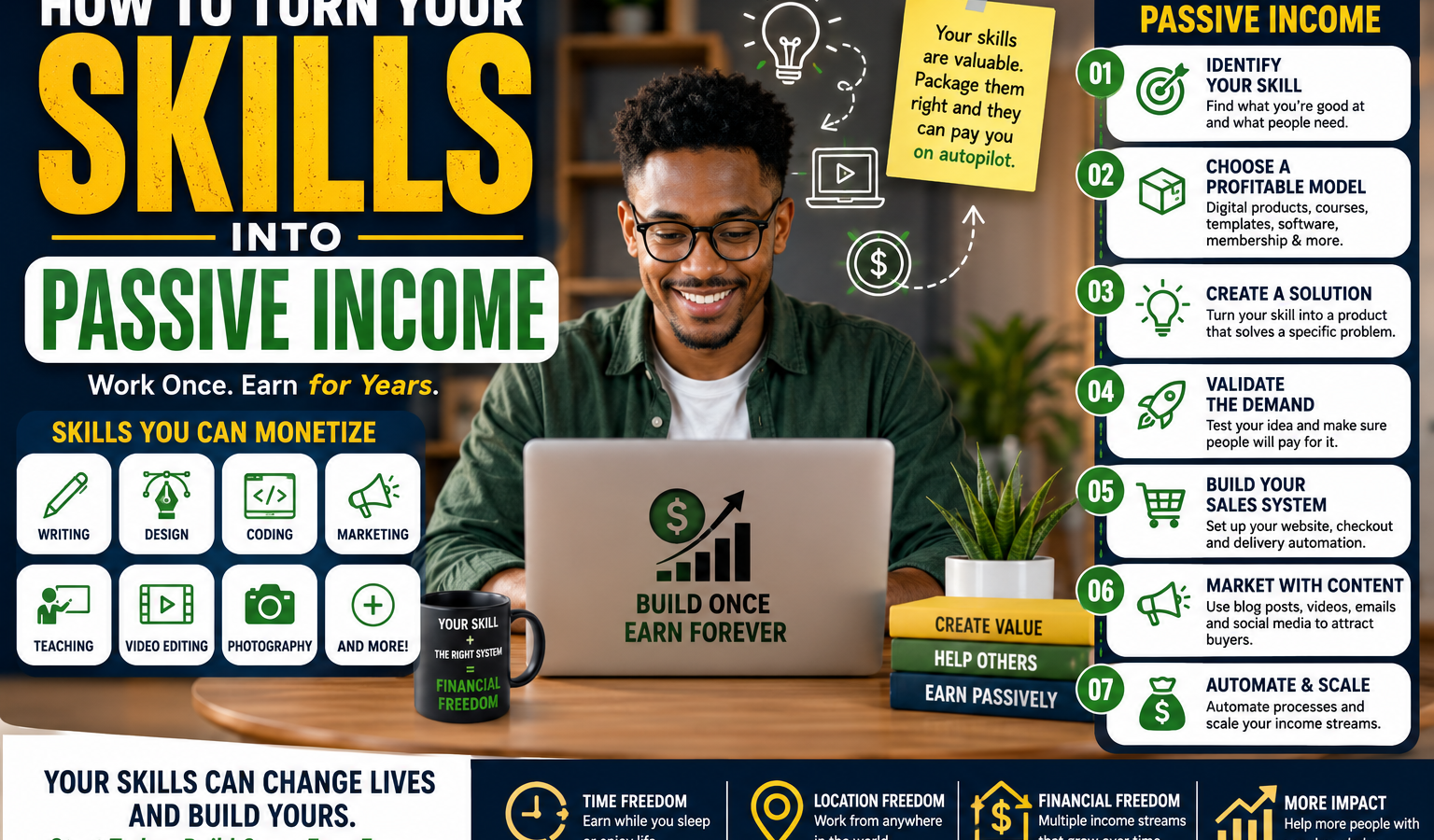

Learning how to make passive income online in 2026 starts with a realistic definition. Passive income sounds simple: build something once, then keep getting paid. However, most online income streams require upfront work, ongoing maintenance, audience building, capital, or a combination of all four. Therefore, the better question is not “How can I make money while doing nothing?” but “Which online asset can I build that keeps producing value with less day-to-day effort over time?”
This guide explains how to make passive income online in 2026 using models that can be built by creators, freelancers, professionals, investors, and small businesses. It also separates genuinely low-maintenance income from business models that are often marketed as passive but actually depend on continuous work.
Table of Contents
- What passive income really means
- 12 passive income ideas for 2026
- Passive income ideas compared
- How to choose and start
- Expert tips
- Common mistakes
- FAQs
What Is Passive Income?
Passive income is money generated from an asset, investment, intellectual property, audience, or system without directly trading every hour for each dollar earned. It is usually better described as income with lower marginal effort rather than income with zero effort.
For example, a digital template can be created once and sold repeatedly. If you want more ideas, see our comprehensive guide to generating passive income streams. An educational article can keep attracting search visitors and affiliate clicks after publication. A diversified investment portfolio can generate interest or dividends without requiring you to work each time a payment arrives.
There is evidence that non-labor income is already a meaningful part of household finances. In the Federal Reserve’s 2025 household survey, 57% of U.S. adults reported some form of non-labor income, while 37% reported interest, dividends, or rental income. citeturn628537search1
Online passive income expands this concept by turning knowledge, software, content, intellectual property, or digital distribution into repeatable assets.
12 Passive Income Ideas to Consider in 2026
1. Sell Digital Products
Digital products are among the most accessible online income models because delivery can be automated. Examples include spreadsheets, templates, checklists, design assets, ebooks, prompt libraries, study materials, and downloadable guides.
The strongest products solve a narrow problem. A generic ebook about productivity is harder to differentiate than a specialized financial tracker for freelancers or a content-planning system for local businesses.
Best for: people with practical knowledge, design skills, writing ability, or repeatable workflows. Our guide on turning skills into passive income explores this approach in more detail.
2. Build an Affiliate Content Website
Affiliate marketing pays a commission when your content drives a qualifying sale or action. The model works particularly well when the content answers high-intent questions such as comparisons, reviews, buying guides, tutorials, and “best” lists.
Affiliate marketing remains a substantial commercial channel. Shopify reports, citing 2025 estimates, a global affiliate marketing industry value of $18.4 billion and U.S. advertiser spending of $12.42 billion in 2025. citeturn628537search4
The key is to create genuinely useful content rather than thin pages written only to insert affiliate links. Google recommends people-first content that provides original analysis, substantial value, clear authorship, and trustworthy information. citeturn628537search0turn628537search3
3. Publish Evergreen YouTube Videos
Evergreen videos can continue collecting views months or years after publication. Tutorials, software walkthroughs, skill lessons, product explainers, and educational videos can generate advertising, affiliate, sponsorship, or product revenue.
Video is not automatically passive. In practice, research, recording, editing, thumbnails, and audience management take work. The “passive” advantage comes from the long shelf life of a useful video.
4. Create and Sell Online Courses
A course can convert your expertise into a structured asset that students can purchase repeatedly. Record lessons around one clear outcome, add worksheets or exercises, and automate enrollment and delivery.
A focused course normally performs better than a massive collection of loosely connected lessons. Update material when software, regulations, exams, or industry practices change.
5. License Your Creative Work
Licensing can generate repeat revenue from assets you already create. Depending on your field, that might include stock photography, music, sound effects, illustrations, fonts, code components, video footage, or educational resources.
The advantage is that one original asset may generate multiple licensing transactions. However, discovery, quality control, and platform rules still matter.
6. Build a Small Subscription Product
A lightweight software product, database, calculator, browser tool, or niche membership can produce recurring revenue. The objective is not to build the next giant platform. A simple tool that solves a painful recurring problem for a narrow audience can be more practical.
Software is usually semi-passive, not passive. For that reason, hosting, customer support, security, bug fixes, and product updates create ongoing obligations.
7. Create a Paid Newsletter or Membership
Membership models work when subscribers receive continuing value: research, curated information, templates, private communities, analysis, or educational resources. A searchable archive can become an additional asset over time.
Choose a narrowly defined audience and promise a clear recurring outcome. Retention matters as much as acquisition.
8. Publish an Ebook or Practical Guide
Books can become long-lived intellectual property. The most commercially useful ebooks are specific, actionable, and updated around a defined problem or audience.
Consider repurposing existing knowledge into multiple formats: a book, workbook, checklist, video lesson, and email sequence can all support one core idea.
9. Rent Out Digital Assets
Some digital assets can create revenue through licensing or rental arrangements, including specialized datasets, API access, website placements, software components, or premium research libraries.
This model requires careful attention to ownership, privacy, platform policies, and intellectual-property rights. Never sell or license data that you do not have the legal right to use.
10. Invest Automatically
Investing is one of the clearest forms of low-maintenance income when the asset itself generates interest, dividends, or other distributions. Options may include diversified funds, bonds, cash-interest products, or real-estate investment vehicles, depending on your country, tax rules, risk tolerance, and eligibility. For a deeper look at investing, read our stock market investing guide for beginners.
Investment returns are never guaranteed. Asset prices can fall, income can change, and taxes and fees can materially affect results. Treat investing as long-term wealth building, not a shortcut to fast cash. You can also compare approaches in our investment strategies guide for beginners.
11. Create Print-on-Demand Products
Print-on-demand stores can automate fulfillment for products such as apparel, posters, notebooks, or other merchandise. You create the design and listing; a fulfillment provider handles production and shipping when an order arrives.
The work shifts toward design quality, niche selection, merchandising, customer service, and marketing. Because competition can be intense, original concepts matter.
12. Build an SEO-Driven Resource Library
A well-organized library of useful articles, calculators, glossaries, tutorials, and comparison pages can become a long-term traffic asset. You can monetize that audience with ads, affiliate partnerships, sponsorships, or your own products.
Ultimately, SEO should support useful publishing rather than replace it. Google’s guidance says there is no preferred word count and advises against creating large amounts of content mainly to attract search traffic. citeturn628537search3
Passive Income Ideas Compared
| Model | Startup Cost | Upfront Work | Ongoing Work | Scale Potential | Main Risk |
|---|---|---|---|---|---|
| Digital products | Low | Medium | Low–Medium | High | Weak demand |
| Affiliate website | Low–Medium | High | Medium | High | Traffic dependence |
| Evergreen YouTube | Low–Medium | High | Medium | High | Platform dependence |
| Online course | Low–Medium | High | Low–Medium | High | Content becoming outdated |
| Licensing | Low | Medium | Low | Medium–High | Low demand or rights issues |
| Software subscription | Medium–High | High | High | Very High | Support and competition |
| Investing | Varies | Low | Low | Capital-dependent | Market loss |
| Print-on-demand | Low | Medium | Low–Medium | Medium–High | Competition and margins |
How to Start Building Passive Income Online
Step 1: Start with an asset, not a platform
First, choose what you want to own: an audience, email list, product catalog, intellectual-property library, website, software tool, or investment portfolio. Although platforms can help distribute an asset, relying entirely on one platform creates concentration risk.
Step 2: Pick one narrow problem
Define the audience, problem, and measurable outcome. “Help freelancers organize irregular income” is more actionable than “teach people about money.”
Step 3: Validate demand before building too much
Study search queries, communities, competitor reviews, marketplace listings, and questions people repeatedly ask. Look for evidence of a problem worth solving rather than assuming an idea will sell.
Step 4: Build the minimum useful asset
Create the smallest version that solves the problem properly. Launching a useful $20 template is usually more informative than spending six months building an oversized course no one has requested.
Step 5: Automate delivery and routine tasks
Use email sequences, payment automation, scheduled content, digital fulfillment, customer-service templates, and analytics. At the same time, automation should reduce repetitive work; it should not reduce product quality.
Step 6: Reinvest early revenue
Use initial earnings to improve the asset: better research, distribution, design, SEO, email capture, product updates, or diversification. A small stream becomes more resilient when it is treated as a system rather than a one-off win.
Expert Tips for Passive Income in 2026
- Build an owned audience. An email list gives you a direct communication channel instead of depending completely on social algorithms.
- Favor recurring problems. Products and content tied to problems people repeatedly face have better long-term potential than novelty trends.
- Use AI as leverage, not as a substitute for expertise. AI can help with research organization, outlines, customer support workflows, coding assistance, and repurposing, but fact-check important claims and add original judgment.
- Track unit economics. Revenue is not profit. Monitor acquisition cost, fees, refunds, taxes, hosting, software subscriptions, and maintenance time.
- Diversify mature income streams. Once one asset works, add a second channel rather than creating five untested ideas at once.
- Update what changes. Tax information, software instructions, regulations, prices, and product specifications can become inaccurate quickly.
Common Passive Income Mistakes
Expecting zero work
Most successful passive-income assets require substantial setup and occasional maintenance. Calling something passive does not remove the need for quality control.
Chasing “guaranteed” returns
Guaranteed high returns, secret systems, and effortless daily profits are major warning signs. Legitimate income models involve trade-offs, uncertainty, or work.
Building before validating
A polished product with no clear buyer is still a weak business. For this reason, validate the problem and willingness to pay before investing heavily.
Depending on one platform
A search update, account suspension, algorithm change, or platform fee can damage your income. Build direct channels and retain control of your customer relationships where practical.
Ignoring taxes and regulations
Online income can have tax, licensing, consumer-protection, intellectual-property, advertising-disclosure, or financial-regulatory implications. Rules vary by country, so obtain local professional advice when the amounts or risks become material.
Frequently Asked Questions
1. What is the best passive income online in 2026?
There is no single best option. For low starting capital, digital products, affiliate content, evergreen educational media, and licensing are often accessible. For people with substantial capital, diversified investments can be more hands-off.
2. Can I make passive income online with no money?
You can start with little cash, but you will usually contribute another resource: time, skills, knowledge, or an existing audience. Free tools can reduce startup costs, but they do not eliminate the work required to create something valuable.
3. How much passive income can a beginner make?
There is no reliable universal figure. Earnings depend on demand, traffic, conversion rate, pricing, margins, capital, and time. Treat online income claims as case studies rather than forecasts.
4. Is affiliate marketing still worth it in 2026?
Yes, affiliate marketing remains a large commercial channel, but easy-ranking, thin-content strategies are less defensible. Useful original comparisons, first-hand experience, clear disclosures, and genuine buyer guidance are stronger foundations. Shopify reports substantial affiliate spending and sales activity in 2025. citeturn628537search4
5. Is YouTube passive income?
Not completely. Older videos can continue earning, but creators typically need ongoing publishing, audience engagement, optimization, and occasional updates. The passive component comes from the longevity and repeat consumption of successful content.
6. Are digital products a good passive income source?
They can be. Digital products are attractive because delivery costs are low and fulfillment can be automated. However, marketing, updates, refunds, support, and competition still require attention.
7. Can investing count as passive income?
Yes. Interest, dividends, and some forms of rental or investment income can be relatively hands-off. However, investments carry risk and the amount of income depends heavily on the capital invested, asset performance, taxes, and fees. The Federal Reserve household data shows interest, dividends, or rental income are common forms of non-labor income. citeturn628537search1
8. How long does it take to build passive income?
It varies widely. A simple digital product might launch quickly, while an SEO website, course library, or software product may take months to build an audience. Focus on creating an asset with durable value rather than trying to force a specific income timeline.
Conclusion
The most realistic answer to how to make passive income online in 2026 is to build assets that continue delivering value after the initial work is complete. Digital products, affiliate content, evergreen media, courses, licensing, software, memberships, and investing can all play a role, but none should be treated as effortless money.
The strongest strategy is usually simple: choose one narrow audience, solve one meaningful problem, build one valuable asset, automate what can be automated, measure the economics, and improve the system over time. Google’s current guidance also emphasizes original, useful, people-first content rather than content produced primarily to manipulate search rankings. citeturn628537search0turn628537search3
Call to Action
Ready to start? Pick one passive-income model from this guide and define the exact audience, problem, offer, and first deliverable you can launch. Then give yourself a measurable 30-day target: publish the first asset, test it with real users, and use the feedback to build your next version.
Disclaimer: This article is for educational purposes and is not financial, tax, legal, or investment advice. Investment and business outcomes can vary, and you should evaluate risks and obtain professional advice where appropriate.